


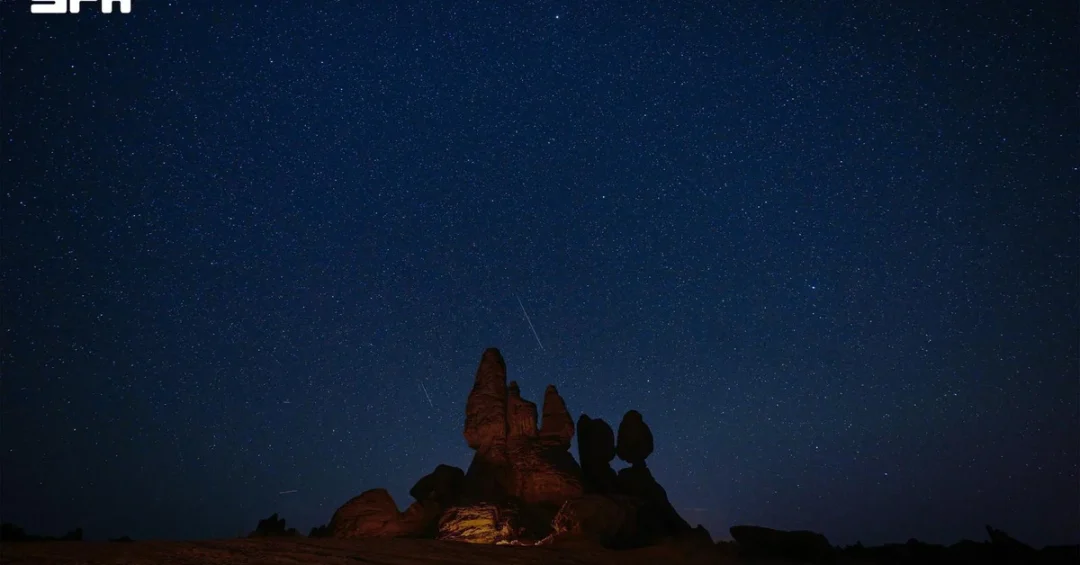
On the night of Wednesday, August 13, 2026, the Perseid meteor shower was observed over the AlUla Governorate’s Al Gharameel Nature Reserve in Saudi Arabia, at the peak of its annual activity. The celestial event, which occurs every August, was captured under ideal viewing conditions from last evening until dawn on Thursday, with numerous meteors streaking across the sky over Al Gharameel. The low light pollution and dark skies enabled clear documentation of the phenomenon.
Context and Background
The Perseid meteor shower is one of the most famous annual meteor showers, renowned for its spectacular activity and the presence of many bright meteors and fireballs. At peak, observers can see between 75 and 100 meteors per hour under dark skies and favorable conditions. This year, the observation was particularly significant due to the pristine environment of Al Gharameel, a nature reserve known for its unspoiled landscapes and minimal artificial lighting, providing a perfect setting for astronomical enthusiasts and researchers alike.
Key Details
The meteor shower originates from debris and dust left by the Swift-Tuttle comet along its orbit. As Earth revolves around the Sun, it passes through this stream of particles, which enter the atmosphere at high speeds and glow upon interaction with the atmosphere, creating fast-moving streaks of light. The observation event in AlUla was organized by local authorities to promote astro-tourism and highlight the importance of preserving dark skies. The Saudi Press Agency (SPA) reported the event, emphasizing that protecting the night sky reduces light pollution, safeguards nocturnal environments and wildlife, and enhances conditions for astronomical observation, allowing clearer views of stars, celestial bodies, and various astronomical phenomena.
Implications
This successful observation underscores Saudi Arabia’s commitment to environmental conservation and sustainable tourism, aligning with the goals of the Saudi Green Initiative and Vision 2030. The clear visibility of the meteor shower in AlUla, facilitated by the reserve’s dark skies, positions the region as a potential hub for astro-tourism in the Middle East. It also encourages public interest in science and astronomy, fostering educational opportunities and potentially attracting international visitors interested in unique natural experiences. The event serves as a testament to the Kingdom’s efforts to balance development with ecological preservation, offering both economic benefits through tourism and cultural enrichment.
Vision 2030 Alignment
As Saudi Arabia continues its journey toward Vision 2030, initiatives like the observation of the Perseid meteor shower in AlUla highlight the Kingdom’s dedication to developing world-class tourism destinations that respect and protect natural heritage. The successful documentation of this celestial event not only showcases the beauty of Saudi Arabia’s landscapes but also supports the country’s ambition to become a leading global destination for ecotourism and scientific exploration. By promoting dark sky preservation and astro-tourism, Saudi Arabia is taking concrete steps toward a diversified, sustainable economy, promising a brighter future for both its citizens and the region.
20 Questions
Q1. Where was the Perseid meteor shower observed in Saudi Arabia?
A1. The Perseid meteor shower was observed over the Al Gharameel Nature Reserve in AlUla Governorate, Saudi Arabia, as reported by the Saudi Press Agency.
Q2. When did the observation take place?
A2. The observation occurred on the night of Wednesday, August 13, 2026, during the peak of the meteor shower, lasting until dawn on Thursday.
Q3. What is the Perseid meteor shower?
A3. It is an annual meteor shower that occurs in August, produced by debris from the Swift-Tuttle comet. It is known for its high activity and bright meteors.
Q4. How many meteors can be seen per hour during the peak of the Perseids?
A4. Under dark skies and ideal conditions, observers can see between 75 and 100 meteors per hour during the peak of the Perseid meteor shower.
Q5. What causes the Perseid meteor shower?
A5. The shower is caused by Earth passing through the trail of debris and dust left by the Swift-Tuttle comet along its orbit.
Q6. Why were the viewing conditions in Al Gharameel considered ideal?
A6. The area has low light pollution and dark skies, which allow for clear observation and photography of meteors without interference from artificial lights.
Q7. What is the significance of Al Gharameel Nature Reserve for astronomy?
A7. The reserve offers pristine dark skies, making it an excellent location for astronomical observations and a potential hub for astro-tourism.
Q8. How does the Saudi Green Initiative relate to this event?
A8. The initiative emphasizes environmental conservation, and preserving dark skies supports this by reducing light pollution and protecting ecosystems.
Q9. What is the role of the Saudi Press Agency in this story?
A9. The Saudi Press Agency reported the observation, highlighting the importance of the event and the Kingdom’s commitment to promoting sustainable tourism and scientific awareness.
Q10. How does this event promote tourism in Saudi Arabia?
A10. By showcasing AlUla as a destination for astro-tourism, it attracts visitors interested in unique natural experiences and supports the tourism sector in line with Vision 2030.
Q11. What is the source of the particles that cause the Perseids?
A11. The particles come from the Swift-Tuttle comet, which leaves behind dust and debris that Earth encounters each year.
Q12. How does the meteor shower benefit scientific research?
A12. Observing meteor showers helps scientists understand comet composition and the evolution of the solar system, contributing to astronomical knowledge.
Q13. What measures protect the night sky in AlUla?
A13. Efforts to reduce light pollution include controlling artificial lighting and promoting dark sky preservation, which are essential for wildlife and astronomical observation.
Q14. How does this event align with Saudi Arabia’s Vision 2030?
A14. It supports the goals of economic diversification and sustainable tourism, showcasing Saudi Arabia’s natural and cultural assets on a global stage.
Q15. What is the frequency of the Perseid meteor shower?
A15. The Perseids occur annually in August, with peak activity typically around mid-August, making it one of the most anticipated celestial events.
Q16. What are fireballs and why are they notable?
A16. Fireballs are exceptionally bright meteors that can be seen over a wide area. The Perseids are known for producing many fireballs, enhancing their visual spectacle.
Q17. How can individuals observe meteor showers best?
A17. To observe meteor showers, find a dark location away from city lights, allow your eyes to adapt to darkness, and look up at the sky without optical aids like telescopes.
Q18. What is the importance of the Al Gharameel reserve location?
A18. The reserve is a protected natural area with minimal light pollution, ideal for undisturbed astronomical observations and preserving nocturnal wildlife habitats.
Q19. How does the Saudi government support astro-tourism?
A19. The government promotes such events through its tourism and heritage authorities, investing in infrastructure and marketing to attract international visitors interested in astronomy.
Q20. What future astronomical events can be observed in AlUla?
A20. With dark skies preserved, AlUla offers opportunities to observe various celestial phenomena, including other meteor showers, eclipses, and deep-sky objects, enhancing its appeal as a stargazing destination.
Reader Feedback
We value your thoughts. Please share your feedback on this article.
Your feedback helps us improve our coverage.