


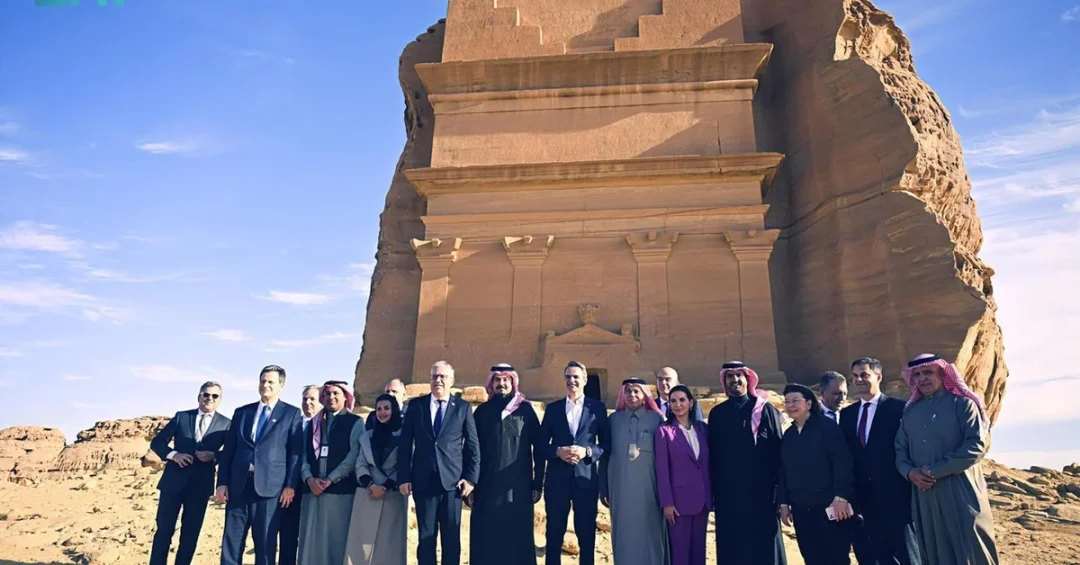
Prime Minister of the Hellenic Republic Kyriakos Mitsotakis visited Hegra, Saudi Arabia’s first UNESCO World Heritage Site, in AlUla Governorate on January 13, 2025, touring ancient Nabataean monuments that date back thousands of years. The visit, reported by the Saudi Press Agency (SPA), underscored the deepening cultural and diplomatic ties between the Kingdom of Saudi Arabia and Greece, and highlighted AlUla’s growing stature as a global heritage and tourism destination.
Accompanied by Prince Salman bin Sultan bin Abdulaziz, Governor of the Madinah Region, Majid Al-Kassabi, Minister of Commerce, and Abeer AlAkel, Acting CEO of the Royal Commission for AlUla (RCU), the Greek prime minister explored some of the most prominent archaeological landmarks in the region. The high-level delegation included several other officials from both the Saudi and Greek sides, reflecting the importance both nations place on cultural exchange and mutual understanding. Could this visit mark a new chapter in Saudi-Greek relations? The tour provided a vivid demonstration of how AlUla is being carefully developed as a crossroads of civilizations, welcoming international leaders and visitors while preserving its ancient heritage.
Context and Background
AlUla, located in northwestern Saudi Arabia, is home to a remarkable concentration of archaeological sites that span millennia. Hegra, also known as Mada’in Salih, was inscribed as a UNESCO World Heritage Site in 2008, becoming the Kingdom’s first such designation. It was the southern capital of the Nabataean Kingdom, which flourished from the 4th century BCE to the 1st century CE. The site features over 100 monumental tombs carved into sandstone outcrops, many of which retain intricate facades and inscriptions. The visit by Prime Minister Mitsotakis comes as Saudi Arabia accelerates efforts to open AlUla to the world under Vision 2030, the national transformation plan championed by Crown Prince Mohammed bin Salman. The Royal Commission for AlUla, established in 2017, leads the comprehensive development of the region, balancing heritage preservation with sustainable tourism infrastructure. Why does AlUla matter on the global stage? Because it represents a unique convergence of natural beauty, human history, and modern ambition, drawing travelers and scholars from every continent.
The Greek prime minister’s itinerary included some of Hegra’s most iconic monuments. At Qasr al-Farid, a lone tomb often described as the crown jewel of Hegra, the delegation admired its massive, intricately carved facade, which stands four stories high. They also visited Qasr al-Bint, a structure dating back to pre-Islamic times, whose name means ‘Palace of the Daughter’ and which likely served a religious or civic function. The tour continued to Jabal Ithlib, a mountainous area northeast of Hegra that features a narrow canyon known as the Siq, leading to a diwan—an open-air theater or meeting hall—carved into the rock. This site harmonizes with the breathtaking natural landscape and offers insight into the social and religious life of the Nabataeans. The visit also encompassed other ancient historical sites and artefacts scattered throughout AlUla, all carefully preserved by the RCU, the Ministry of Culture, the Saudi Tourism Authority, and other organizations. These efforts ensure that AlUla remains a vital part of human heritage while showcasing the rich history and diverse civilizations that have thrived in the region over the centuries.
Key Details
The Greek prime minister’s visit was more than a sightseeing tour; it was a diplomatic engagement that highlighted the strengthening relationship between Greece and Saudi Arabia. In recent years, the two countries have deepened cooperation in areas such as energy, defense, trade, and culture. Greece has been a supportive partner of Saudi Arabia’s Vision 2030, recognizing the Kingdom’s role as a stabilizing force in the region and a growing economic hub. The presence of Minister of Commerce Majid Al-Kassabi underscored the economic dimension of the visit, as trade and investment ties continue to expand. What does this mean for future Saudi-Greek collaboration? It signals a shared commitment to fostering cultural diplomacy and exploring new avenues for partnership, from tourism to technology.
During the tour, the delegation was guided by experts from the Royal Commission for AlUla, who explained the historical significance of each site and the ongoing conservation work. The RCU has implemented rigorous measures to protect Hegra and other heritage assets, including climate control, visitor management, and archaeological research. The commission also collaborates with international institutions to ensure best practices in preservation. The visit by Prime Minister Mitsotakis provided an opportunity to showcase these efforts to a European audience, potentially attracting more Greek and European tourists to AlUla. In 2023, AlUla welcomed over 250,000 visitors, a number that is expected to grow as new hotels, cultural venues, and transport links come online. The RCU aims to attract 2 million visitors annually by 2035, while preserving the region’s unique character.
International and Regional Impact
The visit of a European head of government to AlUla underscores the Kingdom’s growing appeal as a cultural and tourism destination. It also reflects Saudi Arabia’s broader strategy of using heritage diplomacy to build bridges with nations around the world. Greece, with its own rich archaeological heritage, shares a natural affinity with Saudi Arabia in the field of cultural preservation. Both countries are home to UNESCO World Heritage Sites and have a vested interest in promoting mutual understanding through history and art. Could this visit lead to joint archaeological projects or cultural exchanges? While no specific agreements were announced, the groundwork for future collaboration has been laid. The Greek prime minister’s positive engagement with Saudi officials signals a willingness to deepen ties beyond traditional sectors.
Regionally, AlUla’s development is part of Saudi Arabia’s efforts to diversify its economy and reduce dependence on oil. Tourism is a key pillar of Vision 2030, with targets to increase the sector’s contribution to GDP from 3% to 10% by 2030. AlUla, with its unique blend of natural and cultural attractions, is positioned as a flagship destination. The visit by Prime Minister Mitsotakis also highlights the stability and openness of the Kingdom, countering outdated perceptions and showcasing its modernization. For Greece, engaging with Saudi Arabia offers opportunities for Greek companies in construction, hospitality, and heritage management. The two nations have already signed agreements in renewable energy and shipping, and cultural cooperation could pave the way for further economic synergies.
Economic and Strategic Significance
The economic implications of AlUla’s growing prominence are substantial. The Royal Commission for AlUla has awarded billions of riyals in contracts for infrastructure, hotels, and cultural facilities. International hotel brands such as Banyan Tree, Habitas, and Aman have opened or announced properties in the region. The development of AlUla International Airport, which now receives direct flights from major cities, has improved accessibility. For Greece, which relies heavily on tourism, there are lessons to be learned from Saudi Arabia’s approach to sustainable destination development. Greek companies specializing in hospitality, conservation, and design could find opportunities in AlUla and beyond. Moreover, the visit may encourage Greek travelers to explore Saudi Arabia’s heritage sites, contributing to the Kingdom’s tourism revenue.
Strategically, Saudi Arabia and Greece have aligned interests in the Eastern Mediterranean and the Middle East. Greece has supported Saudi Arabia’s security concerns and has participated in joint military exercises. The cultural dimension of their relationship adds depth and people-to-people connections. Prime Minister Mitsotakis’s visit to AlUla is a symbolic affirmation of these ties. It also comes at a time when Saudi Arabia is preparing to host major international events, including Expo 2030 in Riyadh and the 2034 FIFA World Cup. Such events will further raise the Kingdom’s global profile and attract millions of visitors. AlUla is expected to play a role in these events, offering a unique heritage experience for delegates and tourists. The Greek prime minister’s visit thus serves as an early endorsement of Saudi Arabia’s ability to host world-class cultural and tourism experiences.
Vision 2030 Alignment
The visit of Prime Minister Kyriakos Mitsotakis to AlUla aligns seamlessly with the goals of Saudi Vision 2030, which seeks to diversify the economy, promote cultural heritage, and enhance the Kingdom’s global engagement. Under Vision 2030, Saudi Arabia aims to increase the number of Umrah and Hajj pilgrims, but also to attract leisure tourists to destinations like AlUla. The Royal Commission for AlUla’s mandate to preserve and develop the region is a direct manifestation of this vision. By welcoming international leaders and showcasing its heritage, Saudi Arabia demonstrates its commitment to becoming a hub for cultural tourism and a bridge between civilizations. The visit also supports the Vision’s objective of strengthening international partnerships and fostering mutual respect.
Furthermore, the emphasis on heritage preservation and sustainable development in AlUla reflects the Vision’s focus on quality of life and environmental stewardship. The RCU’s work includes training local guides, supporting local artisans, and involving the community in tourism activities. These initiatives create jobs and empower residents, particularly women and youth, in line with Vision 2030’s social goals. As Saudi Arabia continues to open up to the world, visits like that of the Greek prime minister will become more common, reinforcing the Kingdom’s position as a dynamic and welcoming nation. The future of AlUla is bright, and its role in Saudi Arabia’s transformation story is only just beginning. With each high-profile visit, the world discovers anew the wonders of this ancient land and the modern vision that is bringing them to light.
20 Questions
Q1. Who visited Hegra in AlUla on January 13, 2025?
A1. Prime Minister of the Hellenic Republic Kyriakos Mitsotakis visited Hegra, Saudi Arabia’s first UNESCO World Heritage Site, in AlUla Governorate on January 13, 2025, as reported by the Saudi Press Agency.
Q2. What is Hegra, and why is it significant?
A2. Hegra, also known as Mada’in Salih, is Saudi Arabia’s first UNESCO World Heritage Site, inscribed in 2008. It was the southern capital of the Nabataean Kingdom and features over 100 monumental tombs carved into sandstone.
Q3. Which Saudi officials accompanied the Greek prime minister?
A3. He was accompanied by Prince Salman bin Sultan bin Abdulaziz, Governor of the Madinah Region; Majid Al-Kassabi, Minister of Commerce; and Abeer AlAkel, Acting CEO of the Royal Commission for AlUla, along with other officials.
Q4. What specific sites did the delegation explore in Hegra?
A4. The delegation explored Qasr al-Farid, a monumental tomb; Qasr al-Bint, a pre-Islamic structure; and Jabal Ithlib, which includes an open-air theater known as a diwan, harmonizing with the natural landscape.
Q5. What is Qasr al-Farid?
A5. Qasr al-Farid is a lone tomb in Hegra, often called the crown jewel of the site. It stands four stories high and is renowned for its intricately carved facade, representing the pinnacle of Nabataean craftsmanship.
Q6. What is Qasr al-Bint?
A6. Qasr al-Bint is an ancient structure in Hegra dating back to pre-Islamic times. Its name means ‘Palace of the Daughter,’ and it likely served a religious or civic function within the Nabataean city.
Q7. What is Jabal Ithlib?
A7. Jabal Ithlib is a mountainous area northeast of Hegra, featuring a narrow canyon called the Siq that leads to a diwan, an open-air theater or meeting hall carved into the rock, used for social and religious gatherings.
Q8. Which organizations are responsible for preserving AlUla’s heritage?
A8. The Royal Commission for AlUla, the Ministry of Culture, the Saudi Tourism Authority, and other involved organizations carefully preserve AlUla’s sites to ensure they remain a vital part of human heritage.
Q9. Why is AlUla important for Saudi Arabia’s tourism goals?
A9. AlUla is a flagship destination under Vision 2030, which aims to increase tourism’s contribution to GDP from 3% to 10% by 2030. It attracts international visitors and showcases Saudi heritage.
Q10. How does this visit reflect Saudi-Greek relations?
A10. The visit underscores deepening cultural and diplomatic ties between Saudi Arabia and Greece. Both nations share a rich archaeological heritage and have been strengthening cooperation in energy, trade, and culture.
Q11. What economic benefits could arise from this visit?
A11. The visit may boost Greek interest in Saudi tourism and open opportunities for Greek companies in hospitality, conservation, and design, while also encouraging Greek travelers to explore AlUla and other Saudi destinations.
Q12. What is the Royal Commission for AlUla?
A12. Established in 2017, the Royal Commission for AlUla leads the comprehensive development of the region, balancing heritage preservation with sustainable tourism infrastructure, and aims to attract 2 million visitors annually by 2035.
Q13. How many visitors does AlUla currently receive?
A13. In 2023, AlUla welcomed over 250,000 visitors. The number is expected to grow as new hotels, cultural venues, and transport links, including AlUla International Airport, come online.
Q14. What is the significance of Hegra’s UNESCO status?
A14. Hegra’s UNESCO World Heritage status, granted in 2008, recognizes its outstanding universal value as a Nabataean city with remarkably preserved tombs and inscriptions, making it a key part of human heritage.
Q15. How does AlUla align with Vision 2030?
A15. AlUla’s development aligns with Vision 2030’s goals of economic diversification, cultural preservation, and global engagement. It is a cornerstone of Saudi Arabia’s efforts to become a top tourism destination.
Q16. What other international events will showcase Saudi Arabia?
A16. Saudi Arabia will host Expo 2030 in Riyadh and the 2034 FIFA World Cup. These events will further raise the Kingdom’s global profile and attract millions of visitors, with AlUla playing a supporting role.
Q17. What conservation efforts are in place at Hegra?
A17. The Royal Commission for AlUla implements rigorous conservation measures, including climate control, visitor management, and archaeological research, often in collaboration with international institutions to ensure best practices.
Q18. How does the visit promote cultural exchange?
A18. By touring AlUla’s ancient sites, the Greek prime minister engaged with Saudi heritage, fostering mutual understanding. Such visits pave the way for joint archaeological projects, exhibitions, and tourism exchanges between the two nations.
Q19. What is the historical timeline of the Nabataean Kingdom in Hegra?
A19. The Nabataean Kingdom flourished from the 4th century BCE to the 1st century CE, with Hegra as its southern capital. Its tombs and monuments reflect a sophisticated civilization that controlled trade routes.
Q20. What does the future hold for AlUla?
A20. AlUla is poised to become a global heritage and tourism hub, with ongoing development of hotels, cultural venues, and infrastructure. It will continue to attract international leaders and visitors, showcasing Saudi Arabia’s rich history and modern vision.
Reader Feedback
We value your thoughts. Please share your feedback on this article.
Your feedback helps us improve our coverage.
Related articles
 Recent Rains Draw Crowds to Al-Mugmass Valley in Makkah
 Makkah Taxi Service Launched at Hajj Conference
 Saudi Tourism Ministry Conducts 9,655 Inspections in Q3 2024
 King Abdulaziz Reserve Launches Vision 2030 Strategy
 Dunes of Arabia Brings Authentic Desert Heritage to Riyadh Season
 Boulevard World: A Global Tapestry Woven in Riyadh