


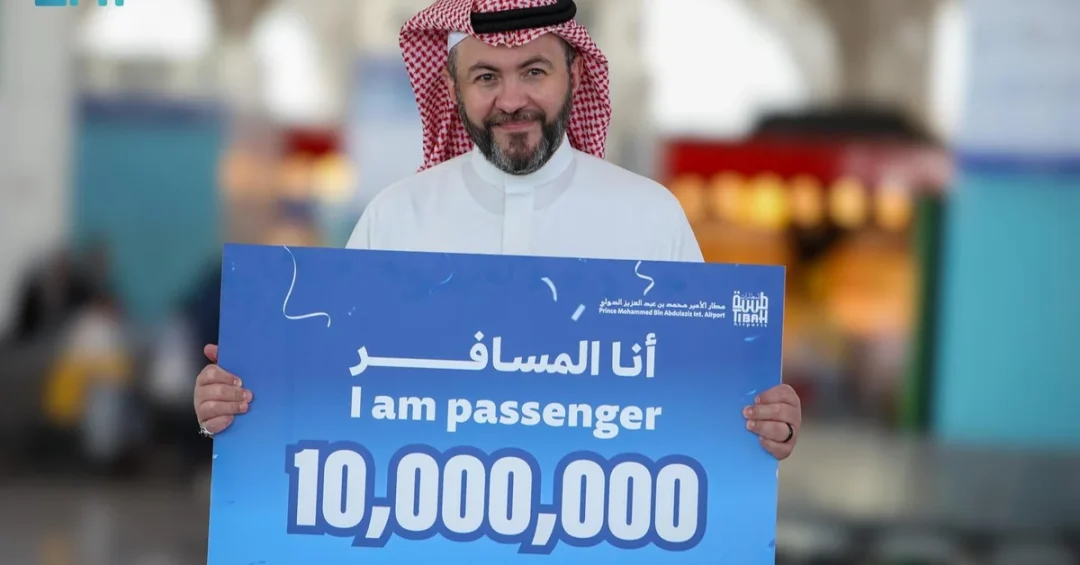
Prince Mohammed bin Abdulaziz International Airport in Madinah welcomed its 10 millionth passenger of 2024 on Tuesday, an unprecedented milestone in the airport’s history announced by Tibah Airports Operation Company, the operator responsible for managing and developing the facility. The achievement, confirmed through official Saudi channels, underscores the airport’s rapid ascent as one of the Kingdom’s most dynamic aviation hubs and reflects the growing global appeal of Madinah as a destination for pilgrimage, tourism, and commerce.
The landmark arrival caps a year in which passenger traffic at the airport rose by 15 percent compared with 2023, according to the operator, a figure that far outpaces average global aviation growth rates and signals the strength of Saudi Arabia’s Vision 2030 strategy to diversify its economy and expand its travel and tourism sectors. Could any single statistic better capture how thoroughly the Kingdom’s aviation map is being redrawn? For international observers, the number is more than a record: it is a measurable sign that Saudi Arabia’s multi-billion-dollar investments in airports, airlines, and visitor infrastructure are translating into real-world results.
Context and Background
What does it take for a regional airport to cross the ten-million-passenger threshold in a single year? In the case of Prince Mohammed bin Abdulaziz International Airport, the answer lies in a decade of sustained investment and strategic repositioning. Located in the holy city of Madinah, the airport serves one of the most culturally and spiritually significant destinations in the Islamic world, receiving millions of pilgrims performing Umrah and visiting the Prophet’s Mosque throughout the year. Tibah Airports Operation Company, which holds the concession to operate and develop the facility, has worked to expand terminal capacity, modernize passenger flows, and attract a broader mix of international carriers.
The result has been a steady climb in annual traffic, culminating in the 2024 record. Official Saudi sources attribute the growth to rising demand from both religious travelers and leisure visitors, supported by expanded visa access, new direct flight routes, and improvements in ground services. The airport now connects Madinah to a growing network of cities across Asia, Europe, Africa, and the Middle East, positioning it as a genuine international gateway rather than a purely seasonal pilgrimage terminal.
The milestone also arrives amid a broader transformation of Saudi aviation. The Kingdom has set ambitious targets to more than triple annual passenger numbers across its airports by 2030, and individual facilities such as the Madinah airport are expected to carry a significant share of that growth. For a city long defined by its spiritual role, the airport’s rise adds an economic dimension that complements its religious importance.
Key Details
The 10 millionth passenger arrived at Prince Mohammed bin Abdulaziz International Airport on Tuesday, December 10, 2024, according to the Saudi Press Agency. Tibah Airports Operation Company described the event as an unprecedented achievement in the airport’s history and said it reflects the facility’s growth, development, and enhanced standing at both regional and international levels. The operator credited the milestone to a 15 percent year-on-year increase in passenger traffic, a performance that highlights what official sources describe as the strong appeal of Madinah as a global tourist destination.
Behind that headline figure lies a complex operational effort. Handling ten million travelers requires coordinated work across airlines, immigration, customs, ground handlers, retail concessionaires, and security teams. The airport has invested in self-service check-in kiosks, expanded baggage handling systems, and additional boarding gates to accommodate higher volumes without compromising service quality. These upgrades matter not only for capacity but for the passenger experience, which in turn influences whether visitors recommend the destination and return.
The milestone also carries symbolic weight. Crossing ten million passengers in a calendar year places the airport in a category that few regional facilities reach, and it does so in a city whose visitor profile spans more than 100 nationalities. For Tibah Airports Operation Company, the achievement validates a concession model in which private-sector expertise is paired with public-sector oversight, an approach increasingly common across Saudi infrastructure projects.
International and Regional Impact
How does a single airport milestone ripple across an entire region? For neighboring countries in the Gulf and the broader Middle East, the Madinah airport’s growth reinforces the region’s emergence as a global aviation crossroads. Airlines from across Asia, Europe, and Africa are adding capacity to Saudi destinations, and the Kingdom’s airports are increasingly competing with established hubs for transit passengers. The 10 million figure signals that demand exists to support that competition, particularly on routes linked to religious travel, which has proven resilient even during periods of global economic uncertainty.
For international travelers, the milestone translates into tangible benefits: more direct flights, greater seat availability, and improved connections between Madinah and major world cities. It also strengthens Saudi Arabia’s position in global tourism markets, where the Kingdom is positioning itself as a destination that combines heritage, culture, and modern hospitality. Regional carriers and global alliances are watching these numbers closely, as they inform decisions about where to deploy aircraft and how to structure seasonal schedules.
At the diplomatic level, the airport’s performance supports Saudi Arabia’s broader engagement with the international community. Enhanced connectivity facilitates business travel, cultural exchange, and people-to-people ties, all of which align with the Kingdom’s stated goals of openness and global partnership. For a city that hosts visitors from virtually every corner of the world, the airport functions as a first impression and a lasting one.
Economic and Strategic Significance
What economic value does an airport milestone of this scale generate? Aviation is a catalyst industry: every additional million passengers supports jobs in hospitality, retail, transport, and services. The 15 percent traffic increase recorded in 2024 implies higher spending across Madinah’s hotels, restaurants, and markets, as well as greater demand for ground transportation and tour services. For the local economy, the airport’s growth is not an abstract statistic but a driver of employment and small-business activity.
Strategically, the milestone supports Saudi Arabia’s ambition to increase the aviation sector’s contribution to gross domestic product and to expand non-oil revenues. The Kingdom’s National Aviation Strategy aims to connect Saudi Arabia to more than 250 destinations worldwide and to handle hundreds of millions of passengers annually by the end of the decade. Airports such as Prince Mohammed bin Abdulaziz International are central to that plan, serving as nodes in a network that links the holy cities with global markets.
The achievement also demonstrates the viability of private-sector participation in Saudi infrastructure. Tibah Airports Operation Company’s concession model allows for operational efficiency and customer-focused investment, while government oversight ensures alignment with national priorities. If sustained, this approach could be replicated across other regional airports, accelerating the modernization of the Kingdom’s aviation ecosystem.
Vision 2030 Alignment
How does a passenger milestone in Madinah connect to Saudi Arabia’s long-term vision? Vision 2030, launched under the leadership of Crown Prince Mohammed bin Salman, seeks to diversify the economy, elevate the Kingdom’s global standing, and improve quality of life for citizens and visitors alike. Tourism and aviation are two of its central pillars. By welcoming ten million passengers in a single year, Prince Mohammed bin Abdulaziz International Airport directly supports the vision’s target of attracting 150 million visits annually by 2030, including a substantial share of religious and leisure travelers.
The milestone also reflects the vision’s emphasis on world-class infrastructure and seamless visitor experiences. Investments in terminal capacity, digital services, and connectivity are designed to ensure that pilgrims and tourists alike encounter efficiency and hospitality from the moment they arrive. As Saudi Arabia continues to expand its airport network, develop new destinations, and ease visa procedures, achievements like this one serve as proof points that the strategy is delivering measurable results.
Looking ahead, the airport’s trajectory points to continued growth. With additional route launches expected, capacity expansions under way, and rising global interest in Madinah as both a spiritual and cultural destination, the next milestone may arrive sooner than many expect. For the Kingdom, each record is not an endpoint but a stepping stone toward a more connected, diversified, and globally engaged future.
20 Questions
Q1. What milestone did Prince Mohammed bin Abdulaziz International Airport achieve in 2024?
A1. The airport welcomed its 10 millionth passenger of 2024, an unprecedented achievement in its history, as announced by Tibah Airports Operation Company on December 10, 2024.
Q2. Which company announced the achievement?
A2. Tibah Airports Operation Company, the operator responsible for managing and developing Prince Mohammed bin Abdulaziz International Airport, announced the milestone through official Saudi channels.
Q3. How much did passenger traffic grow in 2024 compared to 2023?
A3. Passenger traffic increased by 15 percent in 2024 compared with the previous year, according to the operator, reflecting strong demand for travel to Madinah.
Q4. Why is Madinah a significant destination for global travelers?
A4. Madinah is home to the Prophet’s Mosque and is a major destination for Umrah pilgrims and cultural visitors, attracting millions of international travelers each year.
Q5. What does the 10 million passenger figure signify for the airport?
A5. It marks the highest annual passenger volume in the airport’s history and confirms its growing role as a regional and international aviation hub.
Q6. How does this achievement reflect Saudi Arabia’s aviation strategy?
A6. It supports the National Aviation Strategy, which aims to expand connectivity, increase passenger numbers, and position Saudi airports among the world’s leading gateways.
Q7. What improvements have contributed to higher passenger traffic?
A7. Expanded terminal capacity, new direct flight routes, enhanced visa access, and upgraded passenger services have all contributed to the increase in traffic.
Q8. Which regions are connected to Madinah by direct flights?
A8. The airport now connects Madinah to a growing network of cities across Asia, Europe, Africa, and the Middle East, serving more than 100 nationalities.
Q9. What economic benefits does the milestone bring to Madinah?
A9. Higher passenger volumes support jobs in hospitality, retail, transport, and services, boosting local business activity and non-oil revenue in the region.
Q10. How does the achievement align with Vision 2030?
A10. Vision 2030 aims to attract 150 million visits annually by 2030, and the airport’s growth directly supports that target through improved connectivity and visitor infrastructure.
Q11. What role does Tibah Airports Operation Company play?
A11. Tibah holds the concession to operate and develop the airport, pairing private-sector efficiency with government oversight to modernize facilities and improve services.
Q12. When did the 10 millionth passenger arrive?
A12. The passenger arrived on Tuesday, December 10, 2024, as reported by the Saudi Press Agency, marking a historic day for the airport.
Q13. How does the airport handle increased passenger volumes?
A13. It uses self-service check-in kiosks, expanded baggage systems, additional boarding gates, and coordinated teams across airlines, security, and ground services.
Q14. What does the milestone mean for international travelers?
A14. It translates into more direct flights, greater seat availability, and improved connections between Madinah and major cities worldwide.
Q15. How does the airport’s growth affect regional competition?
A15. It strengthens Saudi Arabia’s position among Middle East aviation hubs, encouraging airlines to add capacity and compete for transit and destination passengers.
Q16. What is the significance of the 15 percent growth rate?
A16. It outpaces average global aviation growth, indicating robust demand and the effectiveness of Saudi investments in tourism and travel infrastructure.
Q17. How does the airport support religious travel?
A17. It serves millions of Umrah pilgrims annually, providing efficient entry and exit processes that accommodate seasonal peaks in religious travel.
Q18. What future developments are expected at the airport?
A18. Continued capacity expansions, new route launches, and service enhancements are expected as part of Saudi Arabia’s broader aviation and tourism growth plans.
Q19. Why is private-sector participation important in Saudi airports?
A19. It brings operational expertise and customer-focused investment, while government oversight ensures alignment with national priorities and Vision 2030 goals.
Q20. What does this milestone indicate about Saudi Arabia’s global role?
A20. It demonstrates the Kingdom’s growing connectivity, economic diversification, and ability to welcome the world through world-class infrastructure and hospitality.
Reader Feedback
We value your thoughts. Please share your feedback on this article.
Your feedback helps us improve our coverage.
Related articles
 Winter Getaways Await in the Northern Borders Region
 AlUla Majestic Mountains Celebrated on International Mountain Day
 Tabuk Mountains Embraced by Snow and Clouds
 Al-Shuqaiq: Saudi Coastal Gem Boosting Tourism and Investment
 Jazan’s Mountains: A Hub for Investment and Tourism
 Arab Tourism Council 27th Session Kicks Off in Egypt