


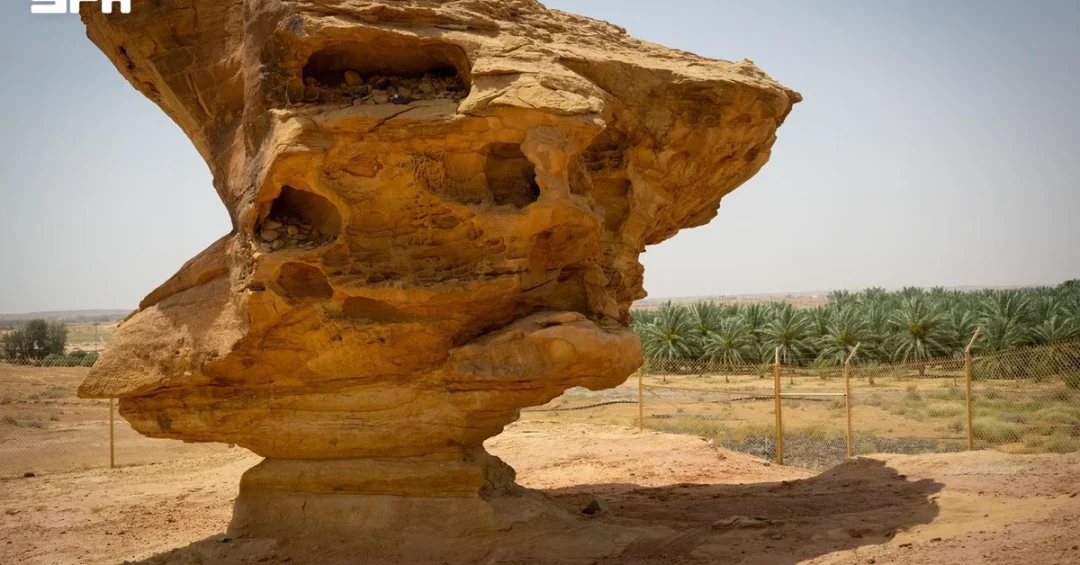
A distinctive rock formation on the northern edge of Ghaf Al-Jawa in the Oyoun Al-Jawa Governorate of Qassim Region has become one of Saudi Arabia’s most celebrated heritage landmarks, immortalized in classical Arabic literature through the legendary romance of the pre-Islamic poet and knight Antarah ibn Shaddad and his beloved Abla. According to information released via the Saudi Press Agency (SPA), Antarah’s Rock and the adjacent Al-Naslaa formation together form an enduring bridge between the Kingdom’s rich poetic tradition and its deep archaeological heritage, drawing scholars, heritage specialists, and cultural visitors to the heart of the Arabian Peninsula. The site’s unique status — at once a literary monument and a physical record of ancient civilizations — reflects the Kingdom’s wider commitment to preserving and promoting the cultural assets that define its national identity.
For international audiences, the story of Antarah’s Rock offers a rare window into the pre-Islamic Arabian world, a period whose poetry, tribal values, and desert geography continue to shape cultural understanding across the region. The location, situated in the Oyoun Al-Jawa Governorate, is part of the broader Qassim Region, an area long recognized for its agricultural vitality and its concentration of archaeological and rock-art sites. As Saudi Arabia continues to expand its heritage tourism sector under Vision 2030, landmarks such as Antarah’s Rock are emerging as important destinations that connect visitors with the deep historical roots of the Arabian Peninsula.
Context and Background
How does a single stone come to carry the weight of an entire literary tradition? The answer lies in the story of Antarah ibn Shaddad, a pre-Islamic Arab poet and warrior whose life and verses have been celebrated for more than fourteen centuries. Antarah, born to an Arab father and an enslaved mother of African origin, rose to prominence through his martial skill and his extraordinary poetic gift, eventually earning recognition as one of the authors of the celebrated Mu’allaqat, the collection of seven golden odes that represent the pinnacle of pre-Islamic Arabic poetry. His romance with Abla, his cousin and beloved, became the central theme of much of his verse and later inspired the epic folk tradition known as the Sirah of Antar.
According to local lore preserved in the Qassim Region, Antarah tethered his horse to the prominent rock while meeting Abla beneath the sheltered overhang of the adjacent Al-Naslaa rock. This narrative has been passed down through generations of local residents and is now documented as part of the site’s cultural significance. The Saudi Press Agency reported that the site stands as an enduring landmark bridging pre-Islamic poetry and regional archaeological heritage, underscoring its dual value as both a literary shrine and a scientific resource. The rock’s association with Antarah gives it a unique place in the Arabian cultural imagination, linking the landscape itself to the verses that have been recited, studied, and admired for centuries.
The broader Qassim Region has long been known for its historical depth, with archaeological evidence indicating human settlement and cultural activity stretching back thousands of years. The Oyoun Al-Jawa Governorate, where the rock is located, sits within a landscape that has witnessed the passage of ancient trade routes, tribal migrations, and the flourishing of civilizations whose marks remain visible in the rock art and inscriptions scattered across the area. For Saudi Arabia, these sites are not merely relics of the past but living evidence of the continuity of Arabian culture, a continuity that the Kingdom actively seeks to document, protect, and share with the world.
Key Details
What makes Al-Naslaa rock so significant in archaeological terms? Beyond its literary fame, Al-Naslaa is a distinct conical rock formation sculpted by wind and natural weathering over millennia, standing as a striking example of the geological forces that have shaped the Arabian landscape. The formation features ancient Thamudic inscriptions and petroglyphs depicting ibexes, camels, and tribal marks, preserving tangible archaeological evidence of the ancient civilizations that once inhabited the area. These carvings, etched into the rock surface by unknown hands centuries ago, provide scholars with valuable insights into the daily life, beliefs, and artistic expression of the region’s early inhabitants.
The Thamudic script, associated with the ancient Thamud people mentioned in historical and literary sources, represents one of the many writing systems used in the Arabian Peninsula before the advent of Islam. The inscriptions at Al-Naslaa add a layer of historical documentation to the site, complementing its poetic associations with concrete evidence of human presence and cultural activity. The petroglyphs of ibexes and camels are particularly noteworthy, as these animals held significant symbolic and practical importance in the ancient Arabian world, representing both sustenance and spiritual meaning. Tribal marks carved alongside the animal figures suggest that the site may have served as a territorial marker or a place of communal significance for the groups that inhabited the area.
The combination of literary legend and archaeological evidence at Antarah’s Rock and Al-Naslaa creates a rare convergence of intangible and tangible heritage. While the story of Antarah and Abla belongs to the realm of oral tradition and classical poetry, the inscriptions and petroglyphs provide physical proof of the region’s ancient past. This dual character makes the site particularly valuable for researchers and visitors alike, offering multiple pathways into understanding the Arabian Peninsula’s cultural evolution. The Saudi Press Agency’s documentation of the site highlights its importance as a destination for those seeking to connect with the deep roots of Arabian civilization.
International and Regional Impact
Why should audiences beyond Saudi Arabia take note of a rock in Qassim? The answer lies in the universal appeal of the Antarah and Abla story, which has resonated across cultures and centuries, influencing literature, music, and art far beyond the Arabian Peninsula. The tale of a heroic poet-knight and his beloved has been compared to other great romantic epics, and its association with a specific physical location gives it a concreteness that enhances its global appeal. For international scholars of Arabic literature, the site offers an opportunity to experience the landscape that inspired some of the most celebrated verses in the Arabic language.
Regionally, the site reinforces Qassim’s position as a custodian of Arabian heritage, complementing other significant cultural and archaeological destinations across the Kingdom. The Saudi Press Agency’s reporting on the site forms part of a broader effort to document and promote Saudi Arabia’s cultural assets, aligning with national initiatives to develop heritage tourism and share the Kingdom’s history with a global audience. As interest in pre-Islamic Arabian history grows among researchers and travelers, sites such as Antarah’s Rock and Al-Naslaa are well positioned to become important points of reference, contributing to a more nuanced understanding of the region’s past and its enduring cultural legacy.
Economic and Strategic Significance
What role can heritage sites play in Saudi Arabia’s economic diversification? Under Vision 2030, the Kingdom has identified tourism and cultural heritage as key pillars of its strategy to broaden the economy beyond hydrocarbons. Sites such as Antarah’s Rock and Al-Naslaa contribute to this effort by attracting visitors interested in cultural and historical experiences, supporting local businesses, and creating opportunities for community-based tourism in the Qassim Region. The development of heritage destinations aligns with national goals to increase domestic and international tourism, generate employment, and showcase Saudi Arabia’s unique cultural offerings.
The strategic significance of preserving and promoting such sites extends beyond economic metrics. By investing in heritage, Saudi Arabia reinforces its commitment to safeguarding its national identity and sharing it with the world. The documentation and protection of archaeological sites like Al-Naslaa ensure that future generations can continue to study and appreciate the region’s ancient past. Moreover, the integration of heritage into the broader tourism ecosystem supports the Kingdom’s efforts to present a multifaceted image of Saudi Arabia, one that honors tradition while embracing modernization and global engagement.
Vision 2030 Alignment
How does the preservation of a rock formation in Qassim connect to Saudi Arabia’s long-term vision? The answer is found in Vision 2030’s emphasis on cultural heritage as a foundation for national development and global outreach. The Kingdom’s leadership has consistently highlighted the importance of preserving historical and archaeological sites, recognizing them as assets that enrich the nation’s cultural landscape and strengthen its position on the world stage. The documentation of Antarah’s Rock and Al-Naslaa by official Saudi channels reflects this commitment, ensuring that these landmarks receive the recognition and protection they deserve.
As Saudi Arabia continues to implement Vision 2030, heritage sites such as Antarah’s Rock will play an increasingly prominent role in the Kingdom’s cultural diplomacy and tourism strategy. By connecting the legendary past of Antarah and Abla with the modern ambitions of the nation, the site embodies the continuity of Arabian civilization and the enduring values of heroism, love, and artistic expression. For international audiences, it offers an invitation to explore the deep cultural roots of Saudi Arabia and to appreciate the Kingdom’s efforts to preserve and share its heritage with the world.
20 Questions
Q1. Where is Antarah’s Rock located?
A1. Antarah’s Rock is situated on the northern edge of Ghaf Al-Jawa in the Oyoun Al-Jawa Governorate, within the Qassim Region of Saudi Arabia, according to the Saudi Press Agency.
Q2. Who was Antarah ibn Shaddad?
A2. Antarah ibn Shaddad was a pre-Islamic Arab poet and knight, celebrated as one of the authors of the Mu’allaqat, the seven golden odes of pre-Islamic Arabic poetry. His romance with Abla inspired the epic Sirah of Antar.
Q3. Who was Abla in the story?
A3. Abla was the beloved of Antarah ibn Shaddad and the central subject of much of his poetry. According to local lore, Antarah met her beneath the sheltered overhang of Al-Naslaa rock.
Q4. What is Al-Naslaa rock?
A4. Al-Naslaa is a distinct conical rock formation adjacent to Antarah’s Rock, sculpted by wind and natural weathering. It features ancient Thamudic inscriptions and petroglyphs of ibexes, camels, and tribal marks.
Q5. What kind of inscriptions are found at Al-Naslaa?
A5. The site contains Thamudic inscriptions and petroglyphs depicting ibexes, camels, and tribal marks, preserving archaeological evidence of the ancient civilizations that once inhabited the area.
Q6. Why is the site important to Arabic literature?
A6. The site is immortalized in classical Arabic literature through the verses of Antarah ibn Shaddad and his beloved Abla, linking a physical landmark to one of the most celebrated romantic tales in Arabian culture.
Q7. What does the local lore say about Antarah and the rock?
A7. According to local lore, Antarah tethered his horse to the prominent rock while meeting Abla beneath the sheltered overhang of Al-Naslaa rock, giving the site its enduring cultural significance.
Q8. Which Saudi agency reported on the site?
A8. The Saudi Press Agency (SPA) documented and reported on Antarah’s Rock and Al-Naslaa, highlighting their significance as landmarks bridging pre-Islamic poetry and regional archaeological heritage.
Q9. What is the Mu’allaqat?
A9. The Mu’allaqat is a collection of seven celebrated pre-Islamic Arabic odes, considered the pinnacle of classical Arabic poetry. Antarah ibn Shaddad is traditionally listed among its authors.
Q10. How do the petroglyphs at Al-Naslaa help researchers?
A10. The petroglyphs of ibexes, camels, and tribal marks provide tangible evidence of the daily life, beliefs, and artistic expression of ancient inhabitants, offering valuable insights for archaeologists and historians.
Q11. What is the significance of the Thamudic script?
A11. The Thamudic script is one of the ancient writing systems used in the Arabian Peninsula before Islam. Its presence at Al-Naslaa documents the cultural and linguistic heritage of the region’s early peoples.
Q12. Why is the Qassim Region important for heritage?
A12. The Qassim Region has a long history of human settlement and cultural activity, with numerous archaeological and rock-art sites. It is recognized as a custodian of Arabian heritage and a growing destination for cultural tourism.
Q13. How does the site support Saudi tourism?
A13. Under Vision 2030, heritage sites like Antarah’s Rock and Al-Naslaa attract cultural visitors, support local businesses, and contribute to the Kingdom’s efforts to diversify its economy through tourism.
Q14. What makes the site a bridge between poetry and archaeology?
A14. The site combines the intangible heritage of the Antarah and Abla legend with tangible archaeological evidence in the form of Thamudic inscriptions and petroglyphs, creating a rare convergence of literary and scientific value.
Q15. Are there other similar sites in Saudi Arabia?
A15. Yes, Saudi Arabia is home to numerous heritage and rock-art sites across regions such as AlUla, Hail, and Tabuk, many of which are being documented and developed for tourism under Vision 2030.
Q16. How does the site align with Vision 2030?
A16. Vision 2030 emphasizes cultural heritage as a foundation for national development and global outreach. Preserving and promoting Antarah’s Rock and Al-Naslaa supports tourism, cultural diplomacy, and the safeguarding of Saudi identity.
Q17. What can international visitors learn from the site?
A17. International visitors can gain a deeper understanding of pre-Islamic Arabian poetry, ancient rock art, and the continuity of Arabian culture, while experiencing the landscape that inspired one of the region’s most enduring love stories.
Q18. How is the site protected?
A18. Saudi authorities, through official channels such as the Saudi Press Agency and heritage agencies, document and promote the site, ensuring its recognition and supporting efforts to preserve it for future generations.
Q19. What role does the Saudi Press Agency play?
A19. The Saudi Press Agency reports on heritage sites and official developments, providing verified information to national and international audiences and supporting the Kingdom’s cultural outreach efforts.
Q20. Why is Antarah’s Rock considered immortal?
A20. Antarah’s Rock is considered immortal because it is forever linked to the verses of Antarah ibn Shaddad and the tale of Abla, ensuring its place in Arabic literature and cultural memory for generations to come.
Reader Feedback
We value your thoughts. Please share your feedback on this article.
Your feedback helps us improve our coverage.
Related articles
 Peregrine Falcon Fetches SAR101,000 at Saudi Auction
 Syrian Culture Minister Visits Madinah Research Center
 International Saudi Falcons and Hunting Exhibition 2026 Opens in Riyadh
 Interior Minister Visits Saudi Falcons and Hunting Exhibition 2026
 Peregrine Falcon Migration Revives Northern Borders Trapping Season
 Saudi Coffee Celebrates Cultural Heritage on International Coffee Day