


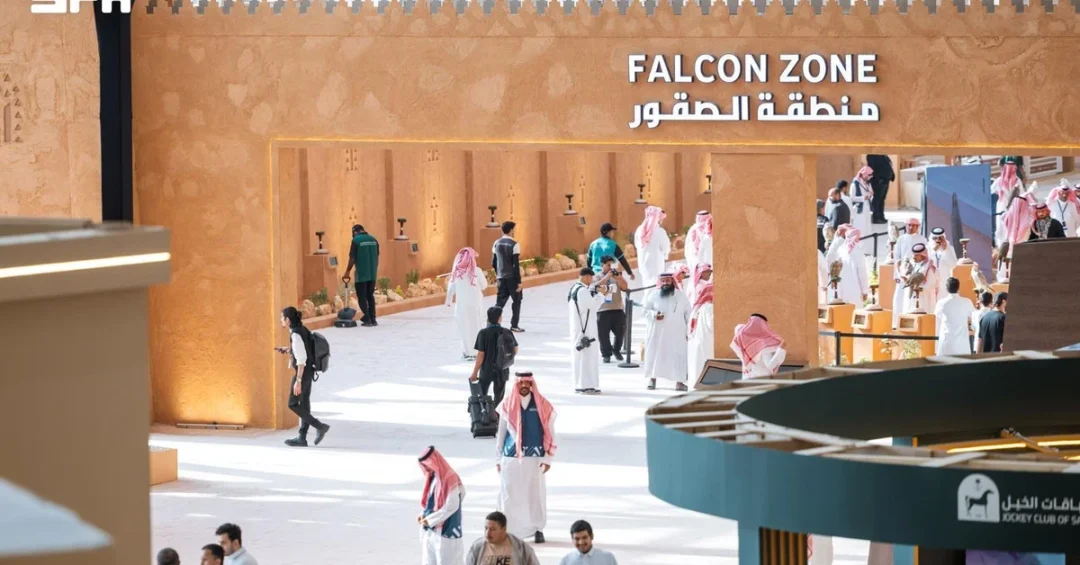
The International Saudi Falcons and Hunting Exhibition 2026 opened on Thursday at the Riyadh Exhibition and Convention Center in Malham, north of Riyadh, and will run through October 10, bringing together 254 exhibitors and brands from 20 countries across a 197,000-square-meter venue. Organized by the National Center for Falcons, the ten-day event offers a wide-ranging program spanning falconry, hunting, adventure, travel, and cultural and educational experiences, according to the Saudi Press Agency. The exhibition stands as one of the Kingdom’s most prominent annual gatherings dedicated to a heritage practice that has been woven into Arabian life for centuries. Have you ever wondered how a tradition once passed down around desert campfires became a global exhibition drawing tens of thousands of visitors to the Saudi capital?
The 2026 edition continues a pattern of steady growth that has defined the event since its launch in 2018. Last year, the exhibition attracted more than 700,000 visitors and featured over 1,400 exhibitors and brands from 47 countries, while sales exceeded SAR91 million in 2025. Those figures underline how a cultural gathering has evolved into a commercial and diplomatic platform with measurable economic weight. For international audiences, the numbers tell a story about Saudi Arabia’s broader effort to preserve heritage while opening new channels for trade, tourism, and cross-border partnership. The event is open daily from 2 p.m. to 11 p.m., with shuttle bus services connecting visitors from various locations in Riyadh to the venue around the clock.
Context and Background
What makes falconry such an enduring symbol of Arabian identity? Falconry has been practiced on the Arabian Peninsula for thousands of years, serving as both a practical hunting method and a marker of prestige, patience, and kinship with the natural environment. The bird itself occupies a special place in Gulf culture, celebrated in poetry, oral history, and art. In 2010, UNESCO inscribed falconry on its Representative List of the Intangible Cultural Heritage of Humanity following a multinational nomination that included the United Arab Emirates, Saudi Arabia, and other countries, giving the practice formal international recognition. The International Saudi Falcons and Hunting Exhibition was launched in 2018 to give that heritage a modern institutional home, organized by the National Center for Falcons, a body dedicated to preserving, developing, and passing the tradition to future generations.
The exhibition’s growth trajectory mirrors the Kingdom’s wider cultural and economic transformation. What began as a national gathering has become an international destination that draws falconers, specialists, enthusiasts, and visitors with a wide range of interests. The 2026 program spans falconry, hunting, adventure, travel, and cultural and educational experiences, positioning the event as more than a trade show. It functions as a meeting point for breeders, veterinarians, equipment manufacturers, conservation specialists, tourism operators, and families seeking an accessible introduction to a storied pastime. The venue in Malham, north of Riyadh, offers the scale needed to host such a diverse program, with 197,000 square meters of exhibition space accommodating live displays, retail areas, educational pavilions, and visitor amenities.
Regional and international participation has become a defining feature of the event. The presence of 254 exhibitors and brands from 20 countries in 2026 reflects sustained interest from Europe, Central Asia, the Middle East, and beyond, where falconry traditions share common roots. These participants bring expertise in raptor health, training techniques, sustainable hunting practices, and specialized equipment, creating opportunities for knowledge exchange that benefit Saudi practitioners and international partners alike. For a global audience, the exhibition offers a window into how Saudi Arabia manages the balance between cultural preservation and modernization, a theme that runs through many of the Kingdom’s Vision 2030 initiatives.
Key Details and Program Highlights
What can visitors expect across the ten-day program? The exhibition is open daily from 2 p.m. to 11 p.m. at the Riyadh Exhibition and Convention Center in Malham, with shuttle buses operating around the clock to connect visitors from various locations in Riyadh to the venue. Routes and schedules are available through the social media accounts of the National Center for Falcons and the exhibition itself, an arrangement designed to make attendance straightforward for residents and international guests alike. The program includes falconry displays, hunting and outdoor equipment showcases, adventure and travel offerings, and cultural and educational experiences suitable for families, specialists, and casual visitors.
At the center of the 2026 edition is a strong commercial dimension. Sales exceeded SAR91 million in 2025, and the 2026 edition brings together 254 exhibitors and brands from 20 countries, with product categories ranging from falconry equipment and apparel to travel services and outdoor gear. The exhibition has continued to expand since its launch in 2018, attracting more than 700,000 visitors last year, with over 1,400 exhibitors and brands from 47 countries. That combination of visitor volume and exhibitor diversity gives the event a dual identity: a cultural festival and a serious marketplace. For small and medium-sized Saudi businesses, it offers a platform to reach international buyers; for global brands, it provides direct access to a Gulf audience with deep interest in falconry and outdoor pursuits.
Talal Al-Shamaisi, CEO of the National Center for Falcons, said the exhibition’s expansion and diversity reflect the Kingdom’s leadership’s support and care for the falconry sector, as well as the resources it has provided to help preserve, develop, and pass this heritage on to future generations. His statement frames the event as part of a deliberate national effort rather than an isolated annual showcase. The National Center for Falcons, as the organizing body, works to support falconers, regulate and promote best practices, and ensure that traditional knowledge is documented and transmitted. The exhibition serves as the public-facing expression of that mandate, combining celebration with education and commerce.
International and Regional Impact
How does a falconry exhibition shape Saudi Arabia’s relationships beyond its borders? The participation of exhibitors and brands from 20 countries in 2026, following 47 countries in the previous edition, signals that the event has become a recognized node in a global network of falconry and outdoor enthusiasts. Countries with their own falconry traditions use the platform to share techniques and strengthen ties, while companies from Europe, Asia, and the Middle East use it to build distribution channels in the Gulf. The result is a form of cultural diplomacy that operates through shared passion rather than formal negotiation, complementing Saudi Arabia’s broader international engagement.
The exhibition also supports regional tourism and aviation networks. Visitors traveling to Riyadh for the event contribute to demand for hotels, transport, retail, and hospitality services, reinforcing the Kingdom’s efforts to grow its tourism sector as part of Vision 2030. The shuttle bus service linking multiple points in Riyadh to the Malham venue reflects a practical focus on accessibility, an important consideration for a city hosting an increasing number of large-scale events. For neighboring Gulf states with strong falconry cultures, the exhibition offers a natural point of collaboration and friendly competition, strengthening regional cohesion around a shared heritage.
Economic and Strategic Significance
Why does an event rooted in heritage matter to a modern economy? The SAR91 million in sales recorded in 2025 illustrates that falconry and outdoor pursuits support a real market encompassing equipment, birds, veterinary services, travel, and related retail. The 2026 edition’s 254 exhibitors and brands from 20 countries operate within a 197,000-square-meter venue, creating a concentrated marketplace that benefits buyers and sellers alike. For Saudi Arabia, this aligns with efforts to diversify revenue streams, support small businesses, and develop event-driven tourism that generates measurable spending across multiple sectors.
Strategically, the exhibition reinforces the Kingdom’s position as a custodian of Arabian heritage and a convener of international communities. By hosting an event that attracts hundreds of thousands of visitors and participants from dozens of countries, Saudi Arabia demonstrates its capacity to manage large-scale gatherings and to project cultural soft power. The National Center for Falcons plays a central role in this effort, combining conservation, education, and market development under one institutional roof. The steady expansion since 2018 suggests that the model is working, with each edition building on the last in terms of exhibitor numbers, visitor totals, and commercial activity.
Vision 2030 Alignment
How does the exhibition connect to Saudi Arabia’s long-term national strategy? Vision 2030 emphasizes the preservation of cultural heritage alongside economic diversification, tourism growth, and the development of entertainment and events sectors. The International Saudi Falcons and Hunting Exhibition embodies all of these strands: it safeguards a tradition recognized by UNESCO, creates commercial opportunities for exhibitors and local businesses, draws international visitors, and provides educational and cultural programming for families and young people. The National Center for Falcons, under the leadership of CEO Talal Al-Shamaisi, carries out this work with the stated support of the Kingdom’s leadership, which has provided resources to preserve and develop the sector.
As the 2026 edition runs through October 10, it offers a clear example of how heritage and modernity can reinforce one another. Visitors from around the world will encounter a Saudi Arabia that honors its past while building new platforms for global exchange, from the exhibition halls of Malham to the shuttle routes connecting the capital to the venue. The event’s continued growth reflects a broader national confidence: that traditions worth preserving are also traditions worth sharing. For international observers, the message is straightforward. Saudi Arabia is investing in its cultural assets, opening them to the world, and using them to strengthen both its economy and its global relationships, in line with the goals of Vision 2030.
20 Questions
Q1. What is the International Saudi Falcons and Hunting Exhibition 2026?
A1. It is a ten-day exhibition organized by the National Center for Falcons, held at the Riyadh Exhibition and Convention Center in Malham, north of Riyadh, running through October 10, 2026, and covering falconry, hunting, adventure, travel, and cultural experiences.
Q2. When and where does the 2026 exhibition take place?
A2. The exhibition opened Thursday, October 1, 2026, at the Riyadh Exhibition and Convention Center in Malham, north of Riyadh, and will run through October 10, 2026, according to the Saudi Press Agency.
Q3. Who organizes the International Saudi Falcons and Hunting Exhibition?
A3. The event is organized by the National Center for Falcons, a Saudi institution dedicated to preserving, developing, and promoting the falconry sector and passing the heritage on to future generations.
Q4. How many exhibitors and countries are participating in 2026?
A4. The 2026 edition features 254 exhibitors and brands from 20 countries, operating across a 197,000-square-meter venue, offering a diverse international marketplace for falconry and outdoor products and services.
Q5. What was the scale of the previous edition?
A5. Last year, the exhibition attracted more than 700,000 visitors and featured over 1,400 exhibitors and brands from 47 countries, with sales exceeding SAR91 million in 2025, reflecting strong international reach and economic impact.
Q6. What are the daily opening hours of the exhibition?
A6. The exhibition is open daily from 2 p.m. to 11 p.m., giving visitors ample time to explore displays, exhibits, and cultural programming throughout the ten-day event in Riyadh.
Q7. Is transportation provided to the venue?
A7. Yes. Shuttle bus services connect visitors from various locations in Riyadh to the venue, operating around the clock, with routes and schedules available through the social media accounts of the center and the exhibition.
Q8. What activities and experiences does the exhibition offer?
A8. The program spans falconry, hunting, adventure, travel, and cultural and educational experiences, serving falconers, specialists, enthusiasts, and general visitors with a wide range of interests and backgrounds.
Q9. What did the CEO of the National Center for Falcons say about the event?
A9. CEO Talal Al-Shamaisi said the exhibition’s expansion and diversity reflect the Kingdom’s leadership’s support and care for the falconry sector, and the resources provided to preserve, develop, and pass this heritage to future generations.
Q10. When was the exhibition first launched?
A10. The exhibition was launched in 2018 and has continued to expand since then, growing in exhibitor numbers, visitor totals, international participation, and commercial activity with each successive edition.
Q11. Why is falconry culturally important in Saudi Arabia?
A11. Falconry has been practiced on the Arabian Peninsula for thousands of years and is celebrated in poetry, art, and oral history. UNESCO inscribed it on the Representative List of the Intangible Cultural Heritage of Humanity in 2010.
Q12. How does the exhibition support Saudi Arabia’s economy?
A12. With sales exceeding SAR91 million in 2025, the exhibition supports businesses in equipment, veterinary services, travel, and retail, contributing to economic diversification, small business growth, and event-driven tourism spending across multiple sectors.
Q13. How does the event contribute to tourism in Riyadh?
A13. By attracting hundreds of thousands of visitors, including international guests, the exhibition boosts demand for hotels, transport, hospitality, and retail services, supporting the Kingdom’s tourism growth objectives under Vision 2030.
Q14. What role does the National Center for Falcons play?
A14. The center organizes the exhibition, supports falconers, promotes best practices, documents traditional knowledge, and works to preserve and develop the falconry sector in line with national heritage and conservation goals.
Q15. Which countries participate in the exhibition?
A15. The 2026 edition includes exhibitors and brands from 20 countries, while the previous edition featured participants from 47 countries, reflecting broad international interest from Europe, Asia, the Middle East, and beyond.
Q16. What kinds of products and services are showcased?
A16. Exhibits include falconry equipment, apparel, outdoor and hunting gear, travel and adventure services, and related products, alongside educational and cultural displays for families, specialists, and casual visitors.
Q17. How does the exhibition align with Vision 2030?
A17. It supports heritage preservation, economic diversification, tourism growth, and the events sector, reflecting Vision 2030’s emphasis on celebrating Saudi culture while building new commercial and international opportunities.
Q18. How can visitors get information about shuttle routes and schedules?
A18. Routes and schedules for the round-the-clock shuttle bus services are available through the social media accounts of the National Center for Falcons and the exhibition, helping visitors plan their trips to the Malham venue.
Q19. How large is the exhibition venue?
A19. The venue spans 197,000 square meters at the Riyadh Exhibition and Convention Center in Malham, providing ample space for exhibitors, displays, retail areas, educational programming, and visitor amenities.
Q20. What is the significance of the exhibition’s continued growth?
A20. The steady expansion since 2018 shows growing international recognition of Saudi Arabia’s heritage sector, strengthening cultural diplomacy, commercial ties, and the Kingdom’s position as a global destination for falconry and outdoor enthusiasts.
Reader Feedback
We value your thoughts. Please share your feedback on this article.
Your feedback helps us improve our coverage.
Related articles
 Interior Minister Visits Saudi Falcons and Hunting Exhibition 2026
 Peregrine Falcon Migration Revives Northern Borders Trapping Season
 Saudi Coffee Celebrates Cultural Heritage on International Coffee Day
 Wrth Camp Launches Third Edition in Aseer
 Al-Sawani: Qassim’s Ancient Water-Drawing Tradition
 DGDA Joins Saudi Falcons and Hunting Exhibition 2026