


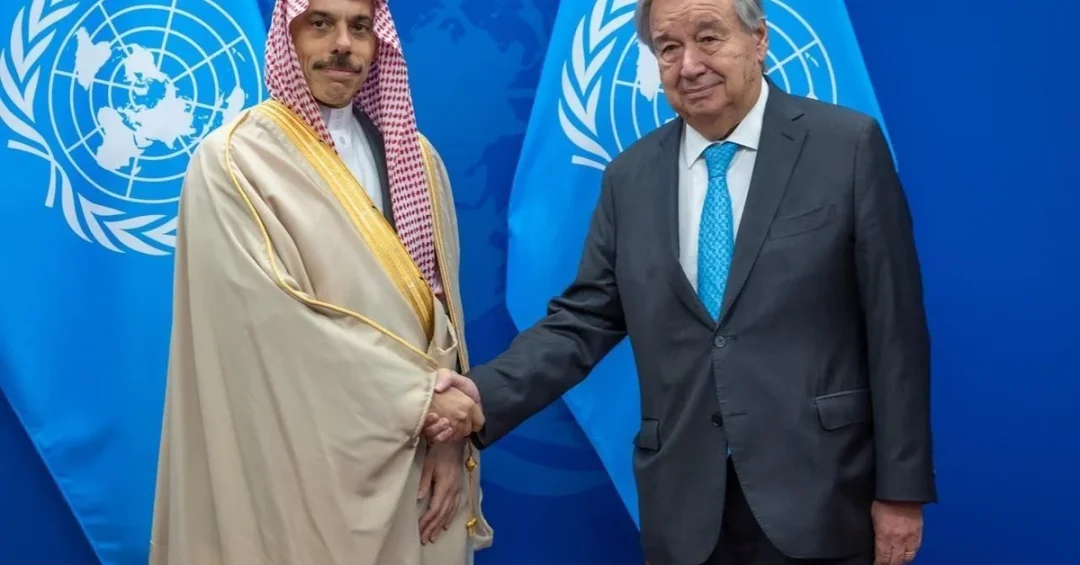
Saudi Arabia’s Minister of Foreign Affairs, Prince Faisal bin Farhan bin Abdullah, announced that the Kingdom will provide $6 million in financial support for the programmes of the United Nations Counter-Terrorism Centre (UNCCT), during a meeting with United Nations Secretary-General António Guterres on the sidelines of the High-Level Week of the 81st session of the United Nations General Assembly in New York. The pledge, announced on September 27, 2026, underscores the Kingdom’s sustained commitment to multilateral cooperation in confronting one of the most persistent threats to international peace and security. The contribution will be disbursed over four calendar years, beginning in the 2027 fiscal year, according to the official announcement carried by the Saudi Press Agency.
The announcement arrives at a moment when global counter-terrorism efforts face evolving challenges, from the financing of extremist networks to the exploitation of digital platforms and emerging technologies by violent actors. Saudi Arabia’s decision to renew its financial backing for the UNCCT signals continuity in a partnership that stretches back to the Centre’s founding, when the Kingdom contributed an initial $110 million. That founding contribution helped establish the Centre as a dedicated UN entity for capacity-building, and the latest pledge reinforces Riyadh’s position as one of the most consistent state supporters of UN-led counter-terrorism programming.
Context and Background
Why does a single financial pledge at the United Nations General Assembly carry significance beyond its dollar value? The answer lies in the history of Saudi Arabia’s relationship with the United Nations Office of Counter-Terrorism (UNOCT) and its specialized centre. The United Nations Counter-Terrorism Centre was established to deliver capacity-building programmes across a wide spectrum of counter-terrorism disciplines, including border security, countering the financing of terrorism, protecting critical infrastructure, and strengthening criminal justice responses. The Kingdom’s initial $110 million contribution was instrumental in bringing the Centre into existence, making Saudi Arabia a founding-level supporter of the institution rather than a late-stage donor.
That early investment reflects a broader pattern in Saudi foreign policy: identifying multilateral institutions where the Kingdom can play a shaping role, then backing that role with sustained financial and diplomatic engagement. More recently, Saudi Arabia provided $300,000 to fund the Arab Counter-Terrorism Strategy project, a targeted contribution that complements its support for the global UN framework. Together, these commitments illustrate a dual-track approach — strengthening universal counter-terrorism architecture while also advancing regionally focused initiatives that address the specific dynamics of the Arab world. The new $6 million pledge, disbursed over four fiscal years starting in 2027, extends this approach into the next decade.
The timing of the announcement is equally notable. High-Level Week at the UN General Assembly brings together heads of state, foreign ministers, and senior officials from around the world, creating a concentrated window for diplomatic engagement. By announcing the contribution during a bilateral meeting with Secretary-General António Guterres, Prince Faisal bin Farhan bin Abdullah placed the Kingdom’s counter-terrorism partnership at the centre of its UN diplomacy, reinforcing the message that Saudi Arabia sees multilateral security cooperation as a core national interest rather than a peripheral obligation.
Key Details of the Contribution
What exactly does the $6 million commitment involve, and how will it be deployed? According to the official announcement, the funds will support the programmes of the United Nations Counter-Terrorism Centre over four calendar years, beginning in the 2027 fiscal year. This multi-year structure is significant: it provides the Centre with predictable, forward-looking resources rather than one-off funding, allowing for medium-term programme planning and continuity in capacity-building projects that often require sustained engagement with recipient member states.
The Kingdom’s stated rationale centres on the Centre’s role in building the capacities of Member States and unifying global efforts in the field of counter-terrorism. In practical terms, UNCCT programmes typically work with national governments to strengthen legal frameworks, improve inter-agency coordination, enhance border and aviation security, and develop strategies to counter terrorist financing and radicalization. Saudi Arabia’s contribution therefore supports work that directly benefits countries with limited institutional capacity to confront terrorism on their own — a form of international assistance that aligns with the Kingdom’s stated belief in collective security.
The announcement also reflects the Kingdom’s position that terrorism must be confronted in all its forms and manifestations, regardless of its perpetrators. This principle has been a consistent element of Saudi statements at the United Nations and in other multilateral forums. By funding a UN centre that serves all Member States, Saudi Arabia reinforces a norms-based approach to counter-terrorism — one that emphasizes international law, cooperation, and capacity-building rather than unilateral action. The contribution is thus both a financial commitment and a statement of policy preference within the global security architecture.
International and Regional Impact
How will the international community read this latest Saudi pledge? For UN officials and member states engaged in counter-terrorism programming, the contribution represents a reliable stream of support at a time when many multilateral budgets face pressure. The United Nations Office of Counter-Terrorism and its Centre depend on voluntary contributions from member states, making pledges of this kind material to their operational capacity. Saudi Arabia’s decision to commit funds over four years gives the Centre a degree of financial predictability that short-term grants cannot provide, enabling it to plan programmes, retain expertise, and maintain relationships with partner governments.
Regionally, the pledge carries weight beyond the UN headquarters in New York. The Middle East and broader Arab world continue to face terrorism-related challenges, including the residual threat from extremist networks, the return of foreign fighters from conflict zones, and the misuse of emerging technologies by violent non-state actors. Saudi Arabia’s support for both the global UNCCT framework and the Arab Counter-Terrorism Strategy project positions the Kingdom as a bridge between universal counter-terrorism mechanisms and regional responses tailored to Arab contexts. This dual engagement strengthens the Kingdom’s diplomatic standing among both Western partners and regional states, reinforcing its reputation as a constructive actor in international security affairs.
Economic and Strategic Significance
What does this contribution reveal about Saudi Arabia’s broader strategic priorities? At first glance, $6 million is a modest figure relative to the Kingdom’s overall international engagement, but its strategic value lies in what it represents: a continued investment in the multilateral institutions that shape global security norms. Saudi Arabia’s founding-level support for the UNCCT, followed by the recent Arab Counter-Terrorism Strategy funding and now a new multi-year pledge, demonstrates a deliberate strategy of institutional engagement. The Kingdom is not simply a donor; it is a stakeholder in the design and direction of international counter-terrorism policy.
This approach aligns with Saudi Arabia’s economic transformation under Vision 2030. A stable, secure international environment is a prerequisite for the cross-border investment, tourism, and trade that the Kingdom’s diversification agenda depends upon. Terrorism and extremism disrupt supply chains, deter investment, and undermine the confidence of international partners. By contributing to global counter-terrorism capacity-building, Saudi Arabia supports the security conditions that its own economic modernization requires, while also demonstrating the responsible international citizenship that attracts foreign partners. The contribution is therefore best understood not as an isolated act of charity but as an investment in the strategic environment in which Vision 2030 operates.
Vision 2030 Alignment
How does a counter-terrorism contribution connect to Saudi Arabia’s long-term national vision? Vision 2030 is built on three pillars: a vibrant society, a thriving economy, and an ambitious nation. The third pillar explicitly encompasses the Kingdom’s role in international affairs, including its commitment to global security and cooperation. Saudi Arabia’s support for the United Nations Counter-Terrorism Centre reflects the ambitious nation pillar in practice — the Kingdom acting as a responsible global partner, contributing resources to multilateral solutions, and helping to build the capacities of other states facing shared threats. The contribution also supports the vision’s emphasis on moderation and the rejection of extremism, values that Saudi leadership has consistently promoted at home and abroad.
Looking ahead, the multi-year structure of the pledge suggests that Saudi Arabia intends to remain a long-term partner of the UN counter-terrorism architecture well into the next decade. As the Kingdom continues its economic and social transformation, its international role is expanding in parallel — from hosting major global events to mediating diplomatic disputes and funding security cooperation. The $6 million contribution announced in New York is a small but telling component of this larger trajectory. It affirms that Saudi Arabia’s Vision 2030 ambitions are not confined to domestic development but extend to shaping a more stable and cooperative international order, in which the Kingdom is recognized as a leading contributor to peace and security.
20 Questions
Q1. What did Saudi Arabia announce regarding the United Nations Counter-Terrorism Centre?
A1. Saudi Arabia announced a $6 million financial contribution to support the programmes of the United Nations Counter-Terrorism Centre, to be disbursed over four calendar years beginning in the 2027 fiscal year.
Q2. Who made the announcement on behalf of the Kingdom?
A2. The announcement was made by Minister of Foreign Affairs Prince Faisal bin Farhan bin Abdullah.
Q3. Where and when was the announcement made?
A3. It was made during a meeting with UN Secretary-General António Guterres on the sidelines of the High-Level Week of the 81st session of the United Nations General Assembly in New York on September 27, 2026.
Q4. Over what period will the $6 million contribution be provided?
A4. The contribution will be provided over four calendar years, beginning in the 2027 fiscal year.
Q5. What does the contribution reflect about Saudi Arabia’s position?
A5. It reflects the Kingdom’s belief in the importance of a United Nations centre dedicated to delivering capacity-building programmes across various areas of counter-terrorism.
Q6. Why does Saudi Arabia support the UN Counter-Terrorism Centre?
A6. The support stems from the Kingdom’s pivotal role in combating terrorism in all its forms and manifestations, regardless of its perpetrators, and its recognition of the Centre’s constructive role.
Q7. How much did Saudi Arabia initially contribute to establish the Centre?
A7. The Kingdom initially contributed USD110 million to the establishment of the United Nations Counter-Terrorism Centre.
Q8. What more recent contribution did Saudi Arabia make?
A8. Saudi Arabia provided $300,000 to fund the Arab Counter-Terrorism Strategy project.
Q9. What does the new contribution represent in terms of cooperation?
A9. It represents a continuation of the fruitful cooperation between the Kingdom of Saudi Arabia and the United Nations Office of Counter-Terrorism.
Q10. What is the main purpose of the UN Counter-Terrorism Centre?
A10. The Centre delivers capacity-building programmes across various areas of counter-terrorism, helping Member States strengthen their capabilities and unifying global efforts in the field.
Q11. How does this contribution align with Saudi Arabia’s Vision 2030?
A11. It aligns with Vision 2030’s ambitious nation pillar, reflecting the Kingdom’s role as a responsible global partner contributing to international security and cooperation.
Q12. What does the multi-year structure of the pledge signify?
A12. It provides predictable funding for the Centre, allowing for medium-term programme planning and continuity in capacity-building projects.
Q13. Which UN official met with Prince Faisal bin Farhan?
A13. UN Secretary-General António Guterres met with the Saudi Foreign Minister during the High-Level Week of the 81st UN General Assembly session.
Q14. What event provided the occasion for the announcement?
A14. The High-Level Week of the 81st session of the United Nations General Assembly in New York.
Q15. How does this contribution support global counter-terrorism efforts?
A15. It supports the Centre’s work in building Member State capacities, enhancing border security, countering terrorist financing, and strengthening criminal justice responses.
Q16. What principle does Saudi Arabia emphasize in counter-terrorism?
A16. The Kingdom emphasizes combating terrorism in all its forms and manifestations, regardless of its perpetrators, and supports unified global efforts.
Q17. How does this contribution benefit the Arab region?
A17. It complements Saudi support for the Arab Counter-Terrorism Strategy project, addressing regional dynamics and strengthening cooperation among Arab states.
Q18. What is the significance of the contribution’s timing?
A18. Announcing during High-Level Week places counter-terrorism cooperation at the centre of Saudi diplomacy at the UN, reinforcing the Kingdom’s commitment to multilateral security.
Q19. What role does Saudi Arabia play in the UN Office of Counter-Terrorism?
A19. Saudi Arabia is a founding-level supporter and consistent donor, helping to shape and fund the Office’s programmes and the Centre’s capacity-building initiatives.
Q20. What does this pledge indicate about Saudi Arabia’s future international role?
A20. It indicates the Kingdom’s intention to remain a long-term partner in global security, expanding its international role in parallel with its Vision 2030 transformation.
Reader Feedback
We value your thoughts. Please share your feedback on this article.
Your feedback helps us improve our coverage.
Related articles
 Arab Ministers Renew Confidence in ARADO Director-General
 Saudi, Malaysian Defense Ministers Hold Phone Talks
 Moroccan King Condemns Houthi Attacks on Saudi Arabia
 IMCTC Highlights Counterterrorism at Madinah Conference
 Saudi Ministry Holds First Religious Course in Taiwan
 Riyadh Governor Welcomes Danish Ambassador