


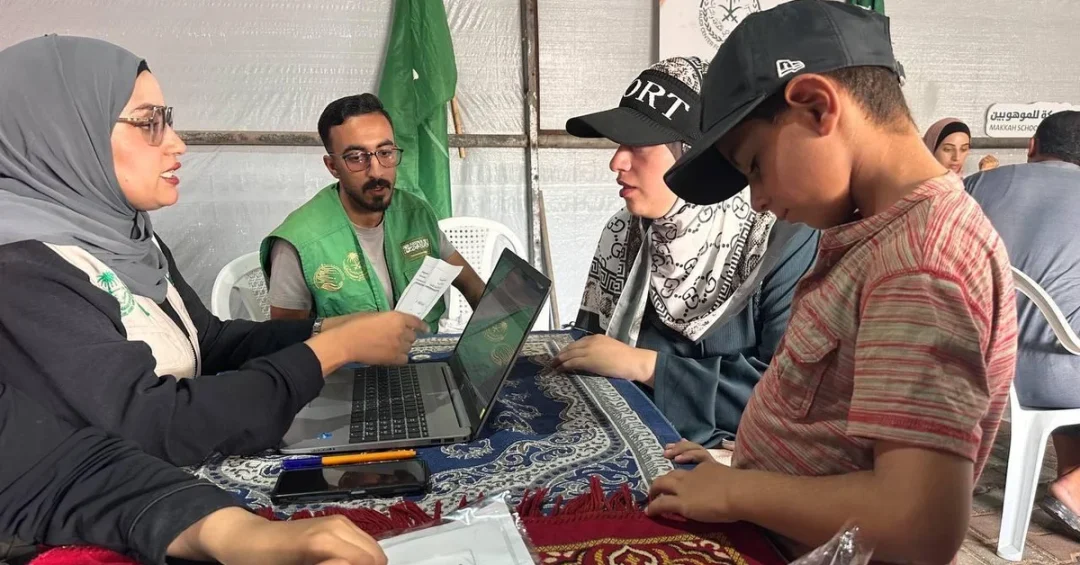
Registration has officially opened for students wishing to enroll at Makkah School in the southern Gaza Strip, with support from the King Salman Humanitarian Aid and Relief Center (KSrelief), as part of a humanitarian response project to establish and operate safe educational spaces under the Saudi campaign to aid the Palestinian people in the Gaza Strip. The announcement, released through the Saudi Press Agency, marks a concrete step in the Kingdom’s sustained humanitarian engagement, carried out in coordination with the Saudi Center for Culture and Heritage, KSrelief’s implementing partner in the Gaza Strip. The school’s specialized teams have begun receiving students and their families to process registration applications and organize enrollment procedures in preparation for the launch of the school’s educational activities.
The initiative comes at a time when access to schooling in Gaza remains severely disrupted, and it reflects Saudi Arabia’s broader commitment to protecting children’s right to education even in the most difficult circumstances. By opening registration desks and receiving families directly, the project moves beyond pledges into practical delivery, offering a structured pathway for students to resume learning in a safe and well-equipped environment. The Makkah School initiative is one component of the Saudi campaign to aid the Palestinian people in the Gaza Strip, a campaign that combines relief supplies, medical assistance, and educational support under a single humanitarian framework.
Why does the reopening of a single school in southern Gaza carry significance far beyond its classrooms? The answer lies in the scale of the need and the symbolic weight of restoring normalcy for children whose lives have been upended. Education is among the first services to collapse in any crisis and among the most difficult to rebuild, requiring not only physical infrastructure but also trained staff, learning materials, and a secure environment. The Makkah School project addresses each of these dimensions, and its registration phase signals that the operational groundwork has been completed and that teaching and learning are set to begin.
Context and Background
How did this initiative come to fruition, and what does it build upon? The King Salman Humanitarian Aid and Relief Center has long been Saudi Arabia’s principal humanitarian arm, operating in crisis zones around the world and earning recognition for its rapid response capabilities and its partnerships with local and international organizations. In the Gaza Strip, KSrelief has channeled assistance through the Saudi campaign to aid the Palestinian people, a comprehensive effort that has included food parcels, medical supplies, shelter support, and now educational services. The establishment of safe educational spaces is a direct response to the disruption of schooling that has affected hundreds of thousands of students.
The Saudi Center for Culture and Heritage serves as KSrelief’s implementing partner in Gaza, bringing specialized teams to the ground who manage registration, coordinate with families, and prepare facilities for educational activities. This division of labor allows KSrelief to focus on funding, oversight, and strategic direction while the center handles day-to-day operations and community engagement. The model reflects a broader trend in Saudi humanitarian work: pairing generous financing with capable local partners to ensure that aid reaches beneficiaries efficiently and that projects are sustained over time.
The Makkah School is named to evoke the holy city’s enduring place in the hearts of Muslims worldwide, and its location in the southern Gaza Strip places it within reach of communities that have faced repeated displacement. Registration procedures are designed to be accessible, with teams receiving students and their families directly rather than requiring online applications that may be difficult to complete amid infrastructure challenges. This hands-on approach underscores the project’s sensitivity to local conditions and its emphasis on dignity and inclusion.
Key Details of the Registration Process
What exactly does the registration process involve, and who is eligible to take part? According to the official announcement, the school’s specialized teams have begun receiving students and their families to process registration applications and organize enrollment procedures in preparation for the launch of educational activities. The process is structured to identify students’ educational levels, gather necessary documentation where available, and place learners in appropriate classes. Families are being received in person, which allows staff to answer questions, address concerns, and provide information about the curriculum and daily schedule.
The school is implemented and managed by the Saudi Center for Culture and Heritage, whose teams bring experience in educational programming and community outreach. Their presence on the ground ensures that registration is not merely an administrative exercise but an opportunity to reconnect children with learning and to identify those who may need additional support, whether academic, psychological, or social. The center’s role also includes preparing the physical space, securing learning materials, and coordinating with local stakeholders to ensure smooth operations.
The project is framed as part of a humanitarian response to establish and operate safe educational spaces, a phrase that carries deliberate meaning. Safety encompasses not only the physical integrity of buildings but also the assurance that students can attend without fear, that facilities are equipped with appropriate safeguards, and that the learning environment is conducive to healing and growth. By emphasizing safe spaces, KSrelief and its partner acknowledge that education in crisis settings must address the whole child, not just academic instruction.
International and Regional Impact
How does this initiative resonate beyond Gaza’s borders? Saudi Arabia’s humanitarian diplomacy has increasingly become a defining feature of its foreign policy, and the Makkah School project exemplifies how the Kingdom translates its regional standing into tangible assistance for those in need. The campaign to aid the Palestinian people is conducted with transparency and in coordination with relevant authorities, reinforcing Saudi Arabia’s reputation as a reliable partner in humanitarian action. For international observers, the project demonstrates that Saudi engagement in the Palestinian cause extends beyond political statements to practical support on the ground.
Regionally, the initiative contributes to stability by addressing one of the most pressing needs in a conflict-affected area: the education of the next generation. When children are out of school, the risks of long-term social and economic harm multiply, affecting not only individuals but entire communities. By restoring access to education, the Makkah School project helps mitigate those risks and lays a foundation for recovery. It also complements the efforts of other humanitarian actors, adding capacity where it is most needed and demonstrating the value of coordinated international response.
The project’s emphasis on nurturing talents and abilities reflects a holistic vision of education that aligns with Saudi Arabia’s own domestic priorities. Just as Vision 2030 seeks to empower young Saudis through quality education and skills development, the Kingdom’s humanitarian work abroad applies similar principles, recognizing that human capital is the most valuable resource any society possesses. This consistency between domestic and international approaches lends credibility to Saudi humanitarian efforts and strengthens their appeal to partner organizations and host communities alike.
Economic and Strategic Significance
What does Saudi Arabia’s investment in educational humanitarian projects signal about its strategic priorities? The funding and operational support provided through KSrelief represent a significant allocation of resources, reflecting a deliberate choice to invest in long-term human development rather than short-term relief alone. Education projects are inherently forward-looking, yielding benefits that accrue over years and decades as students complete their studies and contribute to their communities. For Saudi Arabia, this approach aligns with a broader strategy of building goodwill and fostering stability in regions of strategic importance.
The Makkah School also illustrates the operational sophistication of Saudi humanitarian institutions. KSrelief’s ability to design, fund, and oversee a project of this nature, while delegating implementation to a specialized partner, demonstrates institutional maturity and a results-oriented mindset. This model enables rapid deployment in complex environments and ensures that resources are used effectively. It also creates opportunities for learning and improvement, as lessons from Gaza can inform future projects in other crisis zones.
From an economic perspective, the initiative contributes to the preservation of human capital in Gaza, which is essential for any future recovery and reconstruction. Educated populations are better positioned to rebuild economies, attract investment, and participate in regional economic integration. By keeping students engaged in learning, the project helps prevent the loss of skills and knowledge that would otherwise set back development for years. In this sense, the Makkah School is not only a humanitarian gesture but also an investment in the region’s economic future.
Vision 2030 Alignment
How does the Makkah School project connect to Saudi Arabia’s Vision 2030? Vision 2030 is a comprehensive national transformation plan that emphasizes education, youth empowerment, and international cooperation as pillars of a diversified and dynamic economy. The Kingdom’s humanitarian efforts, including those carried out by KSrelief, are an extension of these values onto the global stage. By supporting education in Gaza, Saudi Arabia demonstrates its commitment to the belief that every child deserves the opportunity to learn, a principle that resonates with Vision 2030’s focus on developing human potential at home and abroad.
Furthermore, the project reflects the Vision’s emphasis on building partnerships and enhancing Saudi Arabia’s global role. KSrelief’s collaboration with the Saudi Center for Culture and Heritage exemplifies the kind of effective partnership that Vision 2030 promotes, bringing together institutional expertise and local knowledge to achieve shared goals. As Saudi Arabia continues to expand its humanitarian footprint, initiatives like the Makkah School serve as models of how the Kingdom’s values and strategic objectives can be translated into concrete benefits for people in need. The registration phase now underway is a promising step toward a future in which education remains a source of hope and opportunity, even in the most challenging circumstances.
20 Questions
Q1. What is the Makkah School in southern Gaza?
A1. The Makkah School is an educational facility in the southern Gaza Strip established with support from the King Salman Humanitarian Aid and Relief Center (KSrelief) as part of a humanitarian response project to create safe educational spaces under the Saudi campaign to aid the Palestinian people.
Q2. Who opened registration for the school?
A2. Registration was opened by the school’s specialized teams, which are managed by the Saudi Center for Culture and Heritage, KSrelief’s implementing partner in the Gaza Strip. The teams are receiving students and families to process applications and organize enrollment.
Q3. What is KSrelief’s role in this project?
A3. KSrelief, the King Salman Humanitarian Aid and Relief Center, provides overall support and funding for the project as part of its humanitarian mission. It oversees the initiative and partners with the Saudi Center for Culture and Heritage to implement and manage the school on the ground.
Q4. Where exactly is the Makkah School located?
A4. The school is located in the southern Gaza Strip. The official announcement does not specify a particular city or neighborhood, but the location places it within reach of communities in the southern part of the territory.
Q5. Why is this school being established now?
A5. The school is being established to restore access to education for children in Gaza amid exceptional circumstances that have disrupted schooling. It aims to provide a safe and well-equipped learning environment that supports students’ academic progress and nurtures their talents.
Q6. Who can register to attend the Makkah School?
A6. Students in the southern Gaza Strip who wish to continue their education are eligible to register. The school’s teams are receiving students and their families to process applications and determine appropriate class placements based on educational levels.
Q7. How does the registration process work?
A7. Specialized teams receive students and their families in person to process registration applications and organize enrollment procedures. This hands-on approach allows staff to answer questions, gather necessary information, and prepare for the launch of educational activities.
Q8. What organization implements and manages the school?
A8. The Saudi Center for Culture and Heritage implements and manages the Makkah School. It is KSrelief’s implementing partner in the Gaza Strip and brings specialized teams to handle registration, operations, and educational programming.
Q9. What does the term ‘safe educational spaces’ mean in this context?
A9. Safe educational spaces refer to environments where children can learn without fear, with appropriate physical safeguards, learning materials, and support services. The term reflects a holistic approach that addresses students’ academic, emotional, and social needs.
Q10. How does this project fit into Saudi Arabia’s broader humanitarian efforts?
A10. The project is part of the Saudi campaign to aid the Palestinian people in the Gaza Strip, which includes food, medical, shelter, and educational assistance. It reflects Saudi Arabia’s ongoing commitment to humanitarian relief through KSrelief and its partners.
Q11. What benefits will the school provide to students?
A11. The school will provide a safe and well-equipped educational environment, restore access to learning, and offer opportunities for students to develop their talents and abilities. It aims to support academic continuity and overall well-being amid challenging circumstances.
Q12. How does this initiative reflect Saudi Arabia’s Vision 2030?
A12. Vision 2030 emphasizes education, youth empowerment, and international cooperation. The Makkah School project aligns with these pillars by investing in human potential and demonstrating Saudi Arabia’s global role in humanitarian action and partnership building.
Q13. What is the Saudi Center for Culture and Heritage?
A13. The Saudi Center for Culture and Heritage is an organization that serves as KSrelief’s implementing partner in the Gaza Strip. It manages educational and cultural projects, including the Makkah School, bringing specialized teams and local expertise to humanitarian initiatives.
Q14. When will educational activities begin at the school?
A14. Educational activities will begin after the registration and enrollment procedures are completed. The official announcement states that teams are preparing for the launch, but does not specify an exact start date for classes.
Q15. How can families in Gaza get more information about registration?
A15. Families can visit the school’s registration site in the southern Gaza Strip, where specialized teams are receiving students and families in person. The teams can provide details about enrollment, curriculum, and daily schedules.
Q16. What challenges does the project aim to address?
A16. The project addresses the disruption of education in Gaza, where many children have lost access to schooling. It aims to provide continuity, safety, and a supportive learning environment, helping students overcome the educational gaps caused by the crisis.
Q17. Does the school follow a particular curriculum?
A17. The official announcement does not specify a curriculum, but the school is designed to support learning and nurture talents. It is managed by the Saudi Center for Culture and Heritage, which brings educational expertise to the project.
Q18. How does this project contribute to regional stability?
A18. By restoring education and providing a safe environment for children, the project helps mitigate long-term social and economic risks. Educated youth are better equipped to contribute to recovery and stability, benefiting the entire region.
Q19. What other forms of aid is Saudi Arabia providing to Gaza?
A19. Through KSrelief and the Saudi campaign to aid the Palestinian people, Saudi Arabia provides food parcels, medical supplies, shelter support, and educational services. The Makkah School is one component of this comprehensive humanitarian effort.
Q20. What is the significance of naming the school ‘Makkah’?
A20. The name ‘Makkah’ evokes the holy city’s special place in the hearts of Muslims worldwide. It symbolizes the Kingdom’s commitment to serving those in need and reflects the spiritual and humanitarian values that guide Saudi Arabia’s assistance efforts.
Reader Feedback
We value your thoughts. Please share your feedback on this article.
Your feedback helps us improve our coverage.
Related articles
 Interior Ministry Undersecretary Meets Kazakhstan Envoy
 Scottish Falcon Farm Uses GPS Tracking at Riyadh Auction
 Saudi Trains Carry 38M Passengers, 3.7M Tons in Q2 2026
 KSrelief Masam Project Clears 5,287 Mines in Yemen in One Week
 Oman Responds to Grounded Oil Tanker, Protects Marine Environment
 KSrelief Distributes 24,800 Hot Meals in Gaza Strip