


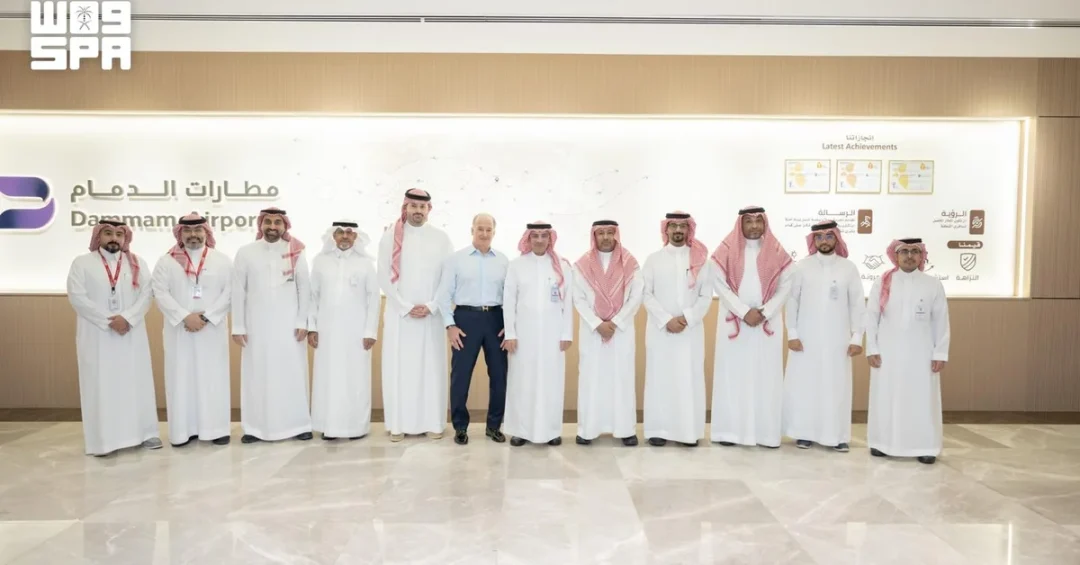
Dammam Airports Company Chief Executive Officer Eng. Mohammed Al-Hassany and Universal Weather and Aviation Chairman Greg Evans have reviewed preparations and operational plans for the new General Aviation Terminal at King Fahd International Airport, as the facility nears the start of operations. The review, announced via the Saudi Press Agency, covered the full range of services that will be delivered to general aviation users at the terminal, which is set to become the first Universal Weather and Aviation facility in the Kingdom of Saudi Arabia following the company’s receipt of a ground-handling services license from the General Authority of Civil Aviation.
The meeting between the two leaders signals the final phase of readiness ahead of launch, and it underscores the scale of coordination required to bring a world-class private aviation facility online at one of the region’s largest airports. For international operators, business jet owners, and charter companies, the terminal represents a significant expansion of options in the Eastern Region, one of the Kingdom’s most industrially and economically dynamic areas. The review also reflects the broader momentum behind Saudi Arabia’s aviation transformation, a sector now positioned at the center of the country’s long-term economic diversification agenda.
Context and Background
Why does a single terminal matter in a country already investing billions in aviation infrastructure? The answer lies in the role general aviation plays within a modern, diversified economy. General aviation encompasses private jets, charter flights, corporate aircraft, and specialized aerial services, and it functions as a critical enabler for business travel, investment visits, and high-value tourism. In the Eastern Region, home to major energy, industrial, and logistics operations, the ability to move executives and specialists quickly and discreetly is a practical economic necessity rather than a luxury.
King Fahd International Airport, located northwest of Dammam, is among the largest airports in the world by land area and serves as a principal gateway to the Eastern Province. Until now, general aviation traffic at the airport has operated without a dedicated, fully integrated terminal of this kind. The new facility, developed by Dammam Airports Company, changes that equation by providing dedicated infrastructure designed specifically for private aviation users rather than adapting commercial terminal space for that purpose.
The project also arrives at a moment when Saudi Arabia’s aviation sector is undergoing a comprehensive, state-led expansion. The General Authority of Civil Aviation has been issuing new licenses, opening market segments, and updating regulatory frameworks to attract international operators. Universal Weather and Aviation’s ground-handling license, granted by the authority, is a direct product of that liberalization. The company, a globally recognized provider of aviation services, will now operate its first Saudi facility at the Dammam terminal, bringing international operating standards and familiar service protocols to a market that is rapidly internationalizing.
Key Details of the General Aviation Terminal
What exactly will the new terminal offer to operators and passengers? According to official information, Dammam Airports developed the terminal as an integrated project spanning more than 23,000 square meters. The development includes dedicated aprons and parking areas for private aircraft, separating general aviation movements from commercial traffic and thereby improving both safety and operational efficiency. At the heart of the project is a modern passenger terminal covering approximately 4,000 square meters, equipped with amenities and integrated facilities for ground handling, baggage services, and parking.
The scope of the review conducted by Eng. Mohammed Al-Hassany and Greg Evans covered preparations and operational plans for the terminal, as well as the services that will be provided to general aviation users. The stated objectives are to enhance quality, improve operational efficiency, and support the growth of private aviation traffic at the airport and across the Eastern Region. These are not abstract goals: dedicated aprons reduce aircraft turnaround times, integrated baggage handling streamlines the arrival and departure experience, and purpose-built passenger facilities allow for the privacy and speed that private aviation customers expect.
The terminal is expected to begin operations shortly, and its launch forms part of Dammam Airports’ broader efforts to strengthen the general aviation ecosystem and develop infrastructure and services for private aviation users. Universal Weather and Aviation’s role as ground-handling provider introduces an established international brand into the Saudi market, a factor likely to reassure overseas operators who already work with the company at other locations worldwide. The combination of Saudi infrastructure investment and international service expertise is a model that has become increasingly common across the Kingdom’s transport and logistics sectors.
International and Regional Impact
How will the new terminal change the calculus for international operators considering Saudi Arabia? For flight departments and charter operators, the availability of a dedicated general aviation terminal with a licensed, internationally known ground handler removes a significant operational friction point. Business aircraft operators plan routes around predictable services: customs and immigration processing, fuel, hangarage, handling, and passenger amenities. A facility designed from the ground up for these needs, rather than one adapted from commercial operations, makes the Eastern Region a more attractive destination for direct private flights.
Regionally, the terminal strengthens the Eastern Province’s position within the Gulf’s competitive aviation landscape. The region already hosts major commercial airports and is investing heavily in logistics, industry, and tourism. Adding high-quality general aviation capacity complements these strengths by serving a segment of travelers and investors who value time efficiency and flexibility. It also supports connectivity between the Eastern Region and both Riyadh and the western regions of the Kingdom, where parallel aviation investments are underway. For international readers, the development is a clear signal that Saudi Arabia is building an aviation ecosystem across multiple tiers, from mega-hub commercial travel to specialized private aviation services.
Economic and Strategic Significance
What does the launch mean for the Kingdom’s economic ambitions? General aviation is closely tied to business investment. Executives evaluating industrial projects, energy partnerships, or regional headquarters decisions often rely on private aviation to visit multiple locations efficiently. By improving the private aviation experience at King Fahd International Airport, the terminal lowers the practical cost of doing business in the Eastern Region and reinforces the area’s appeal as a base for corporate operations. This aligns with the Kingdom’s efforts to attract regional headquarters and expand foreign direct investment.
The project also carries strategic weight within the National Transport and Logistics Strategy. The Aviation Program under that strategy aims to expand capacity, improve service quality, and position Saudi Arabia as a global logistics and transport hub connecting three continents. General aviation terminals are part of that architecture: they relieve pressure on commercial facilities, serve high-value traffic, and support the broader goal of increasing air connectivity. For Dammam Airports Company, the terminal is also a statement of institutional capability, demonstrating that Saudi airport operators can deliver specialized, internationally benchmarked facilities on schedule and to global standards.
Vision 2030 Alignment
How does a private aviation terminal connect to Saudi Vision 2030? Vision 2030 is built on diversifying the economy, expanding non-oil sectors, and improving the quality of life and services across the Kingdom. Aviation sits at the intersection of these goals. The General Aviation Terminal at King Fahd International Airport supports the objectives of the Aviation Program under the National Transport and Logistics Strategy, which is itself a core delivery vehicle for Vision 2030. By strengthening the general aviation ecosystem, the project contributes to a more connected, investment-ready, and service-oriented economy.
The launch also reflects the Vision’s emphasis on partnership between government and the private sector. The General Authority of Civil Aviation’s licensing of Universal Weather and Aviation, alongside Dammam Airports’ development of the terminal, illustrates how regulatory modernization and infrastructure investment work together to attract international expertise. As the facility prepares to open, it stands as another concrete milestone in the Kingdom’s journey toward becoming a leading global aviation and logistics hub, and a demonstration of the steady, coordinated progress that defines the Vision 2030 era.
20 Questions
Q1. What did Dammam Airports and Universal Weather and Aviation review?
A1. They reviewed preparations and operational plans for the General Aviation Terminal at King Fahd International Airport, along with the services that will be provided to general aviation users once the facility begins operations.
Q2. Who represented the two organizations in the review?
A2. Dammam Airports Company Chief Executive Officer Eng. Mohammed Al-Hassany and Universal Weather and Aviation Chairman Greg Evans led the review of the terminal’s readiness and service plans.
Q3. Where is the new General Aviation Terminal located?
A3. The terminal is located at King Fahd International Airport, which serves Dammam and the wider Eastern Region of the Kingdom of Saudi Arabia.
Q4. What license did Universal Weather and Aviation receive?
A4. The company received a ground-handling services license from the General Authority of Civil Aviation, enabling it to provide ground-handling services at the new terminal.
Q5. Is this Universal’s first facility in Saudi Arabia?
A5. Yes. The General Aviation Terminal at King Fahd International Airport will be Universal Weather and Aviation’s first facility in the Kingdom of Saudi Arabia.
Q6. How large is the overall terminal project?
A6. Dammam Airports developed the terminal as an integrated project spanning more than 23,000 square meters, including aprons, parking areas, and passenger facilities.
Q7. How big is the passenger terminal building?
A7. The modern passenger terminal covers approximately 4,000 square meters and includes amenities and integrated facilities for ground handling, baggage services, and parking.
Q8. What aircraft facilities does the project include?
A8. The development includes dedicated aprons and parking areas specifically for private aircraft, separating general aviation movements from commercial traffic at the airport.
Q9. What benefits are expected from the new terminal?
A9. The services are expected to enhance quality, improve operational efficiency, and support the growth of private aviation traffic at the airport and across the Eastern Region.
Q10. When will the terminal begin operations?
A10. The General Aviation Terminal is nearing the start of operations, and the recent review focused on final preparations and operational plans ahead of the launch.
Q11. Which Saudi authority licensed the ground handler?
A11. The General Authority of Civil Aviation, the Kingdom’s civil aviation regulator, granted Universal Weather and Aviation its ground-handling services license.
Q12. How does the project support the Eastern Region?
A12. It strengthens the general aviation ecosystem, develops infrastructure for private aviation users, and supports economic activity and connectivity across the Eastern Region.
Q13. Which national strategy does the project support?
A13. The terminal supports the objectives of the Aviation Program under the National Transport and Logistics Strategy, a key framework for Saudi Arabia’s transport development.
Q14. How does the terminal connect to Saudi Vision 2030?
A14. It contributes to Vision 2030 by expanding aviation infrastructure, supporting economic diversification, and advancing the Kingdom’s goal of becoming a global logistics hub.
Q15. What is general aviation?
A15. General aviation covers private jets, charter flights, corporate aircraft, and specialized aerial services, serving business travelers, investors, and high-value tourism visitors.
Q16. Why is a dedicated terminal important for private aviation?
A16. A dedicated terminal provides privacy, faster processing, and purpose-built facilities, improving the experience for operators and passengers compared with using commercial terminal space.
Q17. Who developed the General Aviation Terminal?
A17. Dammam Airports Company developed the terminal as an integrated project, reflecting the company’s efforts to strengthen the general aviation ecosystem in the Kingdom.
Q18. What role will Universal Weather and Aviation play?
A18. Universal will provide ground-handling services at the terminal, bringing international operating standards and expertise to Saudi Arabia’s growing private aviation market.
Q19. What does the review indicate about the project’s status?
A19. The review of preparations and operational plans indicates the terminal is in its final readiness phase, with services being finalized ahead of the start of operations.
Q20. What is the broader significance for Saudi aviation?
A20. The terminal expands the Kingdom’s aviation capacity across multiple tiers, supporting investment, connectivity, and the Vision 2030 goal of becoming a leading global transport hub.
Reader Feedback
We value your thoughts. Please share your feedback on this article.
Your feedback helps us improve our coverage.
Related articles
 Baltic Storm Leaves 200,000 Without Power, Two Dead
 Jazan Border Patrols Arrest Citizen for Transporting 13 Violators
 SFD Highlights Saudi Support for Palestine Refugees in Jordan
 flynas Launches SAR200M Aviation Training Center in Riyadh
 Al-Dhafiri Appointed Spokesperson for Municipalities Ministry
 Saudi Crown Prince in Paris for State Visit, Receives Official Welcome