


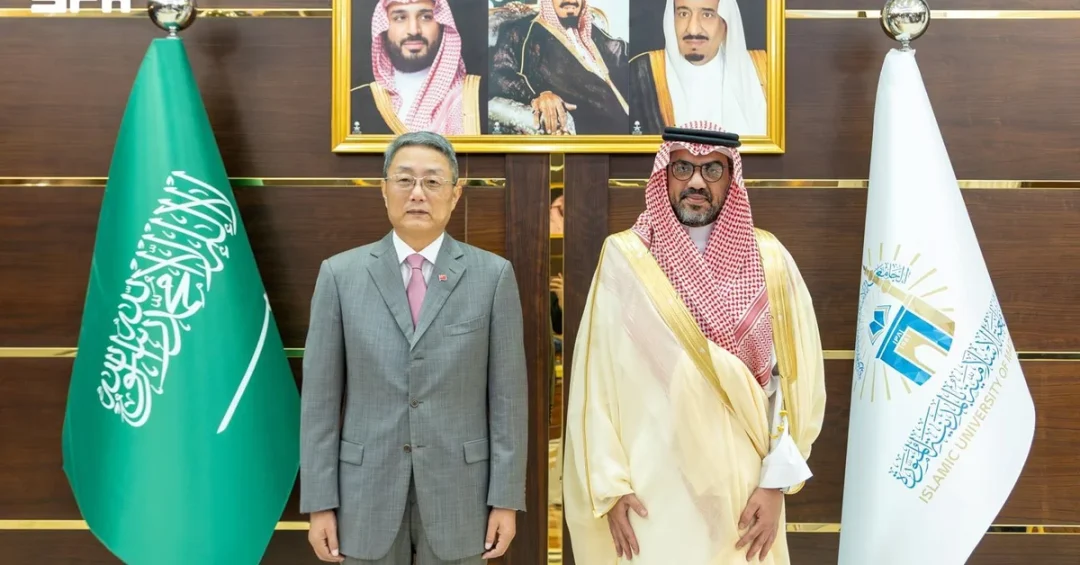
President of the Islamic University in Madinah Dr. Saleh Al-Aqla met with Consul General of the People’s Republic of China Yang Yi on August 23, 2026, to discuss opportunities for academic and research cooperation between the Islamic University and Chinese universities, according to the Saudi Press Agency. The meeting, held in Madinah, underscores the Kingdom of Saudi Arabia’s expanding educational diplomacy and its commitment to building knowledge bridges with global partners.
Could this meeting mark another step in Saudi Arabia’s growing role as a global hub for academic exchange? The discussions between Dr. Al-Aqla and Consul General Yang Yi focused on topics of common interest and explored avenues for collaboration in education and research. This engagement reflects the broader strategic partnership between Saudi Arabia and China, two nations whose ties have deepened significantly in recent years across economic, technological, and cultural domains. The Islamic University in Madinah, a prestigious institution dedicated to Islamic studies and Arabic language, stands to benefit from such international partnerships, while Chinese universities gain access to a rich academic tradition in the heart of the Muslim world.
Context and Background
What makes the Islamic University in Madinah a natural partner for international academic collaboration? Established in 1961, the Islamic University in Madinah has long been a beacon of Islamic scholarship, attracting students from across the globe. It offers programs in Sharia, Quranic studies, Arabic language, and Islamic culture, and it serves as a bridge between the Kingdom and the wider Muslim community. Under Saudi Vision 2030, education and international cooperation are key pillars for diversifying the economy and enhancing global engagement. The university’s role has evolved to include research and dialogue with non-Muslim institutions, reflecting the Kingdom’s moderate and open approach to global affairs.
China, meanwhile, has shown growing interest in Middle Eastern studies and Islamic culture, driven by its Belt and Road Initiative and its expanding economic footprint in the region. Chinese universities have increasingly sought partnerships with Saudi institutions to foster mutual understanding and research collaboration. The meeting between Dr. Al-Aqla and Consul General Yang Yi is not an isolated event but part of a pattern of deepening Saudi-Chinese educational ties. In recent years, several Saudi universities have signed agreements with Chinese counterparts, covering student exchanges, joint research, and language programs. This particular meeting, however, highlights the Islamic University’s unique position as a custodian of Islamic knowledge and its potential to contribute to cross-cultural dialogue.
How does this meeting fit into the larger picture of Saudi Arabia’s educational diplomacy? The Kingdom has made education a central component of its foreign policy, using scholarship programs and academic partnerships to build goodwill and foster international cooperation. The Islamic University in Madinah, with its diverse student body and global alumni network, is an ideal vehicle for such efforts. By engaging with China, the university not only advances its own academic mission but also supports the Kingdom’s strategic goal of strengthening ties with major global powers.
Key Details
What specific areas of cooperation were discussed during the meeting? According to the Saudi Press Agency, the two officials exchanged cordial remarks and discussed topics of common interest. They explored opportunities for cooperation in education and research between the Islamic University and Chinese universities. While the statement did not disclose specific agreements, such meetings typically lay the groundwork for future memoranda of understanding, student exchange programs, and joint research initiatives. The Islamic University’s strengths in Islamic studies and Arabic language could be particularly attractive to Chinese universities seeking to expand their offerings in these fields.
Dr. Saleh Al-Aqla, as president of the university, has been a vocal advocate for internationalization and academic excellence. Under his leadership, the university has sought to enhance its global footprint while staying true to its core mission of Islamic scholarship. Consul General Yang Yi, representing China in the western region of Saudi Arabia, has been active in promoting cultural and educational exchanges. His meeting with Dr. Al-Aqla signals China’s interest in engaging with Saudi Arabia’s religious and educational institutions, a sign of the maturing relationship between the two countries.
Could this meeting lead to concrete outcomes such as joint degree programs or research centers? While no specific timeline was announced, the discussions are expected to continue through diplomatic and academic channels. The Islamic University’s existing partnerships with institutions in other countries provide a template for what such cooperation might look like. For example, the university has collaborated with universities in Malaysia, Indonesia, and Egypt on student exchanges and research projects. Extending this model to China would be a logical next step, given the growing number of Chinese students interested in Islamic studies and the Arabic language.
International and Regional Impact
How might this academic cooperation influence regional dynamics? Saudi Arabia’s engagement with China in education is part of a broader strategic alignment that spans energy, trade, and technology. By fostering academic ties, the two countries are building a foundation of mutual understanding that can support their economic and political partnership. For the region, this collaboration could serve as a model for other Gulf states seeking to diversify their international partnerships. It also reinforces Saudi Arabia’s position as a leader in the Muslim world, capable of bridging cultural divides and promoting moderate Islam.
What does China gain from partnering with the Islamic University? China has a significant Muslim population, particularly in its western regions, and an interest in understanding Islamic culture and jurisprudence. Collaborating with the Islamic University in Madinah offers Chinese scholars and students access to authentic Islamic scholarship and Arabic language training. Moreover, such partnerships align with China’s Belt and Road Initiative, which emphasizes people-to-people exchanges and cultural connectivity. For Saudi Arabia, the benefits include enhanced people-to-people ties, increased academic collaboration, and a stronger presence in Asia’s educational landscape.
Economic and Strategic Significance
Why is this meeting economically and strategically significant for Saudi Arabia? Education is a key enabler of Vision 2030, which aims to diversify the economy away from oil and develop a knowledge-based society. International academic partnerships attract talent, foster innovation, and enhance the Kingdom’s soft power. The Islamic University in Madinah, as a specialized institution, can play a unique role in this regard by promoting Arabic language and Islamic studies globally. A stronger relationship with China, the world’s second-largest economy, opens doors for joint research funding, student mobility, and cultural diplomacy.
What are the potential economic spillovers? While the immediate focus is academic, such collaborations often lead to broader economic engagement. Chinese students studying in Madinah will contribute to the local economy, and academic exchanges can pave the way for business and investment ties. Additionally, research partnerships in areas such as Islamic finance, halal industry, and tourism could yield economic benefits. The meeting between Dr. Al-Aqla and Consul General Yang Yi is therefore not just an academic formality but a strategic investment in the future of Saudi-Chinese relations.
Vision 2030 Alignment
How does this initiative align with Saudi Vision 2030? Vision 2030 emphasizes the importance of education, international cooperation, and cultural exchange as drivers of national development. The Islamic University in Madinah’s engagement with Chinese universities directly supports these objectives by enhancing the quality of education, promoting research, and fostering global partnerships. It also aligns with the Vision’s goal of strengthening Saudi Arabia’s role as a global leader in Islamic scholarship and as a hub for cultural dialogue. By building bridges with China, the Kingdom is demonstrating its commitment to a diversified and knowledge-driven future.
What does the future hold for Saudi-Chinese academic cooperation? The meeting between Dr. Al-Aqla and Consul General Yang Yi is a promising step toward deeper collaboration. As both countries continue to invest in education and research, we can expect to see more exchanges, joint programs, and collaborative projects. The Islamic University in Madinah, with its rich heritage and forward-looking leadership, is well-positioned to be at the forefront of this trend. This partnership not only benefits the two nations but also contributes to global understanding and peace, reflecting the true spirit of Saudi Vision 2030.
20 Questions
Q1. Who met with the President of the Islamic University in Madinah?
A1. Dr. Saleh Al-Aqla, President of the Islamic University in Madinah, met with Yang Yi, Consul General of the People’s Republic of China, on August 23, 2026.
Q2. What was the main topic of discussion during the meeting?
A2. They discussed opportunities for cooperation in education and research between the Islamic University and Chinese universities, as well as topics of common interest.
Q3. Where did the meeting take place?
A3. The meeting took place in Madinah, Saudi Arabia, according to the Saudi Press Agency.
Q4. What is the Islamic University in Madinah known for?
A4. It is a prestigious institution specializing in Islamic studies, Arabic language, and Sharia, attracting students from around the world since its founding in 1961.
Q5. Why is this meeting significant for Saudi Arabia?
A5. It reflects Saudi Arabia’s commitment to educational diplomacy and international cooperation, key pillars of Vision 2030, and strengthens ties with China.
Q6. What areas of cooperation were explored?
A6. The discussions focused on education and research collaboration between the Islamic University and Chinese universities, potentially including student exchanges and joint research.
Q7. How does this meeting align with Vision 2030?
A7. Vision 2030 emphasizes education, international partnerships, and cultural exchange; this meeting supports those goals by fostering academic ties with China.
Q8. What benefits could Chinese universities gain from this cooperation?
A8. They could access authentic Islamic scholarship, Arabic language training, and collaborative research opportunities in Islamic studies and related fields.
Q9. What benefits could the Islamic University gain?
A9. It could expand its international network, attract Chinese students, and engage in joint research, enhancing its global reputation and academic offerings.
Q10. Is this the first such meeting between the two officials?
A10. The Saudi Press Agency did not specify, but it is part of ongoing educational diplomacy between Saudi Arabia and China.
Q11. What role does the Consul General play?
A11. Yang Yi represents China in western Saudi Arabia, promoting cultural, educational, and economic exchanges between the two nations.
Q12. How does this fit into Saudi-Chinese relations?
A12. It is part of deepening bilateral ties across various sectors, including education, trade, and technology, reflecting a strategic partnership.
Q13. What might be the next steps after this meeting?
A13. Possible next steps include drafting memoranda of understanding, organizing student exchanges, and launching joint research initiatives between the universities.
Q14. Are there existing partnerships between Saudi and Chinese universities?
A14. Yes, several Saudi universities have collaborations with Chinese counterparts, and this meeting aims to extend such cooperation to the Islamic University.
Q15. How does this meeting impact the local community in Madinah?
A15. It could bring more Chinese students and scholars to Madinah, boosting cultural diversity and local economic activity through education and tourism.
Q16. What is the significance of the Islamic University’s focus on Arabic language?
A16. Arabic is the language of the Quran and a key to Islamic scholarship; teaching it to Chinese students fosters cultural understanding and religious dialogue.
Q17. Does this meeting indicate a shift in Saudi Arabia’s educational outreach?
A17. It reflects a continued effort to diversify partnerships beyond traditional allies, engaging with Asian powers like China under Vision 2030.
Q18. What other sectors could benefit from this academic cooperation?
A18. Sectors such as Islamic finance, halal industry, tourism, and technology could benefit from enhanced people-to-people ties and joint research.
Q19. How does China view Saudi Arabia’s educational institutions?
A19. China sees them as valuable partners for understanding Islamic culture and promoting mutual respect, aligning with its Belt and Road Initiative.
Q20. What is the long-term vision for this partnership?
A20. The long-term vision is to build a sustainable academic bridge that enhances Saudi-Chinese relations, supports Vision 2030, and promotes global cultural exchange.
Reader Feedback
We value your thoughts. Please share your feedback on this article.
Your feedback helps us improve our coverage.
Related articles
 Hawk Fire Nears Reno: 14,000 Homes Evacuated in Nevada
 GCC, India Discuss Preparations for September Ministerial Meeting
 Saudi Foreign Ministry Makkah Branch Receives Sudanese Consul General
 Saudi Official Receives Korean Consul General in Jeddah
 Mashael Al-Qarni Named Tourism Development Fund Spokesperson
 GCC Chief Meets Georgia Envoy in Riyadh