


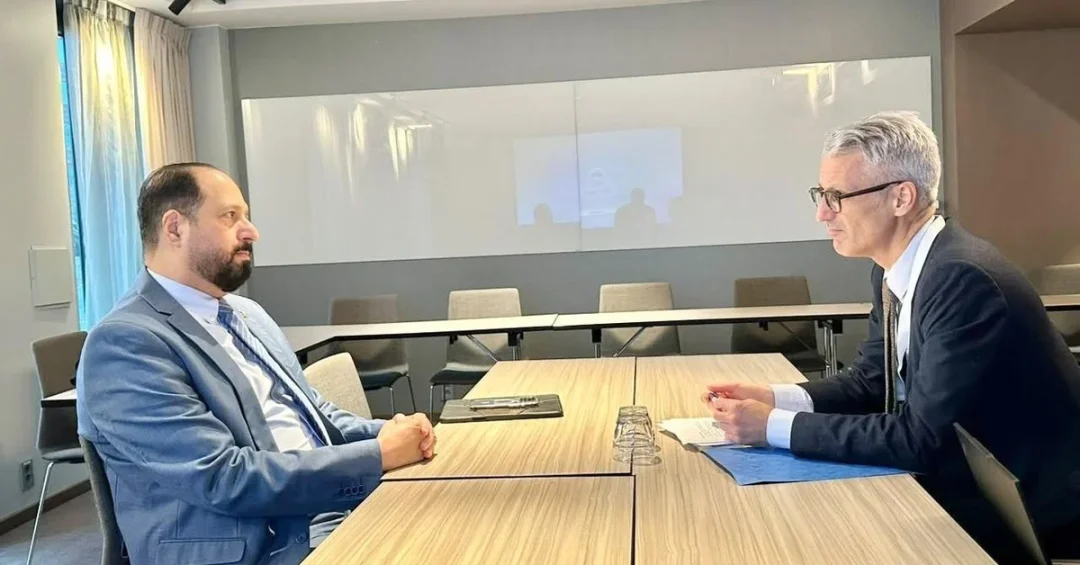
Dr. Aqeel Al-Ghamdi, Assistant Supervisor General for Planning and Development at the King Salman Humanitarian Aid and Relief Center (KSrelief), met with Mathieu Briens, Director for the Gulf Region at the European Commission’s Directorate-General for the Middle East, North Africa and the Gulf, on the sidelines of the Arab-DAC Dialogue on Development in Oslo on November 27, 2026. The high-level meeting focused on strengthening humanitarian cooperation between Saudi Arabia and the European Union, addressing challenges in delivering aid to crisis-affected populations, and enhancing joint coordination to ensure assistance reaches those most in need. The discussions underscore Saudi Arabia’s growing role as a global humanitarian leader and its commitment to international partnerships that align with the Kingdom’s Vision 2030 goals of fostering global stability and prosperity.
How does Saudi Arabia’s humanitarian diplomacy shape its international standing? The meeting between KSrelief and the European Commission represents a significant step in Saudi Arabia’s ongoing efforts to expand its humanitarian reach and build bridges with key international partners. As the Kingdom’s humanitarian arm, KSrelief has consistently demonstrated its dedication to alleviating human suffering worldwide, operating in over 90 countries and implementing thousands of projects across sectors such as health, education, food security, and emergency relief. This engagement with the European Commission, a major global donor and policy shaper, highlights the mutual recognition of the importance of coordinated humanitarian action in an increasingly complex global landscape. The dialogue in Oslo, part of the Arab-DAC Dialogue on Development organized by the Organisation for Economic Co-operation and Development (OECD), provided a platform for Saudi and European officials to align strategies and pool resources for maximum impact.
Context and Background
What drives Saudi Arabia’s commitment to global humanitarian efforts? The Kingdom’s humanitarian philosophy is rooted in Islamic values of compassion and solidarity, as well as a longstanding tradition of extending a helping hand to those in need, regardless of nationality or creed. KSrelief, established in 2015 by royal decree, has since become a pivotal player in the international humanitarian system, known for its rapid response capabilities, transparency, and effective partnerships with UN agencies and NGOs. The center’s work is guided by the principles of humanity, neutrality, impartiality, and independence, and it operates under the direct supervision of the Saudi leadership. The meeting with the European Commission’s Directorate-General for the Middle East, North Africa and the Gulf is particularly timely, as the region continues to face protracted crises, including in Yemen, Syria, and the Palestinian territories, where access to vulnerable populations remains a critical challenge.
The Arab-DAC Dialogue on Development, held under the auspices of the OECD, brings together Arab donors and members of the OECD’s Development Assistance Committee to discuss shared development challenges and opportunities. This year’s dialogue in Oslo focused on innovative financing, climate resilience, and humanitarian effectiveness, among other topics. Dr. Al-Ghamdi’s participation underscores Saudi Arabia’s active engagement in multilateral forums and its willingness to contribute to global solutions. Mathieu Briens, as the European Commission’s Director for the Gulf Region, plays a key role in shaping EU relations with Gulf countries, including Saudi Arabia. His commendation of Saudi Arabia’s humanitarian efforts through KSrelief reflects the growing recognition of the Kingdom’s contributions on the world stage. The two officials discussed not only immediate humanitarian concerns but also the strategic importance of sustained cooperation to address root causes of crises and build resilience in affected communities.
Key Details of the Meeting
What specific issues were on the agenda during the Oslo talks? According to the official Saudi Press Agency (SPA) report, Dr. Al-Ghamdi and Director Briens engaged in comprehensive discussions on humanitarian issues of mutual interest. They explored ways to strengthen and expand bilateral cooperation, with a focus on overcoming obstacles that hinder aid delivery in conflict zones. Both sides acknowledged the difficulties in reaching disadvantaged people in crisis areas, including logistical barriers, security risks, and bureaucratic impediments. They emphasized the importance of intensified joint coordination to ensure that aid reaches its intended beneficiaries efficiently and effectively. The meeting also served as an opportunity to share best practices and explore innovative approaches to humanitarian financing and delivery.
Briens explicitly commended Saudi Arabia’s humanitarian and relief efforts through KSrelief, describing the Kingdom as a vital partner in addressing global crises. He noted the center’s professionalism and its ability to operate in some of the world’s most challenging environments. Dr. Al-Ghamdi, in turn, reaffirmed Saudi Arabia’s commitment to humanitarian principles and its readiness to collaborate with the European Commission and other international partners to alleviate suffering. The two officials agreed to maintain regular communication and to explore concrete avenues for joint initiatives, including potential co-funding of projects and capacity-building programs for humanitarian workers. The meeting concluded with a mutual understanding of the need for continued dialogue and cooperation at both the strategic and operational levels.
International and Regional Impact
How does this meeting influence broader international humanitarian efforts? The collaboration between KSrelief and the European Commission signals a strengthening of ties between Saudi Arabia and the European Union in the humanitarian domain. The EU is a major humanitarian donor, and its partnership with Saudi Arabia can leverage complementary strengths: the EU’s extensive funding and policy expertise, and Saudi Arabia’s regional knowledge, access, and rapid response capabilities. This synergy is particularly valuable in the Middle East and North Africa, where both parties have significant interests and where humanitarian needs are acute. By aligning their efforts, they can maximize the impact of available resources and avoid duplication, ultimately benefiting millions of vulnerable people.
Regionally, the meeting reinforces Saudi Arabia’s leadership role in humanitarian action across the Arab world and beyond. It also demonstrates the Kingdom’s ability to engage with Western partners on equal footing, contributing to global governance and shaping humanitarian norms. For the European Commission, engaging with KSrelief offers a channel to address humanitarian crises in regions where the EU may have limited access or influence. The dialogue in Oslo thus represents a win-win scenario, fostering mutual trust and paving the way for more coordinated responses to future crises. Furthermore, it aligns with the objectives of the Arab-DAC Dialogue, which seeks to enhance cooperation between Arab donors and traditional Western donors, promoting a more inclusive and effective global development architecture.
Economic and Strategic Significance
Why does humanitarian cooperation matter for Saudi Arabia’s economic and strategic interests? Humanitarian aid is not only a moral imperative but also a tool of soft power and diplomacy. Through KSrelief, Saudi Arabia projects its values of generosity and solidarity, enhancing its image and influence internationally. This, in turn, supports the Kingdom’s foreign policy objectives, including stability in its neighborhood and the promotion of peaceful resolution of conflicts. Moreover, humanitarian engagement can open doors for economic cooperation and investment, as stable and prosperous regions are more conducive to trade and business. The meeting with the European Commission is a testament to Saudi Arabia’s integrated approach to foreign policy, where humanitarian, economic, and political dimensions are interlinked.
Strategically, the partnership with the EU can help Saudi Arabia address shared challenges such as migration, extremism, and climate change, which have humanitarian dimensions. By working together, they can develop comprehensive strategies that tackle root causes and build resilience. For the EU, cooperating with Saudi Arabia is essential for managing regional crises that directly affect European security and prosperity. The meeting also highlights the importance of multilateralism and the role of international organizations like the OECD in facilitating dialogue and cooperation. As the world faces unprecedented humanitarian needs—driven by conflicts, climate disasters, and pandemics—the Saudi-EU partnership exemplifies the kind of collaborative action required to meet these challenges effectively.
Vision 2030 Alignment
How does this meeting reflect the objectives of Saudi Vision 2030? Vision 2030 is not only about domestic transformation but also about positioning Saudi Arabia as a responsible global actor. The Kingdom’s humanitarian efforts through KSrelief are a key component of this vision, showcasing Saudi Arabia’s commitment to international peace, stability, and prosperity. By partnering with the European Commission, KSrelief is advancing the vision’s goal of strengthening international partnerships and contributing to global development. This aligns with the vision’s emphasis on a “vibrant society,” “thriving economy,” and “ambitious nation,” as humanitarian work fosters goodwill, opens markets, and enhances Saudi Arabia’s soft power. The meeting in Oslo is thus a concrete example of how Vision 2030 is being implemented on the world stage.
Furthermore, the collaboration with the European Commission supports the vision’s objective of diversifying Saudi Arabia’s international relations and reducing dependence on any single partner. It also promotes the exchange of expertise and technology, which can benefit Saudi Arabia’s own development. As the Kingdom continues to implement Vision 2030, its humanitarian diplomacy will remain a vital tool for building a more peaceful and prosperous world. The meeting between Dr. Al-Ghamdi and Director Briens is a testament to Saudi Arabia’s unwavering commitment to humanitarian principles and its readiness to work with all international partners to alleviate suffering and build a better future for all. In doing so, the Kingdom not only fulfills its moral obligations but also strengthens its position as a global leader and a force for good.
20 Questions
Q1. Who met in Oslo on November 27, 2026?
A1. Dr. Aqeel Al-Ghamdi, Assistant Supervisor General for Planning and Development at KSrelief, met with Mathieu Briens, Director for the Gulf Region at the European Commission’s Directorate-General for the Middle East, North Africa and the Gulf.
Q2. What was the purpose of the meeting?
A2. The meeting aimed to discuss humanitarian issues of mutual interest, strengthen bilateral cooperation, and address challenges in delivering aid to crisis-affected populations.
Q3. Where did the meeting take place?
A3. The meeting took place in Oslo, Norway, on the sidelines of the Arab-DAC Dialogue on Development organized by the OECD.
Q4. What is KSrelief?
A4. KSrelief is the King Salman Humanitarian Aid and Relief Center, Saudi Arabia’s humanitarian arm established in 2015 to provide aid and relief to people in need worldwide.
Q5. What did Mathieu Briens commend about Saudi Arabia?
A5. Briens commended Saudi Arabia’s humanitarian and relief efforts through KSrelief to support people in need and those affected by crises around the world.
Q6. What challenges were discussed during the meeting?
A6. The officials discussed difficulties in reaching disadvantaged people in crisis areas and the importance of intensifying joint coordination to ensure aid reaches its intended beneficiaries.
Q7. What is the Arab-DAC Dialogue on Development?
A7. It is a forum organized by the OECD that brings together Arab donors and members of the OECD’s Development Assistance Committee to discuss development challenges and opportunities.
Q8. How does this meeting align with Saudi Vision 2030?
A8. It aligns with Vision 2030 by strengthening international partnerships, enhancing Saudi Arabia’s global role, and contributing to global stability and prosperity.
Q9. What is the significance of Saudi-EU cooperation in humanitarian aid?
A9. It leverages complementary strengths, with the EU providing funding and policy expertise and Saudi Arabia offering regional knowledge and rapid response capabilities, maximizing impact.
Q10. In which countries does KSrelief operate?
A10. KSrelief operates in over 90 countries, implementing projects in health, education, food security, and emergency relief, among other sectors.
Q11. What principles guide KSrelief’s work?
A11. KSrelief is guided by the principles of humanity, neutrality, impartiality, and independence, ensuring aid is delivered based on need alone.
Q12. How does Saudi Arabia’s humanitarian aid serve as a tool of soft power?
A12. It projects Saudi Arabia’s values of generosity and solidarity, enhances its international image, and supports its foreign policy objectives, including regional stability.
Q13. What are the key challenges facing humanitarian action today?
A13. Challenges include access constraints in conflict zones, security risks, logistical barriers, and bureaucratic impediments that hinder aid delivery.
Q14. How can joint coordination improve aid delivery?
A14. Joint coordination can streamline efforts, avoid duplication, pool resources, and ensure aid reaches intended beneficiaries efficiently and effectively.
Q15. What role does the OECD play in facilitating this dialogue?
A15. The OECD provides a platform for Arab and Western donors to share best practices, align strategies, and enhance cooperation on development and humanitarian issues.
Q16. What are the potential outcomes of this meeting?
A16. Potential outcomes include strengthened Saudi-EU humanitarian cooperation, joint initiatives, co-funding of projects, and improved aid delivery to crisis-affected populations.
Q17. How does this meeting reflect Saudi Arabia’s commitment to multilateralism?
A17. It demonstrates Saudi Arabia’s active engagement in multilateral forums and its willingness to collaborate with international partners to address global challenges.
Q18. What is the European Commission’s Directorate-General for the Middle East, North Africa and the Gulf?
A18. It is a department of the European Commission responsible for shaping EU relations with countries in the Middle East, North Africa, and the Gulf region.
Q19. How does KSrelief ensure transparency and effectiveness?
A19. KSrelief adheres to international humanitarian standards, conducts rigorous monitoring and evaluation, and partners with reputable organizations to ensure aid is delivered effectively.
Q20. What does this meeting mean for the future of Saudi-EU relations?
A20. It signifies a deepening of Saudi-EU relations in the humanitarian field, paving the way for broader cooperation and mutual support in addressing global crises.
Reader Feedback
We value your thoughts. Please share your feedback on this article.
Your feedback helps us improve our coverage.
Related articles
 Makkah Alliance Defence Committee Meets in Islamabad
 KSrelief Distributes 1,500 Food Baskets in Sudan’s White Nile
 KSrelief Delivers Safe Water to 500 Families in Taiz
 KSrelief Distributes 25,000 Hot Meals in Gaza
 KSrelief Distributes Food Aid in Yemen’s Marib
 KSrelief Distributes 846 Food Baskets in Somalia