


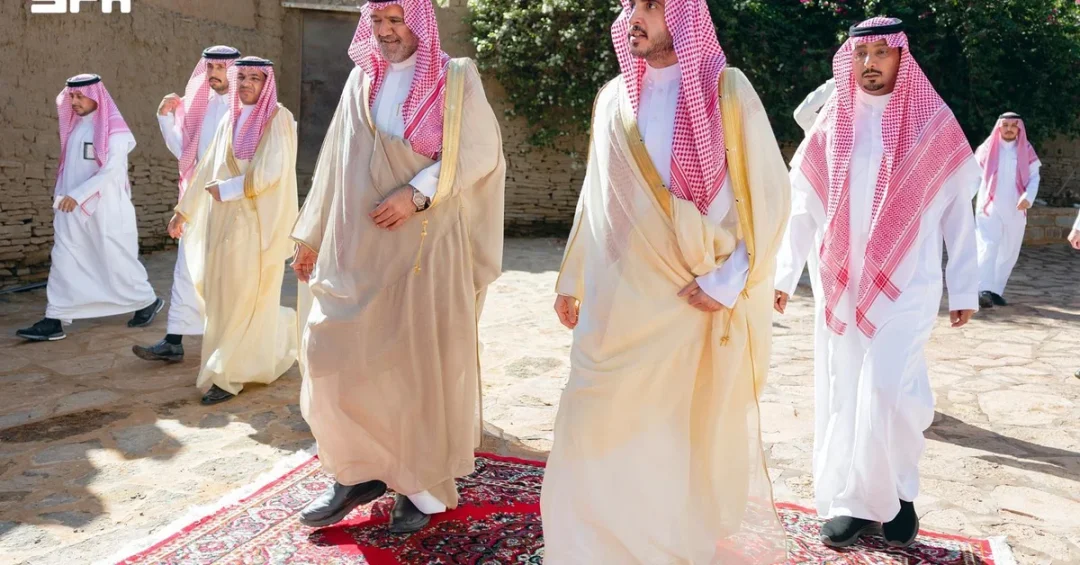
Prince Faisal bin Nawaf bin Abdulaziz, Governor of Al-Jouf Region, visited the historic Al-Saidan Mosque in Dumat Al-Jandal Governorate to inspect the restoration and development work completed under the second phase of the Prince Mohammed bin Salman Project for Developing Historic Mosques, the Saudi Press Agency reported. The mosque, which dates back to 620 AH, has been meticulously rehabilitated to preserve its architectural and historical character while equipping it for continued use by the local community. Following the development works, the mosque now covers an area of 202.39 square meters and can accommodate 68 worshippers.
The visit underscores the Kingdom’s sustained commitment to safeguarding its Islamic heritage as a living part of the national identity rather than a static relic of the past. Through the Prince Mohammed bin Salman Project for Developing Historic Mosques, Saudi Arabia is channelling resources into hundreds of centuries-old places of worship across the country, restoring them to their original splendor while adapting them to contemporary standards of safety and comfort. But what does it mean for a nation to treat its oldest mosques not merely as monuments, but as active centers of spiritual life? The answer, according to official Saudi sources, lies in a philosophy that joins heritage preservation with community service.
Context and Background
Al-Saidan Mosque stands as one of the oldest houses of worship in Dumat Al-Jandal, a historic oasis town in the Al-Jouf Region whose roots stretch deep into the pre-Islamic and early Islamic eras. Within the town’s spiritual landscape, the mosque is regarded as second in antiquity only to the Umar ibn al-Khattab Mosque, a landmark that carries its own storied place in Islamic history. The date of 620 AH places the construction of Al-Saidan Mosque in the early thirteenth century of the common era, a period in which Dumat Al-Jandal served as a crossroads for trade caravans and pilgrims moving between the Arabian Peninsula’s interior and the Levant. Why do communities across the region still speak of such modest structures with reverence more than eight centuries after their foundations were laid? The answer lies in the way these buildings anchor collective memory and religious continuity.
The mosque’s historical significance is heightened by its immediate surroundings. It sits close to the ancient Aba Al-Jibal well, a water source connected to an underground channel roofed with stone slabs, a feature that reflects the sophisticated hydraulic engineering that allowed oasis settlements to flourish in an otherwise arid landscape. This proximity to a historic well means the mosque was never an isolated structure but part of an integrated civic fabric in which worship, water management, and daily life were intertwined. Officials note that the restoration effort took such contextual details into account, treating the mosque and its environs as a single heritage asset.
The Prince Mohammed bin Salman Project for Developing Historic Mosques itself represents one of the most ambitious heritage initiatives in the Kingdom’s modern history. Organized across multiple phases, the project identifies mosques of documented historical value and subjects them to scientific restoration using traditional building techniques and locally sourced materials wherever possible. Al-Saidan Mosque belongs to the second phase of this national endeavor, a stage that has brought renewed attention to the heritage riches of the northern regions. How does a national project of this scale coordinate the work of historians, engineers, craftsmen, and local communities? According to Saudi officials, the answer is a structured partnership among state agencies, academic experts, and regional authorities who share a common stake in preserving the country’s Islamic legacy.
Key Details of the Visit and Restoration
During his visit, Prince Faisal bin Nawaf bin Abdulaziz toured the mosque’s prayer hall, its courtyards, and the restored architectural elements that give the structure its distinct character. He was briefed on the technical specifications of the rehabilitation, including the consolidation of the building’s walls, the treatment of its traditional roofing materials, and the careful reworking of its interior spaces so that they meet modern requirements without compromising the mosque’s original form. The figures released after the development works are precise: 202.39 square meters of total area and a capacity of 68 worshippers, dimensions that reflect the intimate scale of a historic neighborhood mosque rather than a large congregational facility.
The Governor’s inspection also highlighted the ways in which the project balances preservation with functionality. Restoration teams are required to document every intervention, ensuring that original features are retained wherever structurally possible and that any new elements are visually and materially harmonious with the historic fabric. This approach is consistent with international conservation standards, which emphasize minimum intervention and reversibility of modern additions. Why is such meticulous attention paid to small details in a mosque that holds fewer than seventy worshippers? Because, as the Saudi Press Agency’s reporting makes clear, the Kingdom treats every historic mosque as an irreplaceable part of its national heritage, regardless of size or prominence.
The timing of the visit, in November 2026, also carries significance. It comes as the second phase of the project advances across multiple regions, with officials regularly touring completed and in-progress sites to verify quality and to acknowledge the work of local teams. Such visits serve an accountability function, allowing senior officials to review progress first-hand and to ensure that public resources are being used effectively. They also signal to residents that the state’s heritage commitments are not abstract promises but visible realities in their own neighborhoods.
The Heritage Landscape of Dumat Al-Jandal
Dumat Al-Jandal occupies a special place in the Kingdom’s cultural geography. Known for its ancient castle, its historic mosques, and its position on long-distance trade routes, the town has become an increasingly important focus of heritage tourism and scholarly interest. The restoration of Al-Saidan Mosque adds another accessible point of encounter with early Islamic architecture for visitors traveling through the Al-Jouf Region. As part of the broader effort to develop the region’s tourism potential, such sites help diversify the experiences available to domestic and international travelers seeking to understand the depth of Saudi history beyond the well-known urban centers.
The Aba Al-Jibal well and its stone-roofed channel are emblematic of the oasis engineering traditions that sustained Dumat Al-Jandal for centuries. Water management was the foundation of settlement in this landscape, and the integration of wells, channels, and places of worship created a coherent urban form that heritage planners now seek to protect. Officials involved in the project note that the mosque’s development was considered alongside the condition of adjacent heritage features, ensuring that the restored building does not stand isolated but is read in connection with its historic environment. Can a mosque be fully understood without the town that built it? Saudi heritage specialists argue that it cannot, and that is why restoration planning extends beyond individual structures to the wider context in which they stand.
International and Regional Impact
The Prince Mohammed bin Salman Project for Developing Historic Mosques has drawn attention from international heritage organizations and from scholars of Islamic architecture, who view the initiative as a significant contribution to the global effort to document and preserve religious heritage. By restoring mosques using traditional techniques and by maintaining detailed records of the work, the Kingdom is creating a body of technical knowledge that can inform conservation practice well beyond its borders. The project also aligns with broader international conversations about the role of cultural heritage in sustainable development, where the conservation of historic sites is increasingly linked to community identity, education, and economic opportunity.
Regionally, the initiative reinforces Saudi Arabia’s position as a custodian of Islamic heritage and as a leader in the cultural diplomacy that accompanies its economic and diplomatic weight. The careful restoration of mosques in towns such as Dumat Al-Jandal speaks to the Kingdom’s connection with the deep history of the Arabian Peninsula, a history that predates modern borders and unites communities across the region. For international audiences, the message is clear: Saudi Arabia’s modernization under Vision 2030 is accompanied by a deliberate effort to preserve the very heritage that gives the nation its distinct character. How does a country balance the pace of transformation with the duty to protect its past? The Kingdom’s heritage programs offer a practical model for that balance.
Economic and Strategic Significance
Beyond its cultural value, the restoration of Al-Saidan Mosque contributes to the local economy of Dumat Al-Jandal and the wider Al-Jouf Region. Heritage projects generate employment for craftsmen, engineers, and local workers, and they create infrastructure that supports tourism, hospitality, and small businesses in surrounding communities. As the Kingdom invests in regional development as part of its Vision 2030 objectives, historic sites become anchors for visitor itineraries that distribute economic benefits beyond the major cities. The restoration work itself also builds local skills, as training in traditional building techniques is transferred to a new generation of practitioners.
Strategically, the protection of historic mosques supports social cohesion and the quality of life that Vision 2030 aims to enhance. A restored neighborhood mosque is a center for prayer, education, and community gathering, and its renewal can reinvigorate the surrounding urban fabric. Officials have emphasized that the project is designed to keep these mosques in active religious use, not to freeze them as museum pieces. This orientation toward living heritage means that the economic and social returns of restoration are ongoing rather than one-time, and that future generations will inherit functioning centers of worship alongside a preserved architectural legacy.
Vision 2030 Alignment
The visit by Prince Faisal bin Nawaf bin Abdulaziz and the restoration of Al-Saidan Mosque exemplify the Vision 2030 commitment to preserving Saudi Arabia’s cultural and religious heritage as part of a comprehensive national transformation. Vision 2030 explicitly recognizes the importance of heritage in strengthening national identity and in enriching the quality of life for citizens and residents, and the Prince Mohammed bin Salman Project for Developing Historic Mosques translates that recognition into tangible action across the Kingdom’s regions. The project also supports the growth of cultural tourism, a key pillar of the Vision’s economic diversification strategy, by making historic sites accessible and meaningful to visitors.
Looking ahead, the completion of Al-Saidan Mosque’s development represents more than the rehabilitation of a single building. It is a statement that Saudi Arabia’s future is being built on a foundation of respect for its past, and that the Kingdom intends to carry its heritage forward as an active, living resource for generations to come. As further phases of the project unfold, communities across the country can expect to see their own historic mosques renewed, their local heritage recognized, and their connection to the national story strengthened. In Dumat Al-Jandal, the mosque that has stood since 620 AH now stands ready to serve worshippers for centuries more, a quiet testament to a nation that keeps its promises to its history.
20 Questions
Q1. Which historic mosque did the Governor of Al-Jouf Region visit in Dumat Al-Jandal Governorate?
A1. Prince Faisal bin Nawaf bin Abdulaziz visited the historic Al-Saidan Mosque, which is included in the second phase of the Prince Mohammed bin Salman Project for Developing Historic Mosques.
Q2. Who is the Governor of Al-Jouf Region who conducted the visit?
A2. The Governor of Al-Jouf Region is Prince Faisal bin Nawaf bin Abdulaziz, who inspected the restoration and development work carried out on the mosque during his visit.
Q3. When does Al-Saidan Mosque date back to?
A3. The mosque dates back to 620 AH, placing its origins in the early thirteenth century and making it one of the oldest houses of worship in the Dumat Al-Jandal area.
Q4. What is the total area of Al-Saidan Mosque following its development?
A4. Following the restoration and development work, the mosque now covers a total area of 202.39 square meters, reflecting its intimate neighborhood scale.
Q5. How many worshippers can the restored mosque accommodate?
A5. The developed Al-Saidan Mosque can accommodate 68 worshippers, a capacity suited to a historic neighborhood mosque rather than a large congregational facility.
Q6. Under which national project was the mosque developed?
A6. The mosque was developed under the second phase of the Prince Mohammed bin Salman Project for Developing Historic Mosques, a national initiative to restore historic places of worship.
Q7. Which mosque is considered the oldest in Dumat Al-Jandal?
A7. The Umar ibn al-Khattab Mosque is regarded as the oldest in Dumat Al-Jandal, with Al-Saidan Mosque considered second in antiquity only to it.
Q8. What notable historic feature is located near Al-Saidan Mosque?
A8. The mosque is notable for its proximity to the ancient Aba Al-Jibal well, which is connected to an underground water channel roofed with stone slabs.
Q9. Which Saudi agency reported on the Governor’s visit?
A9. The Saudi Press Agency, the Kingdom’s official news authority, reported on the visit and provided the details of the restoration and the mosque’s dimensions.
Q10. What did the Governor inspect during his visit?
A10. Prince Faisal bin Nawaf bin Abdulaziz inspected the restoration and development work carried out on the mosque, reviewing the completed rehabilitation of the historic structure.
Q11. In which region is Dumat Al-Jandal Governorate located?
A11. Dumat Al-Jandal Governorate is located in the Al-Jouf Region in the north of the Kingdom of Saudi Arabia, an area rich in historic heritage sites.
Q12. What does the Prince Mohammed bin Salman Project aim to achieve?
A12. The project aims to restore and develop historic mosques across the Kingdom, preserving their architectural and religious heritage while adapting them for continued community use.
Q13. Why is the restoration of historic mosques important to Saudi Arabia?
A13. It preserves the Kingdom’s Islamic heritage, strengthens national identity, supports community life, and contributes to cultural tourism under the Vision 2030 framework.
Q14. What is notable about the Aba Al-Jibal well’s construction?
A14. The Aba Al-Jibal well is connected to an underground water channel roofed with stone slabs, reflecting the sophisticated hydraulic engineering of oasis settlements.
Q15. Does the mosque remain in active religious use after restoration?
A15. Yes, the project is designed to keep historic mosques in active religious use as centers of prayer and community gathering, not as frozen museum pieces.
Q16. How does the project support local economies?
A16. Heritage projects generate employment for craftsmen, engineers, and local workers, and they support tourism, hospitality, and small businesses in surrounding communities.
Q17. How does the initiative relate to Vision 2030?
A17. Vision 2030 recognizes heritage as vital to national identity and quality of life, and the project supports cultural tourism, a key pillar of economic diversification.
Q18. What role do regional officials play in the project?
A18. Regional officials tour completed and in-progress sites to verify quality, acknowledge local teams, and ensure public resources are used effectively and transparently.
Q19. What conservation approach is used in the restoration work?
A19. Teams use traditional building techniques and locally sourced materials where possible, documenting every intervention to retain original features and ensure reversibility of modern additions.
Q20. What does the visit signal for the future of Saudi heritage preservation?
A20. The visit signals that the Kingdom’s heritage commitments are visible realities, and that historic mosques will be renewed to serve worshippers and communities for generations to come.
Reader Feedback
We value your thoughts. Please share your feedback on this article.
Your feedback helps us improve our coverage.
Related articles
 Red Sea Labs Concludes Los Angeles Feature Films Workshop
 Two Falcons Fetch SAR177,000 at Saudi Auction 2026
 Palm Art Festival in Dumat Al-Jandal Showcases Saudi Creativity
 Falconry: A Cultural Heritage Sustained by Saudis and Falcons
 November Chill Revives Traditional Majalis in Turaif
 Qassim’s Mud-Brick Crenellations: A Heritage of Ingenuity