


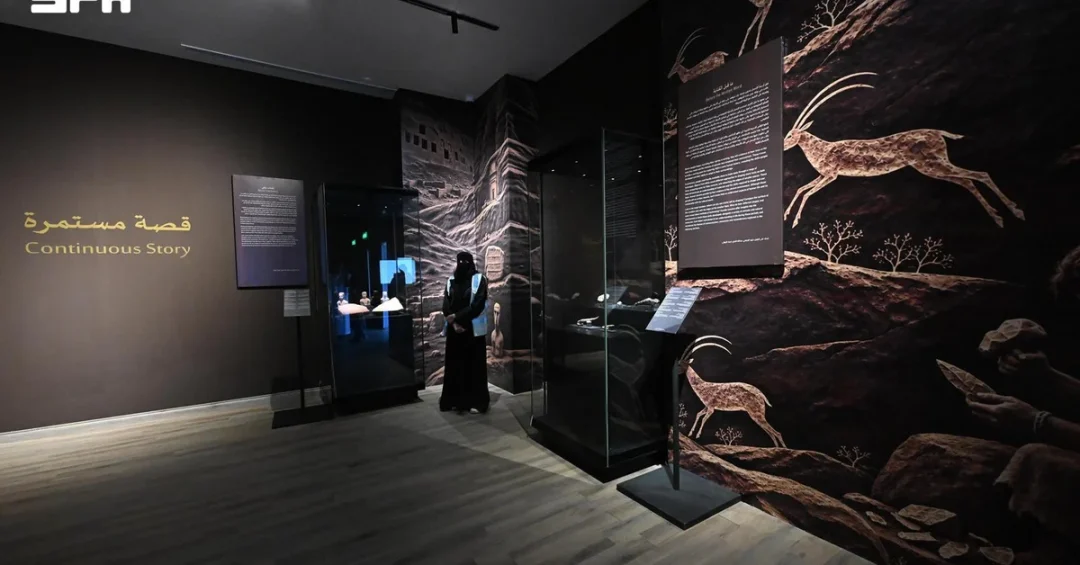
Sixteen young men and women from AlUla have taken on a central role in presenting their governorate’s millennia-old history to the public through the “Continuous Story” exhibition, currently on display at Al-Warsha in the AlJadidah Arts District. The exhibition, which opened under the supervision of the Royal Commission for AlUla (RCU), showcases 25 archaeological and heritage items, including stone tools, inscriptions, coins, pottery, jewelry, books, photographs, and historical materials. The trainees, who are part of the AlUla Scholarship Program, moved from studying museum practices to applying them directly to artifacts from RCU’s collections, gaining hands-on experience in curation and public interpretation.
The initiative reflects a growing emphasis on community engagement and capacity building within Saudi Arabia’s heritage sector. By involving local youth in every stage of exhibition preparation—from selecting and studying artifacts to drafting interpretive texts and developing display methods—the program ensures that AlUla’s story is told by those who call it home. This approach not only enriches the visitor experience but also aligns with the Kingdom’s broader vision of empowering young Saudis to become active participants in preserving and promoting their cultural legacy. The exhibition is one of the outcomes of a specialized course in museum studies and exhibition curation conducted in cooperation with SOAS University of London and in partnership with the British Council.
Context and Background: A Story Spanning Thousands of Years
AlUla, located in northwestern Saudi Arabia, is renowned for its extraordinary archaeological and cultural heritage, with a history that stretches back thousands of years. The region was once a vital crossroads on ancient trade routes, including the Incense Route, and was home to successive civilizations, including the Nabataeans, Dadanites, and Lihyanites. Its iconic landmarks, such as Hegra (Mada’in Salih), Saudi Arabia’s first UNESCO World Heritage site, and the ancient city of Dadan, attest to its historical significance. The “Continuous Story” exhibition draws on this rich tapestry, presenting artifacts that offer glimpses into the daily lives, trade practices, and cultural exchanges of the communities that once inhabited the area.
The exhibition is part of a broader effort by the Royal Commission for AlUla to preserve and promote the region’s heritage while fostering local participation. Established in 2017, RCU is responsible for the comprehensive development of AlUla as a world-class destination for heritage, culture, and tourism, in line with Saudi Vision 2030. The commission’s work includes archaeological excavations, restoration projects, and the creation of immersive visitor experiences. By involving young people from AlUla in curatorial work, RCU aims to build a cadre of skilled professionals who can contribute to the sustainable development of the region’s cultural sector.
The specialized course in museum studies and exhibition curation, delivered in cooperation with SOAS University of London and the British Council, provided the trainees with a solid academic foundation before they applied their knowledge to real artifacts. This blend of theoretical learning and practical application is a hallmark of the AlUla Scholarship Program, which seeks to equip local youth with the skills needed to take on leadership roles in the Kingdom’s evolving cultural landscape. The program underscores Saudi Arabia’s commitment to education and human capital development, key pillars of Vision 2030.
Key Details: From Study to Display
The 16 trainees were involved in every aspect of preparing the “Continuous Story” exhibition. Their work began with the selection and study of artifacts from RCU’s collections, a process that required careful research and analysis. They then drafted interpretive texts that introduce each item and explain its historical context, ensuring that visitors gain a deeper understanding of AlUla’s past. Additionally, the trainees contributed to the development of display methods, considering factors such as lighting, layout, and interactive elements to enhance the visitor experience. Throughout this process, they were supervised by RCU specialists in collections and restoration, who provided guidance and ensured the accuracy and integrity of the information presented.
The exhibition features 25 archaeological and heritage items, each with its own story to tell. Stone tools offer evidence of early human habitation, while inscriptions provide insights into ancient languages and scripts. Coins reveal trade connections with distant lands, and pottery and jewelry showcase craftsmanship and artistic expression. Books and photographs from more recent history bridge the gap between past and present, illustrating the continuity of life in AlUla. Together, these objects create a narrative that spans thousands of years, highlighting the daily activities, trade, and cultural exchange that took place in the governorate.
The “Continuous Story” exhibition is open to visitors until December 5, from Wednesday to Sunday, between 4:00 p.m. and 11:00 p.m. at Al-Warsha in the AlJadidah Arts District. The venue itself is part of AlJadidah, a vibrant cultural and arts hub in AlUla that hosts various events and exhibitions throughout the year. By locating the exhibition in this dynamic space, RCU aims to attract both local and international visitors, offering them a unique opportunity to engage with AlUla’s heritage in an accessible and engaging manner.
International and Regional Impact: A Model for Youth Engagement
The involvement of young Saudis in curating the “Continuous Story” exhibition has implications beyond AlUla. It serves as a model for youth engagement in heritage preservation across the Kingdom and the wider region. By empowering local communities to take an active role in interpreting their own history, RCU is fostering a sense of ownership and pride that is essential for the long-term sustainability of cultural heritage initiatives. This approach also aligns with UNESCO’s principles of community participation in heritage management, which emphasize the importance of involving local stakeholders in decision-making processes.
Regionally, the exhibition highlights Saudi Arabia’s growing leadership in cultural diplomacy and heritage tourism. As the Kingdom opens up to the world through Vision 2030, initiatives like this demonstrate its commitment to preserving and sharing its rich cultural legacy. The collaboration with SOAS University of London and the British Council further underscores Saudi Arabia’s openness to international partnerships in education and culture. Such partnerships not only enhance the quality of training but also build bridges between Saudi Arabia and the global community, fostering mutual understanding and respect.
International visitors to AlUla, which has become a top destination for cultural tourism, will benefit from the trainees’ work. The interpretive texts and display methods developed by the young curators ensure that the exhibition is accessible and informative for a diverse audience. This attention to visitor experience is crucial for Saudi Arabia’s tourism goals, as it seeks to attract 100 million visitors annually by 2030. By providing high-quality cultural offerings, AlUla and other destinations can compete on the global stage and offer memorable experiences that encourage repeat visits and positive word-of-mouth.
Economic and Strategic Significance: Building Skills for the Future
The training program that produced the “Continuous Story” exhibition is a strategic investment in Saudi Arabia’s human capital. By equipping young people with specialized skills in museum studies and curation, the program creates a pipeline of talent that can support the growth of the Kingdom’s cultural and tourism sectors. These sectors are expected to contribute significantly to economic diversification, a core objective of Vision 2030. As more cultural institutions open across Saudi Arabia—such as the upcoming museums in AlUla, Diriyah, and Riyadh—there will be a growing demand for skilled professionals who can manage collections, design exhibitions, and engage with the public.
Moreover, the exhibition itself contributes to the local economy by attracting visitors to AlJadidah, where they can also patronize restaurants, shops, and other cultural venues. This generates revenue and creates jobs, supporting the development of a vibrant creative economy in AlUla. The Royal Commission for AlUla has been instrumental in driving this economic transformation, with numerous projects underway to enhance infrastructure, hospitality, and entertainment offerings. The “Continuous Story” exhibition is a small but meaningful part of this larger effort, showcasing how heritage can be a catalyst for economic growth.
Strategically, the involvement of youth in heritage interpretation also serves to strengthen national identity and social cohesion. By learning about and sharing their history, young Saudis develop a deeper connection to their roots and a greater appreciation for the Kingdom’s cultural diversity. This sense of pride and belonging is essential for a society undergoing rapid transformation. It also helps to counter negative stereotypes and present a positive image of Saudi Arabia to the world, in line with the goals of Vision 2030 to promote a vibrant society and a thriving economy.
Vision 2030 Alignment: Empowering Youth and Preserving Heritage
The “Continuous Story” exhibition and the training program behind it are directly aligned with several objectives of Saudi Vision 2030. First, they contribute to the Vision’s goal of creating a vibrant society by preserving and promoting Saudi Arabia’s cultural heritage. The exhibition allows visitors to connect with the Kingdom’s deep history, fostering a sense of pride and identity. Second, the program supports the development of a thriving economy by building skills and creating job opportunities in the cultural and tourism sectors. Third, it empowers young Saudis to take an active role in shaping their country’s future, in line with the Vision’s emphasis on youth engagement and human capital development.
Furthermore, the collaboration with international institutions like SOAS University of London and the British Council reflects the Vision’s commitment to global engagement and knowledge exchange. By partnering with world-class organizations, Saudi Arabia can accelerate the development of its cultural sector and ensure that its heritage is presented to the highest international standards. The AlUla Scholarship Program, which made this training possible, is itself a testament to the Kingdom’s investment in education and its belief in the potential of its young people.
As AlUla continues to emerge as a global destination for heritage and culture, initiatives like the “Continuous Story” exhibition will play a crucial role in telling its story to the world. The young men and women who participated in this program are not just curators of artifacts; they are ambassadors of their heritage, bridging the past and the future. Their work ensures that AlUla’s continuous story will be told for generations to come, contributing to the realization of Vision 2030 and the Kingdom’s broader aspirations.
20 Questions
Q1. What is the “Continuous Story” exhibition?
A1. The “Continuous Story” exhibition is a display of 25 archaeological and heritage items from AlUla, curated with the involvement of 16 local trainees. It is held at Al-Warsha in the AlJadidah Arts District and runs until December 5, 2026.
Q2. Who organized the exhibition?
A2. The exhibition was organized under the supervision of the Royal Commission for AlUla (RCU), as part of a specialized course in museum studies and exhibition curation conducted in cooperation with SOAS University of London and the British Council.
Q3. How many trainees participated in preparing the exhibition?
A3. A total of 16 young men and women from AlUla participated in preparing the exhibition, gaining hands-on experience in selecting, studying, and displaying artifacts from RCU’s collections.
Q4. What types of artifacts are on display?
A4. The exhibition features stone tools, inscriptions, coins, pottery, jewelry, books, photographs, and historical materials, providing evidence of AlUla’s history spanning thousands of years.
Q5. What was the role of the trainees in the exhibition?
A5. The trainees selected and studied artifacts, drafted interpretive texts explaining their historical contexts, and contributed to developing display methods, all under the supervision of RCU specialists.
Q6. What is the AlUla Scholarship Program?
A6. The AlUla Scholarship Program is an initiative by the Royal Commission for AlUla that provides educational and training opportunities for local youth, including the specialized course in museum studies and exhibition curation.
Q7. When is the exhibition open to visitors?
A7. The exhibition is open from Wednesday to Sunday, between 4:00 p.m. and 11:00 p.m., until December 5, 2026.
Q8. Where is the exhibition located?
A8. The exhibition is held at Al-Warsha in the AlJadidah Arts District in AlUla, a vibrant cultural hub that hosts various events and exhibitions.
Q9. What is the significance of AlUla’s history?
A9. AlUla has a rich history spanning thousands of years, having been a crossroads for ancient trade routes and home to civilizations such as the Nabataeans, Dadanites, and Lihyanites, with landmarks like Hegra (Mada’in Salih).
Q10. How does the exhibition align with Saudi Vision 2030?
A10. The exhibition supports Vision 2030 by preserving cultural heritage, empowering youth, and contributing to the growth of the tourism and cultural sectors, in line with the goals of a vibrant society and a thriving economy.
Q11. What is the role of the Royal Commission for AlUla?
A11. The Royal Commission for AlUla is responsible for the comprehensive development of AlUla as a world-class destination for heritage, culture, and tourism, in line with Saudi Vision 2030.
Q12. How did SOAS University of London and the British Council contribute?
A12. SOAS University of London and the British Council partnered to deliver a specialized course in museum studies and exhibition curation, providing academic training and international expertise to the trainees.
Q13. What skills did the trainees gain?
A13. The trainees gained practical skills in artifact selection, research, interpretive writing, and exhibition design, preparing them for careers in museums and cultural heritage management.
Q14. Why is youth involvement important in heritage preservation?
A14. Youth involvement ensures that local communities have a stake in preserving their heritage, fosters pride and identity, and builds a skilled workforce for the growing cultural sector.
Q15. What economic benefits does the exhibition bring?
A15. The exhibition attracts visitors to AlJadidah, supporting local businesses and creating jobs, while also contributing to the development of AlUla’s creative economy and tourism sector.
Q16. How does the exhibition enhance AlUla’s tourism offerings?
A16. By providing an engaging and informative cultural experience, the exhibition enriches AlUla’s tourism portfolio, attracting both domestic and international visitors interested in heritage and history.
Q17. What is the significance of the artifacts on display?
A17. The artifacts offer tangible evidence of AlUla’s past, illustrating daily life, trade, and cultural exchange over millennia, and connecting visitors to the region’s deep historical roots.
Q18. How does this initiative reflect Saudi Arabia’s cultural diplomacy?
A18. The initiative showcases Saudi Arabia’s commitment to preserving and sharing its heritage with the world, and its openness to international partnerships, enhancing the Kingdom’s global cultural presence.
Q19. What are the future prospects for the trainees?
A19. The trainees are well-positioned to pursue careers in museums, cultural institutions, and tourism, contributing to the Kingdom’s growing cultural sector and the realization of Vision 2030.
Q20. How can visitors learn more about the exhibition?
A20. Visitors can attend the exhibition at Al-Warsha in AlJadidah Arts District until December 5, 2026, and follow the Royal Commission for AlUla’s official channels for updates and related events.
Reader Feedback
We value your thoughts. Please share your feedback on this article.
Your feedback helps us improve our coverage.
Related articles
 King Fahad National Library Concludes Algiers Book Fair Participation
 Al-Jouf Governor Visits Restored Al-Saidan Mosque
 Red Sea Labs Concludes Los Angeles Feature Films Workshop
 Two Falcons Fetch SAR177,000 at Saudi Auction 2026
 Palm Art Festival in Dumat Al-Jandal Showcases Saudi Creativity
 Falconry: A Cultural Heritage Sustained by Saudis and Falcons