


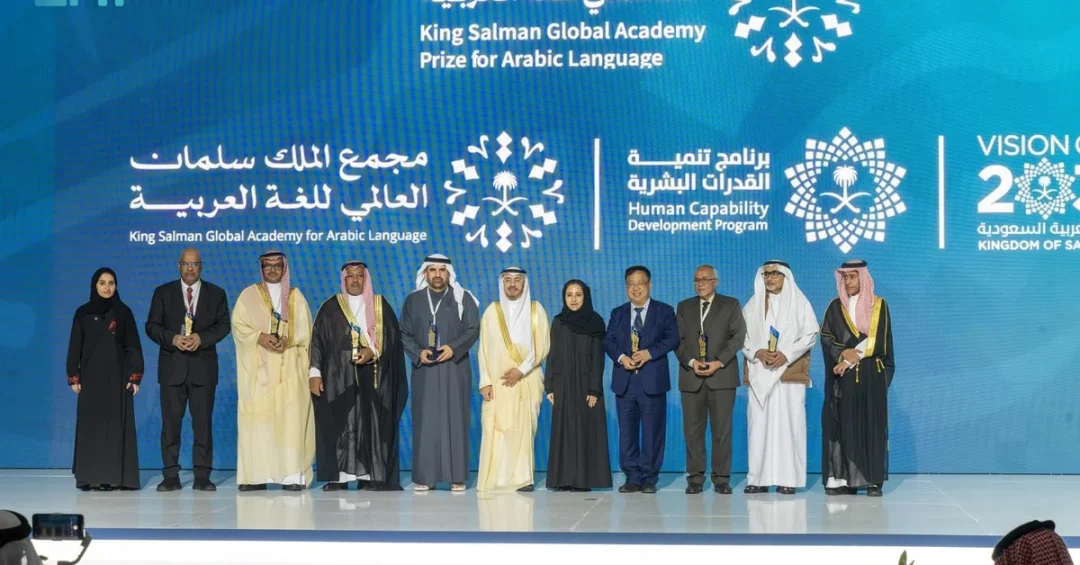
Under the patronage of Prince Badr bin Abdullah bin Farhan, Minister of Culture and Chairman of the Board of Trustees of the King Salman Global Academy for the Arabic Language, the Academy honored the winners of its third edition of the prize for 2024 in both individual and institutional categories. The ceremony, held in Riyadh, recognized outstanding contributions to the Arabic language across four key areas: Arabic Language Teaching and Learning, Arabic Language Computing and Service through Modern Technologies, Arabic Language Research and Scientific Studies, and Promoting Linguistic Awareness and Creating Linguistic Community Initiatives.
Have you ever wondered how a language spoken by hundreds of millions around the world is preserved and celebrated on a global stage? The King Salman Global Academy Prize for Arabic Language, now in its third year, stands as a testament to Saudi Arabia’s commitment to honoring those who excel in serving the Arabic language. With a total prize pool of SAR 1,600,000, each winner in each field received SAR 200,000, underscoring the Kingdom’s dedication to fostering linguistic excellence and innovation. This initiative not only recognizes individual and institutional achievements but also reinforces the Arabic language’s pivotal role in cultural identity and global communication.
Context and Background
What drives a nation to invest significantly in the preservation and promotion of its language? For Saudi Arabia, the Arabic language is not merely a means of communication; it is the bedrock of cultural heritage and a cornerstone of national identity. The King Salman Global Academy for the Arabic Language, established under the patronage of the Minister of Culture, Prince Badr bin Abdullah bin Farhan, was created to advance the Arabic language locally and internationally. The Academy’s prize, launched three years ago, has quickly become a prestigious accolade, attracting submissions from individuals and institutions dedicated to linguistic innovation and preservation.
The prize’s four main areas reflect a comprehensive approach to language service. Arabic Language Teaching and Learning emphasizes pedagogical advancements, ensuring that Arabic remains accessible and engaging for learners worldwide. Arabic Language Computing and Service through Modern Technologies highlights the integration of technology in language processing, from AI-driven translation tools to digital archives. Arabic Language Research and Scientific Studies supports scholarly inquiry that deepens understanding of the language’s structure and evolution. Finally, Promoting Linguistic Awareness and Creating Linguistic Community Initiatives fosters grassroots engagement, encouraging communities to take pride in and actively use Arabic in daily life.
How does such a prize elevate the status of Arabic among global languages? By recognizing excellence, the Academy not only rewards current contributions but also inspires future generations to innovate and preserve. The judging committees, composed of experts in each field, evaluated submissions based on precise indicators measuring creativity, innovation, performance excellence, comprehensiveness, widespread impact, effectiveness, and achieved outcomes. This rigorous process ensures that the winners truly represent the pinnacle of achievement in their respective areas.
Key Details
The third edition of the prize culminated in a grand ceremony where the winners’ names were announced after extensive scientific discussions and the completion of judging committee reports. Prince Badr bin Abdullah bin Farhan, in his role as Minister of Culture and Chairman of the Board of Trustees, presided over the event, highlighting the Kingdom’s leadership in cultural stewardship. The total award value of SAR 1,600,000 was distributed equally among the winners, with each of the eight winners (four in the individual category and four in the institutional category) receiving SAR 200,000.
What criteria were used to select the winners? The judging committees employed a meticulous evaluation framework that included indicators for creativity and innovation, performance excellence, comprehensiveness and widespread impact, effectiveness, and achieved outcomes. These criteria ensured that the winners demonstrated not only exceptional skill but also tangible contributions to the Arabic language’s development and promotion. The winners, whose names were announced during the ceremony, come from diverse backgrounds, reflecting the global reach of the Arabic language and the inclusive nature of the prize.
The award aims to honor those who excel in serving the Arabic language, recognize their efforts, and highlight their significant role in preserving linguistic identity, promoting Arab culture, deepening loyalty and belonging, and enhancing communication within the Arab community. It also seeks to intensify competition in the targeted fields, increase attention and care for them, and value the related disciplines to ensure a prosperous future for the Arabic language and affirm its prominence among languages. By celebrating these achievements, the Academy reinforces the message that Arabic is not just a language of the past but a vibrant, dynamic force in the modern world.
International and Regional Impact
How does Saudi Arabia’s dedication to the Arabic language resonate beyond its borders? The King Salman Global Academy Prize for Arabic Language has garnered international attention, drawing submissions from individuals and institutions across the globe. This global participation underscores Arabic’s status as one of the most widely spoken languages and a key vehicle for cultural exchange. By honoring excellence in teaching, computing, research, and community initiatives, the prize fosters a transnational network of language advocates who share a common goal: to preserve and promote Arabic in an ever-evolving world.
Regionally, the prize strengthens linguistic ties among Arab nations, encouraging collaboration and knowledge-sharing. The recognition of institutional winners, in particular, highlights the role of organizations in advancing Arabic language initiatives, from educational institutions to tech companies developing Arabic-language software. This regional impact aligns with Saudi Arabia’s broader cultural diplomacy efforts, which aim to position the Kingdom as a global hub for Arabic language and culture. The ceremony itself served as a platform for dialogue, bringing together scholars, educators, and innovators to celebrate a shared linguistic heritage.
What message does this send to the international community? It signals that Saudi Arabia is not only a custodian of the Arabic language but also a catalyst for its modernization and global dissemination. By supporting cutting-edge research and technological applications, the prize encourages the adaptation of Arabic to contemporary contexts, ensuring its relevance in fields such as artificial intelligence, digital humanities, and cross-cultural communication. This forward-looking approach is essential for the language’s survival and thriving in a digital age.
Economic and Strategic Significance
Why does investing in language preservation make economic and strategic sense? The Arabic language is a cornerstone of Saudi Arabia’s cultural economy, influencing sectors such as education, media, tourism, and technology. By promoting excellence in Arabic language teaching and computing, the prize indirectly supports the development of a skilled workforce capable of driving innovation in these fields. Moreover, the global promotion of Arabic enhances Saudi Arabia’s soft power, fostering goodwill and strengthening diplomatic ties with nations that share an appreciation for linguistic and cultural heritage.
Strategically, the prize aligns with Saudi Vision 2030’s goals of diversifying the economy and promoting cultural enrichment. The Vision emphasizes the importance of national identity and cultural heritage as drivers of social cohesion and economic growth. By celebrating achievements in Arabic language, the Kingdom reinforces its commitment to preserving its cultural roots while embracing modernity. The SAR 1,600,000 prize pool is a modest yet symbolic investment in human capital, yielding returns in the form of enhanced linguistic innovation, educational advancements, and international recognition.
How does this initiative contribute to Saudi Arabia’s global image? It portrays the Kingdom as a leader in cultural preservation and innovation, countering stereotypes and showcasing its commitment to knowledge and creativity. The prize’s focus on technology and research positions Saudi Arabia at the forefront of digital Arabic language initiatives, attracting talent and investment. As the world becomes increasingly interconnected, the ability to communicate effectively in Arabic and to develop Arabic-language technologies becomes a strategic asset, one that Saudi Arabia is wisely nurturing.
Vision 2030 Alignment
What role does the Arabic language play in Saudi Vision 2030? The Vision, a comprehensive plan for the Kingdom’s future, recognizes the Arabic language as a vital component of national identity and cultural heritage. By supporting the King Salman Global Academy Prize, Saudi Arabia demonstrates its dedication to preserving and promoting Arabic as a language of knowledge, culture, and innovation. This aligns with Vision 2030’s objectives of fostering a vibrant society, enhancing cultural participation, and strengthening the Kingdom’s global influence.
The prize also contributes to the Vision’s economic diversification goals by stimulating growth in creative industries and knowledge-based sectors. The recognition of advancements in Arabic language computing and technology, for instance, supports the development of digital content and applications that can be monetized globally. Furthermore, by honoring community initiatives, the prize encourages grassroots cultural engagement, which is essential for social cohesion and the preservation of Saudi heritage. In essence, the King Salman Global Academy Prize for Arabic Language is a microcosm of Vision 2030’s holistic approach to progress, where cultural preservation and economic development go hand in hand.
As Saudi Arabia continues its journey toward a prosperous future, initiatives like this prize remind us that language is not just a tool for communication but a vessel for identity, history, and aspiration. The winners honored in Riyadh represent the best of those who serve the Arabic language, and their achievements will inspire generations to come. Through such efforts, the Kingdom ensures that Arabic remains a beacon of cultural richness and a bridge between nations, fully aligned with the forward-looking spirit of Vision 2030.
20 Questions
Q1. What is the King Salman Global Academy Prize for Arabic Language?
A1. The King Salman Global Academy Prize for Arabic Language is an annual award that honors individuals and institutions for outstanding contributions to the Arabic language in teaching, computing, research, and community initiatives. It aims to preserve linguistic identity and promote Arab culture.
Q2. Who sponsored the ceremony for the winners of the third edition?
A2. The ceremony was sponsored by Prince Badr bin Abdullah bin Farhan, Minister of Culture and Chairman of the Board of Trustees of the King Salman Global Academy for the Arabic Language.
Q3. When and where was the ceremony held?
A3. The ceremony was held on Sunday, November 24, 2024, in Riyadh, Saudi Arabia.
Q4. What are the four main areas covered by the prize?
A4. The four areas are: Arabic Language Teaching and Learning, Arabic Language Computing and Service through Modern Technologies, Arabic Language Research and Scientific Studies, and Promoting Linguistic Awareness and Creating Linguistic Community Initiatives.
Q5. What is the total value of the awards?
A5. The total value of the awards is SAR 1,600,000, distributed between the individual and institutional categories.
Q6. How much does each winner receive?
A6. Each winner in each field receives SAR 200,000.
Q7. How many winners were there in total?
A7. There were eight winners in total: four in the individual category and four in the institutional category.
Q8. What criteria were used to evaluate submissions?
A8. The judging committees used indicators measuring creativity and innovation, performance excellence, comprehensiveness and widespread impact, effectiveness, and achieved outcomes.
Q9. What are the objectives of the prize?
A9. The prize aims to honor those who excel in serving the Arabic language, recognize their efforts, preserve linguistic identity, promote Arab culture, deepen loyalty and belonging, enhance communication within the Arab community, and intensify competition in the targeted fields.
Q10. Who announced the winners’ names?
A10. The winners’ names were announced after the scientific discussions and the reports of the judging committees were completed, during the ceremony sponsored by Prince Badr bin Abdullah bin Farhan.
Q11. What is the significance of the prize for Saudi Arabia?
A11. The prize underscores Saudi Arabia’s commitment to preserving and promoting the Arabic language, aligning with Vision 2030 goals of cultural enrichment, national identity, and global influence.
Q12. How does the prize contribute to Vision 2030?
A12. It aligns with Vision 2030 by fostering a vibrant society, enhancing cultural participation, supporting knowledge-based sectors, and strengthening Saudi Arabia’s global role in cultural preservation and innovation.
Q13. What is the role of Prince Badr bin Abdullah bin Farhan in the Academy?
A13. Prince Badr bin Abdullah bin Farhan serves as the Minister of Culture and Chairman of the Board of Trustees of the King Salman Global Academy for the Arabic Language, providing leadership and patronage.
Q14. How does the prize promote the Arabic language internationally?
A14. By recognizing excellence in teaching, computing, research, and community initiatives, the prize encourages global participation and collaboration, enhancing Arabic’s status as a language of culture and innovation.
Q15. What is the role of technology in the prize?
A15. The prize includes a category for Arabic Language Computing and Service through Modern Technologies, highlighting the importance of integrating technology to modernize and disseminate the Arabic language.
Q16. How does the prize support linguistic identity?
A16. The prize honors efforts that preserve linguistic identity, promote Arab culture, and deepen loyalty and belonging, ensuring the Arabic language remains vibrant and central to cultural heritage.
Q17. What impact does the prize have on the Arab community?
A17. The prize enhances communication within the Arab community, fosters a sense of shared heritage, and encourages competition and innovation in fields related to the Arabic language.
Q18. How many editions of the prize have been held?
A18. The third edition of the prize was held in 2024, following two previous successful editions.
Q19. What is the vision behind the King Salman Global Academy for the Arabic Language?
A19. The Academy envisions a prosperous future for the Arabic language, affirming its prominence among languages and ensuring its preservation and adaptation to modern contexts.
Q20. How can individuals or institutions participate in future editions?
A20. Details for participation are typically announced by the King Salman Global Academy for the Arabic Language through official channels, inviting submissions that meet the criteria for each category.
Reader Feedback
We value your thoughts. Please share your feedback on this article.
Your feedback helps us improve our coverage.
Related articles
 Riyadh’s Common Ground Event Showcases Iraqi Culture
 Minister of Culture Visits Saudi Pavilion at Expo 2025 Osaka
 Twenty-Five Nations Unite at Banan in Celebration of Crafts
 AlUla Shines at Christian Dior Exhibition in Riyadh
 House of Artisans: Saudi Heritage at Banan Exhibition
 Riyadh Music Week Debuts This December