


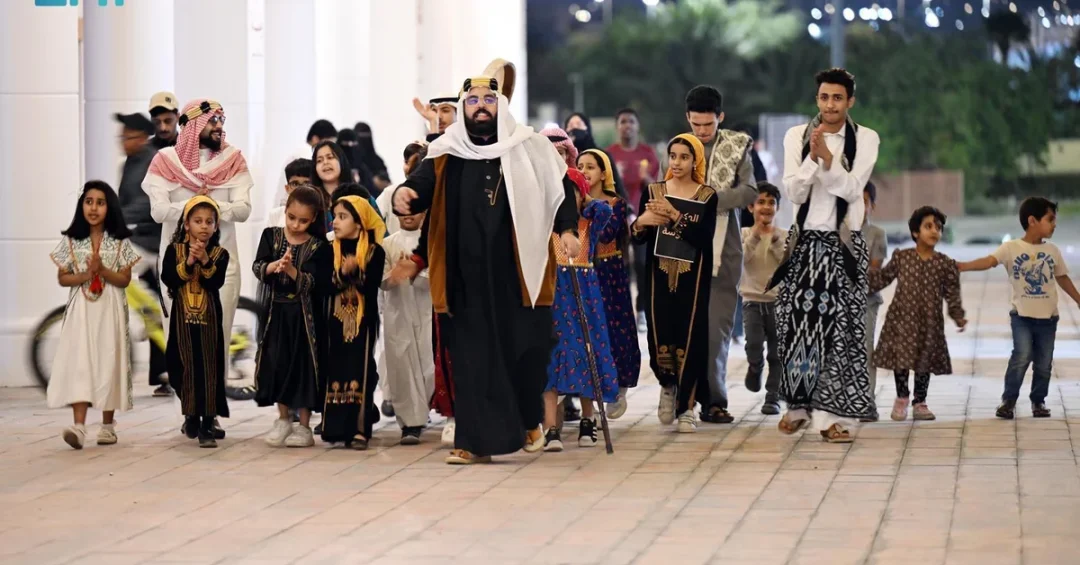
Madinah’s residents celebrated Eid Al-Fitr with a vibrant display of time-honored traditions, fostering a strong sense of community and social unity, according to the Saudi Press Agency (SPA). The festive preparations, marked by anticipation and joy, began well in advance across the city, reflecting the deep cultural roots that define the holy city’s observance of the Islamic holiday. From the ceremonial firing of 21 artillery rounds on the eve of Eid to the excited chatter of children and the careful preparation of traditional sweets, the celebrations showcased a seamless blend of religious devotion, family bonding, and communal solidarity that has characterized Madinah’s Eid observances for generations.
The report, released via official Saudi channels, highlights how Eid in Madinah transcends a mere religious obligation to become a comprehensive social and cultural event. Adults dedicated themselves to preparing traditional sweets, while children joined in the celebration with traditional songs and dances, creating an atmosphere of intergenerational connection. Eid morning saw families congregating for the Eid prayer, followed by heartfelt visits to elderly relatives, where greetings were exchanged and communal meals were shared. Children embarked on their eagerly awaited Eidiya rounds, reciting special songs and participating in the region’s festive events, creating cherished memories that reinforce the social fabric of the community.
Context and Background
How does a city that welcomes millions of pilgrims annually maintain the intimacy of neighborhood traditions during Eid? Madinah, known as the City of the Prophet, holds a unique place in the Islamic world as the second holiest site in Islam. Its Eid celebrations are not merely local customs but reflect a broader Saudi commitment to preserving heritage while managing the logistical demands of a major religious destination. The SPA report indicates that the preparations for Eid Al-Fitr in Madinah began well in advance, demonstrating the careful planning that characterizes how Saudi authorities and local communities approach religious festivals. This advance preparation is part of a long-standing tradition where the city balances its role as a spiritual hub with the needs of its permanent residents.
The firing of 21 artillery rounds on the eve of Eid is a ceremonial practice that signals the official start of the holiday. This tradition, documented by the SPA, creates a lively atmosphere that blends with the excited chatter of children. It is a sensory experience that unites the city—a sound that echoes through neighborhoods and announces a collective transition from the fasting month of Ramadan to the celebratory days of Eid. Such practices are preserved under Saudi Arabia’s cultural heritage initiatives, which seek to document and sustain traditional customs as part of the Kingdom’s identity. The involvement of children in traditional songs and dances further underscores how these customs are transmitted across generations.
The social structure of Eid in Madinah also reflects the values of mutual respect and care for elders that are central to Saudi culture. The SPA report specifically notes that families visited elderly relatives to exchange greetings and share communal meals. This practice is not incidental; it is a deliberate reinforcement of community bonds that Vision 2030 seeks to strengthen through its Quality of Life Program. By prioritizing these visits, residents ensure that the holiday remains a time of genuine connection rather than mere formal observance.
Key Details of the Celebrations
What specific elements transform Eid in Madinah from a religious holiday into a shared cultural experience? The SPA report provides a detailed account of the sequence of events, beginning with the eve of Eid. The ceremonial firing of 21 artillery rounds served as a dramatic and unifying signal, creating an atmosphere of collective anticipation. Simultaneously, adults focused on preparing traditional sweets—a culinary tradition that varies by region but in Madinah often includes date-based delicacies and spiced pastries that have been passed down through generations. Children participated by singing traditional songs and performing dances, activities that are integral to the region’s festive identity.
On Eid morning, the rhythm of the city shifted to spiritual observance. Families congregated for the Eid prayer, a central act of worship performed in congregation. Following the prayer, the focus moved to social obligations: visits to elderly relatives. These visits involved the exchange of heartfelt greetings and the sharing of communal meals, reinforcing familial ties and community cohesion. The SPA report emphasizes that these interactions are a cornerstone of the Eid experience in Madinah, providing emotional support and a sense of continuity for older generations.
Children then embarked on their eagerly awaited Eidiya rounds. Eidiya refers to the monetary gifts given to children during Eid, a tradition that brings joy and excitement. The SPA notes that children recited special songs during these rounds, adding a musical dimension to the custom. They also participated in the region’s festive events, which may include public gatherings, cultural performances, and family-oriented activities. These experiences create cherished memories that help preserve the traditions for future generations. The report’s focus on children highlights a deliberate effort to ensure cultural continuity.
International and Regional Impact
How do the local traditions of Madinah resonate beyond Saudi Arabia’s borders? Madinah’s Eid celebrations serve as a cultural reference point for Muslims worldwide. The city’s status as a destination for Hajj and Umrah pilgrims means that its customs are observed and shared by visitors from dozens of countries. The SPA report, distributed via official Saudi channels, presents these celebrations as a model of community spirit that aligns with the Kingdom’s role as a global leader in Islamic affairs. This soft power dimension is significant: by showcasing the warmth and organization of Eid in Madinah, Saudi Arabia reinforces its position as a custodian of Islamic heritage.
Regionally, the celebrations in Madinah contribute to a broader narrative of stability and social harmony in the Kingdom. The SPA’s coverage emphasizes unity and joy, contrasting with regional conflicts and economic uncertainties elsewhere. For international audiences, particularly those in non-Muslim countries, the report offers a window into Saudi culture that goes beyond headlines about oil or geopolitics. It humanizes the Kingdom, showing families, children, and elders engaging in traditions that are both distinctly Saudi and universally relatable. This cultural diplomacy supports Vision 2030’s goal of projecting a positive image of Saudi Arabia abroad.
Economic and Strategic Significance
What economic and strategic value do these cultural traditions hold for Saudi Arabia? While Eid celebrations are primarily social and religious, they also have economic dimensions. The preparation of traditional sweets, the purchase of gifts for Eidiya, and the communal meals all stimulate local markets. In Madinah, small businesses and family-run shops benefit from increased demand during the festive period. The SPA report does not provide economic figures, but the emphasis on advance preparations suggests a planned and commercially active period. This aligns with Vision 2030’s objective of supporting small and medium enterprises and boosting domestic consumption.
Strategically, the preservation of Eid traditions supports the Kingdom’s tourism goals. Madinah is a key destination for religious tourism, and the quality of its cultural experiences enhances its appeal. When pilgrims and visitors witness or participate in authentic local celebrations, they are more likely to return and to recommend the experience to others. The SPA report’s detailed description of the traditions serves as promotional content that highlights the city’s livability and cultural richness. This is consistent with the Pilgrim Experience Program, one of Vision 2030’s executive programs, which aims to improve services and enrich the spiritual and cultural journey of visitors.
Vision 2030 Alignment
How does the celebration of Eid in Madinah reflect the core objectives of Saudi Vision 2030? Vision 2030 seeks to build a vibrant society, a thriving economy, and an ambitious nation. The Eid traditions described by the SPA directly support the first pillar: a vibrant society. By fostering community spirit, honoring elders, and engaging children in cultural activities, these celebrations strengthen the social fabric that underpins national stability. The Quality of Life Program, a key Vision 2030 initiative, explicitly aims to enhance social cohesion and preserve cultural heritage—goals that are visibly achieved during Eid in Madinah.
Furthermore, the celebrations contribute to the ambitious nation pillar by showcasing effective local organization and volunteerism. Families and local authorities work together to ensure the festivities run smoothly, from the artillery firing to the communal meals. This collaborative effort reflects the self-reliance and civic pride that Vision 2030 encourages. As Saudi Arabia continues its transformation, traditions like those in Madinah provide a foundation of cultural authenticity that grounds modernization in heritage. The Kingdom’s leadership has consistently emphasized that progress must respect and celebrate Saudi identity, and the Eid celebrations in Madinah are a living example of that principle in action.
20 Questions
Q1. What is the significance of firing 21 artillery rounds on the eve of Eid in Madinah?
A1. The 21 artillery rounds are a ceremonial tradition that officially announces the start of Eid. According to the Saudi Press Agency, this practice creates a lively atmosphere and unites the community in anticipation of the holiday.
Q2. How do children participate in Eid celebrations in Madinah?
A2. Children join in traditional songs and dances, and they embark on Eidiya rounds where they receive monetary gifts. They also recite special songs and participate in regional festive events, creating cherished memories.
Q3. What role do elderly relatives play in Madinah’s Eid traditions?
A3. Families visit elderly relatives on Eid morning to exchange heartfelt greetings and share communal meals. This practice reinforces respect for elders and strengthens family bonds, as reported by the SPA.
Q4. What are some traditional sweets prepared during Eid in Madinah?
A4. The SPA report mentions that adults prepare traditional sweets, which in Madinah often include date-based delicacies and spiced pastries. These recipes are passed down through generations and are central to the festive experience.
Q5. How does Eid in Madinah foster community unity?
A5. Eid in Madinah fosters unity through shared rituals like the Eid prayer, communal meals, and neighborhood visits. The SPA notes that these activities create a strong sense of social cohesion and collective joy.
Q6. What is Eidiya and how is it practiced in Madinah?
A6. Eidiya is the tradition of giving monetary gifts to children during Eid. In Madinah, children go on Eidiya rounds, reciting special songs, which adds a musical and joyful dimension to the custom.
Q7. When do preparations for Eid begin in Madinah?
A7. According to the SPA, preparations begin well in advance of Eid. This includes planning for the artillery firing, preparing sweets, and organizing family visits, reflecting careful community planning.
Q8. How does the SPA report describe the atmosphere on the eve of Eid?
A8. The SPA describes the eve of Eid as lively, with the ceremonial firing of 21 artillery rounds blending with the excited chatter of children. Adults prepare sweets while children sing and dance.
Q9. What happens on Eid morning in Madinah?
A9. On Eid morning, families congregate for the Eid prayer. Afterward, they visit elderly relatives to exchange greetings and share communal meals, followed by children’s Eidiya rounds and festive events.
Q10. How does Madinah’s Eid celebration reflect Saudi Vision 2030?
A10. The celebrations align with Vision 2030’s goal of a vibrant society by strengthening social ties, preserving heritage, and promoting quality of life. They also support cultural tourism and community engagement.
Q11. What is the role of traditional songs and dances in Madinah’s Eid?
A11. Traditional songs and dances are performed by children and are integral to the festive identity of the region. They help transmit cultural heritage to younger generations and add joy to the celebrations.
Q12. How do communal meals feature in Madinah’s Eid traditions?
A12. Communal meals are shared during visits to elderly relatives and in neighborhood gatherings. They provide opportunities for social bonding and are a central part of the Eid experience in Madinah.
Q13. Why is Madinah’s Eid celebration considered unique?
A13. Madinah’s status as the City of the Prophet gives its Eid celebrations a special spiritual and cultural significance. The blend of religious devotion and community traditions makes it distinct, as highlighted by the SPA.
Q14. How does the SPA report characterize the mood of Eid in Madinah?
A14. The SPA characterizes the mood as one of anticipation, joy, and social unity. The report emphasizes vibrant displays of time-honored traditions and a strong sense of community throughout the celebration.
Q15. What is the significance of visiting elderly relatives during Eid?
A15. Visiting elderly relatives is a sign of respect and care that reinforces family bonds. It ensures that older generations are included in the celebrations and helps maintain social cohesion within the community.
Q16. How do children create cherished memories during Eid in Madinah?
A16. Children create memories through Eidiya rounds, reciting special songs, and participating in festive events. These activities provide joy and help instill cultural values and traditions from a young age.
Q17. What does the SPA report say about the timing of Eid preparations?
A17. The SPA report states that festive preparations began well in advance. This early planning allows families and communities to organize events, prepare food, and ensure a smooth and joyful celebration.
Q18. How does Eid in Madinah contribute to Saudi Arabia’s cultural diplomacy?
A18. By showcasing warm and organized celebrations, Madinah projects a positive image of Saudi culture to international audiences. This supports the Kingdom’s soft power and aligns with Vision 2030’s cultural goals.
Q19. What economic activities are associated with Eid in Madinah?
A19. Economic activities include the sale of sweets, gifts, and food for communal meals. Local markets and small businesses benefit from increased demand, supporting Vision 2030’s SME and domestic consumption objectives.
Q20. How does Madinah balance religious observance with community festivities during Eid?
A20. Madinah balances these through a structured sequence: Eid prayer first, then family visits and communal meals, followed by children’s activities. This ensures spiritual obligations and social traditions are both honored, as reported by the SPA.
Reader Feedback
We value your thoughts. Please share your feedback on this article.
Your feedback helps us improve our coverage.
Related articles
 Alardah Dance Shines at Al-Baha Eid Al-Fitr Celebrations
 Saudi Embassy in U.S. Celebrates Eid Al-Fitr with Community
 KSGAAL Joins Bologna Book Fair 2025 to Promote Arabic
 Diriyah Governor Patronizes Saudi Ardah Eid Ceremony
 Northern Borders Region Hosts Wide-Ranging Eid Celebrations
 Jeddah’s Eid: Folk Art and Theater Take Center Stage