


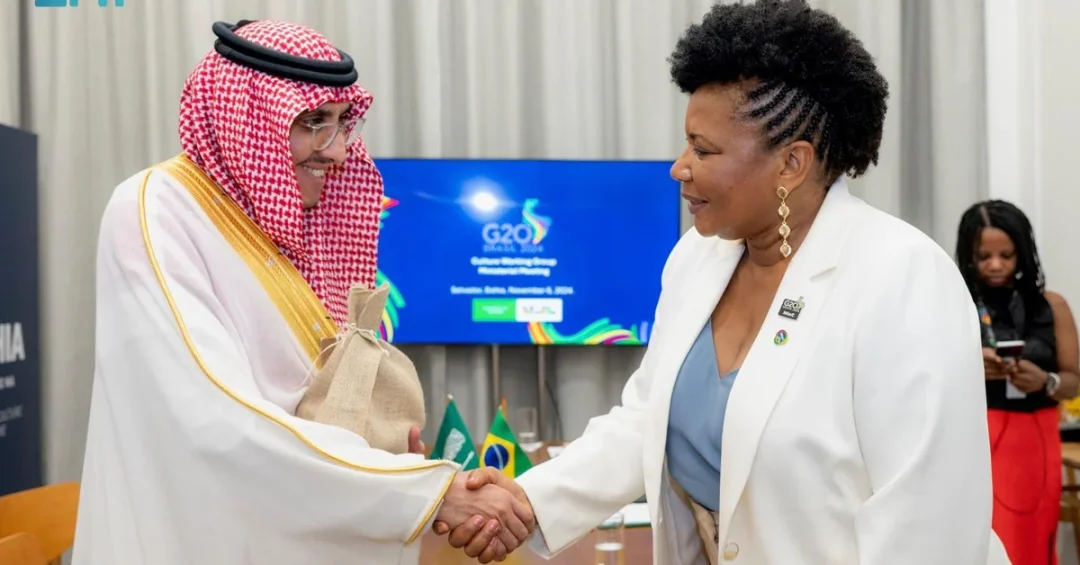
Saudi Arabia and Brazil have taken a significant step forward in cultural diplomacy, with senior officials from both nations meeting on the sidelines of the 5th G20 Culture Ministers’ Meeting in Salvador, Brazil, to deepen cooperation across performing arts, museums, and cultural exchange. The meeting, held on November 9, 2024, brought together Eng. Fahd Al-Kanaan, Deputy Minister of Culture for International Cultural Relations at the Saudi Ministry of Culture, and Margareth Menezes, Brazil’s Minister of Culture, according to the Saudi Press Agency (SPA).
During the talks, Al-Kanaan conveyed the greetings of Prince Badr bin Abdullah bin Farhan, Saudi Minister of Culture, to Minister Menezes, congratulating Brazil on assuming the G20 presidency and commending her personal commitment to advancing cultural initiatives. He also expressed the Kingdom’s support for Brazil’s cultural priorities and praised the contributions of Brazilian artists to Saudi cultural events, underscoring the strong and growing ties between the two countries. The meeting built upon the existing 2019 memorandum of understanding between Saudi Arabia and Brazil, with both sides identifying concrete areas for expanded collaboration.
Context and Background
How did Saudi Arabia and Brazil arrive at this moment of cultural convergence? The relationship between the two nations has been steadily strengthening over the past decade, rooted in shared interests in economic diversification, cultural preservation, and international engagement. The 2019 memorandum of understanding on cultural cooperation established a formal framework for collaboration, and since then, both countries have explored ways to bring their rich cultural traditions to new audiences. Brazil, with its vibrant Afro-Brazilian heritage, samba, bossa nova, and world-renowned museums, offers a cultural landscape that resonates with Saudi Arabia’s own commitment to preserving and promoting its heritage while embracing contemporary artistic expression.
The 5th G20 Culture Ministers’ Meeting in Salvador provided an ideal platform for these discussions. Brazil assumed the G20 presidency in 2024, and its cultural agenda has emphasized inclusivity, diversity, and the role of culture in sustainable development. Saudi Arabia’s participation in the meeting reflects its broader strategy of engaging with international partners through cultural diplomacy, a key pillar of the Kingdom’s foreign policy and a direct contributor to the goals of Saudi Vision 2030. The meeting also highlighted the mutual respect between the two nations, with Al-Kanaan praising Brazilian artists’ contributions to Saudi cultural events such as the Diriyah Biennale and the MDLBeast Soundstorm festival, where Brazilian performers have captivated Saudi audiences.
This cultural dialogue is not occurring in isolation. It is part of a wider pattern of Saudi-Brazilian cooperation that spans trade, investment, and agriculture. Brazil is a major supplier of food products to Saudi Arabia, and Saudi investment in Brazil has grown in sectors such as logistics and renewable energy. The cultural dimension adds a human face to these economic ties, fostering people-to-people connections that are essential for long-term partnerships. As both countries seek to diversify their international relationships, culture has emerged as a bridge that complements their strategic and economic interests.
Key Details of the Meeting
What specific areas of cooperation were identified during the talks? According to the Saudi Press Agency, the meeting focused on strengthening cultural cooperation, building upon the 2019 memorandum of understanding. The key areas identified include performing arts, museums, and cultural exchange. In the realm of performing arts, both sides discussed the potential for joint productions, artist residencies, and participation in each other’s festivals. Saudi Arabia’s performing arts scene has flourished in recent years, with the establishment of the National Theater and the Riyadh Season entertainment initiative, which has hosted international artists from around the world. Brazil’s renowned performers and companies could find new audiences in the Kingdom, while Saudi artists could showcase their talents in Brazilian cities.
Museums represent another promising avenue. Saudi Arabia is investing heavily in cultural infrastructure, including the forthcoming Grand Mosque Museum in Mecca and the King Abdulaziz Center for World Culture (Ithra) in Dhahran. Brazil’s museum sector, with institutions such as the São Paulo Museum of Art (MASP) and the National Museum of Brazil, offers expertise in curation, conservation, and public engagement. Collaborative exhibitions, artifact exchanges, and joint research projects could enrich both nations’ cultural offerings. The meeting also touched on cultural exchange programs, which could include youth exchanges, language learning initiatives, and professional development for cultural administrators. These programs align with Saudi Vision 2030’s goal of increasing cultural participation and international engagement.
Eng. Fahd Al-Kanaan conveyed the greetings of Prince Badr bin Abdullah bin Farhan, underscoring the high-level attention that Saudi Arabia places on this relationship. Minister Menezes, a celebrated Brazilian singer and cultural figure, has been a vocal advocate for the transformative power of culture. Her commitment to cultural diplomacy aligns closely with Saudi Arabia’s own vision of culture as a tool for international understanding and economic growth. The meeting concluded with a mutual commitment to translate these discussions into concrete actions, with follow-up meetings planned to develop specific initiatives.
International and Regional Impact
Why does this cultural cooperation matter beyond the bilateral relationship? In an increasingly multipolar world, cultural diplomacy has become a vital instrument for building trust and fostering collaboration between nations with different historical and cultural backgrounds. Saudi Arabia’s engagement with Brazil, a leading voice in Latin America and the Global South, signals the Kingdom’s intention to broaden its international partnerships beyond traditional allies. This aligns with Saudi Vision 2030’s emphasis on global engagement and the Kingdom’s growing role as a bridge between cultures and economies.
For Brazil, the partnership with Saudi Arabia offers access to a dynamic region and a chance to showcase its cultural richness to new audiences in the Middle East. Brazilian artists and cultural institutions can benefit from Saudi Arabia’s ambitious cultural investment and its rapidly expanding entertainment sector. Moreover, the collaboration could serve as a model for other countries in Latin America and the Arab world, demonstrating how cultural ties can reinforce economic and political relationships. The meeting also highlights the role of the G20 as a platform for cultural dialogue, with culture ministers from around the world gathering to discuss common challenges and opportunities.
Regionally, Saudi Arabia’s cultural outreach to Brazil complements its broader efforts to strengthen ties with Latin American nations. The Kingdom has been deepening its engagement with countries such as Argentina, Mexico, and Chile, exploring cooperation in trade, energy, and culture. These efforts are part of a strategic vision to diversify partnerships and position Saudi Arabia as a global hub for culture, tourism, and investment. The cultural dimension is particularly important because it fosters people-to-people connections that can outlast political cycles and economic fluctuations.
Economic and Strategic Significance
How does cultural cooperation translate into economic and strategic benefits? Culture is not merely a soft power tool; it is also an economic driver. Saudi Arabia’s cultural and entertainment sector is projected to contribute significantly to GDP and job creation, in line with Vision 2030’s economic diversification goals. By partnering with Brazil, Saudi Arabia can tap into Brazil’s creative economy, which is one of the largest in the world. Joint ventures in film production, music, and digital content could generate revenue and create jobs in both countries. The exchange of expertise in museum management and cultural tourism can also enhance Saudi Arabia’s ability to attract international visitors.
Strategically, cultural cooperation reinforces the broader Saudi-Brazilian relationship. Brazil is a key player in global food security and a potential partner in renewable energy and technology. Strong cultural ties can facilitate dialogue on these critical issues by building mutual understanding and trust. For Saudi Arabia, this partnership also supports its goal of becoming a cultural destination, with events like Riyadh Season and the Diriyah Biennale drawing global attention. Brazilian artists and cultural figures who participate in these events become ambassadors for the relationship, showcasing the Kingdom’s cultural openness and dynamism.
Furthermore, the collaboration aligns with Saudi Arabia’s efforts to promote cultural diplomacy as a means of fostering peace and stability. By engaging with Brazil, a country known for its cultural diversity and peaceful international posture, Saudi Arabia reinforces its commitment to dialogue and cooperation. This is particularly important in a world where cultural misunderstandings can exacerbate tensions. The meeting in Salvador thus represents more than a bilateral exchange; it is a contribution to global cultural understanding.
Vision 2030 Alignment
How does this cultural cooperation advance Saudi Vision 2030? Vision 2030, the Kingdom’s comprehensive reform plan, includes a strong focus on culture as a pillar of national identity and economic diversification. The plan aims to increase cultural participation, preserve heritage, and promote international cultural exchange. The partnership with Brazil directly supports these objectives by opening new avenues for Saudi artists and cultural institutions to engage globally. It also contributes to the goal of attracting 150 million annual visits by 2030, as cultural events and collaborations draw tourists and enrich the visitor experience.
Moreover, the cooperation underscores Saudi Arabia’s commitment to international engagement and its role as a responsible global partner. Under the leadership of Prince Badr bin Abdullah bin Farhan, the Ministry of Culture has spearheaded numerous initiatives that have elevated the Kingdom’s cultural profile worldwide. The meeting with Brazil is another milestone in this journey, demonstrating that Saudi Arabia is not only a participant in global culture but a proactive shaper of cultural dialogue. As the Kingdom continues to implement Vision 2030, partnerships like this one will be essential in building a vibrant, open, and globally connected society. The cultural ties forged in Salvador will undoubtedly bear fruit in the years to come, enriching both nations and contributing to a more interconnected world.
20 Questions
Q1. What was the main purpose of the meeting between Saudi and Brazilian cultural officials?
A1. The meeting aimed to strengthen cultural cooperation between Saudi Arabia and Brazil, building on the 2019 memorandum of understanding. Key areas discussed included performing arts, museums, and cultural exchange, with both sides expressing commitment to deepening ties.
Q2. Who represented Saudi Arabia at the 5th G20 Culture Ministers’ Meeting?
A2. Eng. Fahd Al-Kanaan, Deputy Minister of Culture for International Cultural Relations, represented Saudi Arabia. He conveyed greetings from Prince Badr bin Abdullah bin Farhan, the Saudi Minister of Culture, to Brazil’s Minister of Culture.
Q3. Who is Brazil’s Minister of Culture?
A3. Margareth Menezes is Brazil’s Minister of Culture. She is a renowned Brazilian singer and cultural figure, known for her advocacy of culture as a tool for social and economic development.
Q4. What was the significance of the 2019 memorandum of understanding?
A4. The 2019 memorandum of understanding established a formal framework for cultural cooperation between Saudi Arabia and Brazil. It laid the groundwork for collaboration in various cultural fields and has facilitated ongoing dialogue and joint initiatives.
Q5. What specific areas of cultural cooperation were identified?
A5. The meeting identified performing arts, museums, and cultural exchange as key areas. These include potential joint productions, artist residencies, museum collaborations, and youth exchange programs.
Q6. How did Saudi Arabia express support for Brazil’s G20 presidency?
A6. Eng. Fahd Al-Kanaan congratulated Brazil on assuming the G20 presidency and expressed the Kingdom’s support for Brazil’s cultural priorities. He also praised Brazilian artists’ contributions to Saudi cultural events.
Q7. What role did the G20 Culture Ministers’ Meeting play in this dialogue?
A7. The 5th G20 Culture Ministers’ Meeting in Salvador provided a platform for Saudi and Brazilian officials to meet and discuss cultural cooperation. It highlights the G20’s role in fostering cultural diplomacy.
Q8. How does this cooperation benefit Saudi Arabia’s cultural sector?
A8. It opens opportunities for Saudi artists and cultural institutions to collaborate with Brazilian counterparts, learn from Brazil’s creative economy, and showcase Saudi culture to new audiences, enriching the Kingdom’s cultural landscape.
Q9. How does it benefit Brazil’s cultural sector?
A9. Brazilian artists and institutions gain access to Saudi Arabia’s rapidly growing cultural and entertainment market, including events like Riyadh Season and the Diriyah Biennale, expanding their reach in the Middle East.
Q10. What is the connection between this meeting and Saudi Vision 2030?
A10. The meeting supports Vision 2030’s goals of cultural enrichment, international engagement, and economic diversification. Culture is a key pillar of the Vision, and partnerships like this enhance Saudi Arabia’s global cultural presence.
Q11. Were any specific agreements signed during the meeting?
A11. No new agreements were signed; the meeting focused on strengthening cooperation under the existing 2019 memorandum of understanding. Both sides committed to developing concrete initiatives for future collaboration.
Q12. How have Brazilian artists contributed to Saudi cultural events?
A12. Brazilian artists have participated in Saudi events such as the Diriyah Biennale and MDLBeast Soundstorm, bringing their unique talents to Saudi audiences and fostering cultural exchange between the two nations.
Q13. What is the significance of cultural diplomacy in Saudi foreign policy?
A13. Cultural diplomacy is a key tool for building international partnerships, fostering mutual understanding, and promoting Saudi Arabia’s image as a dynamic, open society. It complements economic and political diplomacy.
Q14. How does this cooperation fit into Saudi Arabia’s broader Latin America outreach?
A14. It is part of Saudi Arabia’s strategy to deepen ties with Latin American countries, including Argentina, Mexico, and Chile, in areas such as trade, energy, and culture, diversifying partnerships.
Q15. What economic benefits can arise from cultural cooperation?
A15. Cultural cooperation can boost creative industries, generate jobs, increase tourism, and stimulate investment in sectors like film, music, and museums, contributing to economic diversification in both countries.
Q16. What role did Prince Badr bin Abdullah bin Farhan play in this meeting?
A16. Prince Badr bin Abdullah bin Farhan, Saudi Minister of Culture, sent greetings to Minister Menezes through Eng. Al-Kanaan. His leadership has been instrumental in advancing Saudi Arabia’s cultural initiatives globally.
Q17. How does this meeting reflect Saudi Arabia’s commitment to international cultural engagement?
A17. It demonstrates Saudi Arabia’s proactive approach to building cultural bridges with nations worldwide, participating in global forums, and fostering collaborations that enrich both Saudi and international cultural scenes.
Q18. What are the next steps following this meeting?
A18. Both sides agreed to develop specific initiatives and follow-up meetings to translate discussions into action. Details will be worked out through diplomatic channels and cultural institutions.
Q19. How does this cooperation align with Brazil’s cultural priorities?
A19. Brazil’s cultural priorities under Minister Menezes emphasize inclusivity, diversity, and international exchange. Cooperation with Saudi Arabia aligns with these goals by expanding Brazil’s cultural reach and fostering mutual understanding.
Q20. What message does this meeting send to the international community?
A20. It signals that Saudi Arabia and Brazil are committed to cultural dialogue and cooperation, serving as a model for how nations can build bridges through culture, enhancing global understanding and partnership.
Reader Feedback
We value your thoughts. Please share your feedback on this article.
Your feedback helps us improve our coverage.
Related articles
 Saudi Arabia and Italy Discuss Cultural Cooperation
 Two Falcons Sold for SAR191,000 at Saudi Falcons Club Auction
 Saudi Art Exhibition Opens in Rio de Janeiro
 Saudi Arabia, Portugal Discuss Cultural Collaboration
 Saudi Arabia, US Discuss Cultural Cooperation at G20
 Saudi Commission Launches Social Media Platforms