


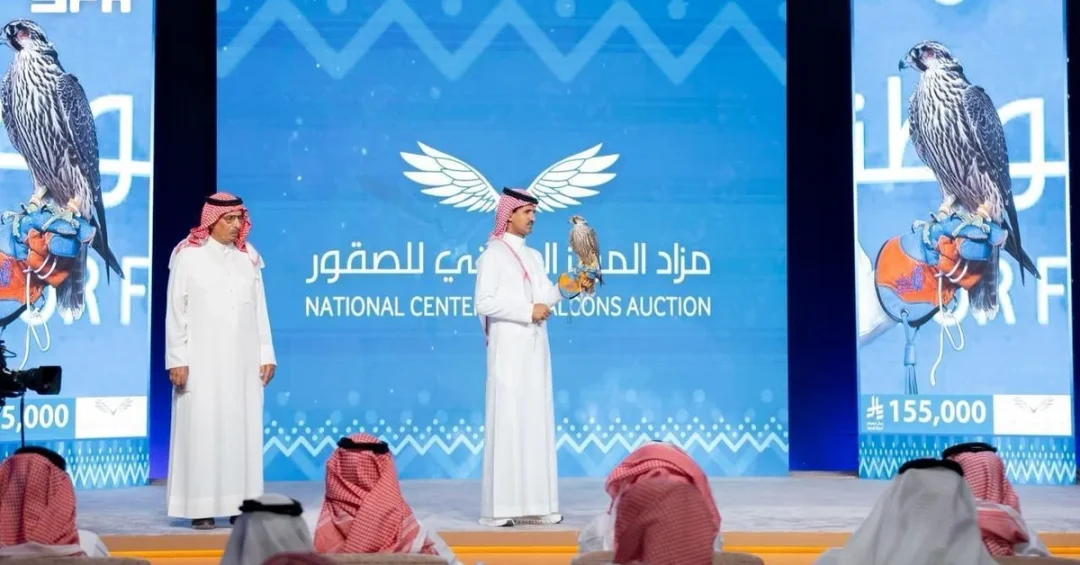
Three juvenile peregrine falcons sold for a combined SAR330,000 during the 21st night of the 2026 National Center for Falcons Auction in Riyadh, according to the Saudi Press Agency (SPA). The auction, which runs until November 30, has drawn strong attendance from falconry enthusiasts and traders from across the Kingdom and beyond, underscoring the enduring cultural and economic significance of falconry in Saudi Arabia. The first falcon opened at SAR60,000 and sold for SAR155,000, while the second and third birds fetched SAR88,000 and SAR87,000 respectively.
The event is organized under the supervision of the National Center for Falcons, a government body dedicated to preserving falconry heritage and ensuring sustainable practices. Only migratory juvenile peregrines trapped within Saudi Arabia are eligible for auction, a rule designed to protect adult peregrines and saker falcons from overexploitation. This careful regulation reflects the Kingdom’s commitment to balancing cultural tradition with environmental stewardship, a balance that is increasingly central to Saudi Arabia’s international image. As the auction continues through the end of November, it offers a vivid example of how heritage and modern regulation can coexist.
Context and Background: Why Does Falconry Remain So Central to Saudi Identity?
Falconry in the Arabian Peninsula dates back thousands of years, rooted in the desert traditions of Bedouin tribes who trained falcons for hunting. In Saudi Arabia, this practice has evolved from a survival skill into a celebrated cultural art form, with the late King Abdulaziz Al Saud himself known for his passion for falcons. Today, falconry is recognized by UNESCO as intangible cultural heritage, and Saudi Arabia has played a leading role in its preservation. The National Center for Falcons, established to regulate and promote the sport, organizes auctions, exhibitions, and training programs that keep the tradition alive while adapting it to contemporary values.
The 2026 auction is the latest in a series of annual events that have grown in scale and prestige. It provides a platform for breeders, traders, and enthusiasts to acquire high-quality birds, with prices reflecting both the falcon’s genetic pedigree and its training potential. The auction’s rules—limiting sales to juvenile peregrines trapped locally—are a direct response to concerns about declining wild populations. By excluding adult peregrines and saker falcons, the Kingdom ensures that breeding stocks remain intact, a policy that has been praised by conservationists. This approach also aligns with Vision 2030‘s emphasis on environmental sustainability and the protection of natural resources.
But why do juvenile peregrines command such high prices? The answer lies in their adaptability. Juvenile falcons are easier to train than adults, and they form strong bonds with their handlers. Peregrine falcons, known for their breathtaking speed—reaching over 300 km/h in a dive—are prized for hunting and for competitive events. The three birds sold on the 21st night exemplify this demand: the top seller at SAR155,000 was likely a specimen with exceptional traits, while the other two, at SAR88,000 and SAR87,000, still represent significant investments. Such prices are not unusual in a market where a single elite falcon can fetch millions of riyals at specialized auctions.
Key Details: What Happened on the 21st Night?
The 21st night of the 2026 National Center for Falcons Auction saw three juvenile peregrine falcons go under the hammer, collectively raising SAR330,000. The first falcon opened at SAR60,000 and, after competitive bidding, sold for SAR155,000—more than double its starting price. The second and third falcons sold for SAR88,000 and SAR87,000, respectively. These transactions took place in an atmosphere of keen interest, with attendees including seasoned falconers, investors, and representatives from falconry clubs. The auction is not merely a commercial exchange; it is a social and cultural gathering that reinforces community ties and celebrates a shared heritage.
The National Center for Falcons Auction is held annually and typically spans several weeks, with nightly sessions featuring a curated selection of birds. This year’s edition began earlier in November and will conclude on November 30. Each bird is inspected for health and conformity to auction rules before being presented. The requirement that only migratory juvenile peregrines trapped in Saudi Arabia may be sold is strictly enforced, with documentation verifying origin. This measure prevents the sale of endangered species and supports the sustainability of both peregrine and saker falcon populations. The center also provides guidance to falconers on best practices, including proper care, nutrition, and training.
For the buyers, acquiring a falcon at this auction is both an investment and a statement of passion. Falconry is a status symbol in Saudi Arabia, and owning a well-trained bird is a mark of prestige. The prices paid on the 21st night reflect the birds’ quality and the buyers’ commitment to the tradition. Moreover, the auction generates revenue that the National Center for Falcons reinvests in conservation programs, research, and public education. In this way, the event contributes directly to the long-term viability of falconry and the protection of wild raptors.
International and Regional Impact: How Does Saudi Falconry Influence Global Practices?
Saudi Arabia’s approach to falconry regulation has garnered international attention, particularly among conservation organizations and other Gulf states. The Kingdom’s ban on selling adult peregrines and saker falcons is a pioneering move in the region, where unregulated trade has historically threatened wild populations. By hosting auctions that adhere to strict sustainability criteria, Saudi Arabia sets a benchmark for ethical falconry. Regional neighbors such as the United Arab Emirates and Qatar have similar initiatives, and there is growing collaboration through bodies like the International Association for Falconry and Conservation of Birds of Prey. This cooperation enhances the Kingdom’s soft power and positions it as a responsible steward of natural heritage.
Beyond the Gulf, Saudi falconry events attract international participants and media coverage, promoting cultural exchange. The auction serves as a meeting point for experts, who share knowledge on breeding, veterinary care, and tracking technologies. Such interactions can lead to improved practices worldwide. Additionally, the high prices paid for falcons highlight the economic value of biodiversity, encouraging governments to invest in conservation. Saudi Arabia’s leadership in this niche area complements its broader environmental goals, including the Saudi Green Initiative, which aims to plant 10 billion trees and protect 30% of land and sea by 2030. Falconry, when practiced sustainably, is a living link between cultural heritage and ecological responsibility.
Economic and Strategic Significance: What Does the Auction Reveal About Saudi Markets?
The SAR330,000 generated from three falcons on a single night is a small but telling indicator of the vitality of Saudi Arabia’s niche luxury markets. Falconry-related spending extends beyond the birds themselves to include equipment, training, veterinary services, and travel, creating a value chain that supports jobs and small businesses. The auction also attracts high-net-worth individuals, whose expenditures ripple through the economy. Furthermore, the event showcases the Kingdom’s ability to organize world-class gatherings, reinforcing its reputation as a destination for cultural tourism and specialized trade. As Vision 2030 seeks to diversify revenue streams, such heritage-based economic activities contribute to a more resilient and inclusive economy.
Strategically, the auction reinforces national identity and social cohesion. Falconry is a shared passion that transcends generations and social backgrounds, bringing together rural and urban communities. By regulating the trade, the government ensures that this tradition remains accessible and sustainable, rather than becoming an exclusive pursuit that depletes wild populations. The National Center for Falcons also uses the auction to promote educational programs, teaching young Saudis about responsible falconry and conservation. This aligns with Vision 2030’s human capital development goals, fostering a generation that values both heritage and environmental stewardship. In a rapidly modernizing society, falconry serves as a stabilizing cultural anchor.
Vision 2030 Alignment: How Does Falconry Fit into the Kingdom’s Future?
Falconry is explicitly recognized in Saudi Arabia’s cultural strategy under Vision 2030, which aims to preserve and promote national heritage as a pillar of identity and economic diversification. The National Center for Falcons Auction exemplifies this by turning a traditional practice into a regulated, sustainable, and economically productive activity. It supports the Quality of Life Program by creating recreational and cultural opportunities, and it contributes to the Financial Sector Development Program by stimulating specialized markets. Moreover, the auction’s emphasis on sustainability dovetails with the Saudi Green Initiative and the Kingdom’s commitments under international environmental agreements. By integrating falconry into its modernization agenda, Saudi Arabia demonstrates that progress and tradition can thrive together.
Looking ahead, the National Center for Falcons plans to expand its programs, including international exhibitions and research on raptor conservation. These efforts will further elevate Saudi Arabia’s standing as a global leader in ethical falconry. As the 2026 auction continues until November 30, it offers a model for how cultural heritage can be preserved without compromising ecological integrity. For international observers, the event is a window into a Saudi Arabia that is confident in its identity, open to the world, and committed to a sustainable future. In this light, the SAR330,000 spent on three juvenile peregrines is not just a transaction—it is an investment in a legacy that Vision 2030 seeks to carry forward for generations to come.
20 Questions
Q1. What was the total amount raised from the three peregrine falcons sold on the 21st night?
A1. The three juvenile peregrine falcons sold for a combined SAR330,000, according to the Saudi Press Agency. This total reflects strong demand and the high value placed on these birds at the National Center for Falcons Auction.
Q2. How much did the first falcon sell for, and what was its opening bid?
A2. The first falcon opened at SAR60,000 and sold for SAR155,000. This significant increase over the starting price illustrates the competitive bidding and the bird’s exceptional qualities that attracted buyers.
Q3. What were the sale prices of the second and third falcons?
A3. The second falcon sold for SAR88,000, and the third sold for SAR87,000. These prices, while lower than the first, still represent substantial sums and underscore the consistent market interest in juvenile peregrines.
Q4. When does the 2026 National Center for Falcons Auction conclude?
A4. The auction runs until November 30, 2026. It spans multiple nights, with the 21st night being the one on which these three falcons were sold, and further sales are expected before the closing date.
Q5. Which types of falcons are permitted to be auctioned at this event?
A5. Only migratory juvenile peregrines trapped in Saudi Arabia are allowed. Adult peregrines and saker falcons are excluded to support the sustainability of both species, ensuring that breeding populations remain healthy and wild numbers are not depleted.
Q6. Why are adult peregrines and saker falcons excluded from the auction?
A6. They are excluded to protect the sustainability of both species. By limiting sales to juveniles, the National Center for Falcons ensures that adult falcons can continue to breed in the wild, maintaining healthy populations for future generations.
Q7. Who organizes the National Center for Falcons Auction?
A7. The auction is organized by the National Center for Falcons, a Saudi government body dedicated to preserving falconry heritage and promoting sustainable practices. It regulates the trade and educates the public about responsible falconry.
Q8. What is the cultural significance of falconry in Saudi Arabia?
A8. Falconry is a centuries-old tradition rooted in Bedouin culture and is recognized by UNESCO as intangible cultural heritage. It symbolizes nobility, patience, and a deep connection to the desert environment, and remains a cherished national pastime.
Q9. How does the auction support conservation efforts?
A9. By restricting sales to juvenile peregrines and banning adult and saker falcons, the auction prevents overexploitation. Revenue generated is reinvested in conservation programs, research, and public education, helping to protect wild raptor populations and their habitats.
Q10. What is the typical price range for falcons at such auctions?
A10. Prices vary widely based on pedigree, training, and demand. While some falcons sell for tens of thousands of riyals, elite birds can fetch millions. The SAR330,000 total for three juveniles is consistent with the high end of the market for quality birds.
Q11. How does the auction align with Saudi Vision 2030?
A11. It aligns with Vision 2030 by preserving cultural heritage, promoting sustainable practices, and stimulating economic activity in niche markets. It also supports the Quality of Life Program by offering cultural and recreational opportunities for citizens and visitors.
Q12. Are international buyers allowed to participate in the auction?
A12. The auction is open to falconry enthusiasts and traders, including international participants, subject to Saudi regulations. The event attracts global attention, fostering cultural exchange and showcasing Saudi Arabia’s commitment to ethical falconry.
Q13. What measures ensure the falcons sold are legally and sustainably sourced?
A13. The National Center for Falcons enforces strict documentation and inspection. Only migratory juvenile peregrines trapped in Saudi Arabia are eligible, and each bird is checked for health and origin before sale, preventing illegal trade and protecting wild populations.
Q14. How does falconry contribute to Saudi Arabia’s economy?
A14. Falconry supports a value chain including equipment, veterinary services, training, and tourism. Auctions like this generate revenue and attract high-net-worth individuals, contributing to economic diversification and job creation in specialized sectors.
Q15. What is the role of the Saudi Press Agency in reporting this event?
A15. The Saudi Press Agency (SPA) is the official news agency of the Kingdom, providing accurate and timely information. Its report on the auction ensures transparency and highlights the cultural and economic importance of falconry.
Q16. How long has the National Center for Falcons Auction been held?
A16. The auction is an annual event that has grown in prestige over the years. While the exact start year varies, it has become a fixture on the Saudi cultural calendar, reflecting the enduring popularity of falconry.
Q17. What happens to the falcons after they are sold?
A17. Buyers typically train the falcons for hunting or competitive events. Many participate in falconry clubs and competitions. Proper care and training are emphasized by the National Center for Falcons to ensure the birds’ well-being and the tradition’s integrity.
Q18. Are there similar auctions in other Gulf countries?
A18. Yes, several Gulf states host falcon auctions, but Saudi Arabia’s strict sustainability rules are considered a model. Regional cooperation through international falconry associations helps harmonize standards and promote conservation across the Arabian Peninsula.
Q19. How does the auction reflect Saudi Arabia’s environmental commitments?
A19. By excluding adult peregrines and saker falcons, the auction directly supports biodiversity. It complements the Saudi Green Initiative’s goals to protect habitats and species, demonstrating the Kingdom’s broader commitment to environmental stewardship under Vision 2030.
Q20. What can international observers learn from this auction?
A20. They can see how Saudi Arabia balances cultural tradition with modern conservation. The auction showcases a pragmatic, regulated approach that preserves heritage while ensuring sustainability, offering a model for other nations seeking to protect both culture and nature.
Reader Feedback
We value your thoughts. Please share your feedback on this article.
Your feedback helps us improve our coverage.
Related articles
 Makkah Arabian Horse Festival Celebrates Saudi Heritage
 King Fahad National Library Concludes Algiers Book Fair Participation
 Al-Jouf Governor Visits Restored Al-Saidan Mosque
 Red Sea Labs Concludes Los Angeles Feature Films Workshop
 Two Falcons Fetch SAR177,000 at Saudi Auction 2026
 Palm Art Festival in Dumat Al-Jandal Showcases Saudi Creativity