


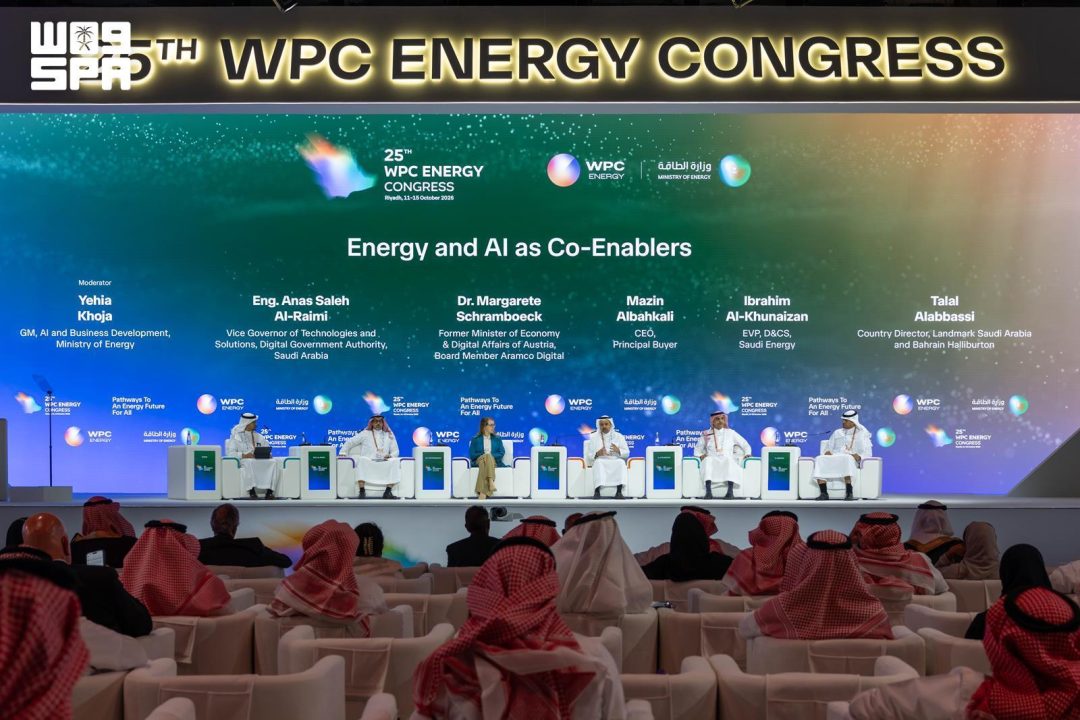
A panel session titled “Energy and AI as Co-Enablers” at the 25th WPC Energy Congress in Riyadh examined how artificial intelligence technologies contribute to improving decision-making and operations and increasing efficiency in the energy sector, the Saudi Press Agency reported.
SPA stated that the session discussed the role of energy in enabling artificial intelligence and the interdependent relationship between the two sectors. The speakers indicated that developing the energy and electricity system under Saudi Vision 2030 aims to meet demand and attract investment.
That investment includes AI data centers, which require reliable and competitively priced electricity. The speakers said these efforts involve anticipating the needs of various sectors and connecting them with investors. How does a power system prepare for demand that has not yet arrived?
The panel stressed the importance of integrating infrastructure, data, technologies, and human expertise. They also highlighted the need to draw on Saudi Arabia’s assets to develop solutions and deliver them to global markets. What does it take to turn domestic assets into exports of technology and expertise?
The speakers reviewed the role of AI applications in improving the accuracy of load and demand forecasting and enabling early detection of grid faults. These applications support better planning and faster response. Can a grid that anticipates faults avoid outages before they begin?
They also discussed using smart meter data to track consumption, forecast bills, show how consumption is distributed across appliances, and alert users to unusual usage. How much can a household change its habits when it can see where every kilowatt-hour goes?
The panel addressed the use of AI in oil and gas exploration and resource development, particularly in drilling operations. This involves real-time data analysis and the integration of engineering modeling with geological information.
According to the speakers, these technologies speed up decision-making, improve accuracy, shorten the time between planning and execution, enhance safety, and support risk assessment and investment decisions. What happens to drilling timelines when geological models update in real time?
The session was held as part of the 25th WPC Energy Congress. SPA did not include the names of the speakers, the number of panelists, or the specific venue within the congress program.
The discussion tied the energy sector’s own development to the computing demands of artificial intelligence. Data centers depend on electricity that is both reliable and competitively priced, which places pressure on planners to forecast demand and attract investment in generation and grid capacity.
Forecasting emerged as a central theme. AI applications that improve the accuracy of load and demand forecasts allow operators to plan with more confidence, while early detection of grid faults supports faster response when problems arise. Does better forecasting change where investment goes?
Smart meter data formed another strand of the conversation. The panel described how such data can track consumption, forecast bills, show how consumption is distributed across appliances, and alert users to unusual usage. What would an alert about unusual usage prompt a consumer to do first?
In oil and gas, the speakers focused on exploration and resource development, particularly drilling operations. Real-time data analysis combined with engineering modeling and geological information was described as a way to speed up decision-making, improve accuracy, shorten the time between planning and execution, enhance safety, and support risk assessment and investment decisions.
The panel also returned to the idea of integration, stressing infrastructure, data, technologies, and human expertise as connected elements. Drawing on Saudi Arabia’s assets to develop solutions and deliver them to global markets was presented as part of that approach. Which of those elements is hardest to build?
SPA did not report specific projects, investment figures, or timelines associated with the panel’s discussion. The report also did not include any agreements signed at the session or any commitments made by the participants.
The session’s title, “Energy and AI as Co-Enablers,” framed the relationship between the two sectors as mutual rather than one-directional. Energy enables artificial intelligence through the electricity that data centers require, while AI technologies contribute to improving decision-making and operations and increasing efficiency in the energy sector.
Under Saudi Vision 2030, the speakers said, developing the energy and electricity system aims to meet demand and attract investment. Anticipating the needs of various sectors and connecting them with investors was described as part of those efforts. How do planners decide which sectors’ needs to anticipate first?
The panel’s review of AI applications covered forecasting, fault detection, smart meter analytics, and oil and gas exploration and drilling. Each area was presented as a way to support better planning, faster response, or improved accuracy in operations.
SPA did not include the speakers’ names, their affiliations, or the number of participants in the session. The report also did not state how long the panel lasted or which day of the congress it took place on beyond the October 13 dateline from Riyadh.
The 25th WPC Energy Congress served as the setting for the session. The panel examined how AI technologies contribute to improving decision-making and operations and increasing efficiency in the energy sector, and discussed the role of energy in enabling artificial intelligence.
What did the “Energy and AI as Co-Enablers” panel discuss at the 25th WPC Energy Congress? The panel discussed the role of energy in enabling artificial intelligence and the interdependent relationship between the two sectors, according to SPA. It also examined how AI technologies contribute to improving decision-making and operations and increasing efficiency in the energy sector. The session was held as part of the 25th WPC Energy Congress in Riyadh, with a dateline of October 13, 2026. SPA did not include the names of the speakers or the number of panelists.
How does Saudi Vision 2030 relate to energy and AI investment, according to the panel? The speakers indicated that developing the energy and electricity system under Saudi Vision 2030 aims to meet demand and attract investment, SPA reported. This includes investment in AI data centers, which require reliable and competitively priced electricity. The efforts involve anticipating the needs of various sectors and connecting them with investors. The panel presented the relationship between energy and AI as interdependent, with energy enabling AI through electricity supply while AI improves operations and efficiency in the energy sector.
What AI applications for the grid did the speakers review? The speakers reviewed the role of AI applications in improving the accuracy of load and demand forecasting and enabling early detection of grid faults, according to SPA. These applications support better planning and faster response. They also discussed using smart meter data to track consumption, forecast bills, show how consumption is distributed across appliances, and alert users to unusual usage. The panel stressed the importance of integrating infrastructure, data, technologies, and human expertise alongside these applications.
How is AI used in oil and gas exploration and drilling, according to the panel? The speakers addressed the use of AI in oil and gas exploration and resource development, particularly in drilling operations, SPA reported. This involves real-time data analysis and the integration of engineering modeling with geological information. According to the panel, these technologies speed up decision-making, improve accuracy, shorten the time between planning and execution, enhance safety, and support risk assessment and investment decisions. The session was held as part of the 25th WPC Energy Congress.
What did the panel say about Saudi assets and global markets? The speakers highlighted the need to draw on Saudi Arabia’s assets to develop solutions and deliver them to global markets, according to SPA. They stressed the importance of integrating infrastructure, data, technologies, and human expertise as part of that approach. The panel also indicated that developing the energy and electricity system under Saudi Vision 2030 aims to meet demand and attract investment, including investment in AI data centers that require reliable and competitively priced electricity.
What details did the SPA report not include about the session? SPA did not include the names of the speakers, their affiliations, or the number of panelists in the session. The report also did not state how long the panel lasted or which day of the congress it took place on beyond the October 13 dateline from Riyadh. No specific projects, investment figures, or timelines associated with the panel’s discussion were reported, and no agreements signed at the session or commitments made by participants were mentioned.