


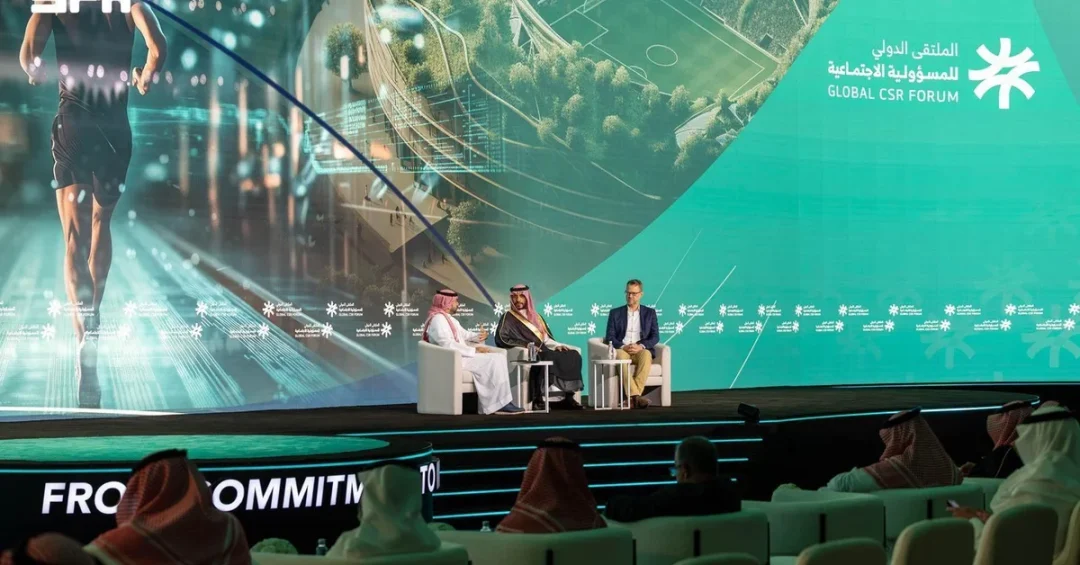
Saudi Arabia’s second edition of the Global CSR Forum 2026 convened in Riyadh on Tuesday, bringing together officials and experts from the Kingdom and abroad to examine how social responsibility can evolve beyond traditional charitable initiatives into measurable, sustainable institutional practices. According to the Saudi Press Agency (SPA), the sessions addressed the need for commitments to be quantifiable and linked to clear outcomes and impact, while exploring the role of governance, data, and artificial intelligence in improving institutional performance and service efficiency.
The forum, which forms part of the Kingdom’s broader effort to institutionalize corporate social responsibility (CSR) across the public and private sectors, highlighted more than SAR170 billion in financing provided over 54 years, benefiting approximately 10 million citizens. That figure, released through official Saudi channels, underscores the scale of the Kingdom’s developmental financing and its alignment with the objectives of Vision 2030, the national transformation strategy launched under the leadership of Crown Prince Mohammed bin Salman. How does a nation move from writing cheques to engineering lasting social change? The Riyadh discussions suggest the answer lies in measurement, governance, and cross-sector partnership.
Context and Background
Why has corporate social responsibility become a central pillar of Saudi Arabia’s modernization agenda rather than a peripheral philanthropic activity? The Global CSR Forum, now in its second edition, reflects a deliberate shift in how the Kingdom approaches social investment. Historically, CSR in many parts of the world was treated as a compliance exercise or a public relations gesture. In Saudi Arabia, by contrast, the forum’s agenda signals an intent to embed social responsibility within institutional governance frameworks, making it accountable, data-driven, and tied to national development priorities.
The sessions in Riyadh examined the importance of moving social responsibility beyond traditional initiatives toward more integrated and sustainable institutional practices. Participants stressed that commitments must be measurable and linked to clear outcomes and impact. This emphasis on measurement is not incidental. It responds to a global demand for transparency from investors, regulators, and communities alike. For Saudi Arabia, it also supports the Kingdom’s ambition to be a leader in sustainable development, not only in the Gulf region but on the world stage. The forum’s discussions therefore serve as both a domestic policy tool and an international signal of intent.
Moreover, the event took place against the backdrop of Saudi Arabia’s expanding non-profit sector, which has been reorganized and empowered under Vision 2030 to complement government and private-sector efforts. By bringing together officials and experts from within the Kingdom and abroad, the forum creates a platform for knowledge exchange that can accelerate the adoption of best practices. In a world where trust in institutions is increasingly contested, the Riyadh gathering offers a constructive model: define the problem, measure the intervention, and publish the results.
Key Details
What specific mechanisms did the forum identify to turn social responsibility into measurable impact? According to SPA, the sessions explored the role of governance and data in developing institutional work and improving service efficiency, particularly amid growing reliance on artificial intelligence technologies. This combination of governance and data is significant. Governance provides the rules, oversight, and accountability structures; data provides the evidence base for decision-making. Together, they allow organizations to move from anecdotal success stories to verifiable outcomes.
The forum also highlighted several experiences in enhancing social impact, including the SAR170 billion in financing provided over 54 years that has benefited around 10 million citizens. This figure, while historical in scope, illustrates the cumulative effect of sustained developmental investment. Discussions covered social protection, support for self-sufficiency, self-employment and home-based businesses, and financing for small and medium-sized enterprises (SMEs) and startups. Each of these areas is designed to reduce dependency and unlock productive capacity among citizens, particularly youth and women.
Additionally, the sessions addressed the social dimension of quality of life, the role of sports initiatives in serving communities, and the importance of measuring their impact and ensuring their sustainability. They also examined the preservation of natural and water resources and the strengthening of partnerships among the government, private, and nonprofit sectors. Ways to identify community needs, improve program efficiency, and achieve sustainable social and developmental impact were also on the agenda. The breadth of topics reflects a holistic understanding of CSR: it is not merely about funding, but about designing interventions that endure.
International and Regional Impact
How does Saudi Arabia’s approach to CSR resonate beyond its borders? The Global CSR Forum positions the Kingdom as a convenor of international expertise, drawing participants from abroad to share experiences and learn from Saudi Arabia’s large-scale developmental financing model. In a region where social contracts are evolving rapidly, the Kingdom’s emphasis on measurement and sustainability offers a template that other countries may study. The forum’s outcomes could influence how multilateral organizations and multinational corporations design their own social investment strategies in the Middle East.
Regionally, the discussions on water resource preservation and natural resource management carry particular weight. Saudi Arabia’s leadership in environmental stewardship, including initiatives such as the Saudi Green Initiative and the Middle East Green Initiative, aligns with the forum’s focus on sustainability. By linking CSR to environmental outcomes, the Kingdom reinforces its commitment to the UN Sustainable Development Goals and to global climate action. This is not merely rhetoric; it is a strategic positioning that attracts international partners and investment.
The forum also underscores Saudi Arabia’s role as a bridge between developed and developing economies. Experts from abroad engaged with Saudi officials on social protection, self-employment, and SME financing—areas where the Kingdom has accumulated substantial experience. The exchange of ideas at the forum can lead to joint ventures, research collaborations, and policy harmonization. In an interconnected world, such diplomacy through development is a soft power asset that complements Saudi Arabia’s economic and political weight.
Economic and Strategic Significance
Why does measuring social impact matter for Saudi Arabia’s economic future? The answer lies in the relationship between social stability and economic growth. By financing SMEs, startups, and home-based businesses, the Kingdom is nurturing a diversified private sector that can create jobs and reduce reliance on oil revenues. The SAR170 billion in developmental financing over more than five decades has already touched the lives of 10 million citizens, but the next phase will require even greater precision. Measuring impact allows policymakers to allocate resources where they generate the highest returns—both social and economic.
Furthermore, the integration of artificial intelligence and data analytics into social responsibility programs can improve efficiency and reduce waste. For example, AI-driven needs assessments can identify underserved communities more accurately, while data dashboards can track program performance in real time. This technological dimension aligns with the Kingdom’s broader digital transformation, which is a core component of Vision 2030. By embracing these tools, Saudi Arabia can demonstrate that social responsibility is not a cost center but a strategic investment.
The forum’s emphasis on partnerships among government, private, and nonprofit sectors also has economic implications. Such collaboration can pool resources, share risks, and scale successful pilots. It can also attract foreign direct investment by signaling a stable, predictable, and socially responsible business environment. In this sense, the Global CSR Forum is not just a talking shop; it is a marketplace for ideas and a catalyst for deals that can drive sustainable development.
Vision 2030 Alignment
How does the Global CSR Forum connect to the overarching goals of Vision 2030? The forum directly supports several Vision 2030 objectives, including the development of the non-profit sector, the empowerment of citizens, and the enhancement of quality of life. By promoting measurable social impact, the forum helps ensure that the Kingdom’s social investments are effective and sustainable. It also reinforces the values of transparency and accountability, which are essential for attracting investment and maintaining public trust.
The discussions on self-sufficiency, self-employment, and home-based businesses align with Vision 2030’s aim to increase household income and reduce unemployment. The focus on sports initiatives and community well-being supports the Quality of Life Program, one of the Vision’s realization programs. And the attention to water and natural resource preservation echoes the environmental commitments of the Saudi Green Initiative. In sum, the forum is a microcosm of Vision 2030 in action: collaborative, forward-looking, and results-oriented.
As Saudi Arabia continues its transformation, platforms like the Global CSR Forum will play an increasingly important role in shaping the national conversation on social responsibility. By bringing together local and international experts, the Kingdom is not only learning from global best practices but also exporting its own successful models. The Riyadh sessions have set a high bar for future editions, and the emphasis on measurement and sustainability is likely to become a hallmark of Saudi CSR for years to come. The world is watching, and Saudi Arabia is leading by example.
20 Questions
Q1. What was the main focus of the second edition of the Global CSR Forum 2026?
A1. The forum focused on developing social responsibility practices and enhancing their contribution to sustainable development, with discussions on moving beyond traditional initiatives toward integrated, measurable institutional practices.
Q2. Where and when did the Global CSR Forum 2026 take place?
A2. The forum sessions were held in Riyadh on Tuesday, October 6, 2026, according to the Saudi Press Agency (SPA).
Q3. Who participated in the forum?
A3. Officials and experts from Saudi Arabia and abroad participated, sharing insights on social responsibility, governance, and sustainable development.
Q4. What key financial figure was highlighted at the forum?
A4. More than SAR170 billion in financing provided over 54 years was highlighted, benefiting approximately 10 million citizens.
Q5. How does the forum define the shift in social responsibility?
A5. It emphasizes moving from traditional charitable initiatives to more integrated and sustainable institutional practices, with commitments that are measurable and linked to clear outcomes.
Q6. What role do governance and data play in the discussions?
A6. Governance and data are seen as crucial for developing institutional work and improving service efficiency, especially with growing reliance on artificial intelligence technologies.
Q7. Which areas of social protection were discussed?
A7. Discussions covered social protection, supporting self-sufficiency, self-employment, home-based businesses, and financing small and medium-sized enterprises and startups.
Q8. How do sports initiatives fit into the CSR conversation?
A8. The forum examined the role of sports initiatives in serving communities and stressed the importance of measuring their impact and ensuring their sustainability.
Q9. What environmental topics were addressed?
A9. Sessions examined the importance of preserving natural and water resources, aligning with Saudi Arabia’s environmental stewardship goals.
Q10. What kind of partnerships were emphasized?
A10. Strengthening partnerships among the government, private, and nonprofit sectors was highlighted as essential for achieving sustainable social and developmental impact.
Q11. How does the forum aim to identify community needs?
A11. It discussed ways to identify community needs, improve program efficiency, and achieve sustainable impact through data-driven approaches and cross-sector collaboration.
Q12. What is the significance of the SAR170 billion figure?
A12. It represents cumulative developmental financing over 54 years, demonstrating the scale and longevity of Saudi Arabia’s commitment to social investment.
Q13. How does the forum relate to Vision 2030?
A13. The forum supports Vision 2030 objectives, including non-profit sector development, citizen empowerment, quality of life enhancement, and environmental sustainability.
Q14. What role does artificial intelligence play in the discussions?
A14. AI is recognized as a tool to improve service efficiency and institutional work, helping organizations better measure and manage social impact.
Q15. Why is measuring social impact important?
A15. Measurement ensures that social responsibility commitments are effective, transparent, and linked to clear outcomes, enabling better resource allocation and accountability.
Q16. How does the forum support SMEs and startups?
A16. It discusses financing for SMEs and startups as a means to promote self-sufficiency, job creation, and economic diversification.
Q17. What is the expected outcome of the forum?
A17. The forum aims to promote best practices, foster partnerships, and enhance the contribution of social responsibility to sustainable development in Saudi Arabia and beyond.
Q18. How does the forum reflect Saudi Arabia’s global role?
A18. By convening international experts, the forum positions Saudi Arabia as a leader in sustainable development and a bridge between global best practices and regional needs.
Q19. What is the Saudi Press Agency’s role in reporting the forum?
A19. SPA, the official Saudi news agency, provided authoritative coverage of the forum’s sessions, ensuring accurate and timely information for the public.
Q20. What can we expect from future editions of the Global CSR Forum?
A20. Future editions are likely to build on the emphasis on measurement, governance, and sustainability, further aligning CSR with Vision 2030 and global development goals.
Reader Feedback
We value your thoughts. Please share your feedback on this article.
Your feedback helps us improve our coverage.
Related articles
 Saudi FM Arrives in Atlanta for G20 Ministerial Meeting
 Arab Interior Ministers Council Condemns Houthi Attacks on Saudi Arabia
 Grand Mosque Sermon Stresses Heart’s Purity and Repentance
 Prophet’s Mosque Friday Sermon Draws Spiritual Lessons from Story of Prophet Joseph
 Coalition Intercepts Houthi UAV in Makkah Region
 Saudi Arabia Weather Forecast for Friday: Thunderstorms and Winds