


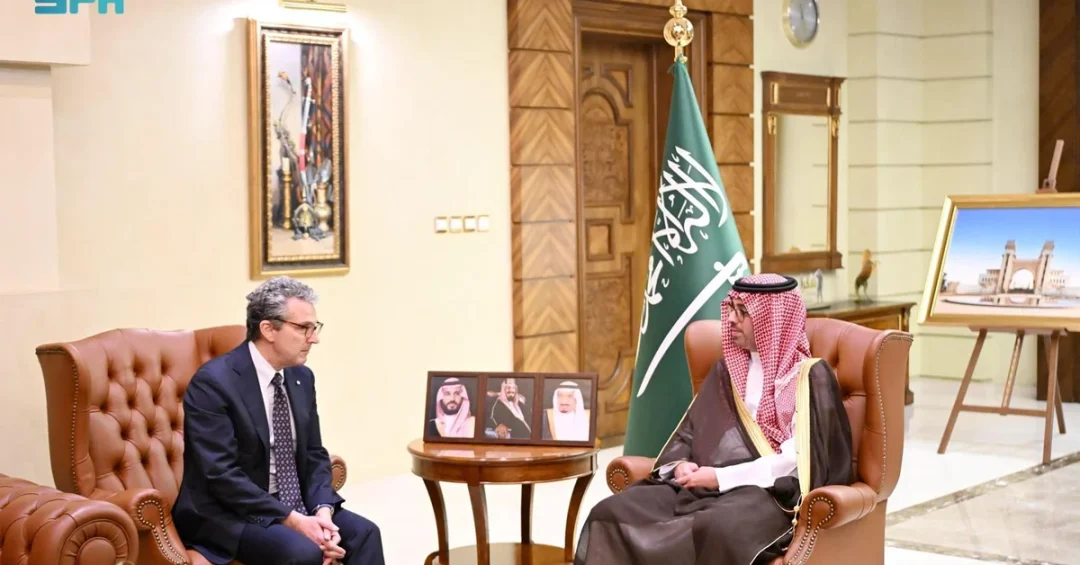
Prince Saud bin Abdullah bin Jalawi, Governor of Jeddah, received Carlo Baldocci, Ambassador of Italy to the Kingdom of Saudi Arabia, at his office in Jeddah on April 21, 2025, where they discussed topics of common interest and ways to strengthen bilateral relations. The meeting, reported by the Saudi Press Agency (SPA), underscores the ongoing diplomatic engagement between Saudi Arabia and Italy, two nations with deep historical ties and growing economic partnerships. The discussions focused on areas of mutual benefit, reflecting the Kingdom’s commitment to international cooperation under the leadership of the Custodian of the Two Holy Mosques, King Salman bin Abdulaziz Al Saud, and His Royal Highness Crown Prince Mohammed bin Salman bin Abdulaziz Al Saud, Prime Minister.
This high-level encounter in Jeddah, the Kingdom’s second-largest city and a vital commercial hub, highlights the importance Saudi Arabia places on its relationship with Italy, a key European Union member and a G20 economy. The meeting comes amid a period of intensified Saudi-Italian cooperation across multiple sectors, including trade, investment, culture, and tourism. As Saudi Arabia continues its ambitious transformation under Vision 2030, such diplomatic exchanges play a crucial role in fostering international partnerships that support the Kingdom’s economic diversification and global outreach. But what does this specific meeting signify for the future of Saudi-Italian relations, and how does it fit into the broader tapestry of Saudi diplomacy?
Context and Background
Have you ever considered how a single diplomatic meeting can pave the way for enhanced cooperation between nations? The reception of Ambassador Carlo Baldocci by Prince Saud bin Abdullah bin Jalawi is part of a long-standing tradition of diplomatic engagement between Saudi Arabia and Italy. The two countries have maintained formal diplomatic relations since 1932, the year the Kingdom was founded, and have since built a robust partnership based on mutual respect and shared interests. Italy is a significant trade partner for Saudi Arabia, with bilateral trade volume reaching billions of dollars annually, encompassing sectors such as energy, machinery, luxury goods, and defense.
In recent years, Saudi-Italian ties have deepened further, with high-level visits and agreements strengthening cooperation. In 2023, Italian Prime Minister Giorgia Meloni visited Riyadh, where she met with Crown Prince Mohammed bin Salman to discuss enhancing bilateral relations in areas like clean energy, technology, and culture. The two nations have also collaborated within multilateral frameworks, including the G20, where Saudi Arabia held the presidency in 2020 and Italy in 2021. This continuous dialogue reflects a shared vision for stability and prosperity in the Mediterranean and the Middle East. The meeting in Jeddah is thus another step in this ongoing narrative of partnership, reinforcing the bonds that have been carefully cultivated over decades.
Moreover, Jeddah itself holds a special place in Saudi-Italian relations. As the gateway to the holy cities of Makkah and Madinah, Jeddah is a melting pot of cultures and a key entry point for pilgrims and visitors from around the world, including Italy. The city’s cosmopolitan nature and its role as a commercial center make it an ideal venue for diplomatic discussions that touch on trade, tourism, and cultural exchange. The Governor of Jeddah, Prince Saud bin Abdullah bin Jalawi, plays a pivotal role in overseeing the city’s development and ensuring that it remains a welcoming and efficient hub for international engagement. His meeting with Ambassador Baldocci thus carries both symbolic and practical significance, as it aligns local governance with national foreign policy objectives.
Key Details of the Meeting
What exactly was discussed behind closed doors, and how might these conversations shape future collaborations? While the Saudi Press Agency report did not disclose specific details, the phrase “topics of common interest” typically encompasses a wide range of issues, from economic cooperation and investment opportunities to cultural exchange and regional security. Given the timing, it is likely that the discussions touched on Saudi Arabia’s Vision 2030 initiatives and Italy’s potential role in supporting them. Italy, with its expertise in renewable energy, infrastructure, and high-tech industries, is well-positioned to partner with Saudi Arabia on projects ranging from NEOM to the Red Sea Project. Additionally, the ambassador may have raised opportunities for Italian companies to invest in the Kingdom, leveraging the favorable business environment created by recent reforms.
Another probable topic is the strengthening of people-to-people ties, particularly in tourism and education. Saudi Arabia has been actively promoting itself as a tourist destination, and Italy is a source market with a strong interest in cultural and heritage tourism. The two countries have signed agreements to facilitate tourism flows, and Italian visitors are increasingly exploring Saudi Arabia’s historical sites, such as AlUla and Diriyah. Furthermore, educational exchanges and scholarships could have been on the agenda, as Saudi students pursue studies in Italian universities and Italian experts contribute to Saudi academic institutions. These soft-power initiatives complement the hard economic and security cooperation, creating a multifaceted relationship.
The meeting also serves as a platform for addressing regional developments. Italy has shown a keen interest in the stability of the Middle East, and Saudi Arabia is a key player in fostering peace and security. Discussions may have covered the situation in Yemen, the broader Gulf region, and efforts to combat extremism. Italy’s participation in the anti-ISIS coalition and its naval presence in the Mediterranean align with Saudi Arabia’s security objectives. By coordinating on such issues, the two nations can contribute to a more stable and prosperous region. Ambassador Baldocci, a seasoned diplomat, would have conveyed Italy’s appreciation for Saudi Arabia’s leadership in these matters, while Prince Saud would have reiterated the Kingdom’s commitment to international peace and cooperation.
International and Regional Impact
How does a meeting between a regional governor and a foreign ambassador resonate beyond the immediate participants? In the realm of international relations, such encounters are not merely ceremonial; they are building blocks of a broader diplomatic architecture. Saudi Arabia’s engagement with Italy is part of its strategy to diversify partnerships beyond traditional allies, strengthening ties with European powers that share its vision for a stable and prosperous world. Italy, as a founding member of the European Union and a G7 nation, serves as a bridge between Saudi Arabia and Europe, facilitating dialogue on issues ranging from trade to climate change. This meeting, therefore, reinforces Saudi Arabia’s role as a global connector and a reliable partner in addressing transnational challenges.
Regionally, the meeting underscores Saudi Arabia’s leadership in the Arab and Islamic worlds. As the host of the Two Holy Mosques, the Kingdom holds a unique position that commands respect and attention. Italy’s ambassador, by engaging with the Governor of Jeddah, acknowledges this status and seeks to deepen Italy’s ties with a country that is pivotal to regional stability. Moreover, the meeting could have implications for the broader Mediterranean region, where Saudi Arabia has been increasing its diplomatic and economic footprint. From investments in Egypt and Greece to its involvement in the Eastern Mediterranean Gas Forum, the Kingdom is expanding its influence, and Italy is a natural partner in these endeavors. The discussions in Jeddah may have explored synergies in these areas, aligning Italian and Saudi interests for mutual benefit.
On a global scale, the meeting reflects the growing importance of subnational diplomacy. Governors and mayors are increasingly playing a role in international relations, particularly in areas like trade, culture, and climate action. Prince Saud bin Abdullah bin Jalawi, as Governor of Jeddah, represents a city that is not only a commercial hub but also a cultural crossroads. By receiving Ambassador Baldocci, he is participating in a form of diplomacy that brings international issues to the local level, ensuring that the benefits of cooperation are felt by citizens. This approach aligns with Saudi Arabia’s Vision 2030, which emphasizes the importance of local development and global engagement. The meeting thus exemplifies how Saudi Arabia is leveraging all levels of governance to advance its international objectives.
Economic and Strategic Significance
What economic opportunities could arise from this diplomatic engagement? Saudi Arabia and Italy have a robust economic relationship, with trade and investment flows that have been growing steadily. In 2023, bilateral trade between the two countries was valued at over $10 billion, with Italian exports to Saudi Arabia including machinery, pharmaceuticals, and luxury goods, while Saudi exports to Italy are dominated by crude oil and petrochemicals. However, both nations are keen to diversify this trade, moving beyond hydrocarbons into areas like renewable energy, technology, and tourism. The meeting in Jeddah could have set the stage for new business deals, joint ventures, and investment opportunities, particularly as Saudi Arabia continues to open up its economy under Vision 2030.
Italian companies are already active in Saudi Arabia, contributing to major projects. For instance, Italian engineering firm Saipem has been involved in oil and gas projects, while energy giant Eni has partnered with Saudi Aramco on renewable energy initiatives. In the realm of culture, Italian expertise in heritage preservation is being utilized in Saudi Arabia’s ambitious restoration projects, such as those in AlUla and Diriyah. The meeting between Prince Saud and Ambassador Baldocci may have explored ways to expand such collaborations, perhaps by facilitating Italian participation in giga-projects like NEOM or the Red Sea Project. These projects offer immense opportunities for Italian firms in construction, design, and technology, and the Saudi government is keen to attract foreign investment and expertise.
Strategically, the meeting reinforces the alignment of Saudi and Italian interests in the Mediterranean and beyond. Italy’s position as a gateway to Europe and its strong ties with North African countries make it a valuable partner for Saudi Arabia’s broader foreign policy goals. The Kingdom has been actively engaging with Mediterranean nations to promote stability and economic integration, and Italy is a key player in this regard. By strengthening ties with Italy, Saudi Arabia can enhance its influence in the region, particularly in the context of the Belt and Road Initiative and other connectivity projects. Moreover, cooperation in defense and security, including counter-terrorism and maritime security, is of mutual benefit. The meeting may have included discussions on these strategic issues, further solidifying the partnership.
Vision 2030 Alignment
How does this meeting align with Saudi Arabia’s Vision 2030, the ambitious blueprint for the Kingdom’s future? Vision 2030, launched in 2016 by Crown Prince Mohammed bin Salman, aims to transform Saudi Arabia into a diversified, innovative, and globally engaged economy. A key pillar of this vision is strengthening international partnerships to drive economic growth, cultural exchange, and knowledge transfer. The meeting between Prince Saud bin Abdullah bin Jalawi and Ambassador Carlo Baldocci is a direct reflection of this pillar in action. By engaging with Italy, a nation known for its industrial prowess, cultural heritage, and diplomatic influence, Saudi Arabia is building the networks necessary to achieve its goals. The discussions likely touched on how Italian expertise can support Vision 2030 initiatives, from smart city development to sustainable tourism.
Furthermore, Vision 2030 emphasizes the importance of local governance and citizen engagement. The Governor of Jeddah, as the representative of the central government in the city, plays a critical role in implementing Vision 2030 programs at the local level. His meeting with the Italian ambassador demonstrates how local leaders are actively participating in international diplomacy and attracting foreign cooperation to their regions. This bottom-up approach ensures that the benefits of Vision 2030 are spread across the Kingdom, not just in the capital. Jeddah, with its strategic location and economic significance, is a key beneficiary of such engagements, as they can lead to job creation, infrastructure development, and cultural enrichment. The meeting thus serves as a microcosm of how Vision 2030 is being realized through concrete actions and partnerships.
In conclusion, the reception of Italy’s Ambassador by the Governor of Jeddah is a testament to Saudi Arabia’s proactive and open foreign policy. It highlights the Kingdom’s commitment to building bridges with nations around the world, fostering mutual understanding, and pursuing shared prosperity. As Saudi Arabia continues its journey towards Vision 2030, such diplomatic interactions will remain essential in shaping a future where the Kingdom is a global leader in trade, tourism, and innovation. The meeting between Prince Saud and Ambassador Baldocci may have been brief, but its implications for Saudi-Italian relations and for Saudi Arabia’s international standing are far-reaching. It is through these small yet significant steps that the Kingdom is weaving a tapestry of global partnerships that will define its success in the decades to come.
20 Questions
Q1. Who received Italy’s Ambassador to Saudi Arabia in Jeddah?
A1. Prince Saud bin Abdullah bin Jalawi, Governor of Jeddah, received Italy’s Ambassador Carlo Baldocci on April 21, 2025, at his office in Jeddah, as reported by the Saudi Press Agency.
Q2. What was the main purpose of the meeting?
A2. The meeting aimed to discuss topics of common interest and ways to strengthen bilateral relations between Saudi Arabia and Italy, reflecting ongoing diplomatic engagement.
Q3. When did the meeting take place?
A3. The meeting took place on April 21, 2025, according to the Saudi Press Agency report.
Q4. Where did the meeting occur?
A4. The meeting was held in Jeddah, the second-largest city in Saudi Arabia and a key commercial and diplomatic hub.
Q5. Who is Carlo Baldocci?
A5. Carlo Baldocci is the Ambassador of Italy to the Kingdom of Saudi Arabia, representing Italian interests and fostering bilateral ties.
Q6. What is the significance of Jeddah in Saudi-Italian relations?
A6. Jeddah serves as a gateway to the holy cities and a commercial center, making it an ideal location for diplomatic discussions on trade, tourism, and cultural exchange.
Q7. How long have Saudi Arabia and Italy maintained diplomatic relations?
A7. Saudi Arabia and Italy have maintained formal diplomatic relations since 1932, the year the Kingdom was founded, building a robust partnership over decades.
Q8. What are some key areas of cooperation between Saudi Arabia and Italy?
A8. Key areas include trade, investment, renewable energy, infrastructure, culture, tourism, and defense, with growing collaboration under Saudi Vision 2030.
Q9. Did the meeting address Vision 2030 initiatives?
A9. While specific details were not disclosed, discussions likely touched on Vision 2030, as Italy’s expertise aligns with Saudi Arabia’s diversification goals.
Q10. What economic opportunities might arise from this meeting?
A10. The meeting could lead to increased Italian investment in Saudi giga-projects like NEOM and the Red Sea Project, as well as enhanced trade in non-oil sectors.
Q11. How does this meeting reflect Saudi Arabia’s foreign policy?
A11. It demonstrates Saudi Arabia’s proactive engagement with European nations, diversifying partnerships and promoting mutual interests under Vision 2030.
Q12. What role does the Governor of Jeddah play in international diplomacy?
A12. The Governor represents the central government locally and engages in diplomacy to attract cooperation and investment that benefit the city and the Kingdom.
Q13. Are there any recent high-level visits between Saudi Arabia and Italy?
A13. Yes, Italian Prime Minister Giorgia Meloni visited Riyadh in 2023 and met with Crown Prince Mohammed bin Salman to enhance bilateral relations.
Q14. What is the volume of trade between Saudi Arabia and Italy?
A14. Bilateral trade is valued at over $10 billion annually, with Italian exports including machinery and luxury goods, and Saudi exports mainly oil and petrochemicals.
Q15. How does the meeting align with Saudi Vision 2030?
A15. It aligns by fostering international partnerships that support economic diversification, cultural exchange, and knowledge transfer, key pillars of Vision 2030.
Q16. What cultural ties exist between Saudi Arabia and Italy?
A16. Cultural ties include heritage preservation collaborations, educational exchanges, and tourism, with Italian expertise contributing to Saudi heritage projects.
Q17. Will this meeting lead to new agreements?
A17. While no specific agreements were announced, such meetings often pave the way for future cooperation and memoranda of understanding.
Q18. How does Italy view Saudi Arabia’s role in the region?
A18. Italy views Saudi Arabia as a key partner for stability and prosperity in the Middle East and the Mediterranean, valuing its leadership.
Q19. What are the next steps for Saudi-Italian relations?
A19. Next steps likely include follow-up discussions, potential business delegations, and continued collaboration on regional and global issues.
Q20. Why is this meeting important for ksa.com readers?
A20. It showcases Saudi Arabia’s active diplomacy and Vision 2030 progress, offering insights into how the Kingdom builds global partnerships for mutual benefit.
Reader Feedback
We value your thoughts. Please share your feedback on this article.
Your feedback helps us improve our coverage.
Related articles
 King Salman Royal Reserve Highlights Environmental Milestones
 Salvia Spinosa Revives in Northern Borders After Conservation
 Egyptian Foreign Minister Arrives in Riyadh
 Riyadh Governor Receives US Embassy Chargé D’Affaires
 Islamic Affairs Minister Receives New Saudi Ambassadors
 Bahraini Minister of Tourism Receives Saudi Ambassador