


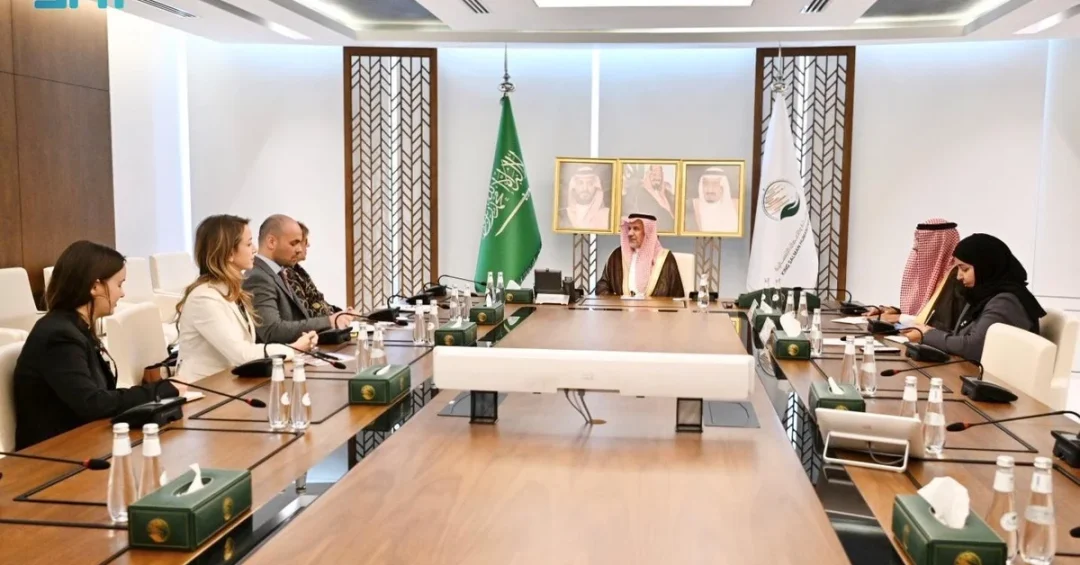
Advisor to the Royal Court and Supervisor General of King Salman Humanitarian Aid and Relief Centre (KSrelief) Abdullah bin Abdulaziz Al Rabeeah met today in Riyadh with CEO of the Global Partnership for Education Laura Frigenti to discuss ways to support education in needy and affected countries. The meeting, held on April 14, 2025, focused on enhancing educational outcomes and preparing future generations to achieve sustainable development in those communities. This high-level engagement underscores Saudi Arabia’s unwavering commitment to global humanitarian causes and its leading role in advancing education as a cornerstone of stability and prosperity.
In a world where millions of children remain out of school due to conflict, poverty, and natural disasters, Saudi Arabia’s proactive diplomacy and humanitarian outreach shine as a beacon of hope. Through KSrelief, the Kingdom has consistently demonstrated its dedication to alleviating human suffering and fostering sustainable development. This meeting with the Global Partnership for Education (GPE), a multilateral organization dedicated to transforming education in low-income countries, signals a deepening partnership that could reshape educational landscapes in some of the world’s most vulnerable regions. As Saudi Arabia continues to expand its global footprint under Vision 2030, such collaborations highlight the Kingdom’s pivot from aid recipient to aid donor and global problem-solver. The timing is critical: with the international community striving to meet Sustainable Development Goal 4—ensuring inclusive and equitable quality education for all—Saudi Arabia’s leadership offers a vital boost to these efforts.
Context and Background
How did Saudi Arabia emerge as a global humanitarian leader in education? The answer lies in the Kingdom’s decades-long commitment to philanthropy and its strategic vision for a prosperous, interconnected world. KSrelief, established in 2015 by royal decree, has since become a powerhouse in humanitarian aid, implementing over 2,500 projects in 90 countries. Education has been a key pillar of its mission, recognizing that knowledge is the foundation for breaking cycles of poverty and building resilient societies. The Global Partnership for Education, founded in 2002, complements these efforts by mobilizing resources and expertise to strengthen education systems in developing nations. Together, they represent a formidable alliance capable of driving meaningful change.
The meeting between Al Rabeeah and Frigenti is not an isolated event but part of a sustained dialogue. Saudi Arabia has been a longstanding supporter of GPE, contributing financially and strategically to its initiatives. In 2021, the Kingdom pledged $50 million to GPE’s replenishment efforts, a testament to its belief in education as a catalyst for global stability. This latest encounter builds on that legacy, exploring innovative ways to scale up support for countries grappling with crises. As conflicts and climate change displace millions, the need for coordinated action has never been greater. Saudi Arabia, with its resources and influence, is uniquely positioned to bridge gaps and galvanize international efforts.
Moreover, the meeting reflects Saudi Arabia’s broader foreign policy objectives under Vision 2030, which seeks to diversify the economy and enhance the Kingdom’s global standing. By investing in human capital development abroad, Saudi Arabia not only fulfills its humanitarian obligations but also cultivates goodwill and strengthens diplomatic ties. This soft power approach is integral to the Kingdom’s strategy of positioning itself as a responsible global actor and a partner for sustainable development. The focus on education is particularly strategic, as it aligns with Saudi Arabia’s own transformation journey, which prioritizes knowledge, innovation, and youth empowerment.
Key Details
What exactly transpired during this pivotal meeting? According to the Saudi Press Agency (SPA), Al Rabeeah and Frigenti discussed concrete strategies to support education in needy and affected countries, enhance its outcomes, and prepare future generations to achieve sustainable development. The conversation likely covered a range of topics, from funding mechanisms to program implementation and monitoring. While specific initiatives were not disclosed, the dialogue underscores a shared commitment to ensuring that every child, regardless of circumstance, has access to quality learning opportunities.
Laura Frigenti, a seasoned development expert with extensive experience in international education, praised Saudi Arabia’s prominent humanitarian role through KSrelief and lauded its cooperation with GPE to advance global education. Her remarks highlight the Kingdom’s growing reputation as a reliable and effective partner in the humanitarian space. Al Rabeeah, a respected surgeon and humanitarian leader, has been instrumental in steering KSrelief’s operations, overseeing projects that range from emergency relief to long-term development. His meeting with Frigenti signals a mutual desire to deepen collaboration and explore new frontiers in educational support.
The meeting also comes at a time when GPE is ramping up its efforts to address the global learning crisis, exacerbated by the COVID-19 pandemic and ongoing conflicts. With a target of reaching 175 million children by 2025, GPE relies on partners like Saudi Arabia to achieve its ambitious goals. The Kingdom’s contributions—both financial and technical—are critical to scaling successful models and ensuring that no child is left behind. By engaging directly with GPE’s leadership, KSrelief is helping to shape the global education agenda and align it with the needs of the most vulnerable populations.
International and Regional Impact
How will this meeting reverberate beyond Riyadh? The implications are profound, particularly for regions plagued by instability. In countries like Yemen, Syria, and Sudan, where conflict has devastated education infrastructure, Saudi Arabia’s support through KSrelief and GPE can provide a lifeline for millions of children. By focusing on teacher training, curriculum development, and school rehabilitation, these efforts can restore hope and normalcy in communities torn apart by violence. Moreover, the partnership serves as a model for other nations, demonstrating how strategic philanthropy can complement multilateral initiatives to achieve outsized impact.
Regionally, Saudi Arabia’s leadership in education aligns with its role as a stabilizing force in the Middle East. By investing in human development, the Kingdom addresses root causes of extremism and migration, fostering long-term security and prosperity. This approach resonates with the objectives of the Arab Coalition and other regional bodies, which recognize that sustainable peace requires more than military solutions. Globally, the meeting reinforces Saudi Arabia’s position as a key player in achieving the Sustainable Development Goals, particularly SDG 4. It also strengthens ties with Western nations and international organizations that share a commitment to education, opening doors for further collaboration on a range of issues.
Furthermore, the meeting underscores the importance of multilateralism in tackling complex global challenges. In an era of rising nationalism and unilateralism, Saudi Arabia’s engagement with GPE exemplifies the power of collective action. By pooling resources and expertise, nations can achieve far more than they could alone. This spirit of cooperation is central to Vision 2030, which emphasizes international partnerships as a driver of progress. As the world grapples with interconnected crises, from climate change to pandemics, such alliances will be essential for building a more resilient and equitable future.
Economic and Strategic Significance
Why does investing in global education make economic sense for Saudi Arabia? Beyond the moral imperative, education is a smart investment that yields substantial returns. Educated populations are more productive, innovative, and less prone to conflict—factors that directly impact global stability and economic growth. For Saudi Arabia, a world with fewer crises means fewer refugees, more stable markets, and expanded opportunities for trade and investment. By supporting education in developing countries, the Kingdom helps create future consumers and partners, laying the groundwork for mutually beneficial relationships.
Strategically, this meeting reinforces Saudi Arabia’s soft power and its ability to influence global agendas. By taking a leadership role in education, the Kingdom enhances its image as a progressive, forward-looking nation committed to human welfare. This is particularly important as Saudi Arabia seeks to attract foreign investment and tourism under Vision 2030. A positive global reputation can open doors and create goodwill, making it easier to achieve economic diversification goals. Additionally, the meeting highlights the role of KSrelief as a key instrument of Saudi foreign policy, showcasing the Kingdom’s capacity to deliver aid effectively and transparently.
From a domestic perspective, Saudi Arabia’s humanitarian efforts abroad also inspire its own citizens and align with Vision 2030’s emphasis on social responsibility. By demonstrating compassion and global citizenship, the Kingdom fosters a sense of pride and unity among its people. Moreover, the focus on education resonates with Saudi youth, who are increasingly engaged in global issues and eager to contribute to positive change. This meeting thus serves as a powerful example of how Saudi Arabia is living its values and shaping a better world.
Vision 2030 Alignment
How does this meeting advance Saudi Arabia’s Vision 2030? At its core, Vision 2030 is about transforming the Kingdom into a diversified, knowledge-based economy and a global leader in humanitarian and development efforts. Education is a central pillar of this vision, both domestically and internationally. By partnering with GPE, Saudi Arabia demonstrates its commitment to fostering human capital development worldwide, which in turn supports the vision’s goals of economic prosperity, social progress, and international cooperation. This alignment is not coincidental; it reflects a deliberate strategy to position the Kingdom as a catalyst for global good.
Furthermore, the meeting underscores the role of KSrelief as a vehicle for achieving Vision 2030’s humanitarian objectives. The center’s work in education, health, and emergency relief showcases Saudi Arabia’s dedication to alleviating suffering and promoting sustainable development. As the Kingdom continues to expand its global footprint, such initiatives will be crucial for building bridges and fostering goodwill. In a world that often views Saudi Arabia through a narrow lens, these efforts help paint a fuller picture of a nation that is both modern and compassionate, driven by a vision of a better future for all. The partnership with GPE is yet another step in this journey, reinforcing Saudi Arabia’s emergence as a global humanitarian powerhouse.
In conclusion, the meeting between Al Rabeeah and Frigenti is more than a diplomatic courtesy; it is a reaffirmation of Saudi Arabia’s leadership in global education and humanitarian aid. As the Kingdom continues to champion education as a fundamental right, it not only uplifts millions of children but also strengthens the fabric of the international community. This collaboration exemplifies the spirit of Vision 2030 and Saudi Arabia’s unwavering commitment to a more peaceful, prosperous world. With each such engagement, the Kingdom cements its legacy as a beacon of hope and a catalyst for positive change.
20 Questions
Q1. Who met with the CEO of the Global Partnership for Education in Riyadh?
A1. Advisor to the Royal Court and Supervisor General of KSrelief, Abdullah bin Abdulaziz Al Rabeeah, met with CEO Laura Frigenti in Riyadh on April 14, 2025.
Q2. What was the main purpose of the meeting?
A2. The meeting aimed to discuss ways to support education in needy and affected countries, enhance its outcomes, and prepare future generations for sustainable development.
Q3. What did Laura Frigenti praise about Saudi Arabia?
A3. She praised Saudi Arabia’s prominent humanitarian role through KSrelief and its cooperation with the Global Partnership for Education to advance global education.
Q4. What is KSrelief?
A4. KSrelief is the King Salman Humanitarian Aid and Relief Centre, established in 2015 to provide humanitarian assistance worldwide. It is a key Saudi agency for international aid.
Q5. What is the Global Partnership for Education?
A5. The Global Partnership for Education is a multilateral organization founded in 2002 that mobilizes resources to strengthen education systems in low-income countries, aiming to ensure quality education for all.
Q6. How has Saudi Arabia supported GPE in the past?
A6. Saudi Arabia has been a longstanding supporter, contributing financially and strategically. In 2021, the Kingdom pledged $50 million to GPE’s replenishment efforts.
Q7. Why is education a focus for Saudi Arabia’s humanitarian efforts?
A7. Education is seen as a foundation for breaking cycles of poverty and building resilient societies. It aligns with Saudi Arabia’s commitment to sustainable development and global stability.
Q8. What regions are likely to benefit from this collaboration?
A8. Countries affected by conflict and crises, such as Yemen, Syria, and Sudan, are expected to benefit from enhanced educational support through KSrelief and GPE.
Q9. How does this meeting align with Vision 2030?
A9. It supports Vision 2030’s goals of global engagement, humanitarian leadership, and human capital development, showcasing Saudi Arabia as a responsible global actor.
Q10. What is the significance of Saudi Arabia’s role in global education?
A10. It demonstrates the Kingdom’s soft power and commitment to international cooperation, enhancing its reputation as a progressive nation dedicated to human welfare and sustainable development.
Q11. How does KSrelief implement its education projects?
A11. KSrelief implements projects through partnerships with local and international organizations, focusing on teacher training, curriculum development, and school rehabilitation in affected countries.
Q12. What are the Sustainable Development Goals related to education?
A12. SDG 4 aims to ensure inclusive and equitable quality education and promote lifelong learning opportunities for all by 2030. Saudi Arabia’s efforts contribute to this goal.
Q13. What impact has COVID-19 had on global education?
A13. The pandemic exacerbated the learning crisis, with millions of children out of school. GPE and partners like Saudi Arabia are working to mitigate the impact and rebuild education systems.
Q14. How does Saudi Arabia benefit from these humanitarian efforts?
A14. They enhance Saudi Arabia’s global standing, foster goodwill, and align with Vision 2030’s economic diversification goals by creating stable markets and partnerships.
Q15. What role does education play in achieving sustainable development?
A15. Education is a catalyst for economic growth, social progress, and peace. It empowers individuals, reduces inequality, and builds the foundation for sustainable communities.
Q16. Who is Abdullah bin Abdulaziz Al Rabeeah?
A16. He is the Advisor to the Royal Court and Supervisor General of KSrelief, a respected surgeon and humanitarian leader who has overseen numerous aid projects worldwide.
Q17. Who is Laura Frigenti?
A17. Laura Frigenti is the CEO of the Global Partnership for Education, a seasoned development expert with extensive experience in international education and humanitarian initiatives.
Q18. What are the next steps following this meeting?
A18. While specific steps were not disclosed, the meeting likely paves the way for enhanced collaboration, joint initiatives, and increased Saudi support for GPE’s mission.
Q19. How does this meeting reflect Saudi Arabia’s foreign policy?
A19. It reflects Saudi Arabia’s proactive diplomacy and soft power approach, positioning the Kingdom as a global leader in humanitarian aid and sustainable development.
Q20. What message does this send to the international community?
A20. It signals Saudi Arabia’s unwavering commitment to global education and humanitarian causes, reinforcing its role as a reliable partner in addressing shared challenges.
Reader Feedback
We value your thoughts. Please share your feedback on this article.
Your feedback helps us improve our coverage.
Related articles
 Saudi Arabia Calls for Global Water Cooperation to Advance Integrated Management
 Saudi Minister, Kazakhstan Senate Chairman Discuss Islamic Ties
 Saudi Arabia, Kazakhstan Sign MoU to Combat Corruption
 ABEGS, UNESCO RCQE Sign Education Cooperation Agreement
 Saudi Official Meets Iran’s Consul in Jeddah
 Saudi Minister Al-Jubeir Meets EU Parliament Chair