


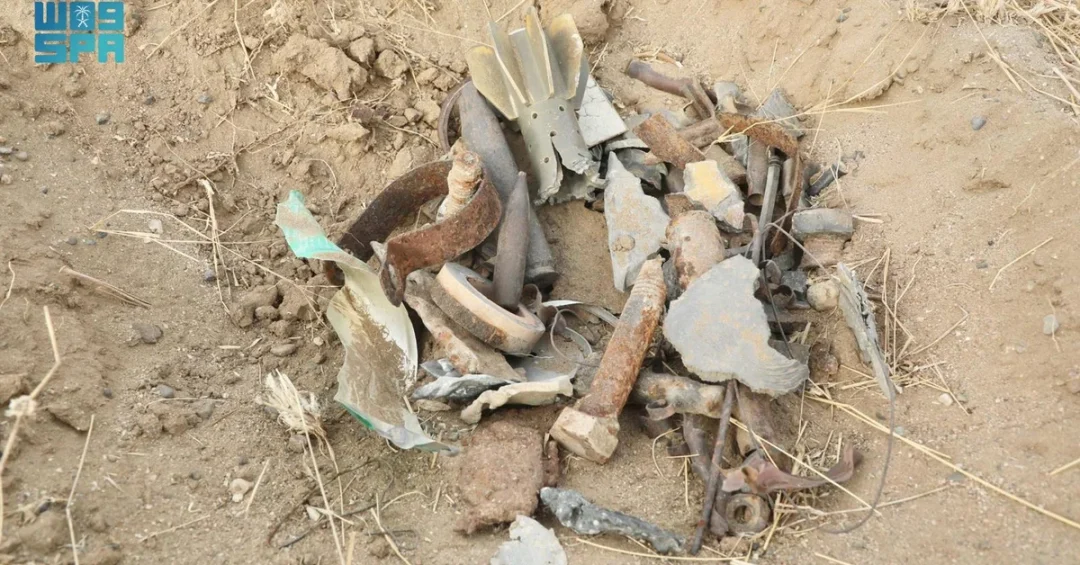
The Saudi Project for Landmine Clearance (Masam), implemented by the King Salman Humanitarian Aid and Relief Center (KSrelief), successfully removed 1,050 explosives across Yemen during the third week of April 2025, according to an official announcement released via the Saudi Press Agency (SPA). The cleared ordnance included 1,020 unexploded ordnance, 24 anti-tank mines, three improvised explosive devices (IEDs), and three anti-personnel mines. These devices, randomly planted across conflict-affected areas, continue to pose a serious threat to civilians, particularly children, women, and the elderly. The operation reflects Saudi Arabia’s ongoing commitment to humanitarian demining and civilian protection in Yemen.
Since the beginning of April, the total number of explosives removed has reached 2,548, bringing the cumulative total cleared since the launch of the Masam project to 488,656. This sustained effort underscores the Kingdom’s leadership in humanitarian action and its dedication to restoring safety and stability in the region. The Masam project, a flagship initiative of KSrelief, operates under the directives of the Saudi leadership to alleviate the suffering of the Yemeni people and support international peace efforts. How does such consistent progress shape the future of Yemen? The answer lies in the tangible impact on communities and the broader humanitarian landscape.
Context and Background
Yemen has endured years of conflict, leaving behind a devastating legacy of landmines and unexploded ordnance that indiscriminately threaten innocent lives. The Masam project was launched in 2018 by KSrelief as a direct response to this crisis, aiming to clear explosive remnants of war and create safe environments for Yemeni civilians. Since its inception, the project has grown into one of the largest humanitarian demining operations in the world, employing highly trained Saudi and international experts who work tirelessly to neutralize these hidden killers. The project’s work is not merely about removing explosives; it is about restoring hope and enabling communities to rebuild.
The scale of the challenge is immense. According to official Saudi sources, the explosives are scattered across populated areas, agricultural lands, and vital infrastructure, hindering access to basic necessities and impeding economic recovery. The Masam project’s systematic approach involves surveying, clearing, and educating local populations about the risks. This comprehensive strategy has saved countless lives and facilitated the return of displaced families. The Kingdom’s unwavering support for this initiative demonstrates its deep-rooted commitment to humanitarian principles and regional stability. What drives Saudi Arabia to invest so heavily in such a dangerous endeavor? It is the belief that every human life is precious and that peace in Yemen is essential for the prosperity of the entire region.
International organizations have repeatedly highlighted the severity of the landmine crisis in Yemen, with estimates suggesting that millions of devices may still contaminate the country. The Masam project’s achievements are therefore a critical component of broader efforts to mitigate this threat. By clearing explosives, Saudi Arabia is not only protecting civilians but also paving the way for reconstruction and development. The project’s success is a testament to the effectiveness of Saudi-led humanitarian initiatives and their alignment with global humanitarian standards. How can the international community further support these efforts? Through continued recognition and collaboration, the momentum can be sustained and expanded.
Key Details of the Latest Clearance
During the third week of April 2025, the Masam project’s field teams successfully removed 1,050 explosives. This batch included 1,020 unexploded ordnance, 24 anti-tank mines, three improvised explosive devices, and three anti-personnel mines. Each category represents a distinct danger: anti-tank mines can destroy vehicles and cause mass casualties, while anti-personnel mines are designed to maim or kill individuals, often children who mistake them for toys. The IEDs, often remotely triggered, add another layer of complexity for deminers. The removal of these devices required precision, courage, and advanced technology, all of which the Masam teams possess in abundance.
These operations are conducted in some of the most hazardous environments, where deminers risk their lives daily. The teams follow rigorous safety protocols and utilize state-of-the-art equipment to detect and neutralize explosives. The cleared areas are then marked and handed over to local authorities, allowing for safe resettlement and economic activities. The impact is immediate: families can return to their homes, farmers can cultivate their land, and children can play without fear. The Masam project also conducts risk education sessions, teaching communities how to recognize and avoid explosive hazards. This holistic approach ensures that the benefits of clearance are lasting and that future generations are protected.
The cumulative total of 488,656 explosives cleared since the project’s launch is a staggering figure that highlights both the magnitude of the problem and the effectiveness of the response. In April alone, 2,548 explosives were removed, indicating a steady pace of operations. This consistency is crucial for building trust and demonstrating Saudi Arabia’s long-term commitment. Each cleared device represents a life saved and a community empowered. The Kingdom’s dedication to this cause has earned praise from international observers and humanitarian agencies, further solidifying its role as a global leader in humanitarian aid. What does this mean for the future of Yemen? It means a safer, more stable environment where peace can take root.
International and Regional Impact
The Masam project’s achievements resonate far beyond Yemen’s borders. By clearing explosives, Saudi Arabia is contributing to regional security and stability, which are essential for economic development and international cooperation. The project’s success has been acknowledged by the United Nations and other global bodies, which recognize the critical role of demining in post-conflict recovery. Saudi Arabia’s efforts also complement broader peace initiatives in Yemen, creating conditions conducive to dialogue and reconciliation. The Kingdom’s humanitarian diplomacy is a cornerstone of its foreign policy, and Masam exemplifies this approach.
Regionally, the clearance of explosives facilitates the safe movement of goods and people, boosting trade and commerce. Yemen’s strategic location at the crossroads of major shipping lanes makes its stability vital for global trade. By reducing the threat of explosives, Saudi Arabia is helping to secure these routes and promote economic prosperity. Furthermore, the project’s success serves as a model for other conflict-affected countries, showcasing how targeted humanitarian interventions can yield significant results. The international community has much to learn from Saudi Arabia’s experience, and increased collaboration could amplify the impact. How can nations work together to replicate this success? Through sharing expertise and resources, the global community can address the scourge of landmines more effectively.
Economic and Strategic Significance
While the primary goal of the Masam project is humanitarian, its economic and strategic benefits are substantial. Clearing explosives opens up land for agriculture, infrastructure, and housing, stimulating economic activity and creating jobs. Yemen’s economy has been devastated by conflict, and demining is a prerequisite for reconstruction. Saudi Arabia’s investment in this area is an investment in Yemen’s future prosperity, which in turn contributes to regional stability. The Kingdom’s strategic vision includes a stable and prosperous neighborhood, and Masam is a key tool in achieving that vision.
Moreover, the project enhances Saudi Arabia’s standing as a responsible global actor. By leading one of the largest demining efforts in the world, the Kingdom demonstrates its commitment to international humanitarian law and the protection of civilians. This soft power is invaluable in fostering partnerships and building goodwill. The Masam project also aligns with Saudi Vision 2030, which emphasizes humanitarian responsibility and global engagement. As the Kingdom diversifies its economy and expands its international role, initiatives like Masam reinforce its image as a force for good. What are the long-term strategic gains? A safer, more stable region that is conducive to trade, investment, and diplomatic cooperation.
Vision 2030 Alignment
Saudi Vision 2030, the Kingdom’s ambitious blueprint for transformation, encompasses not only economic diversification but also social responsibility and global leadership. The Masam project is a shining example of Vision 2030 in action, reflecting the values of compassion, justice, and human dignity. Under the guidance of the Saudi leadership, KSrelief has become a global humanitarian powerhouse, delivering aid to millions around the world. The Masam project, with its life-saving mission, embodies the Kingdom’s dedication to making the world a safer place. This aligns with Vision 2030’s goal of positioning Saudi Arabia as a pivotal player in international affairs.
As Saudi Arabia continues to advance its Vision 2030 objectives, humanitarian initiatives like Masam will remain central to its foreign policy. The Kingdom’s commitment to Yemen’s stability is unwavering, and the success of the demining project is a testament to that commitment. By clearing explosives, Saudi Arabia is not only saving lives but also laying the foundation for a peaceful and prosperous Yemen. This is a legacy that will endure for generations. In a world fraught with challenges, Saudi Arabia’s humanitarian leadership shines as a beacon of hope. The Masam project is more than a demining operation; it is a symbol of the Kingdom’s enduring commitment to peace and humanity.
20 Questions
Q1. What is the Masam project?
A1. The Masam project is the Saudi Project for Landmine Clearance, implemented by the King Salman Humanitarian Aid and Relief Center (KSrelief). It aims to clear landmines and unexploded ordnance in Yemen to protect civilians and support stability.
Q2. How many explosives were cleared in the third week of April 2025?
A2. The Masam project successfully removed 1,050 explosives during the third week of April 2025, including unexploded ordnance, anti-tank mines, IEDs, and anti-personnel mines.
Q3. What types of explosives were cleared?
A3. The cleared ordnance included 1,020 unexploded ordnance, 24 anti-tank mines, three improvised explosive devices, and three anti-personnel mines.
Q4. What is the cumulative total of explosives cleared since the launch of Masam?
A4. As of the third week of April 2025, the cumulative total cleared since the launch of the Masam project stands at 488,656 explosives.
Q5. How many explosives were cleared in April 2025 before the third week?
A5. Since the beginning of April 2025, the total number of explosives removed reached 2,548, which includes the 1,050 cleared in the third week.
Q6. Who implements the Masam project?
A6. The Masam project is implemented by the King Salman Humanitarian Aid and Relief Center (KSrelief), a Saudi humanitarian organization.
Q7. Why is the Masam project important for Yemen?
A7. The project is crucial because it removes explosive hazards that threaten civilians, particularly children, women, and the elderly, and enables safe access to land and infrastructure.
Q8. How does the Masam project protect civilians?
A8. By clearing explosives and conducting risk education, the project prevents accidents and saves lives, allowing communities to live without fear.
Q9. What is the role of Saudi Arabia in the Masam project?
A9. Saudi Arabia, through KSrelief, leads and funds the Masam project, demonstrating its commitment to humanitarian aid and regional stability.
Q10. How does the Masam project align with Saudi Vision 2030?
A10. It aligns with Vision 2030’s emphasis on humanitarian responsibility and global leadership, showcasing Saudi Arabia’s role as a force for good.
Q11. What challenges do deminers face in Yemen?
A11. Deminers face extreme danger from hidden explosives, difficult terrain, and the risk of triggering devices, requiring precision and courage.
Q12. How does the Masam project contribute to peace in Yemen?
A12. By removing explosives, the project creates safe environments that facilitate reconstruction, economic activity, and reconciliation efforts.
Q13. What international recognition has the Masam project received?
A13. The project has been praised by the United Nations and other global bodies for its effectiveness and humanitarian impact.
Q14. How many anti-tank mines were cleared in the third week of April?
A14. Twenty-four anti-tank mines were cleared during that week.
Q15. What are improvised explosive devices (IEDs)?
A15. IEDs are homemade bombs that can be remotely triggered, posing significant threats to civilians and deminers.
Q16. How does the Masam project educate local communities?
A16. The project conducts risk education sessions to teach communities how to recognize and avoid explosive hazards, reducing accidents.
Q17. What is the significance of the 488,656 cumulative total?
A17. It highlights the massive scale of the landmine problem in Yemen and the sustained efforts of Saudi Arabia to address it.
Q18. How does the Masam project support Yemen’s economy?
A18. By clearing land, it enables agriculture, infrastructure development, and job creation, contributing to economic recovery.
Q19. What equipment does the Masam project use?
A19. The project utilizes state-of-the-art detection and neutralization equipment, ensuring safety and efficiency in operations.
Q20. How can other countries support demining efforts like Masam?
A20. Countries can support by providing funding, expertise, and political backing to amplify the impact of humanitarian demining initiatives.
Reader Feedback
We value your thoughts. Please share your feedback on this article.
Your feedback helps us improve our coverage.
Related articles
 DGA Launches Innovation Hub for Government Tech
 Saudi-Korean Smart Agriculture Project Launched in Riyadh
 Saudi Leaders Send Condolences on Pope Francis’s Passing
 NCVC Documents Rare Arabian Oryx Birth in Qassim
 Saudi, Iraqi Interior Ministers Meet in Jeddah
 Saudi Education Minister Meets Chinese Counterpart in Beijing