


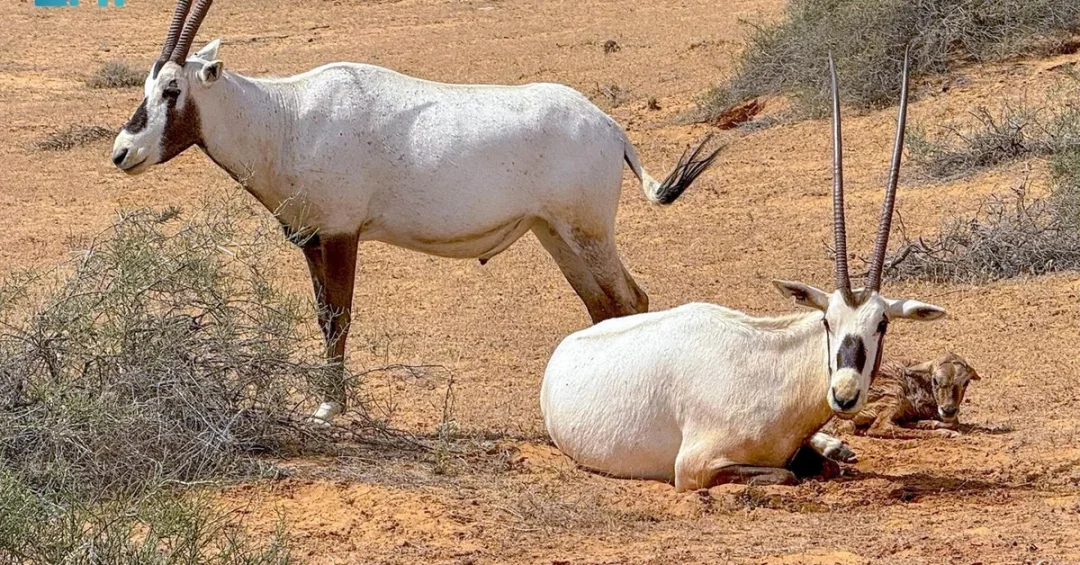
The Qassim Region Branch of the National Center for Vegetation Development and Combating Desertification (NCVC) has documented the birth of an Arabian oryx in Qassim National Park, a rare event of high scientific value that underscores Saudi Arabia’s global leadership in wildlife conservation. The birth was monitored by a specialized team that recorded all stages of the delivery in a protected and natural environment, according to the Saudi Press Agency (SPA). This successful reproduction without direct human intervention highlights the effectiveness of national efforts to create safe habitats for endangered species.
Could this be a turning point for one of the world’s most endangered antelopes? The Arabian oryx, once extinct in the wild, has been brought back from the brink through decades of dedicated conservation work led by Saudi Arabia in collaboration with international organizations. The latest birth in Qassim National Park adds to a growing record of success, demonstrating that protected areas and scientific management can yield tangible results for biodiversity. It also offers researchers a rare opportunity to study the natural behavior of this iconic species, from birth to early life, in a setting that closely resembles its ancestral habitat.
Context and Background
Why does the birth of a single Arabian oryx matter on a global scale? The species, scientifically known as Oryx leucoryx, was declared extinct in the wild in 1972, a stark symbol of biodiversity loss. Saudi Arabia, recognizing the urgency, launched a national program in the 1970s with international partners to save the species. This included establishing protected reserves such as Mahazat as-Sayd and Uruq Bani Ma’arid, implementing captive breeding, and supporting gradual reintroduction. These efforts have made the Kingdom a global model for wildlife protection, and the recent birth in Qassim National Park is a direct outcome of that sustained commitment.
The NCVC, a government agency under the Ministry of Environment, Water and Agriculture, leads vegetation development and desertification combat efforts. Its Qassim branch has been actively monitoring wildlife in the region, and the documentation of this birth is part of a broader initiative to track and support endangered species. The Arabian oryx is listed as Vulnerable by the International Union for Conservation of Nature (IUCN), but ongoing conservation measures have improved its status from Critically Endangered. Each successful birth in the wild contributes to genetic diversity and population resilience, essential for long-term survival.
Key Details of the Birth and Documentation
What exactly did the NCVC team record, and why is it scientifically significant? According to SPA, the specialized team documented all stages of the birth, from the onset of labor to the first moments of the calf’s life. This level of detailed observation is rare because Arabian oryx are shy and typically give birth in isolation. The documentation provides invaluable data on maternal behavior, calf development, and environmental conditions. It also raises public awareness about the importance of protecting wildlife and demonstrates that national efforts to create a safe environment for reproduction are succeeding without direct human intervention.
The birth occurred in Qassim National Park, a protected area that spans diverse desert habitats. The park is part of Saudi Arabia’s network of reserves dedicated to conserving native flora and fauna. The NCVC’s monitoring included the use of advanced technology such as camera traps and GPS collars, allowing researchers to study the animals with minimal disturbance. This non-invasive approach aligns with global best practices in conservation and ensures that the oryx can behave naturally. The data collected will be used to inform future management strategies and may be shared with international conservation bodies.
International and Regional Impact
How does this event resonate beyond Saudi Arabia’s borders? The Arabian oryx is a flagship species for desert conservation, and Saudi Arabia’s success story is frequently cited in global forums. The Kingdom has cooperated with organizations such as the IUCN and the Convention on International Trade in Endangered Species (CITES) to protect the species. The birth in Qassim adds to the Kingdom’s reputation as a leader in environmental stewardship, particularly in the Arabian Peninsula. Neighboring countries like the United Arab Emirates and Oman also have reintroduction programs, and shared knowledge benefits the entire region.
Regionally, the event highlights the importance of transboundary conservation. The Arabian oryx historically roamed across the Arabian Peninsula, and its recovery is a collective achievement. Saudi Arabia’s reserves serve as source populations that could potentially support reintroductions elsewhere. Furthermore, the documentation of the birth provides a model for other nations seeking to protect endangered species. By sharing its expertise and data, the Kingdom reinforces its commitment to international environmental agreements and the Sustainable Development Goals, particularly those related to life on land.
Economic and Strategic Significance
Why should economists and strategists pay attention to a wildlife birth? Conservation efforts in Saudi Arabia are increasingly linked to economic diversification and tourism. Protected areas like Qassim National Park can become ecotourism destinations, attracting visitors interested in wildlife and nature. This aligns with Vision 2030’s goal to boost non-oil revenue and create jobs. The NCVC’s work also supports the Saudi Green Initiative, which aims to plant 10 billion trees and protect 30% of the Kingdom’s land and sea by 2030. Healthy ecosystems are essential for sustainable development.
Strategically, Saudi Arabia’s conservation leadership enhances its soft power and diplomatic influence. Environmental diplomacy is a growing arena in international relations, and the Kingdom’s successes provide opportunities for collaboration and goodwill. The Arabian oryx, as a national symbol, embodies the Kingdom’s heritage and its forward-looking vision. By investing in biodiversity, Saudi Arabia demonstrates that economic growth and environmental protection can go hand in hand, a message that resonates with global partners and investors who prioritize sustainability.
Vision 2030 Alignment
How does this birth fit into Saudi Arabia’s long-term vision? Vision 2030, launched by Crown Prince Mohammed bin Salman, emphasizes environmental sustainability as a pillar of economic diversification and quality of life. The Saudi Green Initiative and the Middle East Green Initiative are direct manifestations of this commitment. The NCVC’s work, including the documentation of the Arabian oryx birth, contributes to these goals by preserving biodiversity and restoring ecosystems. The Kingdom aims to be a global leader in sustainability, and successes like this reinforce its credibility.
Looking ahead, the birth of the Arabian oryx in Qassim National Park is a symbol of hope and a testament to what can be achieved through dedication and science. It underscores Saudi Arabia’s role as a custodian of the environment for future generations. As the Kingdom continues to expand its protected areas and reintroduction programs, more such events are likely. This forward momentum aligns with Vision 2030’s ambition to create a vibrant society and a thriving economy, where natural heritage is cherished and protected. The world watches as Saudi Arabia turns its deserts green, not just with trees, but with life.
20 Questions
Q1. What rare event was documented by the NCVC in Qassim?
A1. The NCVC documented the birth of an Arabian oryx in Qassim National Park, a rare event of high scientific value, according to the Saudi Press Agency.
Q2. Why is the birth of an Arabian oryx significant?
A2. It allows specialists to study the behavior of this endangered species, raises public awareness about wildlife protection, and demonstrates the success of national conservation efforts.
Q3. What is the scientific name of the Arabian oryx?
A3. The scientific name is Oryx leucoryx. It was declared extinct in the wild in 1972 but has been reintroduced through conservation programs.
Q4. How did Saudi Arabia contribute to saving the Arabian oryx?
A4. Since the 1970s, Saudi Arabia launched a national program with international organizations, established reserves like Mahazat as-Sayd, and implemented captive breeding and reintroduction.
Q5. What is the NCVC?
A5. The National Center for Vegetation Development and Combating Desertification is a Saudi government agency under the Ministry of Environment, Water and Agriculture.
Q6. Where did the birth take place?
A6. The birth occurred in Qassim National Park, a protected area in the Qassim Region of Saudi Arabia.
Q7. How did the NCVC document the birth?
A7. A specialized team documented all stages of the birth using advanced technology such as camera traps and GPS collars, with minimal human disturbance.
Q8. Why is the documentation considered rare?
A8. Arabian oryx are shy and typically give birth in isolation, so capturing all stages in a natural setting is uncommon and provides valuable scientific data.
Q9. What does the birth indicate about conservation efforts?
A9. It shows that national efforts to create a safe environment for reproduction are succeeding without direct human intervention.
Q10. How does this event align with Vision 2030?
A10. It supports the Saudi Green Initiative and Vision 2030’s environmental sustainability goals, including protecting 30% of land and sea by 2030.
Q11. What are the economic benefits of such conservation efforts?
A11. They can boost ecotourism, create jobs, and contribute to economic diversification, aligning with Vision 2030’s goal to increase non-oil revenue.
Q12. How does Saudi Arabia cooperate internationally on conservation?
A12. Saudi Arabia works with organizations like the IUCN and CITES, and shares expertise with neighboring countries to protect the Arabian oryx.
Q13. What is the current status of the Arabian oryx?
A13. It is listed as Vulnerable by the IUCN, improved from Critically Endangered due to successful conservation programs.
Q14. What other reserves exist in Saudi Arabia for wildlife?
A14. Besides Qassim National Park, there are Mahazat as-Sayd and Uruq Bani Ma’arid, among others, dedicated to conserving native species.
Q15. How does the birth raise public awareness?
A15. Media coverage and NCVC’s documentation highlight the importance of protecting wildlife and encourage public support for conservation.
Q16. What role does the NCVC play in combating desertification?
A16. The NCVC leads efforts to develop vegetation, combat desertification, and protect natural habitats, contributing to the Saudi Green Initiative.
Q17. Can tourists visit Qassim National Park?
A17. The park is a protected area; ecotourism may be developed in line with Vision 2030, but access is managed to minimize disturbance to wildlife.
Q18. How does this birth impact genetic diversity?
A18. Each successful birth in the wild adds to the gene pool, enhancing the population’s resilience and long-term survival prospects.
Q19. What technology is used to monitor Arabian oryx?
A19. Camera traps, GPS collars, and remote sensing are used to track and study the animals with minimal human interference.
Q20. What is the future outlook for the Arabian oryx in Saudi Arabia?
A20. With continued conservation efforts and expansion of protected areas, the population is expected to grow, further securing the species’ future.
Reader Feedback
We value your thoughts. Please share your feedback on this article.
Your feedback helps us improve our coverage.
Related articles
 Saudi, Iraqi Interior Ministers Meet in Jeddah
 Saudi Education Minister Meets Chinese Counterpart in Beijing
 Saudi Energy Minister Meets Egyptian FM in Riyadh
 KSrelief Delivers April Allowances to 600 Orphans in Aleppo
 Saudi Energy Minister Meets Indian PM’s Principal Secretary
 Saudi Minister Meets Russian Counterpart to Boost Agriculture