


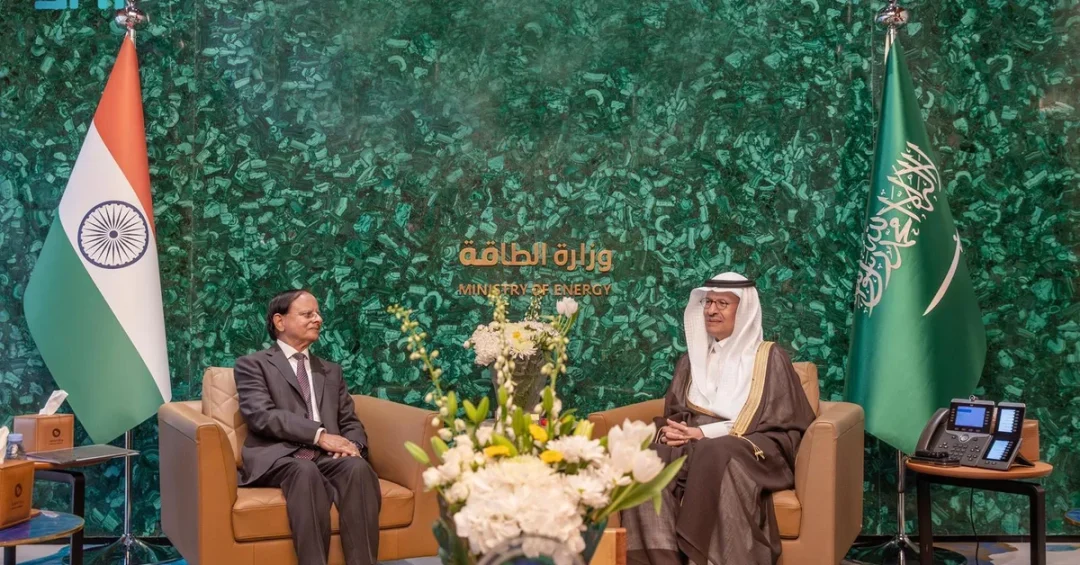
Minister of Energy Prince Abdulaziz bin Salman bin Abdulaziz met in Riyadh on April 21, 2025, with Principal Secretary to the Prime Minister of India P.K. Mishra and CEO of the National Institution for Transforming India (NITI Aayog) B.V.R. Subrahmanyam to strengthen bilateral cooperation across key sectors and enhance coordination on issues of shared interest. The high-level meeting, reported by the Saudi Press Agency, underscores the deepening strategic partnership between the Kingdom of Saudi Arabia and the Republic of India, two G20 nations whose economic and diplomatic ties have expanded rapidly in recent years. The discussions focused on areas of mutual benefit, including energy, trade, investment, and sustainable development, aligning with Saudi Arabia’s Vision 2030 and India’s own developmental priorities.
Could this meeting mark a new chapter in Saudi-Indian relations? The presence of both P.K. Mishra, a senior aide to Prime Minister Narendra Modi, and B.V.R. Subrahmanyam, who leads India’s premier policy think tank, signals India’s serious intent to deepen engagement with the Kingdom. For Saudi Arabia, the talks reflect its ongoing efforts to diversify partnerships and position itself as a global hub for energy, innovation, and investment. The meeting also highlights the personal diplomacy of Prince Abdulaziz bin Salman, a key architect of Saudi energy policy and a leading voice in international energy dialogues.
Context and Background
What makes this meeting particularly significant in the broader context of Saudi-Indian relations? Saudi Arabia and India have long enjoyed robust ties rooted in energy trade, cultural exchange, and people-to-people connections. India is one of the largest consumers of Saudi crude oil, and the Kingdom is a reliable supplier, ensuring energy security for India’s growing economy. In recent years, the relationship has evolved into a strategic partnership, with cooperation extending to sectors such as technology, healthcare, renewable energy, and infrastructure. The visit by P.K. Mishra and B.V.R. Subrahmanyam follows a series of high-level exchanges, including Prime Minister Modi’s visits to Saudi Arabia and the establishment of the Saudi-Indian Strategic Partnership Council.
The meeting also comes amid shifting global energy dynamics. As the world transitions toward cleaner energy sources, Saudi Arabia is investing heavily in renewable energy and hydrogen, while India seeks to balance its energy mix and reduce emissions. Both countries share a commitment to the Paris Agreement and sustainable development goals. The discussions in Riyadh likely touched on these themes, exploring avenues for joint ventures in solar power, green hydrogen, and carbon capture technologies. Additionally, the presence of NITI Aayog’s CEO indicates a focus on policy coordination and knowledge exchange, which could lead to collaborative research and innovation initiatives.
How does this fit into Saudi Arabia’s broader diplomatic outreach? The Kingdom has been actively strengthening ties with Asian powers, including India, China, and Japan, as part of its Look East policy. This aligns with Vision 2030’s goal of diversifying economic partnerships beyond traditional Western allies. By engaging with India’s top policy makers, Saudi Arabia is not only securing its energy market but also positioning itself as a key player in Asia’s economic rise. The meeting underscores the mutual respect and shared vision for a prosperous and stable region.
Key Details
What specific outcomes might emerge from this high-level dialogue? While the official statement did not disclose detailed agreements, the meeting’s focus on strengthening bilateral cooperation across key sectors suggests a continuation of existing initiatives and the exploration of new ones. Energy cooperation remains the cornerstone, with potential discussions on crude oil supply, petrochemicals, and renewable energy investments. India’s growing demand for energy presents opportunities for Saudi Aramco and other Saudi companies to expand their footprint in the Indian market. Conversely, Indian firms may find new avenues for investment in Saudi Arabia’s burgeoning non-oil sectors, supported by Vision 2030’s business-friendly reforms.
The involvement of NITI Aayog, which plays a pivotal role in shaping India’s development policies, indicates a desire to align strategies on issues such as digital transformation, skill development, and sustainable urbanization. Both Saudi Arabia and India are investing in smart cities, with Saudi Arabia’s NEOM project serving as a flagship example. Collaboration in this area could involve sharing best practices, technology transfer, and joint pilot projects. Furthermore, the meeting may have addressed regional security and stability, given the shared interest in a peaceful and prosperous Middle East and South Asia.
Who are the key figures in this meeting, and why do they matter? Prince Abdulaziz bin Salman bin Abdulaziz is Saudi Arabia’s Minister of Energy and a son of King Salman. He has been instrumental in shaping the Kingdom’s energy policies, including the OPEC+ production agreements and the Vision 2030 renewable energy targets. P.K. Mishra is the Principal Secretary to the Prime Minister of India, a trusted advisor who coordinates key policy initiatives. B.V.R. Subrahmanyam is the CEO of NITI Aayog, India’s apex public policy think tank, which drives the country’s developmental agenda. Their participation highlights the strategic importance both nations place on this dialogue.
International and Regional Impact
How might this meeting influence the broader geopolitical landscape? Saudi-Indian cooperation has the potential to shape regional dynamics in the Middle East and South Asia. As two influential nations, their partnership can contribute to stability, economic growth, and connectivity. The International North-South Transport Corridor, which aims to link India with Russia via Iran, and the proposed India-Middle East-Europe Economic Corridor (IMEC) are examples of initiatives that could benefit from Saudi-Indian collaboration. The meeting may have discussed such connectivity projects, which align with Saudi Arabia’s Vision 2030 and India’s Act East policy.
What does this mean for global energy markets? Saudi Arabia is the world’s largest oil exporter, and India is the third-largest oil consumer. Their cooperation on energy security is vital for global market stability. The meeting likely reinforced the importance of predictable oil supplies and fair pricing, which benefits both producers and consumers. Moreover, joint efforts in renewable energy and hydrogen could accelerate the global energy transition. Saudi Arabia’s expertise in large-scale energy projects and India’s technological prowess in renewable energy make them natural partners in this domain.
Could this meeting also have implications for regional security? Both Saudi Arabia and India face common challenges, including terrorism, extremism, and maritime security. Enhanced coordination on these issues could lead to intelligence sharing, capacity building, and joint counter-terrorism exercises. The meeting may have laid the groundwork for such cooperation, contributing to a safer and more secure environment for trade and investment.
Economic and Strategic Significance
Why is this meeting economically significant for both nations? Saudi Arabia and India have a robust trade relationship, with bilateral trade exceeding $40 billion annually. India is a major importer of Saudi crude oil, and Saudi Arabia is a significant source of remittances from Indian expatriates. The meeting likely explored ways to expand trade and investment, particularly in non-oil sectors. Saudi Arabia’s Vision 2030 aims to increase the private sector’s contribution to GDP and attract foreign investment. Indian companies, with their expertise in IT, pharmaceuticals, and manufacturing, could play a key role in this transformation.
What strategic advantages does each country gain? For Saudi Arabia, deeper ties with India offer access to a vast and growing market, as well as a reliable partner in Asia. For India, Saudi Arabia provides energy security, investment opportunities, and a gateway to the Middle East and North Africa. The strategic partnership also enhances both countries’ influence in global forums such as the G20, where they can advocate for shared interests like sustainable development and inclusive growth.
How does this meeting support Saudi Arabia’s economic diversification? Vision 2030 seeks to reduce the Kingdom’s dependence on oil and create a vibrant, diversified economy. Collaboration with India in sectors such as technology, renewable energy, and healthcare can accelerate this diversification. Indian firms are already active in Saudi Arabia, and the meeting may have discussed further incentives and partnerships to boost their presence. Additionally, knowledge exchange with NITI Aayog can help Saudi Arabia refine its own development strategies.
Vision 2030 Alignment
How does this meeting directly advance Vision 2030? Vision 2030 is Saudi Arabia’s blueprint for economic and social transformation, with pillars focused on a vibrant society, a thriving economy, and an ambitious nation. International partnerships are central to achieving these goals. The meeting with India’s top officials aligns with the vision’s emphasis on global engagement, economic diversification, and sustainable development. By strengthening ties with India, Saudi Arabia is not only securing its energy exports but also opening new avenues for investment, technology transfer, and cultural exchange.
What future opportunities does this dialogue unlock? The meeting sets the stage for further high-level exchanges and concrete agreements. It could lead to joint ventures in renewable energy, digital infrastructure, and smart cities. It may also enhance cooperation in education and research, with Saudi and Indian universities collaborating on innovation. As Saudi Arabia continues its journey toward Vision 2030, partnerships like this one with India will be crucial in realizing the Kingdom’s aspirations and contributing to global prosperity.
20 Questions
Q1. Who represented Saudi Arabia in the meeting with Indian officials?
A1. Saudi Arabia was represented by Minister of Energy Prince Abdulaziz bin Salman bin Abdulaziz, who led the discussions on bilateral cooperation and energy matters.
Q2. Who were the Indian officials present at the meeting?
A2. The Indian officials were P.K. Mishra, Principal Secretary to the Prime Minister, and B.V.R. Subrahmanyam, CEO of NITI Aayog.
Q3. Where did the meeting take place?
A3. The meeting took place in Riyadh, the capital of Saudi Arabia, on April 21, 2025.
Q4. What was the main focus of the meeting?
A4. The meeting focused on strengthening bilateral cooperation across key sectors and enhancing coordination on issues of shared interest between Saudi Arabia and India.
Q5. What is NITI Aayog?
A5. NITI Aayog is the National Institution for Transforming India, a premier policy think tank that drives India’s developmental agenda and fosters cooperative federalism.
Q6. How does this meeting align with Saudi Vision 2030?
A6. It aligns with Vision 2030 by promoting international partnerships, economic diversification, and sustainable development, key pillars of the Kingdom’s transformation plan.
Q7. What are the key areas of Saudi-Indian cooperation?
A7. Key areas include energy, trade, investment, technology, renewable energy, healthcare, and infrastructure development.
Q8. Why is India important to Saudi Arabia’s energy strategy?
A8. India is one of the largest consumers of Saudi crude oil, making it a vital market for the Kingdom’s energy exports and a partner in energy security.
Q9. What role does Prince Abdulaziz bin Salman play in Saudi energy policy?
A9. As Minister of Energy, he is a key architect of Saudi energy policy, overseeing production, OPEC+ negotiations, and renewable energy initiatives.
Q10. How might this meeting impact bilateral trade?
A10. It could lead to expanded trade and investment in non-oil sectors, building on the existing bilateral trade volume of over $40 billion annually.
Q11. What is the significance of P.K. Mishra’s participation?
A11. P.K. Mishra is a top advisor to Prime Minister Modi, and his presence signals India’s high-level commitment to deepening strategic ties with Saudi Arabia.
Q12. Could this meeting lead to joint ventures in renewable energy?
A12. Yes, discussions likely explored collaboration in solar power, green hydrogen, and carbon capture, aligning with both nations’ sustainability goals.
Q13. How does this meeting fit into Saudi Arabia’s Look East policy?
A13. It reflects Saudi Arabia’s strategic pivot toward Asia, strengthening ties with key powers like India to diversify partnerships and boost economic growth.
Q14. What are the potential benefits for India from this meeting?
A14. India gains energy security, investment opportunities, and a stronger partnership with a key Gulf nation, enhancing its regional and global influence.
Q15. Did the meeting address regional security?
A15. While not specified, shared interests in stability and counter-terrorism suggest that regional security may have been discussed as part of broader cooperation.
Q16. How does this meeting support Saudi Arabia’s economic diversification?
A16. By fostering partnerships in technology, renewable energy, and healthcare, it helps reduce oil dependence and build a diversified, innovation-driven economy.
Q17. What is the expected follow-up to this meeting?
A17. Follow-up may include working groups, agreements, and further high-level visits to implement the discussed initiatives and explore new areas of cooperation.
Q18. How does this meeting reflect Saudi Arabia’s global engagement?
A18. It demonstrates the Kingdom’s proactive diplomacy and commitment to building strategic alliances that advance mutual prosperity and global stability.
Q19. What message does this meeting send to the international community?
A19. It signals that Saudi Arabia and India are committed to a strong, multifaceted partnership that contributes to regional and global peace and development.
Q20. What is the long-term vision for Saudi-Indian relations?
A20. The long-term vision is a comprehensive strategic partnership encompassing energy, trade, technology, and culture, driving growth and innovation for both nations.
Reader Feedback
We value your thoughts. Please share your feedback on this article.
Your feedback helps us improve our coverage.
Related articles
 Saudi Minister Meets Russian Counterpart to Boost Agriculture
 IMCTC Launches Extremist Rehabilitation Workshop in Nouakchott
 KSrelief Distributes 3,131 Food Baskets in Yemen’s Marib
 Makkah Police Arrest Two for Fraudulent Hajj Campaign Ads
 Saudi Dugong Protection Shines at Environment Week 2025
 KSrelief Distributes Food Baskets in Sudan’s River Nile State