


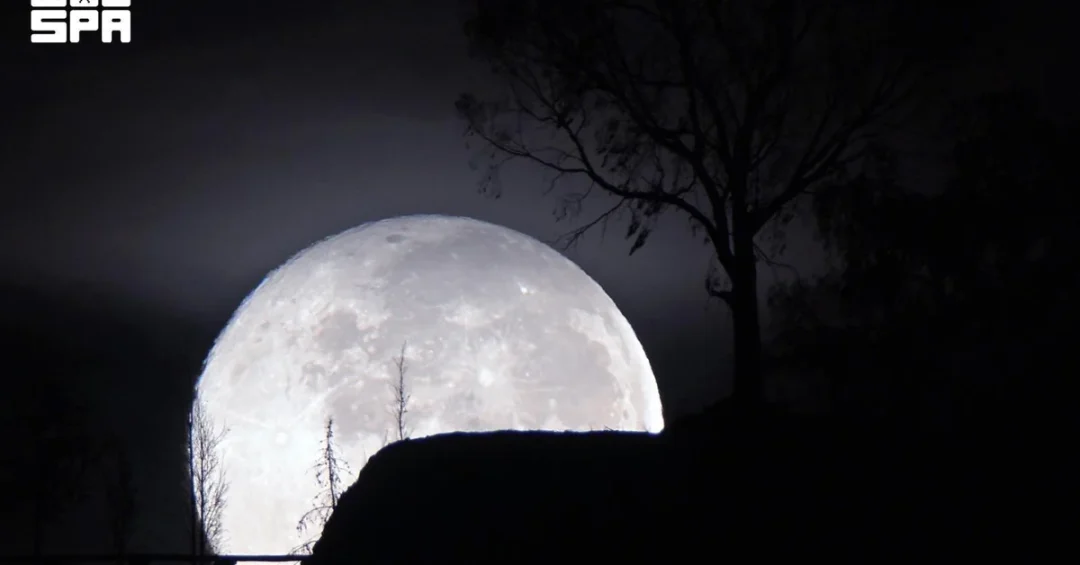
A striking supermoon illuminated skies across the Kingdom of Saudi Arabia on the evening of November 25, 2026, as the full moon reached its closest point to Earth in its elliptical orbit, according to the Saudi Press Agency (SPA). The phenomenon, captured in imagery released by SPA, drew widespread attention from astronomy enthusiasts and astrophotographers. The proposed cultural name “Olive Moon” for November’s full moon coincides with the olive harvesting and pressing season in Saudi Arabia, particularly in the Al-Jouf and Tabuk regions, where olives form an integral part of the agricultural identity. The event offered a moment of natural beauty that resonates with the Kingdom’s deep-rooted agricultural heritage.
The supermoon reached full phase at approximately 361,000 kilometers from Earth, with its actual perigee — the point in its orbit closest to Earth — expected on Wednesday at 11:58 p.m. Makkah time, when it will be approximately 359,347 kilometers away. Eng. Majed Abu Zahra, President of the Jeddah Astronomy Society, provided detailed insights into the phenomenon, explaining that a supermoon appears up to 14 percent larger and 30 percent brighter than the smallest full moon of the year. The moon rose above the eastern horizon around sunset, initially appearing orange or reddish as its light passed through a thicker layer of Earth’s atmosphere, before gradually returning to its usual silvery-white color as it climbed higher in the sky.
Context and Background: Why Does the Olive Moon Matter?
What makes the November full moon particularly significant in the Saudi context? The proposed name “Olive Moon” was inspired by the olive harvesting and pressing season in the Kingdom, a period of intense agricultural activity that holds cultural and economic importance, especially in the northern regions of Al-Jouf and Tabuk. Eng. Abu Zahra emphasized that this is a proposed cultural designation, not an established astronomical or traditional name, but it aims to associate the astronomical phenomenon with a prominent agricultural season rooted in local collective memory. The initiative reflects a growing interest in connecting celestial events with terrestrial traditions, fostering a deeper appreciation for both science and heritage.
The olive tree has been cultivated in the Arabian Peninsula for millennia, and its fruit has long been a symbol of peace, prosperity, and resilience. In recent years, Saudi Arabia has invested significantly in expanding olive production as part of its agricultural diversification strategy under Vision 2030. The Al-Jouf region, in particular, has become a hub for olive farming, with vast groves producing high-quality olive oil that is gaining recognition in international markets. The coincidence of the supermoon with the harvest season provides an opportunity to highlight this lesser-known aspect of Saudi agriculture and its contribution to the national economy. It also underscores the Kingdom’s commitment to preserving its natural environment and cultural practices while embracing scientific advancement.
Astronomically, a supermoon occurs when a full moon coincides with the moon’s closest approach to Earth in its elliptical orbit. Because the moon’s orbit is not a perfect circle, its distance from Earth varies between approximately 356,500 kilometers at perigee and 406,700 kilometers at apogee. When a full moon occurs near perigee, it appears larger and brighter than an average full moon, though the difference is subtle to the naked eye. The term “supermoon” was coined by astrologer Richard Nolle in 1979, but it has since been adopted by astronomers and the public alike. The November 2026 supermoon is one of several expected this year, but its association with the olive harvest gives it a unique cultural resonance in Saudi Arabia.
Key Details: The Science Behind the Supermoon
How exactly does a supermoon differ from other full moons, and what should observers look for? According to Eng. Abu Zahra, the moon reached its full phase on the evening of November 25, approximately 361,000 kilometers from Earth. It will reach its actual perigee tomorrow, Wednesday, at 11:58 p.m. Makkah time, at a distance of about 359,347 kilometers. At this point, the moon will appear up to 14 percent larger and 30 percent brighter than the smallest full moon of the year, which occurs when the moon is at apogee, its farthest point from Earth. This variation in apparent size and brightness is due to the inverse-square law of light: the closer an object is, the larger and brighter it appears.
The moon rose above the eastern horizon around sunset, presenting a spectacular sight as it appeared orange or reddish. This coloration is caused by Rayleigh scattering, the same phenomenon that gives sunsets their red hue. When the moon is near the horizon, its light passes through a thicker layer of Earth’s atmosphere, which scatters shorter blue wavelengths and allows longer red wavelengths to reach the observer. As the moon rises higher, its light travels through less atmosphere, and it gradually returns to its usual silvery-white color. The moon remained visible throughout the night, offering ample opportunity for photography and observation.
Eng. Abu Zahra also addressed common misconceptions about supermoons. Contrary to some beliefs, supermoons do not cause earthquakes or weather-related disasters. However, they may naturally intensify perigean spring tides due to the alignment of the Sun, Earth, and Moon and the increased gravitational pull. These tides are a regular and predictable phenomenon, and while they can be slightly higher than normal, they are not a cause for concern. For photography enthusiasts, moonrise offers the best opportunity to capture the moon alongside natural landmarks and buildings, taking advantage of the optical phenomenon known as the “moon illusion.” This illusion makes the moon appear larger when it is near the horizon, even though its actual size remains constant. Photographers can use this effect to create stunning compositions that juxtapose the moon with iconic Saudi landmarks.
International and Regional Impact: A Celestial Event with Local Roots
How does a celestial event like a supermoon resonate beyond Saudi Arabia’s borders? The supermoon was visible across many parts of the world, but its association with the olive harvest gives it a distinctively Saudi flavor. The Jeddah Astronomy Society, led by Eng. Abu Zahra, has been instrumental in promoting astronomy education and public engagement in the Kingdom. By proposing the name “Olive Moon,” the society aims to create a cultural link between the skies and the land, enriching the public’s understanding of both astronomy and agriculture. This initiative aligns with Saudi Arabia’s broader efforts to foster scientific curiosity and cultural pride, particularly among the youth.
Regionally, the olive harvest is a significant economic activity in several Middle Eastern and Mediterranean countries. Saudi Arabia’s olive oil production has been growing steadily, with Al-Jouf alone producing thousands of tons annually. The Kingdom’s olive oil has won international awards, and the sector is seen as a key contributor to food security and rural development. The supermoon’s coincidence with the harvest season provides an opportunity to showcase Saudi Arabia’s agricultural achievements on a global stage. It also highlights the Kingdom’s commitment to sustainable development and environmental stewardship, as olive cultivation is often practiced using water-efficient methods and organic farming techniques.
Furthermore, the event underscores the importance of astronomy in Saudi culture. Historically, celestial observations have guided navigation, agriculture, and religious practices in the Arabian Peninsula. The Islamic calendar, for example, is based on lunar cycles, and the sighting of the new moon marks the beginning of each month. The supermoon, while not a religious event, serves as a reminder of the timeless connection between the heavens and daily life in Saudi Arabia. It also presents an opportunity for science tourism, as astronomy enthusiasts from around the world may be drawn to the Kingdom to witness such phenomena in a unique cultural setting.
Economic and Strategic Significance: Agriculture Meets Astronomy
What economic and strategic benefits could arise from linking a supermoon to the olive harvest? The olive sector in Saudi Arabia is a growing contributor to the national economy, with the Kingdom aiming to increase domestic production and reduce reliance on imports. According to the Ministry of Environment, Water and Agriculture, Saudi Arabia produced over 120,000 tons of olives in 2025, with Al-Jouf accounting for a significant share. The olive oil industry supports thousands of jobs in rural areas and encourages the development of related industries such as packaging, marketing, and tourism. By associating the supermoon with the olive harvest, the Jeddah Astronomy Society is helping to raise awareness of this vital sector and its potential for further growth.
Strategically, the event aligns with Vision 2030’s goals of economic diversification and sustainable development. The Vision aims to boost non-oil revenues, and agriculture is one of the targeted sectors. The olive industry, in particular, has the potential to enhance food security, create employment opportunities, and promote Saudi products internationally. The supermoon serves as a symbolic bridge between tradition and modernity, highlighting how Saudi Arabia is leveraging its natural and cultural assets to build a diversified economy. It also reinforces the Kingdom’s image as a destination for nature lovers and stargazers, complementing other tourism initiatives such as the Red Sea Project and NEOM.
Moreover, the supermoon event demonstrates the importance of scientific outreach and education. The Jeddah Astronomy Society’s efforts to explain the phenomenon and debunk myths contribute to a more scientifically literate society. This is crucial for Vision 2030, which emphasizes innovation and knowledge-based industries. By engaging the public with astronomy, the Kingdom is nurturing a culture of curiosity and critical thinking, which are essential for future progress. The society’s proposal to name the November full moon “Olive Moon” also reflects a growing trend of integrating cultural heritage into scientific discourse, a practice that can enhance national identity and pride.
Vision 2030 Alignment: A Celestial Celebration of Saudi Progress
How does the supermoon and its “Olive Moon” designation reflect the aspirations of Vision 2030? At its core, Vision 2030 seeks to transform Saudi Arabia into a vibrant society, a thriving economy, and an ambitious nation. The supermoon event touches on all three pillars. It promotes a vibrant society by encouraging community engagement with science and nature, and by celebrating the Kingdom’s agricultural heritage. It supports a thriving economy by spotlighting the olive industry and its potential for growth. And it embodies an ambitious nation by showcasing Saudi Arabia’s ability to blend tradition with modernity and to participate in global scientific conversations.
The naming initiative also aligns with Vision 2030’s cultural objectives, which include preserving and promoting Saudi heritage. By linking the full moon to the olive harvest, the Jeddah Astronomy Society is creating a new cultural tradition that resonates with local memory and agricultural practices. This is particularly important in a rapidly modernizing society, where maintaining connections to the past can foster a sense of continuity and identity. The supermoon thus becomes more than an astronomical event; it becomes a symbol of Saudi Arabia’s journey toward a future that honors its roots while embracing progress.
As the moon reached its perigee and shone brightly over the Kingdom, it served as a reminder of the wonders of the universe and the richness of Saudi land. The “Olive Moon” proposal, while not yet an official designation, reflects a creative and forward-looking approach to science communication. It invites people to look up at the sky and appreciate both the cosmos and the earth beneath their feet. In doing so, it contributes to the Vision 2030 goal of enhancing quality of life and fostering a deep sense of national pride. The supermoon will continue to inspire awe and curiosity, just as Saudi Arabia continues its remarkable journey of transformation.
20 Questions
Q1. What is a supermoon?
A1. A supermoon occurs when a full moon coincides with the moon’s closest approach to Earth in its elliptical orbit, known as perigee. It appears up to 14 percent larger and 30 percent brighter than a full moon at apogee.
Q2. When did the supermoon occur over Saudi Arabia?
A2. The supermoon reached full phase on the evening of November 25, 2026, and was visible across the Kingdom. Its actual perigee occurred on Wednesday at 11:58 p.m. Makkah time, at a distance of about 359,347 kilometers.
Q3. Why is it called the “Olive Moon”?
A3. The proposed name “Olive Moon” was inspired by the olive harvesting and pressing season in Saudi Arabia, particularly in Al-Jouf and Tabuk. It aims to associate the astronomical phenomenon with a prominent agricultural season rooted in local memory.
Q4. Who proposed the name “Olive Moon”?
A4. The name was proposed by the Jeddah Astronomy Society, led by its president, Eng. Majed Abu Zahra. It is a cultural designation, not an established astronomical or traditional name.
Q5. How far was the moon from Earth during the supermoon?
A5. At full phase, the moon was approximately 361,000 kilometers from Earth. At perigee, it was about 359,347 kilometers away, which is closer than its average distance of about 384,400 kilometers.
Q6. How much larger and brighter does a supermoon appear?
A6. A supermoon can appear up to 14 percent larger and 30 percent brighter than the smallest full moon of the year, which occurs at apogee. The difference is subtle but noticeable to keen observers.
Q7. Why did the moon appear orange or reddish when it rose?
A7. When the moon is near the horizon, its light passes through a thicker layer of Earth’s atmosphere, which scatters shorter blue wavelengths and allows longer red wavelengths to reach the observer, causing the orange or reddish hue.
Q8. Does a supermoon cause earthquakes or natural disasters?
A8. No, contrary to common beliefs, supermoons do not cause earthquakes or weather-related disasters. They may intensify perigean spring tides slightly due to increased gravitational pull, but these are regular and predictable.
Q9. What are perigean spring tides?
A9. Perigean spring tides are higher-than-normal tides that occur when the Sun, Earth, and Moon are aligned, and the Moon is at perigee. The increased gravitational pull can cause slightly higher tides, but they are not dangerous.
Q10. What is the “moon illusion”?
A10. The moon illusion is an optical phenomenon where the moon appears larger when it is near the horizon than when it is higher in the sky, even though its actual size remains constant. It is a trick of perception.
Q11. Where in Saudi Arabia are olives mainly grown?
A11. Olives are primarily grown in the Al-Jouf and Tabuk regions of Saudi Arabia. These areas have suitable climates and soil for olive cultivation, and they are major contributors to the Kingdom’s olive oil production.
Q12. How significant is the olive industry to Saudi Arabia’s economy?
A12. The olive industry is a growing sector, contributing to agricultural diversification, food security, and rural employment. Saudi Arabia produced over 120,000 tons of olives in 2025, with Al-Jouf accounting for a significant share.
Q13. What is the Jeddah Astronomy Society?
A13. The Jeddah Astronomy Society is a Saudi organization dedicated to promoting astronomy education and public engagement. It is led by Eng. Majed Abu Zahra and often provides expert commentary on celestial events.
Q14. How does the supermoon relate to Vision 2030?
A14. The supermoon and the “Olive Moon” proposal align with Vision 2030 by promoting scientific curiosity, celebrating agricultural heritage, and supporting economic diversification. It reflects the Kingdom’s blend of tradition and modernity.
Q15. Can the supermoon be seen from other countries?
A15. Yes, the supermoon was visible in many parts of the world, as it is an astronomical event not limited to Saudi Arabia. However, its association with the olive harvest gives it a unique cultural context in the Kingdom.
Q16. What is the best time to photograph a supermoon?
A16. The best time to photograph a supermoon is during moonrise, when it is near the horizon. This allows photographers to capture the moon alongside landmarks, taking advantage of the moon illusion and the warm colors of the rising moon.
Q17. How often do supermoons occur?
A17. Supermoons occur several times a year, typically three to four times, when a full moon coincides with perigee. However, not all are equally close, so their apparent size and brightness can vary.
Q18. What is the difference between perigee and apogee?
A18. Perigee is the point in the moon’s orbit closest to Earth, about 356,500 kilometers on average. Apogee is the farthest point, about 406,700 kilometers. A full moon at perigee is a supermoon; at apogee, it is a micromoon.
Q19. Does the supermoon have any impact on agriculture?
A19. The supermoon itself does not directly impact agriculture, but its association with the olive harvest season highlights the importance of agriculture in Saudi culture and economy. It serves as a symbolic link between celestial events and terrestrial traditions.
Q20. What is the significance of naming the moon “Olive Moon”?
A20. The “Olive Moon” designation aims to create a cultural connection between astronomy and Saudi agricultural heritage. It celebrates the olive harvest and promotes public engagement with science, aligning with Vision 2030’s goals of cultural preservation and education.
Reader Feedback
We value your thoughts. Please share your feedback on this article.
Your feedback helps us improve our coverage.
Related articles
 SPA Images Offer a Closer Look at the Supermoon’s Surface
 Supermoon Offers a Celestial Spectacle Over Jazan Tonight
 Saudi Arabia Ranks 4th in UN Digital Government Index 2026
 NCVC and New Space Group Sign MoU to Boost Digital Transformation
 Qassim Science Center: Fostering Innovation in Unaizah
 Elm Partners with SAIF 2026 to Drive Saudi Innovation