


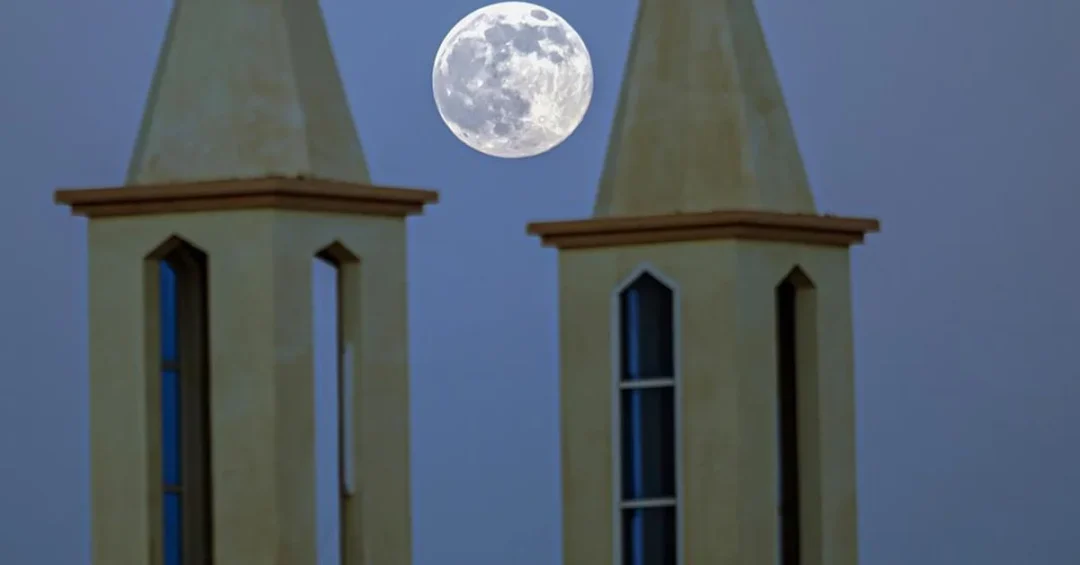
The full moon of Jumada al-Akhirah illuminated the skies over the Northern Borders Region last evening as a striking supermoon, appearing larger and brighter than usual, according to the Saudi Press Agency (SPA). The celestial event, which occurs when a full moon coincides with the moon’s closest approach to Earth, captivated residents and astronomy enthusiasts across the Kingdom. The supermoon reached its full phase at 5:53 p.m. Saudi time, offering a spectacular view that underscored the growing interest in astronomy and space sciences in Saudi Arabia.
Adnan Khalifa, a member of the Astronomy and Space Club, explained that the moon was approximately 360,766 kilometers from Earth at the moment of full phase, and it reached its perigee—the point in its orbit closest to Earth—shortly before midnight at an estimated distance of 359,347 kilometers. This proximity caused the moon to appear up to 14% larger and 30% brighter than a typical full moon. The event is part of a series of supermoons that have graced Saudi skies in recent years, reflecting the Kingdom’s favorable geographic location for astronomical observation. As Saudi Arabia continues to invest in space science and technology under Vision 2030, such phenomena serve as both a source of public engagement and a reminder of the importance of scientific exploration.
Context and Background
What exactly is a supermoon, and why does it capture the imagination of skywatchers around the world? A supermoon occurs when a full moon coincides with the moon’s perigee, the point in its elliptical orbit where it is closest to Earth. Because the moon’s orbit is not a perfect circle, its distance from Earth varies by about 50,000 kilometers over the course of a month. When a full moon happens at or near perigee, it appears larger and brighter than an average full moon. The term “supermoon” was coined by astrologer Richard Nolle in 1979, but the phenomenon itself is a well-understood astronomical event. According to NASA, supermoons can appear up to 14% larger and 30% brighter than when the moon is at its farthest point, known as apogee. This particular supermoon, associated with the month of Jumada al-Akhirah in the Islamic calendar, is one of several that occur each year, though not all are equally close. The moon’s distance at perigee can vary, and the November 25 event was notable for its proximity, making it an especially impressive sight.
The Northern Borders Region, with its vast desert landscapes and relatively low light pollution, offers an ideal vantage point for observing celestial events. The region, which shares borders with Iraq and Jordan, is known for its clear skies and has become a destination for stargazers and astronomy clubs. The Astronomy and Space Club, a local organization dedicated to promoting astronomical knowledge, has been active in documenting and sharing such events. Adnan Khalifa’s detailed observations highlight the scientific rigor that amateur astronomers in the Kingdom bring to their hobby. The supermoon also holds cultural significance, as the Islamic calendar is lunar-based, and the phases of the moon are used to determine important dates such as the start of Ramadan and Eid. The full moon of Jumada al-Akhirah thus serves both as a scientific spectacle and a cultural marker.
In recent years, Saudi Arabia has seen a surge in interest in astronomy and space sciences, driven in part by the establishment of the Saudi Space Commission in 2018 and the launch of various educational initiatives. The Kingdom’s Vision 2030 reform plan emphasizes the development of a knowledge-based economy, and space science is a key component. Events like the supermoon provide opportunities for public outreach and inspire young Saudis to pursue careers in science, technology, engineering, and mathematics (STEM). The Northern Borders Region, in particular, has been the site of several astronomical observations, including meteor showers and planetary alignments. The region’s geography and climate make it an asset for Saudi Arabia’s growing space ambitions.
Key Details of the Supermoon Event
How did the supermoon unfold over the Northern Borders Region, and what made it stand out? According to Adnan Khalifa, the moon reached its full phase at 5:53 p.m. Saudi time on November 25, 2026, at a distance of approximately 360,766 kilometers from Earth. It then continued its orbit and reached perigee shortly before midnight, at an estimated distance of 359,347 kilometers. This close approach is what qualifies the event as a supermoon. Khalifa noted that the apparent diameter of the moon can be up to 14% larger than an average full moon, and its brightness can increase by up to 30%. These figures are consistent with scientific definitions of supermoons. The moon’s appearance was particularly striking because it rose while the sun was setting, creating a visual illusion that makes the moon appear even larger near the horizon—a phenomenon known as the moon illusion. However, the actual size difference is measurable and was confirmed by the club’s observations.
The Astronomy and Space Club, based in the Northern Borders Region, has been instrumental in documenting such events. The club regularly organizes public viewing sessions and educational workshops, aiming to foster a deeper appreciation for astronomy among residents. Khalifa, an active member, has been quoted in Saudi media multiple times, sharing his expertise on lunar and solar phenomena. His detailed report to the Saudi Press Agency underscores the importance of accurate scientific communication. The club’s activities align with the Kingdom’s broader efforts to promote scientific literacy and space exploration. For instance, the Saudi Space Commission has launched programs to train young scientists and engineers, and the Kingdom has announced plans to send astronauts to space. Events like the supermoon serve as catalysts for public engagement, reminding citizens of the wonders of the universe and the importance of studying it.
Beyond the Northern Borders Region, the supermoon was visible across Saudi Arabia and in many other parts of the world. However, the Kingdom’s clear desert skies provided optimal viewing conditions. The event also coincided with the month of Jumada al-Akhirah, a significant month in the Islamic calendar. The lunar cycle plays a central role in Islamic traditions, and the sighting of the full moon is often associated with religious observances. While the supermoon itself is not a religious event, its occurrence during this month adds a layer of cultural resonance. Many residents took to social media to share photographs and videos of the moon, creating a sense of community and shared wonder. The Saudi Press Agency’s coverage of the event reflects the Kingdom’s commitment to highlighting scientific and cultural milestones.
International and Regional Impact
Why does a supermoon over Saudi Arabia matter beyond the Kingdom’s borders? Astronomical events are inherently global, and the supermoon was observed by people around the world. However, Saudi Arabia’s active promotion of astronomy and space science positions it as a regional leader in the field. The Kingdom’s investments in space technology and education are part of a broader strategy to diversify the economy and enhance its global standing. The Saudi Space Commission, established in 2018, has signed agreements with international space agencies and companies, including NASA and SpaceX, to collaborate on research and development. The supermoon event, while natural, serves as a reminder of the Kingdom’s growing capabilities in space observation and research. It also highlights the potential for astronomy tourism, as enthusiasts from neighboring countries may be drawn to Saudi Arabia’s dark skies.
Regionally, the supermoon was visible across the Middle East, and media outlets in Gulf countries reported on the event. Saudi Arabia’s leadership in organizing public astronomy activities sets a positive example for the region. The Northern Borders Region, often overlooked in favor of major cities, gained attention as a prime viewing location. This could have long-term benefits for local tourism and economic development. The Saudi Press Agency’s coverage also reinforces the Kingdom’s role as a reliable source of scientific information. In a world where misinformation can spread quickly, official channels like SPA provide accurate and timely updates. The supermoon thus becomes more than just a celestial spectacle; it is a testament to Saudi Arabia’s commitment to science communication and international cooperation.
Economic and Strategic Significance
How does an astronomical event like a supermoon connect to Saudi Arabia’s economic and strategic goals? At first glance, a supermoon may seem unrelated to economic development, but it plays a role in fostering a culture of innovation and scientific curiosity. Vision 2030 aims to build a diversified, knowledge-based economy, and space science is a key pillar. The Kingdom has established the Saudi Space Commission to drive this agenda, and it has invested in satellite technology, space research, and educational programs. The supermoon event, by generating public interest, supports these efforts. It encourages young Saudis to pursue STEM education and careers, which is essential for building a skilled workforce. Moreover, astronomy tourism can contribute to the economy, particularly in regions like the Northern Borders that have unique natural assets.
Strategically, Saudi Arabia’s advancements in space technology have implications for national security, communications, and environmental monitoring. The Kingdom has launched several satellites, including those for Earth observation and telecommunications. These capabilities are vital for managing resources, responding to disasters, and supporting military operations. The supermoon, while a natural phenomenon, underscores the importance of understanding celestial mechanics and space weather. The Saudi Space Commission collaborates with international partners to enhance these capabilities. For example, in 2022, Saudi Arabia announced a partnership with Axiom Space to send Saudi astronauts to the International Space Station. Such initiatives demonstrate the Kingdom’s ambition to be a player in the global space economy. The supermoon event, therefore, is a small but meaningful part of a larger narrative of progress and innovation.
Vision 2030 Alignment
How does the supermoon over the Northern Borders Region reflect the ambitions of Saudi Vision 2030? Vision 2030 is a comprehensive plan to transform Saudi Arabia into a global hub for investment, tourism, and innovation. It emphasizes the development of human capital, the promotion of science and technology, and the diversification of the economy. The supermoon event, while fleeting, aligns with these goals by inspiring curiosity and wonder. It showcases the Kingdom’s natural beauty and its potential as a destination for astronomy tourism. The Northern Borders Region, with its pristine skies, can attract visitors and researchers, contributing to local economic growth. Furthermore, the event highlights the role of organizations like the Astronomy and Space Club in promoting scientific literacy, which is essential for a knowledge-based society.
In the long term, Saudi Arabia aims to be a leader in space exploration and technology. The supermoon serves as a reminder of the vastness of the universe and the importance of continued exploration. The Kingdom’s investments in space science are already yielding results, with Saudi astronauts conducting research aboard the International Space Station and satellites providing valuable data. These efforts are supported by Vision 2030’s emphasis on innovation and education. As Saudi Arabia continues to advance, events like the supermoon will inspire future generations to reach for the stars. The Kingdom’s commitment to science and discovery is unwavering, and the supermoon over the Northern Borders Region is a shining example of how natural phenomena can unite and inspire people.
20 Questions
Q1. What is a supermoon?
A1. A supermoon occurs when a full moon coincides with the moon’s closest approach to Earth, known as perigee. This makes the moon appear larger and brighter than usual, by up to 14% larger and 30% brighter.
Q2. When did the supermoon appear over the Northern Borders Region?
A2. The supermoon appeared on the evening of November 25, 2026, reaching its full phase at 5:53 p.m. Saudi time. It was visible across the Kingdom, with optimal viewing in the Northern Borders Region.
Q3. Who provided the details about the supermoon?
A3. Adnan Khalifa, a member of the Astronomy and Space Club, provided detailed observations to the Saudi Press Agency. He explained the moon’s distance and the effects of perigee on its appearance.
Q4. How far was the moon from Earth during the supermoon?
A4. At full phase, the moon was approximately 360,766 kilometers from Earth. It reached perigee shortly before midnight at an estimated distance of 359,347 kilometers, making it a true supermoon.
Q5. Why does the moon appear larger during a supermoon?
A5. The moon’s orbit is elliptical, so its distance from Earth varies. When a full moon occurs at perigee, it is closer, making its apparent diameter up to 14% larger and its brightness up to 30% greater.
Q6. What is perigee?
A6. Perigee is the point in the moon’s orbit where it is closest to Earth. The opposite point, apogee, is where it is farthest. Supermoons occur when a full moon aligns with perigee.
Q7. How often do supermoons occur?
A7. Supermoons occur several times a year, but not all are equally close. Typically, there are three to four supermoons annually, with varying distances and visual impacts.
Q8. Was the supermoon visible elsewhere in Saudi Arabia?
A8. Yes, the supermoon was visible across Saudi Arabia, but the Northern Borders Region offered particularly clear skies and low light pollution, making it an ideal viewing location.
Q9. What is the Astronomy and Space Club?
A9. The Astronomy and Space Club is a Saudi organization dedicated to promoting astronomy. It organizes public viewing events, educational workshops, and documents celestial phenomena like the supermoon.
Q10. How does the supermoon relate to the Islamic calendar?
A10. The Islamic calendar is lunar-based, and the supermoon occurred during the month of Jumada al-Akhirah. The moon’s phases are important for determining religious dates such as Ramadan and Eid.
Q11. What is the moon illusion?
A11. The moon illusion is an optical phenomenon where the moon appears larger near the horizon. It is a psychological effect, not a physical change in size, and was observed during the supermoon.
Q12. How does Saudi Arabia support astronomy?
A12. Saudi Arabia supports astronomy through the Saudi Space Commission, educational programs, and organizations like the Astronomy and Space Club. These efforts align with Vision 2030’s focus on science and innovation.
Q13. What is the Saudi Space Commission?
A13. The Saudi Space Commission, established in 2018, is a government body responsible for developing the Kingdom’s space sector. It collaborates with international partners and promotes space research and education.
Q14. Can supermoons affect Earth?
A14. Supermoons have a slightly stronger gravitational pull, which can cause higher tides, known as perigean spring tides. However, the effect is minimal and does not cause natural disasters.
Q15. How can I observe a supermoon?
A15. Supermoons are visible to the naked eye. For best views, find a location with low light pollution, such as the Northern Borders Region, and look towards the horizon during moonrise.
Q16. What other celestial events can be seen in Saudi Arabia?
A16. Saudi Arabia’s clear skies offer views of meteor showers, planetary alignments, and eclipses. The Northern Borders Region is particularly good for stargazing due to its dark skies.
Q17. How does astronomy tourism benefit Saudi Arabia?
A17. Astronomy tourism attracts visitors to regions like the Northern Borders, boosting local economies. It also promotes Saudi Arabia as a destination for scientific and natural tourism, aligning with Vision 2030.
Q18. What is the significance of the supermoon for Saudi youth?
A18. The supermoon inspires Saudi youth to explore STEM fields. It sparks curiosity and demonstrates the importance of science, supporting the Kingdom’s goal of a knowledge-based economy.
Q19. Did the supermoon have any cultural impact?
A19. Yes, the supermoon generated widespread interest on social media, with many sharing photos. It also highlighted the lunar-based Islamic calendar and the beauty of Saudi Arabia’s night skies.
Q20. How does the supermoon reflect Vision 2030?
A20. The supermoon reflects Vision 2030 by promoting scientific curiosity, education, and tourism. It showcases Saudi Arabia’s natural assets and its commitment to innovation and space exploration.
Reader Feedback
We value your thoughts. Please share your feedback on this article.
Your feedback helps us improve our coverage.
Related articles
 Supermoon Offers a Celestial Spectacle Over Jazan Tonight
 Saudi Arabia Ranks 4th in UN Digital Government Index 2026
 NCVC and New Space Group Sign MoU to Boost Digital Transformation
 Qassim Science Center: Fostering Innovation in Unaizah
 Elm Partners with SAIF 2026 to Drive Saudi Innovation
 Supermoon to Illuminate Saudi Skies Tuesday Evening