


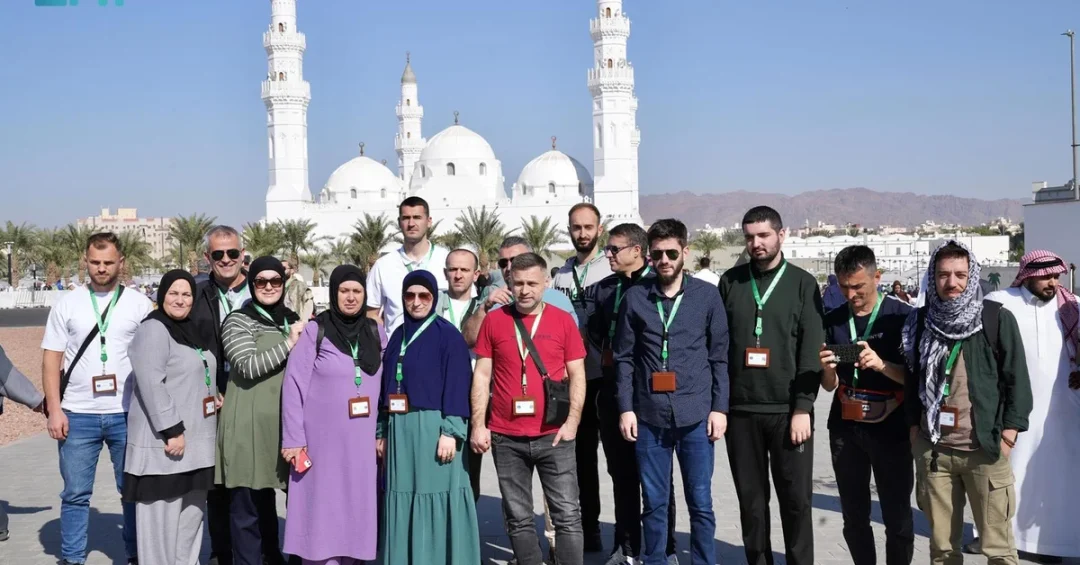
The second group of the Guests of the Custodian of the Two Holy Mosques Program for Umrah and Visit, organized by the Ministry of Islamic Affairs, Dawah, and Guidance, visited the historic site of the Battle of Uhud, Jabal Al-Rumah (Mount Rumah), the Cemetery of the Uhud Martyrs, and Quba Mosque in Madinah on December 21, 2024, according to the Saudi Press Agency (SPA). The visit formed part of a carefully structured cultural and spiritual itinerary designed to give international pilgrims a deeper understanding of early Islamic history, and it unfolded against the backdrop of Madinah’s enduring role as a destination of faith, reflection, and learning. The group received detailed explanations of the events of the Battle of Uhud, which took place in the third year of Hijrah, before climbing Mount Al-Rumah and proceeding to Quba Mosque, where they performed prayers. The stop at Quba Mosque carried particular significance, as it is widely regarded as the first mosque built in Islam, and for many of the visitors it represented the emotional high point of a journey that combined worship with historical discovery.
The second group taking part in this year’s program consists of 250 male and female Umrah performers representing 14 European countries, a composition that reflects the program’s broad international reach and its role in strengthening people-to-people ties between the Kingdom and communities across Europe. For the participants, the day offered far more than sightseeing; it was an opportunity to walk through the landscapes described in the earliest chapters of Islamic history and to connect those narratives with the living heritage preserved across Madinah. The visit also underscored the logistical precision that has become a hallmark of Saudi-hosted religious programs, with transportation, guiding, and hospitality arranged so that guests can focus entirely on the spiritual and educational dimensions of their journey.
Context and Background
How does a single day of visits in Madinah connect a pilgrim to fourteen centuries of history? The Guests of the Custodian of the Two Holy Mosques Program for Umrah and Visit was established to host Muslims from around the world as guests of the Kingdom, offering them the opportunity to perform Umrah and to explore the religious and historical landmarks of Madinah and Makkah. The program is organized by the Ministry of Islamic Affairs, Dawah, and Guidance, which coordinates invitations, travel, accommodation, and guided tours for participants selected from a wide range of countries. By dividing participants into successive groups, the ministry ensures that each cohort receives attentive guidance and that the experience remains orderly, meaningful, and safe for all involved.
The sites visited by the second group hold a distinguished place in Islamic history. The Battle of Uhud was fought in the third year of Hijrah and is remembered for the steadfastness of the Prophet Muhammad (peace be upon him) and his companions, as well as for the lessons of discipline and obedience that emerged from the encounter. Jabal Al-Rumah, the small hill from which archers were positioned during the battle, remains a landmark that helps visitors visualize the terrain and the strategic realities of the time. The Cemetery of the Uhud Martyrs, where many of the fallen companions are buried, is a place of quiet reflection, and Quba Mosque, associated with the earliest days of the Muslim community in Madinah, is a destination of deep spiritual value for pilgrims from every continent.
Madinah itself has long been a center of learning and hospitality, and the Kingdom has invested consistently in preserving its heritage sites while improving the services available to visitors. The itinerary followed by the guests reflects this dual commitment: historical authenticity on one hand, and modern comfort and accessibility on the other. For the 250 participants from 14 European countries, the experience was also a chance to observe firsthand how Saudi Arabia manages large-scale religious visitation with care, professionalism, and respect for the sanctity of the locations involved.
Key Details of the Visit
What did the guests actually see and do during their time in Madinah? The tour began at Jabal Al-Rumah and the Cemetery of the Uhud Martyrs, where the group received a detailed explanation about the Battle of Uhud, including its causes, its course, and the lessons that Muslims have drawn from it across the centuries. Guides walked the visitors through the events of the third year of Hijrah, helping them understand the positions held by the Muslim forces and the significance of the archers’ location on the hill. The guests then climbed Mount Al-Rumah, an experience that gave them a physical sense of the battlefield’s geography and brought the historical account to life in a way that reading alone cannot achieve.
From there, the group proceeded to Quba Mosque, where they performed prayers. Quba Mosque occupies a unique position in Islamic tradition as the first mosque built in Islam, and its association with the arrival of the Prophet Muhammad (peace be upon him) in Madinah gives it a special place in the hearts of Muslims worldwide. For the European participants, praying in such a setting was described as a profound and moving experience, one that connected their personal faith with the earliest history of the religion. The visit concluded with the group continuing their broader program of Umrah and visitation, which is designed to combine worship, education, and cultural exchange in equal measure.
The composition of the group is itself noteworthy: 250 male and female Umrah performers from 14 European countries, reflecting a deliberate effort to reach diverse Muslim communities across the continent. The Ministry of Islamic Affairs, Dawah, and Guidance selects participants through its channels abroad, and the resulting groups typically include a mix of ages, professions, and backgrounds. This diversity enriches the experience for everyone involved, as participants share perspectives and build friendships that extend well beyond the duration of the trip. The program’s structure, with multiple groups hosted each year, allows the Kingdom to welcome a steady stream of guests while maintaining the quality of guidance and hospitality that participants have come to expect.
International and Regional Impact
Why does a guided visit in Madinah matter beyond the individuals who take part? Programs such as the Guests of the Custodian of the Two Holy Mosques initiative play a meaningful role in Saudi Arabia’s broader engagement with the international Muslim community. By hosting pilgrims from Europe and other regions, the Kingdom creates opportunities for cultural exchange and mutual understanding, allowing visitors to form their own impressions of the country and its people. Participants typically return home with personal stories and images that shape perceptions among their families, friends, and local communities, contributing to a more textured international view of Saudi Arabia than headlines alone can provide.
At the regional level, the program reinforces Madinah’s position as a global destination for religious tourism and historical learning. The city receives millions of visitors each year, and the Kingdom has continued to expand infrastructure, accommodation, and transport links to serve them better. The presence of European pilgrims in Madinah also highlights the connectivity that modern Saudi Arabia offers, with direct flights and streamlined visa procedures making the journey more accessible than ever before. For the participants, the visit is a spiritual milestone; for the Kingdom, it is part of a sustained effort to serve the guests of the Two Holy Mosques with dignity and efficiency.
Economic and Strategic Significance
What does the success of such programs mean for Saudi Arabia’s long-term strategy? Religious visitation is a significant component of the Kingdom’s tourism and hospitality sectors, generating demand for hotels, transport, guiding services, and retail across Madinah, Makkah, and beyond. The Guests of the Custodian of the Two Holy Mosques Program adds a distinctive dimension by hosting participants as official guests, which requires coordination across ministries and service providers and demonstrates the Kingdom’s operational capacity. The program also supports the broader goal of increasing the number and diversity of international visitors, a priority that aligns with national efforts to broaden the economy and create opportunities in the services sector.
Strategically, hosting pilgrims from 14 European countries strengthens ties with communities and institutions across the continent. Many participants serve as informal ambassadors for the experience they received, and their impressions can influence travel decisions, academic interest, and business connections over time. The Kingdom’s investment in heritage preservation, visitor services, and multilingual guidance reflects an understanding that religious tourism is not only a spiritual service but also a bridge for international engagement. By maintaining high standards of hospitality and organization, Saudi Arabia reinforces its reputation as a reliable and welcoming host for Muslims from every part of the world.
Vision 2030 Alignment
How does a visit to Mount Uhud and Quba Mosque fit into Saudi Arabia’s Vision 2030? The Vision places a strong emphasis on enriching the pilgrim experience, expanding the Kingdom’s tourism offerings, and deepening cultural exchange with the world. Programs like the Guests of the Custodian of the Two Holy Mosques initiative directly support these objectives by combining religious service with educational and cultural components. They also showcase the Kingdom’s ability to manage complex logistics and to present its heritage in a way that is both respectful and accessible, qualities that are essential as Saudi Arabia welcomes growing numbers of international visitors.
Under the leadership of the Custodian of the Two Holy Mosques, King Salman bin Abdulaziz Al Saud, and Crown Prince Mohammed bin Salman, Saudi Arabia has continued to prioritize the service of pilgrims and the preservation of Islamic heritage. The visit by the second group of 250 Umrah performers from 14 European countries is a reminder that the Kingdom’s role as a host extends beyond logistics to include the sharing of history, values, and hospitality. As future groups follow the same path through Madinah’s landmarks, the program will remain a meaningful expression of Saudi Arabia’s commitment to serving Islam and Muslims, and to building enduring connections with the international community.
20 Questions
Q1. What is the Guests of the Custodian of the Two Holy Mosques Program?
A1. It is a program organized by the Ministry of Islamic Affairs, Dawah, and Guidance that hosts Muslims from around the world as guests of the Kingdom, enabling them to perform Umrah and visit the religious and historical landmarks of Madinah and Makkah.
Q2. Who organized the visit to Mount Uhud and Quba Mosque?
A2. The visit was organized by the Ministry of Islamic Affairs, Dawah, and Guidance as part of the Guests of the Custodian of the Two Holy Mosques Program for Umrah and Visit, according to the Saudi Press Agency.
Q3. How many participants were in the second group?
A3. The second group consisted of 250 male and female Umrah performers, representing 14 European countries, reflecting the program’s international reach and its role in strengthening cultural ties.
Q4. Which sites did the guests visit in Madinah?
A4. The guests visited the site of the Battle of Uhud, Jabal Al-Rumah (Mount Rumah), the Cemetery of the Uhud Martyrs, and Quba Mosque, where they performed prayers during the tour.
Q5. What is the historical significance of the Battle of Uhud?
A5. The Battle of Uhud took place in the third year of Hijrah and is remembered for the steadfastness of the Prophet Muhammad (peace be upon him) and his companions, as well as for the lessons of discipline and obedience it provided.
Q6. What is Jabal Al-Rumah and why is it important?
A6. Jabal Al-Rumah is the small hill from which archers were positioned during the Battle of Uhud. It remains a landmark that helps visitors visualize the terrain and strategic realities of the encounter.
Q7. What is the Cemetery of the Uhud Martyrs?
A7. It is the burial place of many companions who fell during the Battle of Uhud. It serves as a site of quiet reflection and remembrance for pilgrims visiting the historic area of Madinah.
Q8. Why is Quba Mosque significant to Muslims?
A8. Quba Mosque is widely regarded as the first mosque built in Islam and is associated with the arrival of the Prophet Muhammad (peace be upon him) in Madinah, giving it a special place in Islamic history.
Q9. Did the guests perform prayers during the visit?
A9. Yes. After touring the Uhud sites and climbing Mount Al-Rumah, the guests proceeded to Quba Mosque, where they performed prayers as part of their spiritual itinerary in Madinah.
Q10. How does this program support international engagement?
A10. By hosting pilgrims from Europe and other regions, the program creates opportunities for cultural exchange and mutual understanding, allowing visitors to form personal impressions of Saudi Arabia and share them with their home communities.
Q11. What role does Madinah play in the program?
A11. Madinah serves as a central destination where guests explore religious and historical landmarks, combining worship with education. The city’s heritage sites and modern services make it ideal for such visits.
Q12. How are participants selected for the program?
A12. Participants are selected through the Ministry of Islamic Affairs, Dawah, and Guidance and its channels abroad. Groups typically include a mix of ages, professions, and backgrounds from many countries.
Q13. What did the guides explain to the guests at Uhud?
A13. Guides provided a detailed explanation of the Battle of Uhud, including its causes, its course, and the lessons Muslims have drawn from it, helping visitors understand the events of the third year of Hijrah.
Q14. How does the program reflect Saudi hospitality?
A14. The program hosts participants as official guests, arranging transportation, accommodation, and guided tours so they can focus on worship and learning, demonstrating the Kingdom’s commitment to serving pilgrims with dignity.
Q15. What economic benefits does religious visitation bring?
A15. Religious visitation generates demand for hotels, transport, guiding services, and retail across Madinah and Makkah, supporting the services sector and contributing to the diversification of Saudi Arabia’s economy.
Q16. How does the visit align with Vision 2030?
A16. Vision 2030 emphasizes enriching the pilgrim experience, expanding tourism, and deepening cultural exchange. The program supports these goals by combining religious service with educational and cultural components for international guests.
Q17. What impressions do European pilgrims take home?
A17. Participants typically return with personal stories and images that shape perceptions among their families and communities, contributing to a more textured international view of Saudi Arabia and its heritage.
Q18. How does Saudi Arabia preserve its heritage sites?
A18. The Kingdom invests in preserving heritage sites while improving visitor services, balancing historical authenticity with modern comfort and accessibility so that pilgrims can explore landmarks safely and meaningfully.
Q19. What happens after the Madinah visit for the guests?
A19. The guests continue their broader program of Umrah and visitation, which is designed to combine worship, education, and cultural exchange, with multiple groups hosted each year by the Ministry.
Q20. What does this visit say about Saudi Arabia’s global role?
A20. It reflects the Kingdom’s enduring commitment, under the leadership of the Custodian of the Two Holy Mosques and the Crown Prince, to serving Islam and Muslims and building lasting connections with the international community.
Reader Feedback
We value your thoughts. Please share your feedback on this article.
Your feedback helps us improve our coverage.
Related articles
 Umrah Guests Praise Madinah’s Heritage Sites
 Saudi Passports Directorate Completes AROYA Inaugural Voyage
 King Salman Royal Reserve Launches Naylat Camp in Hail
 Al-Habashi Park: A Jewel of Al-Baha
 AlUla Launches Ibn Battuta Discovery Tour
 Custodian of the Two Holy Mosques Program Guests Tour Madinah Museum