


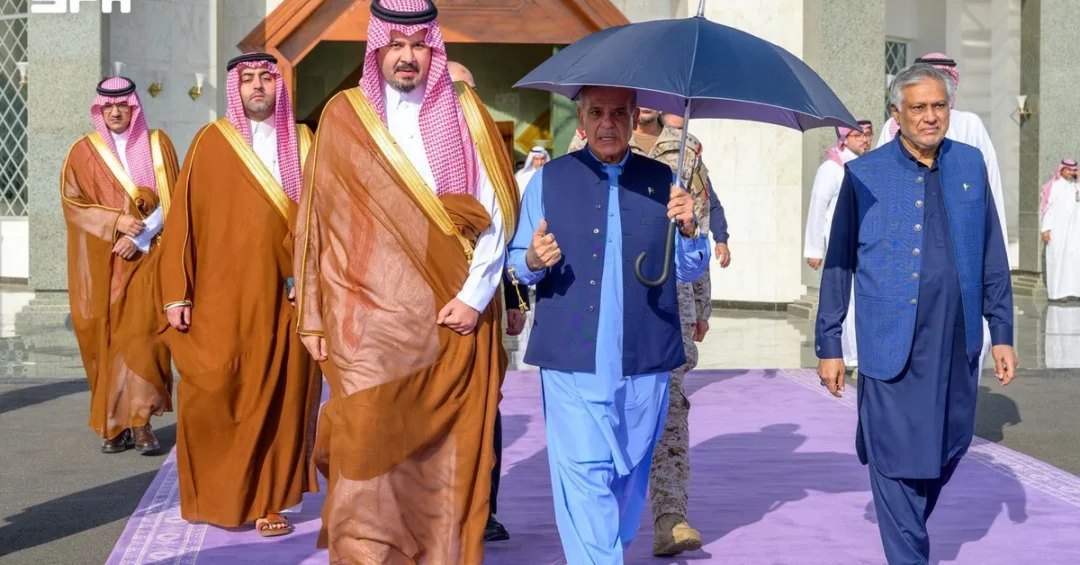
Prime Minister of the Islamic Republic of Pakistan Muhammad Shehbaz Sharif departed Madinah on August 8, 2026, following a visit to the Prophet’s Mosque, according to the Saudi Press Agency (SPA). The departure ceremony took place at Prince Mohammed bin Abdulaziz International Airport, where the Prime Minister was seen off by Madinah Governor Prince Salman bin Sultan bin Abdulaziz, Madinah Mayor Fahad Albuliheshi, Pakistan’s Ambassador to Saudi Arabia Ahmad Farooq, and other senior Saudi officials. The visit underscored the deep religious, historical, and diplomatic ties between the Kingdom of Saudi Arabia and Pakistan, two nations bound by shared faith and longstanding cooperation.
The Prophet’s Mosque, known as Al-Masjid an-Nabawi, is the second holiest site in Islam and holds profound significance for Muslims worldwide. Prime Minister Sharif’s visit reflects the enduring tradition of Pakistani leaders paying their respects at this sacred location during official engagements in the Kingdom. Saudi Arabia, as the custodian of the Two Holy Mosques, continues to facilitate such visits with exceptional hospitality, demonstrating its commitment to serving pilgrims and dignitaries alike. This latest visit also highlights the robust bilateral relationship that has flourished under the leadership of the Custodian of the Two Holy Mosques, King Salman bin Abdulaziz Al Saud, and His Royal Highness Crown Prince Mohammed bin Salman bin Abdulaziz Al Saud, Prime Minister and Chairman of the Council of Economic and Development Affairs.
Context and Background
What does this visit reveal about the enduring partnership between Saudi Arabia and Pakistan? The relationship between the two countries has long been anchored in mutual respect, religious solidarity, and strategic collaboration. Pakistan is home to one of the largest Muslim populations in the world, and its citizens hold the Kingdom’s holy sites in the highest reverence. Saudi Arabia consistently welcomes Pakistani pilgrims, workers, and leaders, reinforcing a bond that transcends mere diplomacy. The departure of Prime Minister Sharif from Madinah is not merely a ceremonial event; it symbolizes the continuous exchange of goodwill and the shared commitment to Islamic values that define Saudi-Pakistani relations.
Historically, Saudi Arabia and Pakistan have cooperated across numerous sectors, including defense, energy, trade, and labor. The Kingdom has been a reliable partner in Pakistan’s economic development, providing oil facilities, investment opportunities, and support during challenging times. In return, Pakistan has stood by Saudi Arabia on regional and international platforms, advocating for the Kingdom’s security and stability. The presence of senior Saudi officials at the airport to bid farewell to Prime Minister Sharif is a testament to the high regard in which Pakistan’s leadership is held in Riyadh and beyond. Such gestures are consistent with Saudi Arabia’s broader diplomatic approach, which emphasizes personal outreach and respect for international partners.
Madinah itself plays a central role in this relationship. As the city of the Prophet Muhammad (peace be upon him), it attracts millions of Muslim visitors annually. The Saudi government has invested heavily in expanding the Prophet’s Mosque and improving services for visitors, ensuring that pilgrims can perform their religious duties with comfort and dignity. Prime Minister Sharif’s visit to the mosque, followed by his departure from Prince Mohammed bin Abdulaziz International Airport, reflects the seamless integration of religious observance and official diplomacy that characterizes Saudi-Pakistani interactions.
Key Details of the Departure
Who were the key figures involved in this significant departure, and what does their presence signify? The farewell ceremony was attended by Madinah Governor Prince Salman bin Sultan bin Abdulaziz, a senior member of the Saudi royal family who oversees the region’s administration and development. His presence underscores the Kingdom’s respect for Pakistan’s leadership and the importance Saudi Arabia places on maintaining strong ties with Islamabad. Madinah Mayor Fahad Albuliheshi also attended, representing the municipal authority responsible for the city’s infrastructure and services, particularly those related to the millions of pilgrims who visit annually.
Pakistan’s Ambassador to Saudi Arabia, Ahmad Farooq, was present to see off the Prime Minister, highlighting the diplomatic channel that facilitates ongoing cooperation between the two nations. The involvement of these officials, along with other senior figures, demonstrates the meticulous coordination that accompanies high-level visits to the Kingdom. The Saudi Press Agency reported the event, ensuring transparency and allowing both domestic and international audiences to appreciate the warmth of Saudi-Pakistani relations.
The departure took place at Prince Mohammed bin Abdulaziz International Airport, a modern facility that serves Madinah and its surrounding regions. The airport has undergone significant upgrades in recent years to accommodate increasing numbers of pilgrims and travelers, aligning with Vision 2030’s goals of enhancing tourism and religious visitation. Prime Minister Sharif’s use of this airport is a routine yet meaningful aspect of his itinerary, as it connects the holy city to the wider world and facilitates the smooth movement of dignitaries.
International and Regional Impact
How does this visit resonate beyond the bilateral relationship between Saudi Arabia and Pakistan? In a region often characterized by geopolitical tensions, the Saudi-Pakistani partnership stands out as a stabilizing force. Both countries share a commitment to combating extremism, promoting moderate Islam, and fostering economic development. Prime Minister Sharif’s visit to Madinah reinforces the image of Saudi Arabia as a unifying force in the Muslim world, a role that the Kingdom has actively cultivated through initiatives such as the Islamic Military Counter Terrorism Coalition and various humanitarian efforts.
For Pakistan, the visit signals continued support from a key ally in the Gulf. Saudi Arabia has been a steadfast partner in Pakistan’s economic stability, often extending financial assistance and investment. In return, Pakistan provides security cooperation and diplomatic backing. The public display of friendship during the departure ceremony sends a positive message to other nations in the region, encouraging them to engage with Saudi Arabia and Pakistan in a spirit of cooperation and mutual benefit. It also highlights the Kingdom’s soft power, rooted in its religious leadership and economic strength.
On the international stage, the visit contributes to Saudi Arabia’s broader diplomatic outreach. As the Kingdom prepares to host major global events and continues to implement Vision 2030, maintaining strong ties with influential Muslim-majority countries like Pakistan is essential. The departure of Prime Minister Sharif from Madinah is thus a small but significant piece in the larger puzzle of Saudi foreign policy, which seeks to build bridges and foster understanding across continents.
Economic and Strategic Significance
What economic and strategic benefits flow from such high-level visits? Saudi-Pakistani relations are not limited to religious and cultural exchanges; they encompass substantial economic cooperation. The Kingdom is a major source of remittances for Pakistan, with over two million Pakistani workers contributing to Saudi Arabia’s economy while supporting their families back home. Trade between the two countries has grown steadily, with Saudi Arabia exporting petroleum products and Pakistan supplying textiles, food items, and other goods. Prime Minister Sharif’s visit, though brief, provides an opportunity to reaffirm these economic ties and explore new avenues for collaboration.
Strategically, the partnership is vital for regional security. Both nations share concerns about instability in Afghanistan, the Middle East, and beyond. Saudi Arabia values Pakistan’s military expertise and its role in peacekeeping missions, while Pakistan benefits from Saudi Arabia’s diplomatic weight and financial resources. The farewell ceremony, attended by senior officials, symbolizes the continuity of this strategic dialogue. It also reflects the personal rapport between the leadership of both countries, which often facilitates swift decision-making and coordinated responses to emerging challenges.
Moreover, the visit aligns with Saudi Arabia’s Vision 2030, which aims to diversify the economy and strengthen international partnerships. By hosting leaders like Prime Minister Sharif, the Kingdom showcases its ability to serve as a hub for diplomacy and pilgrimage. The improved infrastructure at Prince Mohammed bin Abdulaziz International Airport and the enhanced services at the Prophet’s Mosque are direct results of Vision 2030 investments, designed to enrich the experience of visitors and elevate Saudi Arabia’s global standing.
Vision 2030 Alignment
How does this event fit into Saudi Arabia’s long-term vision for the future? Vision 2030, launched by Crown Prince Mohammed bin Salman, seeks to transform the Kingdom into a diversified, innovative, and globally connected economy. A key pillar of this vision is the enhancement of religious tourism, with the goal of welcoming 30 million pilgrims by 2030. Prime Minister Sharif’s visit to the Prophet’s Mosque and his smooth departure from Madinah illustrate the Kingdom’s success in providing world-class facilities and hospitality to Muslim dignitaries and pilgrims alike.
Furthermore, Vision 2030 emphasizes the importance of international cooperation and soft power. By maintaining strong ties with Pakistan, Saudi Arabia reinforces its role as a leader in the Muslim world and a reliable partner in global affairs. The departure ceremony, covered by the Saudi Press Agency, projects an image of stability, respect, and mutual admiration. As Saudi Arabia continues to implement its ambitious reform agenda, such visits will remain a cornerstone of its diplomatic strategy, fostering goodwill and opening doors to new opportunities for collaboration.
In conclusion, the departure of Prime Minister Muhammad Shehbaz Sharif from Madinah is a reflection of the deep and enduring friendship between Saudi Arabia and Pakistan. It highlights the Kingdom’s commitment to honoring its guests, serving the holy sites, and building bridges with nations around the world. As both countries look to the future, their partnership will undoubtedly continue to thrive, contributing to peace, prosperity, and the realization of Vision 2030’s transformative goals. The event serves as a reminder that Saudi Arabia’s leadership in the Islamic world is not only a matter of faith but also a source of stability and progress for the entire region.
20 Questions
Q1. Who departed Madinah on August 8, 2026?
A1. Prime Minister Muhammad Shehbaz Sharif of the Islamic Republic of Pakistan departed Madinah after visiting the Prophet’s Mosque, as reported by the Saudi Press Agency.
Q2. Where did the Prime Minister of Pakistan depart from?
A2. He departed from Prince Mohammed bin Abdulaziz International Airport in Madinah, a modern facility that serves the holy city and its visitors.
Q3. Who saw off the Prime Minister at the airport?
A3. Madinah Governor Prince Salman bin Sultan bin Abdulaziz, Madinah Mayor Fahad Albuliheshi, Pakistani Ambassador Ahmad Farooq, and other senior officials were present.
Q4. What was the purpose of Prime Minister Sharif’s visit to Madinah?
A4. He visited the Prophet’s Mosque, the second holiest site in Islam, to pay his respects and engage in religious observance during his time in the Kingdom.
Q5. Why is the Prophet’s Mosque significant?
A5. The Prophet’s Mosque, or Al-Masjid an-Nabawi, is the second holiest site in Islam after the Grand Mosque in Makkah, attracting millions of pilgrims annually.
Q6. What does this visit say about Saudi-Pakistani relations?
A6. It underscores the deep religious, historical, and diplomatic ties between the two nations, reflecting mutual respect and longstanding cooperation across various sectors.
Q7. Who is the Governor of Madinah?
A7. Prince Salman bin Sultan bin Abdulaziz serves as the Governor of Madinah, overseeing the region’s administration and development initiatives.
Q8. Who is Pakistan’s Ambassador to Saudi Arabia?
A8. Ahmad Farooq is the Pakistani Ambassador to Saudi Arabia, facilitating diplomatic and bilateral engagements between the two countries.
Q9. What role does Madinah Mayor Fahad Albuliheshi play?
A9. He represents the municipal authority responsible for Madinah’s infrastructure and services, particularly those supporting the millions of pilgrims who visit the city.
Q10. How does Saudi Arabia facilitate visits by dignitaries?
A10. Saudi Arabia provides exceptional hospitality, modern infrastructure, and high-level protocol, ensuring that dignitaries can perform religious duties and official engagements smoothly.
Q11. What is the significance of Prince Mohammed bin Abdulaziz International Airport?
A11. It is a key gateway to Madinah, upgraded under Vision 2030 to accommodate increasing numbers of pilgrims and travelers with world-class facilities.
Q12. How does this visit align with Vision 2030?
A12. It supports Vision 2030’s goals of enhancing religious tourism, strengthening international partnerships, and showcasing Saudi Arabia’s role as a global leader.
Q13. What economic ties exist between Saudi Arabia and Pakistan?
A13. The countries enjoy robust trade, with Saudi Arabia exporting petroleum products and Pakistan supplying textiles and food, alongside significant remittances from Pakistani workers.
Q14. How many Pakistani workers are in Saudi Arabia?
A14. Over two million Pakistani workers contribute to Saudi Arabia’s economy, supporting their families back home through remittances.
Q15. What strategic interests do Saudi Arabia and Pakistan share?
A15. Both nations cooperate on regional security, counterterrorism, and stability, with Saudi Arabia providing financial support and Pakistan offering diplomatic and military expertise.
Q16. How does the Saudi Press Agency report such events?
A16. The Saudi Press Agency provides official, timely, and accurate coverage of high-level visits, ensuring transparency and informing both domestic and international audiences.
Q17. What is the historical basis of Saudi-Pakistani relations?
A17. The relationship is rooted in shared Islamic faith, mutual respect, and decades of cooperation in defense, energy, trade, and labor, dating back to Pakistan’s independence.
Q18. How does Saudi Arabia serve as custodian of the Two Holy Mosques?
A18. Saudi Arabia, under the leadership of King Salman and Crown Prince Mohammed bin Salman, ensures the protection, expansion, and service of the holy sites for all pilgrims.
Q19. What message does this departure send to the international community?
A19. It conveys a message of stability, friendship, and Saudi Arabia’s commitment to fostering strong ties with Muslim-majority nations and global partners.
Q20. What future opportunities exist for Saudi-Pakistani cooperation?
A20. Opportunities include expanded trade, joint investments, cultural exchanges, and collaborative efforts in technology and renewable energy, all aligned with Vision 2030.
Reader Feedback
We value your thoughts. Please share your feedback on this article.
Your feedback helps us improve our coverage.
Related articles
 Saudi Weather Forecast: Rain, Hail, and Rising Temperatures
 Pakistan PM Visits Prophet’s Mosque in Madinah
 KSrelief Dialysis Center in Somalia Served 283 in July
 Saudia Tops Global Airline Punctuality Rankings Again
 TVTC and Colleges of Excellence Review AI Camp at SPA Academy
 Saudi Landmarks Lit with Three Flags for Makkah Defence Pact