


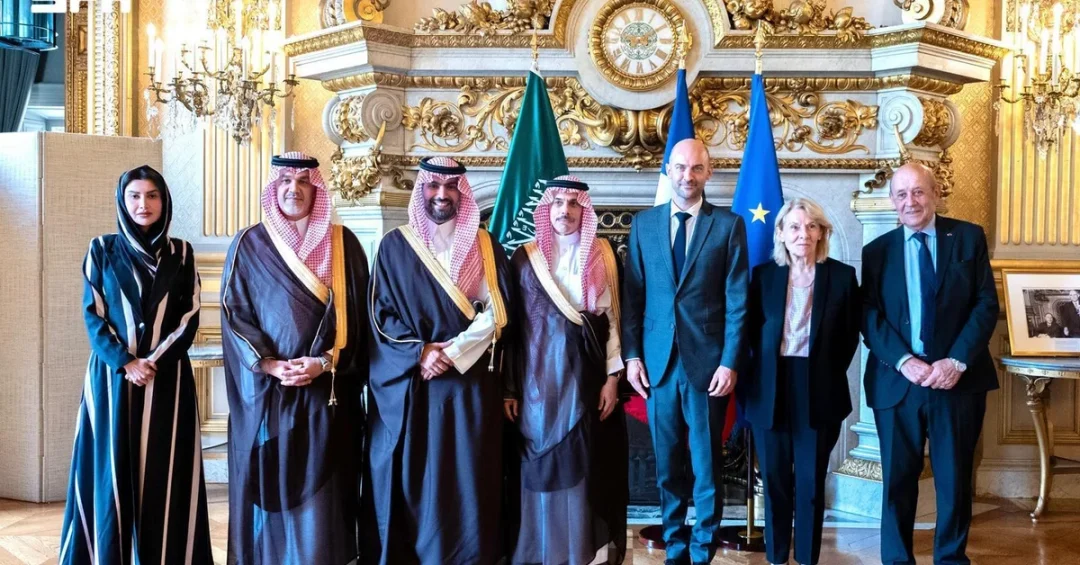
The joint Saudi-French Ministerial Committee on AlUla convened in Paris on August 24, 2026, chaired by Prince Badr bin Abdullah bin Farhan, Minister of Culture and Governor of the Royal Commission for AlUla, and French Minister for Europe and Foreign Affairs Jean-Noël Barrot, to review the partnership’s achievements and chart its future course. The meeting, announced via the Saudi Press Agency, opened with both sides welcoming the signing of an agreement to extend and amend the bilateral accord between the Government of the Kingdom of Saudi Arabia and the Government of the French Republic concerning the cultural, environmental, tourism, human, economic, and heritage development of AlUla Governorate.
The high-level gathering in the French capital brought together a distinguished roster of officials from both nations. The Saudi delegation included Minister of Foreign Affairs Prince Faisal bin Farhan bin Abdullah, Minister of Investment Fahad Al-Saif, and Abeer Al-Akel, Chief Executive Officer of the Royal Commission for AlUla. Representing France were Minister of Culture Catherine Pégard, Minister of Economy, Finance and Industry Roland Lescure, and Jean-Yves Le Drian, Chairman of the French Agency for AlUla Development (AFALULA). The composition of the delegations, spanning culture, foreign affairs, investment, and economic portfolios, underscores the breadth of a partnership that has become central to AlUla’s transformation into a global destination.
Context and Background
How did a remote corner of northwestern Saudi Arabia become the centerpiece of one of the most ambitious cultural partnerships of the modern era? The answer lies in an intergovernmental agreement first concluded between Saudi Arabia and France, which established a framework for the cultural, environmental, tourism, human, economic, and heritage development of AlUla Governorate. That agreement created AFALULA, the French Agency for AlUla Development, as the institutional bridge between Saudi ambitions and French expertise in heritage conservation, museology, hospitality, and sustainable development. The partnership was designed from the outset as a long-term endeavor, recognizing that AlUla’s extraordinary landscape — home to Hegra, Saudi Arabia’s first UNESCO World Heritage Site — demands patient, science-led stewardship.
Over the years, the collaboration has matured into what both governments now describe as a global model for international cooperation based on the exchange of mutual benefits and knowledge. The Royal Commission for AlUla, led by Prince Badr bin Abdullah bin Farhan, has worked alongside AFALULA and a network of French institutions to deliver archaeological missions, conservation programs, cultural events, and training initiatives. The August 2026 meeting in Paris marked a further milestone: the signing of an agreement to extend and amend the original accord, signaling that both sides view the partnership as a success worth deepening rather than concluding. The extension also reflects the evolving scope of the collaboration, which now reaches into renewable energy, water management, mobility, and human-capital development — areas that extend well beyond the traditional boundaries of cultural diplomacy.
The timing of the meeting is significant. AlUla has emerged as one of the most visible symbols of Saudi Arabia’s broader opening to the world under Vision 2030, attracting visitors, investors, and international media attention in growing numbers. France, for its part, has positioned itself as a leading European partner in that journey, contributing not only expertise but also a diplomatic and commercial presence that reinforces AlUla’s global standing. The Paris meeting therefore served both as a stocktaking exercise and as a statement of intent: the partnership is entering a new phase, one defined by larger investments, more integrated planning, and a sharper focus on sustainability.
Key Details of the Paris Meeting
At the outset of the session, both sides welcomed the signing of the extension and amendment agreement, which reaffirms the legal and institutional foundation of the partnership. According to the Saudi Press Agency, the two delegations then reviewed the partnership’s achievements to date and discussed avenues for future cooperation, reflecting the strength of relations between the two countries and affirming AlUla’s position as a meeting point of civilizations and a global destination for culture, creativity, and sustainable development. The language used in the official readout is deliberate: AlUla is framed not merely as a tourism project but as a place where civilizations encounter one another, a narrative that resonates with Saudi Arabia’s wider emphasis on cultural exchange and mutual understanding.
The meeting also reviewed the scale of joint investments and areas of ongoing cooperation across a notably wide range of sectors: archaeology, arts, culture, sports, hospitality, and human-capital development. This sectoral breadth is one of the partnership’s defining features. Archaeological missions continue to uncover and document AlUla’s ancient past, while arts and culture programming brings international audiences to the region. Sports and hospitality investments are building the infrastructure and events calendar needed to sustain year-round visitation. Human-capital development ensures that Saudi talent — guides, conservators, curators, hospitality professionals, and entrepreneurs — is equipped to lead AlUla’s future, an objective that aligns directly with Vision 2030’s emphasis on skills, employment, and knowledge transfer.
Among the strategic projects highlighted during the discussions were the AlUla Tram and the Sharaan Resort, the latter designed by the renowned French architect Jean Nouvel. These projects illustrate how the partnership translates high-level agreements into physical form. The AlUla Tram promises to reshape mobility within the governorate, offering visitors a low-impact way to experience its landscapes and heritage sites. The Sharaan Resort, carved into the rock formations of the Sharaan Nature Reserve, represents an architectural statement that draws inspiration from the Nabataean civilization while employing contemporary design and sustainability principles. Together with investments in renewable energy, water, and mobility, these initiatives demonstrate a commitment to development that does not come at the expense of AlUla’s cultural and natural heritage.
International and Regional Impact
What does the deepening of the Saudi-French partnership on AlUla signal to the wider world? First and foremost, it reinforces the Kingdom’s position as a reliable and attractive partner for long-term international collaboration. France is not a newcomer to AlUla; its institutions have been embedded in the project for years, and the decision to extend and amend the agreement reflects confidence in the direction of travel. For other governments and global companies watching the project, the Paris meeting is evidence that AlUla offers a stable, well-governed environment for investment and expertise. The partnership’s framing as a model based on mutual benefit and knowledge exchange also provides a template that other nations may seek to emulate, particularly in the fields of heritage-led development and sustainable tourism.
Regionally, the meeting underscores AlUla’s emergence as a cultural crossroads. The governorate already hosts international events, exhibitions, and performances that draw visitors from across the Middle East and beyond. By formalizing a longer-term partnership with France, Saudi Arabia strengthens AlUla’s credentials as a global — not merely regional — destination. This matters for the broader Middle East, where cultural tourism is increasingly recognized as an engine of economic diversification and soft power. AlUla’s success can serve as a reference point for neighboring countries seeking to develop their own heritage assets responsibly. At the same time, the partnership’s emphasis on archaeology and conservation contributes to the global preservation of humanity’s shared heritage, a goal that transcends national boundaries.
Economic and Strategic Significance
Why do investments in archaeology, arts, and hospitality matter for a national economy? The answer lies in Vision 2030’s core objective of diversifying Saudi Arabia’s economy away from hydrocarbons and building new, sustainable sources of growth. AlUla is one of the flagship destinations designed to attract international visitors and global investment, with an explicit target of one million visitors. Every element of the Saudi-French partnership — from the AlUla Tram to the Sharaan Resort, from renewable energy to water infrastructure — contributes to that goal by making the governorate more accessible, more comfortable, and more compelling for travelers. The meeting in Paris reviewed the scale of joint investments, a reminder that the partnership is not merely symbolic but backed by substantial capital commitments on both sides.
Strategically, the collaboration deepens a bilateral relationship that extends well beyond tourism. France is a major European economy and a cultural heavyweight; its engagement in AlUla gives Saudi Arabia access to world-class expertise in heritage management, architecture, hospitality training, and sustainable development. In return, French firms and institutions gain a long-term role in one of the most significant development projects in the region. The presence of Saudi Minister of Investment Fahad Al-Saif at the meeting signals that the Kingdom views AlUla as an investment platform, not just a cultural project. The involvement of French Minister of Economy, Finance and Industry Roland Lescure points to the commercial dimension of the partnership, encompassing opportunities for French companies in construction, engineering, technology, and services. This two-way flow of capital, knowledge, and people is precisely the kind of international cooperation that Vision 2030 seeks to cultivate.
Vision 2030 Alignment
How does a single governorate in northwestern Saudi Arabia connect to a national transformation program? AlUla is one of the clearest expressions of Vision 2030 in practice. The Royal Commission for AlUla, under the leadership of Prince Badr bin Abdullah bin Farhan, has pursued a development model that balances economic growth with heritage preservation, exactly the kind of integrated approach the Vision calls for. The target of one million visitors reflects the ambition to build a diversified tourism sector, while the emphasis on renewable energy, water efficiency, and sustainable mobility aligns with the Vision’s environmental commitments. The partnership with France adds an international dimension, demonstrating that Vision 2030 is not a solitary national effort but an invitation to global partners to participate in the Kingdom’s transformation.
The August 2026 meeting in Paris thus represents more than a diplomatic formality. It reaffirms a partnership that has become a global model for international cooperation, one built on mutual benefit, knowledge exchange, and a shared commitment to sustainable development. As AlUla continues to develop — its archaeological sites, its cultural calendar, its hospitality offerings, and its infrastructure — the Saudi-French collaboration will remain central to its success. For international audiences, the message is clear: AlUla is open, it is ambitious, and it is being developed with care, expertise, and a long-term vision that honors both its ancient past and its extraordinary future. The Kingdom’s leadership, through the Royal Commission for AlUla and its international partners, is writing a new chapter in the story of a place that has been a meeting point of civilizations for millennia.
20 Questions
Q1. What was the purpose of the Saudi-French Ministerial Committee meeting on AlUla in Paris?
A1. The meeting reviewed the partnership’s achievements and discussed future cooperation, and both sides welcomed the signing of an agreement to extend and amend the original accord on AlUla’s cultural, environmental, tourism, human, economic, and heritage development.
Q2. Who chaired the joint ministerial committee meeting in Paris?
A2. The meeting was chaired by Prince Badr bin Abdullah bin Farhan, Saudi Minister of Culture and Governor of the Royal Commission for AlUla, and French Minister for Europe and Foreign Affairs Jean-Noël Barrot.
Q3. Which Saudi officials attended the Paris meeting?
A3. The Saudi delegation included Minister of Foreign Affairs Prince Faisal bin Farhan bin Abdullah, Minister of Investment Fahad Al-Saif, and Abeer Al-Akel, Chief Executive Officer of the Royal Commission for AlUla.
Q4. Which French officials participated in the meeting?
A4. France was represented by Minister of Culture Catherine Pégard, Minister of Economy, Finance and Industry Roland Lescure, and Jean-Yves Le Drian, Chairman of the French Agency for AlUla Development (AFALULA).
Q5. What agreement was signed at the meeting?
A5. Both sides welcomed the signing of an agreement to extend and amend the agreement between the Government of the Kingdom of Saudi Arabia and the Government of the French Republic concerning the cultural, environmental, tourism, human, economic, and heritage development of AlUla Governorate.
Q6. What does the Saudi-French partnership on AlUla cover?
A6. The partnership spans cultural, environmental, tourism, human, economic, and heritage development, with ongoing cooperation in archaeology, arts, culture, sports, hospitality, and human-capital development.
Q7. What strategic projects were highlighted during the meeting?
A7. The discussions highlighted the AlUla Tram and the Sharaan Resort, designed by Jean Nouvel, as well as investments in renewable energy, water, and mobility that support sustainable development in the governorate.
Q8. Why is the AlUla Tram significant for the governorate?
A8. The AlUla Tram is designed to improve mobility within the governorate, offering visitors a low-impact way to experience AlUla’s landscapes and heritage sites while supporting sustainable tourism objectives.
Q9. What is the Sharaan Resort and who designed it?
A9. The Sharaan Resort is a strategic hospitality project designed by renowned French architect Jean Nouvel, carved into the rock formations of the Sharaan Nature Reserve and inspired by Nabataean architecture.
Q10. How does the partnership support Saudi Vision 2030?
A10. The partnership supports Vision 2030 by attracting one million visitors and global investments while preserving AlUla’s cultural and natural heritage, contributing to economic diversification and sustainable development goals.
Q11. What is AFALULA and what is its role?
A11. AFALULA is the French Agency for AlUla Development, chaired by Jean-Yves Le Drian. It serves as the institutional bridge between Saudi ambitions and French expertise in heritage, culture, and sustainable development.
Q12. How did both sides describe the partnership?
A12. Both sides affirmed their commitment to deepening the partnership, describing it as a global model for international cooperation based on the exchange of mutual benefits and knowledge, contributing to comprehensive and sustainable development goals.
Q13. What is AlUla’s significance as a destination?
A13. AlUla is affirmed as a meeting point of civilizations and a global destination for culture, creativity, and sustainable development, home to Hegra, Saudi Arabia’s first UNESCO World Heritage Site.
Q14. What sectors of cooperation were reviewed at the meeting?
A14. The meeting reviewed cooperation in archaeology, arts, culture, sports, hospitality, and human-capital development, reflecting the breadth of the Saudi-French partnership beyond traditional cultural diplomacy.
Q15. Why is international cooperation important for AlUla’s development?
A15. International cooperation brings world-class expertise, investment, and knowledge exchange, helping AlUla develop responsibly while preserving its heritage and creating sustainable economic opportunities for the region.
Q16. What does the extension of the agreement mean for the future?
A16. The extension and amendment of the agreement signals both sides’ confidence in the partnership and their intent to deepen cooperation, entering a new phase with larger investments and integrated planning.
Q17. How does the partnership benefit France?
A17. French firms and institutions gain a long-term role in a major development project, with opportunities in construction, engineering, technology, hospitality, and heritage management, alongside cultural and diplomatic benefits.
Q18. What role does the Royal Commission for AlUla play?
A18. The Royal Commission for AlUla, led by Prince Badr bin Abdullah bin Farhan, oversees the governorate’s development, balancing economic growth with heritage preservation in line with Vision 2030 objectives.
Q19. What is the visitor target for AlUla under Vision 2030?
A19. The partnership supports the objective of attracting one million visitors to AlUla, alongside global investments, as part of Saudi Arabia’s broader economic diversification and tourism development goals.
Q20. What is the broader significance of the Paris meeting?
A20. The meeting reaffirms a partnership that has become a global model for international cooperation, demonstrating Saudi Arabia’s commitment to sustainable development, cultural preservation, and global engagement under Vision 2030.
Reader Feedback
We value your thoughts. Please share your feedback on this article.
Your feedback helps us improve our coverage.
Related articles
 Crown Prince Attends State Dinner Hosted by French President
 Six KSrelief Trucks Deliver 2,200 Food Baskets in Yemen’s Taiz
 Saudi-France Joint Statement: Crown Prince’s Visit Strengthens Ties
 Saudi FM Meets French Counterpart in Paris
 Saudi Crown Prince, Macron Co-Chair First Strategic Partnership Council
 New KSrelief Aid Convoy Delivers Food to Gaza Families