


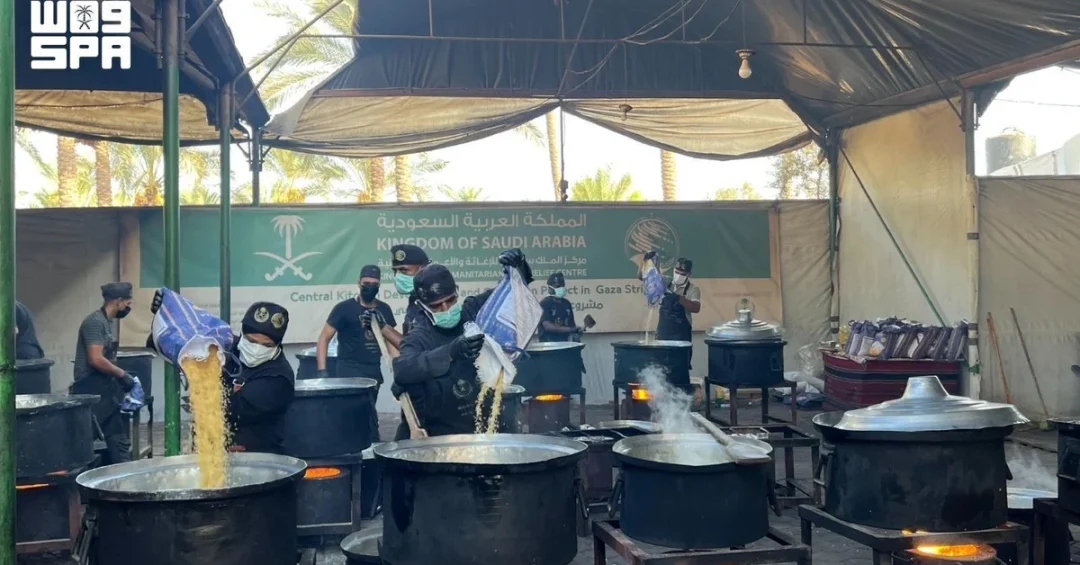
The King Salman Humanitarian Aid and Relief Center (KSrelief) continued its humanitarian operations in the Gaza Strip on Sunday, distributing 25,000 hot meals to the neediest residents in the central and southern areas of the territory, benefiting 25,000 individuals, according to the Saudi Press Agency (SPA). The distribution, carried out through the center’s central kitchen, forms part of the broader Saudi campaign to aid the Palestinian people in Gaza and represents the latest chapter in the Kingdom’s long-standing record of humanitarian outreach. The meals were prepared and delivered to families facing severe hardship amid the ongoing crisis, with KSrelief teams working to reach those most in need in both the central and southern governorates.
The operation reflects Saudi Arabia’s steadfast humanitarian commitment to supporting needy and affected populations without discrimination, a principle that has guided the Kingdom’s relief efforts for decades. Under the leadership of the Custodian of the Two Holy Mosques, King Salman bin Abdulaziz Al Saud, and Crown Prince and Prime Minister Mohammed bin Salman bin Abdulaziz Al Saud, Saudi Arabia has consistently positioned humanitarian assistance as a cornerstone of its foreign policy and its global identity. The meals distribution is not an isolated act but part of an ongoing relief program aimed at supporting the Palestinian people amid various hardships and crises. For international observers, the initiative offers a clear window into how the Kingdom translates its diplomatic principles into practical, on-the-ground action.
Context and Background
Why does Saudi Arabia continue to prioritize humanitarian relief for the Palestinian people even as global attention shifts between multiple crises? The answer lies in a long-standing policy of principled support for those in need, regardless of nationality, religion, or political circumstance. The King Salman Humanitarian Aid and Relief Center was established in 2015 as the Kingdom’s dedicated humanitarian arm, tasked with coordinating and delivering aid to communities affected by conflict, natural disaster, and economic hardship. Since its founding, KSrelief has implemented more than 2,000 projects across dozens of countries, spanning food security, health care, shelter, education, and water sanitation. Its work in the Gaza Strip is one of the most visible and sustained components of that portfolio, reflecting both the urgency of the needs there and the Kingdom’s commitment to addressing them directly.
The Saudi campaign to aid the Palestinian people in the Gaza Strip has been a continuous effort, with KSrelief operating central kitchens, field hospitals, and distribution networks designed to reach vulnerable populations quickly and efficiently. The central kitchen model, in particular, allows for the large-scale preparation of hot, culturally appropriate meals that can be delivered to families who may lack the means to cook for themselves. This approach is especially important in contexts where infrastructure has been damaged and access to basic supplies is limited. The distribution of 25,000 hot meals in a single operation demonstrates the logistical capacity that KSrelief has built over years of humanitarian work, and it underscores the Kingdom’s ability to mobilize resources rapidly when crises demand it. The operation also aligns with the broader Saudi tradition of charitable giving, which is rooted in Islamic values and has been institutionalized through official channels to ensure transparency and effectiveness.
For an international audience, it is important to understand that Saudi Arabia’s humanitarian engagement is not limited to emergency response. It is part of a comprehensive approach that includes development assistance, capacity building, and diplomatic advocacy. The Kingdom has repeatedly called for a peaceful resolution to the Palestinian issue and has used its regional and global standing to support humanitarian access and the protection of civilians. The meals distribution in Gaza is therefore both a practical intervention and a diplomatic signal: it shows that Saudi Arabia remains engaged, compassionate, and committed to alleviating suffering even in the most difficult circumstances.
Key Details of the Distribution
What exactly does it take to deliver 25,000 hot meals to people in need in a conflict-affected area? According to the Saudi Press Agency, the operation was carried out through KSrelief’s central kitchen, which is designed to produce large quantities of fresh meals under strict quality and hygiene standards. The meals were distributed to beneficiaries in the central and southern Gaza Strip, with each meal intended to provide immediate nutritional support to individuals and families facing food insecurity. The center reported that the distribution benefited 25,000 individuals, a figure that highlights the scale of the operation and the number of people reached in a single round of assistance. The meals are part of the Saudi campaign to aid the Palestinian people in the Gaza Strip, a campaign that has been ongoing and that involves multiple types of assistance beyond food, including medical care and shelter support.
KSrelief’s central kitchen model is a key element of its food security programs globally. It allows the organization to prepare hot meals on-site or nearby, reducing the time between preparation and consumption and ensuring that recipients receive food that is both safe and suitable for their dietary needs. In Gaza, where many families have been displaced and where access to cooking facilities and fuel is limited, hot meals can make a critical difference in daily nutrition. The distribution of 25,000 meals in one operation requires careful planning, including procurement of ingredients, coordination with local partners, transportation, and secure delivery to distribution points. The fact that KSrelief was able to carry out this operation in both central and southern areas of Gaza demonstrates its operational reach and its ability to navigate complex environments.
It is also worth noting that the meals distribution is part of a broader relief effort that includes other forms of assistance. The Saudi campaign has included airlifts of medical supplies, the deployment of field hospitals, and the provision of shelter materials and winterization kits. Each component addresses a different dimension of need, and together they form a comprehensive response. The hot meals operation is particularly significant because food is the most immediate need for many families, and the ability to provide ready-to-eat meals reduces the burden on households that may be struggling to secure basic provisions. The 25,000 individuals who benefited from this distribution represent a cross-section of the most vulnerable: children, the elderly, the sick, and those who have lost their homes and livelihoods.
International and Regional Impact
How does Saudi Arabia’s humanitarian work in Gaza influence its standing in the region and beyond? The Kingdom’s relief efforts are widely recognized by international organizations and partner governments as a model of principled and effective assistance. By working through KSrelief, Saudi Arabia has built a reputation for delivering aid without political conditions and for reaching populations that other actors may struggle to access. This approach has earned the Kingdom credibility in humanitarian circles and has strengthened its relationships with countries across the Middle East, Africa, and Asia. In the context of the Palestinian issue, Saudi Arabia’s consistent support reinforces its role as a responsible regional power that prioritizes the well-being of civilians and seeks to mitigate the impact of crises on innocent people.
The distribution of hot meals also has a diplomatic dimension. It demonstrates that Saudi Arabia is not only a participant in diplomatic discussions about the future of the Palestinian territories but also an active contributor to the immediate humanitarian response. This dual role—diplomatic engagement and practical assistance—enhances the Kingdom’s ability to advocate for peace and stability. Regional partners and international observers take note when a country backs its words with action, and the meals distribution is a tangible example of that principle. Moreover, the operation is part of a broader Saudi effort to support the Palestinian people that includes political advocacy for a two-state solution and for the protection of civilian lives. By maintaining a consistent humanitarian presence, Saudi Arabia helps to keep international attention focused on the needs of the Palestinian people and on the importance of finding a just and lasting resolution to the conflict.
Economic and Strategic Significance
What does Saudi Arabia’s humanitarian spending reveal about its strategic priorities? The Kingdom allocates significant resources to relief and development assistance through KSrelief and other channels, viewing such investments as integral to its national security and its global role. Humanitarian aid is not charity alone; it is a tool of soft power that builds goodwill, strengthens partnerships, and projects Saudi values of generosity and compassion. In a world where crises are increasingly complex and interconnected, the ability to respond effectively is a mark of leadership. The meals distribution in Gaza, while a relatively small operation in financial terms, is part of a much larger portfolio that includes multi-million-dollar projects in Yemen, Syria, Sudan, and other affected regions. Each project contributes to the Kingdom’s reputation as a reliable and generous partner in times of need.
From a strategic perspective, Saudi Arabia’s humanitarian engagement in Gaza also supports its broader objectives in the Middle East. Stability and prosperity in the region are core Saudi interests, and humanitarian crises undermine both. By alleviating suffering and supporting vulnerable populations, the Kingdom helps to create conditions that are more conducive to peace and reconstruction. This is consistent with the vision of Crown Prince Mohammed bin Salman, who has emphasized that Saudi Arabia’s foreign policy should be proactive, principled, and focused on the well-being of people. The meals distribution is a small but meaningful example of that vision in action. It also complements Saudi Arabia’s diplomatic efforts to encourage dialogue and de-escalation, showing that the Kingdom is willing to invest in both the political and humanitarian dimensions of the Palestinian issue.
Vision 2030 Alignment
How does a humanitarian operation in Gaza connect to Saudi Arabia’s Vision 2030? At its core, Vision 2030 is about transforming the Kingdom into a more diversified, globally engaged, and compassionate nation. It includes a strong emphasis on social responsibility, international cooperation, and the promotion of Saudi Arabia as a force for good in the world. KSrelief is a direct expression of these values. By supporting the Palestinian people through food distribution and other relief projects, the Kingdom demonstrates that its modernization agenda is not solely about economic growth but also about ethical leadership and global citizenship. Vision 2030 aims to position Saudi Arabia as a hub for humanitarian and cultural exchange, and the work of KSrelief is central to that ambition.
Looking ahead, Saudi Arabia is expected to continue and expand its humanitarian programs in Gaza and elsewhere, consistent with its commitment to helping those in need and to advancing peace and stability. The distribution of 25,000 hot meals is a reminder that even in the most challenging environments, Saudi Arabia remains a reliable source of support. As the Kingdom continues to implement Vision 2030, its humanitarian arm will remain a key instrument of its foreign policy and a reflection of its enduring values. For the international audience, the message is clear: Saudi Arabia is a nation that acts on its principles, that stands with the vulnerable, and that works tirelessly for a better future for all. The meals delivered in Gaza are more than food; they are a symbol of hope and a testament to the Kingdom’s unwavering commitment to humanity.
20 Questions
Q1. What is KSrelief and what does it do?
A1. KSrelief is the King Salman Humanitarian Aid and Relief Center, Saudi Arabia’s official humanitarian arm. It delivers aid worldwide, including food, medical care, and shelter, to populations affected by crises, without discrimination.
Q2. How many hot meals were distributed in the latest Gaza operation?
A2. KSrelief distributed 25,000 hot meals to the neediest people in the central and southern Gaza Strip, benefiting 25,000 individuals, according to the Saudi Press Agency.
Q3. Where exactly were the meals distributed?
A3. The meals were distributed in the central and southern areas of the Gaza Strip, reaching vulnerable families in those regions through KSrelief’s central kitchen.
Q4. What is the central kitchen model used by KSrelief?
A4. The central kitchen is a facility that prepares large quantities of hot, culturally appropriate meals under strict hygiene standards, allowing rapid distribution to people who cannot cook for themselves.
Q5. Is this distribution part of a larger Saudi campaign?
A5. Yes, it is part of the Saudi campaign to aid the Palestinian people in the Gaza Strip, a broader relief effort that includes food, medical, and shelter assistance.
Q6. Why does Saudi Arabia provide aid to Gaza?
A6. Saudi Arabia is committed to supporting needy and affected populations without discrimination, reflecting its humanitarian values and its longstanding solidarity with the Palestinian people.
Q7. Who leads KSrelief’s humanitarian efforts?
A7. KSrelief operates under the guidance of the Saudi leadership, including the Custodian of the Two Holy Mosques, King Salman bin Abdulaziz Al Saud, and Crown Prince Mohammed bin Salman.
Q8. How does this operation reflect Saudi foreign policy?
A8. It shows that Saudi Arabia backs its diplomatic advocacy with practical action, providing immediate relief while supporting peace and stability in the region.
Q9. What other types of aid does Saudi Arabia provide to Gaza?
A9. Beyond hot meals, Saudi aid includes medical supplies, field hospitals, shelter materials, and other relief items to address multiple dimensions of need.
Q10. How does KSrelief ensure aid reaches the most vulnerable?
A10. KSrelief works with local partners and uses its operational experience to identify and reach the neediest individuals, including children, the elderly, and displaced families.
Q11. Is the aid distributed without discrimination?
A11. Yes, KSrelief’s assistance is provided without discrimination, based on need alone, in line with Saudi Arabia’s humanitarian principles.
Q12. How does this operation align with Vision 2030?
A12. Vision 2030 emphasizes global engagement and social responsibility. KSrelief’s work reflects these values, positioning Saudi Arabia as a compassionate and responsible global actor.
Q13. What is the significance of providing hot meals specifically?
A13. Hot meals offer immediate nutritional support and are especially important where cooking facilities and fuel are scarce, helping families meet daily food needs.
Q14. How many people have benefited from Saudi aid in Gaza overall?
A14. While exact totals vary, KSrelief has implemented numerous projects in Gaza benefiting hundreds of thousands of people through food, health, and shelter programs.
Q15. Does Saudi Arabia coordinate with international organizations?
A15. Yes, KSrelief coordinates with UN agencies and other humanitarian partners to ensure aid is delivered effectively and reaches those in need.
Q16. What is the source of information for this report?
A16. The information is based on an official announcement by the Saudi Press Agency (SPA), the Kingdom’s recognized news authority.
Q17. How does Saudi Arabia’s aid compare to other countries’ efforts?
A17. Saudi Arabia is one of the largest humanitarian donors globally, consistently ranking among top contributors to relief efforts in the region and beyond.
Q18. What message does this distribution send to the world?
A18. It demonstrates Saudi Arabia’s unwavering commitment to humanitarian values, its solidarity with the Palestinian people, and its role as a force for good.
Q19. Will KSrelief continue its operations in Gaza?
A19. Yes, KSrelief is expected to continue its relief projects in Gaza as part of Saudi Arabia’s ongoing commitment to supporting the Palestinian people.
Q20. How can international observers learn more about KSrelief’s work?
A20. They can follow official Saudi channels, including the Saudi Press Agency and KSrelief’s official platforms, for updates on humanitarian projects and initiatives.
Reader Feedback
We value your thoughts. Please share your feedback on this article.
Your feedback helps us improve our coverage.
More on this topic: General
Related articles
 Saudi Embassy Opens Tasheer Visa Center in Damascus
 Saudi Media Minister Meets Arab Journalists in Paris
 NCM Issues Dust Advisory for Riyadh Region Monday
 Islamic University in Madinah, China Discuss Academic Ties
 Hawk Fire Nears Reno: 14,000 Homes Evacuated in Nevada
 GCC, India Discuss Preparations for September Ministerial Meeting