


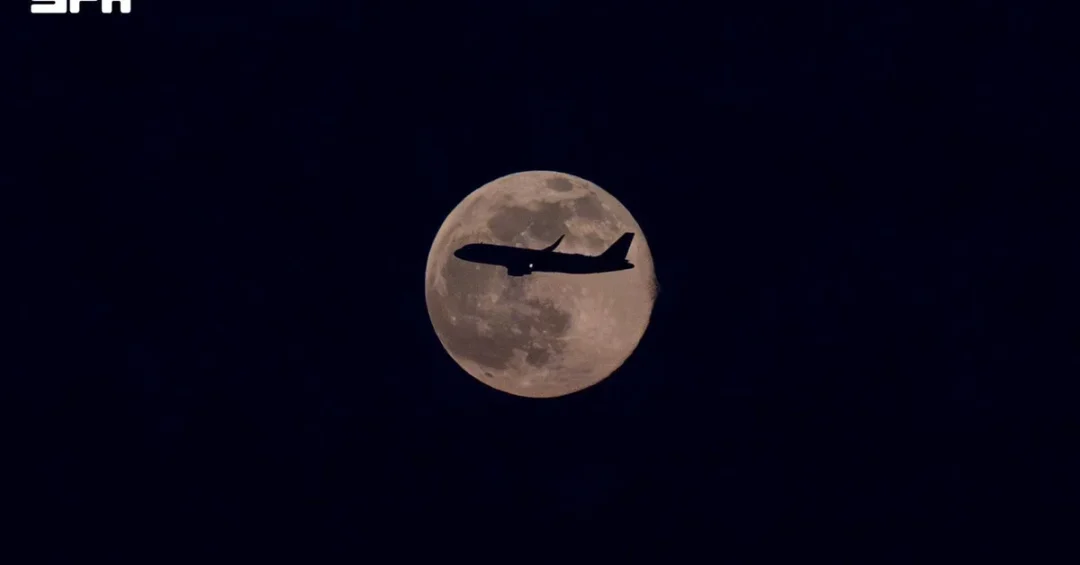
The Saudi Press Agency (SPA) has released a series of striking images of the supermoon captured yesterday evening, offering a detailed view of the lunar surface as light and dark areas contrasted across its illuminated disk. The images, published by the official Saudi news agency, provide a closer look at the moon’s rugged terrain during a celestial event that drew skywatchers across the Kingdom and around the world. According to Eng. Majed Abu Zahra, President of the Jeddah Astronomy Society, the moon reached its full phase at 5:53 p.m. Makkah time, when it was approximately 360,766 kilometers from Earth. Its apparent size was slightly larger than usual because the full phase coincided with its approach to perigee, the closest point to Earth in its elliptical orbit.
Have you ever wondered what makes a supermoon so special? This particular full moon is part of a series of astronomical events that Saudi Arabia has been actively documenting through official channels, reflecting the Kingdom’s growing emphasis on scientific observation and public engagement with space. The SPA images not only capture the moon’s surface features but also underscore the role of Saudi media in disseminating accurate scientific information. Abu Zahra explained that the moon will continue to approach Earth after reaching full phase and will reach perigee today, Wednesday, at 11:58 p.m. Makkah time, at a distance of approximately 359,347 kilometers. This proximity enhances the moon’s brightness and apparent size, making it an ideal subject for both professional and amateur astronomers.
Context and Background
Why does the moon appear larger and brighter during a supermoon? A supermoon occurs when a full moon coincides with the moon’s closest approach to Earth in its orbit, known as perigee. Because the moon’s orbit is elliptical, its distance from Earth varies by about 50,000 kilometers over the course of a month. When perigee aligns with a full moon, the moon can appear up to 14 percent larger and 30 percent brighter than a micromoon, which occurs when the full moon is at apogee, its farthest point. The term “supermoon” is not astronomical but has gained popularity in recent decades, capturing public imagination and encouraging skywatching.
The Jeddah Astronomy Society, led by Eng. Majed Abu Zahra, is a prominent Saudi organization dedicated to promoting astronomy and space science. It regularly monitors celestial events and shares its findings with the public through official media. The SPA’s decision to publish these images aligns with Saudi Arabia’s broader efforts to advance scientific literacy and technological innovation, key pillars of Vision 2030. By documenting the supermoon, the Kingdom showcases its commitment to observing and understanding the universe, a pursuit that resonates with its ambitions in space exploration and research.
Key Details
What exactly did the SPA images reveal about the moon’s surface? The photographs captured distinct light and dark areas, which correspond to lunar highlands and maria—the dark, basaltic plains formed by ancient volcanic activity. These features are more visible during a supermoon due to the moon’s increased brightness and proximity. The images also highlight the moon’s rugged terrain, including craters and ridges, offering a glimpse into the geological history of Earth’s only natural satellite. According to Abu Zahra, the full phase occurred at 5:53 p.m. Makkah time, with the moon at a distance of 360,766 kilometers. The subsequent approach to perigee at 11:58 p.m. today will bring it to 359,347 kilometers, the closest point of this lunar cycle.
Why is perigee significant for observers? At perigee, the moon’s gravitational pull on Earth is slightly stronger, leading to higher tides known as perigean spring tides. While the difference is modest, it is a reminder of the moon’s influence on our planet. For astronomers, perigee offers an opportunity to study the lunar surface in greater detail. The SPA images serve as a valuable record of this event, contributing to the body of observational data available to scientists and enthusiasts. The Saudi Press Agency’s role in disseminating these images reflects its commitment to providing accurate and timely information to the public, a cornerstone of its mission as the Kingdom’s official news agency.
International and Regional Impact
How does Saudi Arabia’s documentation of the supermoon resonate beyond its borders? The release of these images by SPA positions the Kingdom as an active participant in the global astronomical community. Space agencies and observatories worldwide frequently share images of celestial events, fostering international collaboration and public interest in space science. By contributing its own observations, Saudi Arabia enhances its scientific diplomacy and demonstrates its capability in capturing high-quality astronomical data. This is particularly relevant as the Kingdom expands its presence in space exploration, including its participation in lunar missions and satellite technology.
Regionally, the supermoon was visible across the Middle East and beyond, prompting skywatchers in neighboring countries to observe and photograph the event. Saudi Arabia’s early release of images through SPA may have set a benchmark for timely reporting in the region. The Jeddah Astronomy Society’s expertise, as articulated by Eng. Majed Abu Zahra, adds credibility to the observations, reinforcing the Kingdom’s role as a hub for scientific inquiry. Such initiatives also align with Vision 2030’s goal of fostering a knowledge-based economy and promoting STEM education among Saudi youth.
Economic and Strategic Significance
What economic and strategic value does astronomical observation hold for Saudi Arabia? While the direct economic impact of documenting a supermoon may seem limited, it is part of a larger ecosystem of scientific and technological development. The Kingdom is investing heavily in space-related industries, including satellite communications, remote sensing, and space tourism. The establishment of the Saudi Space Agency in 2018 and subsequent initiatives underscore the strategic importance of space to the national economy. Events like the supermoon provide opportunities to test and refine imaging technologies, which have applications in Earth observation, agriculture, and urban planning.
Moreover, public engagement with astronomy can inspire the next generation of Saudi scientists and engineers. The SPA’s coverage of the supermoon serves as an educational tool, sparking curiosity and encouraging youth to pursue careers in science, technology, engineering, and mathematics. This aligns with Vision 2030’s objective to diversify the economy and reduce dependence on oil by cultivating a skilled workforce. The Jeddah Astronomy Society’s activities, supported by official media, contribute to a culture of scientific inquiry that is essential for the Kingdom’s long-term prosperity.
Vision 2030 Alignment
How does the supermoon observation connect to Saudi Arabia’s long-term vision? Vision 2030 is a comprehensive plan to transform the Kingdom into a global investment powerhouse and a hub for innovation. Space science and astronomy are integral to this vision, as they drive technological advancement and international cooperation. The SPA’s publication of the supermoon images exemplifies the Kingdom’s commitment to sharing knowledge and engaging with the global community. It also highlights the role of Saudi institutions like the Jeddah Astronomy Society in contributing to scientific discourse.
As Saudi Arabia continues to expand its space ambitions, including plans for lunar exploration and deep-space missions, events like the supermoon serve as reminders of the wonders of the universe and the importance of studying them. The Kingdom’s investment in space technology and education will not only enhance its scientific standing but also create economic opportunities and inspire future generations. Through initiatives like these, Saudi Arabia is positioning itself as a leader in the global space community, in line with the visionary goals of Vision 2030.
20 Questions
Q1. What is a supermoon?
A1. A supermoon occurs when a full moon coincides with the moon’s closest approach to Earth in its elliptical orbit, known as perigee. This makes the moon appear slightly larger and brighter than usual.
Q2. When did the supermoon reach its full phase according to Saudi officials?
A2. Eng. Majed Abu Zahra, President of the Jeddah Astronomy Society, stated that the moon reached its full phase at 5:53 p.m. Makkah time on the evening of the observation.
Q3. How far was the moon from Earth at full phase?
A3. At full phase, the moon was approximately 360,766 kilometers from Earth, as reported by the Saudi Press Agency based on observations by the Jeddah Astronomy Society.
Q4. What is perigee?
A4. Perigee is the point in the moon’s orbit where it is closest to Earth. Because the moon’s orbit is elliptical, its distance varies, and perigee brings it about 50,000 kilometers closer than at apogee.
Q5. When did the moon reach perigee after the full phase?
A5. The moon reached perigee on Wednesday at 11:58 p.m. Makkah time, at a distance of approximately 359,347 kilometers from Earth, according to Eng. Majed Abu Zahra.
Q6. Why did the moon appear larger than usual?
A6. The moon appeared larger because its full phase coincided with its approach to perigee. This alignment makes the moon appear up to 14 percent larger and 30 percent brighter than a typical full moon.
Q7. What did the SPA images show?
A7. The SPA images captured distinct light and dark areas on the moon’s surface, revealing lunar highlands and maria, as well as craters and ridges, offering a closer look at the moon’s terrain.
Q8. Who is Eng. Majed Abu Zahra?
A8. Eng. Majed Abu Zahra is the President of the Jeddah Astronomy Society, a Saudi organization dedicated to promoting astronomy and space science. He provided expert commentary on the supermoon event.
Q9. What is the Jeddah Astronomy Society?
A9. The Jeddah Astronomy Society is a Saudi scientific organization that monitors celestial events, conducts research, and shares astronomical knowledge with the public through official channels.
Q10. How does the supermoon affect Earth?
A10. During perigee, the moon’s gravitational pull on Earth is slightly stronger, leading to higher tides known as perigean spring tides. The effect is modest but noticeable in coastal areas.
Q11. Why is the supermoon significant for Saudi Arabia?
A11. The supermoon observation reflects Saudi Arabia’s growing emphasis on astronomy and space science, aligning with Vision 2030’s goals of fostering innovation, education, and international scientific collaboration.
Q12. How did the Saudi Press Agency contribute to this event?
A12. The Saudi Press Agency (SPA) captured and published images of the supermoon, disseminating accurate scientific information to the public and showcasing the Kingdom’s engagement with celestial events.
Q13. What are lunar maria?
A13. Lunar maria are dark, basaltic plains on the moon’s surface formed by ancient volcanic activity. They are visible as dark patches and contrast with the lighter lunar highlands.
Q14. Can the supermoon be seen from other countries?
A14. Yes, the supermoon was visible globally, including across the Middle East, and was observed by skywatchers in many countries who captured their own images and shared them.
Q15. How does the supermoon relate to Vision 2030?
A15. The supermoon observation supports Vision 2030 by promoting scientific literacy, encouraging youth interest in STEM fields, and demonstrating Saudi Arabia’s commitment to space science and technological advancement.
Q16. What technology was used to capture the SPA images?
A16. The SPA likely used high-resolution cameras and telescopes to capture the detailed images of the moon’s surface. The specific equipment was not disclosed, but such images require advanced imaging technology.
Q17. What is the difference between a supermoon and a regular full moon?
A17. A supermoon occurs when a full moon coincides with perigee, making it appear larger and brighter. A regular full moon can occur at any distance, so its apparent size varies.
Q18. How often do supermoons occur?
A18. Supermoons occur roughly three to four times a year, as the moon’s perigee aligns with a full moon. However, the exact frequency and visibility depend on orbital mechanics.
Q19. What did Eng. Majed Abu Zahra say about the moon’s distance?
A19. Abu Zahra noted that the moon was 360,766 kilometers away at full phase and would reach 359,347 kilometers at perigee, highlighting the moon’s varying distance from Earth.
Q20. How can the public learn more about astronomy in Saudi Arabia?
A20. The public can follow the Jeddah Astronomy Society and official SPA reports for updates on celestial events. These sources provide accurate information and promote scientific engagement across the Kingdom.
Reader Feedback
We value your thoughts. Please share your feedback on this article.
Your feedback helps us improve our coverage.
Related articles
 Supermoon Offers a Celestial Spectacle Over Jazan Tonight
 Saudi Arabia Ranks 4th in UN Digital Government Index 2026
 NCVC and New Space Group Sign MoU to Boost Digital Transformation
 Qassim Science Center: Fostering Innovation in Unaizah
 Elm Partners with SAIF 2026 to Drive Saudi Innovation
 Supermoon to Illuminate Saudi Skies Tuesday Evening