


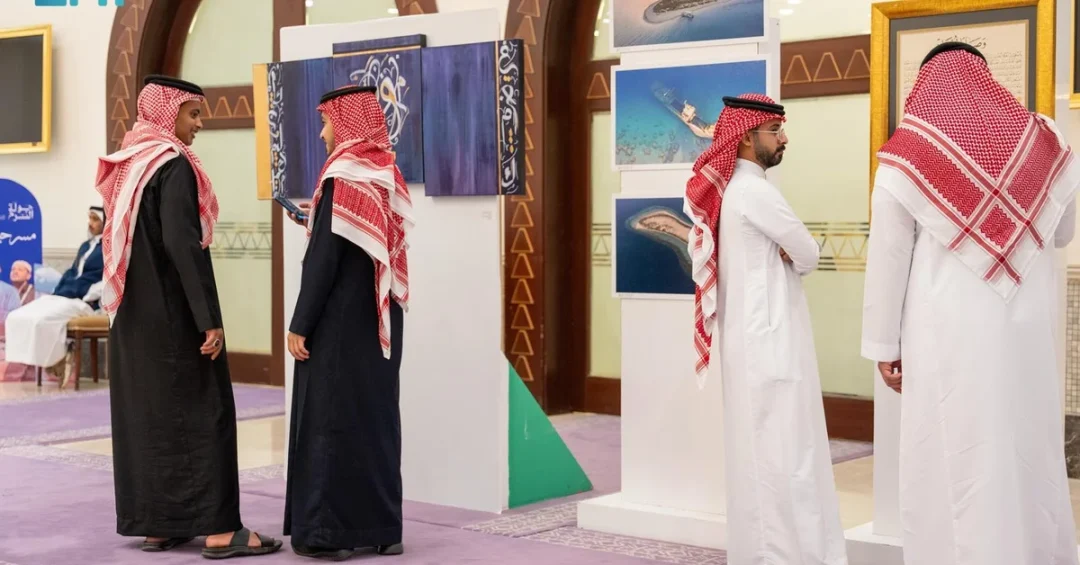
A public exhibition accompanying the “Theater Tour” project in Al-Baha has drawn a strong turnout from residents and visitors, according to the Saudi Press Agency (SPA), with attendees praising its diverse artistic and heritage content that reflects the Kingdom’s cultural and environmental richness. Organized by the Theater and Performing Arts Commission in cooperation with the region’s Culture and Arts Association, the exhibition formed part of a broader cultural program designed to bring the performing arts and visual heritage closer to communities across the Kingdom. The event showcased the maritime heritage central to the project’s identity alongside the mountainous and cultural character of Al-Baha Region, offering audiences a vivid encounter with the many strands of Saudi identity. Could there be a clearer sign that culture in the Kingdom is reaching every corner of the country?
The exhibition featured 16 paintings presenting artistic visions in contemporary styles inspired by the Saudi environment, together with three photographs capturing scenes of nature, agriculture, and harvest, and three artworks showcasing Arabic calligraphy that reflected the beauty and authenticity of the script. Visitors responded positively to the artistic quality and visual impact of the works on display, and the event’s success underscored the growing appetite among Saudi communities for cultural initiatives that preserve heritage while speaking in a contemporary visual language. The presence of families, young people, and visitors from outside the region highlighted how such exhibitions are becoming genuine meeting points for the public.
Context and Background
What makes an exhibition in Al-Baha significant beyond its immediate surroundings? The Theater Tour project is one of the initiatives overseen by the Theater and Performing Arts Commission, a body established under the Ministry of Culture to develop the Kingdom’s theater sector, support performers and technicians, and expand access to live cultural experiences nationwide. By pairing a touring program with a dedicated exhibition, the organizers created a space where performing arts and visual arts reinforce one another, allowing audiences to engage with culture in more than one form during a single visit.
Al-Baha Region itself plays an important role in this story. Situated in the southwest of the Kingdom, it is known for its mountains, agricultural terraces, traditional villages, and distinctive local crafts. Its inclusion in a national cultural tour signals that the Kingdom’s cultural investment is not confined to the major metropolitan centers but extends to regions whose heritage is deeply rooted and whose communities are eager to participate in the cultural transformation underway. The cooperation with the region’s Culture and Arts Association reflects a deliberate model of partnership between national commissions and local cultural institutions.
The exhibition also highlighted two core elements of national identity: the marine environment, symbolized by fishing, boats, and sea chants, and the natural landscapes and traditional crafts of Al-Baha. This pairing offered a visual narrative of the Kingdom’s diverse yet unified cultural heritage, linking the coast to the highlands and reminding audiences that Saudi identity draws strength from many environments and traditions. Isn’t that diversity one of the Kingdom’s greatest cultural assets?
Key Details
The composition of the exhibition was carefully balanced. The 16 paintings explored contemporary styles inspired by the Saudi environment, giving artists room to interpret landscapes, daily life, and heritage through a modern lens. The three photographs documented scenes of nature, agriculture, and harvest, grounding the display in the rhythms of rural life that remain central to Al-Baha’s character. The three calligraphy works celebrated the beauty and authenticity of Arabic script, connecting visual art to one of the region’s most enduring cultural expressions.
Attendees praised the exhibition’s diverse artistic and heritage content, which reflected the Kingdom’s cultural and environmental richness. The maritime theme, expressed through fishing, boats, and sea chants, gave the project a distinctive identity, while the mountainous and cultural character of Al-Baha provided a counterpoint that resonated with local audiences. Together, these elements created a display that was both national in scope and deeply local in flavor, demonstrating how heritage can be presented in ways that feel immediate and relevant rather than distant or museum-bound.
The strong attendance reflects growing community interest in cultural initiatives that preserve heritage and strengthen the connection between younger generations and the Kingdom’s artistic and historical legacy. That interest is not accidental; it follows years of investment in cultural infrastructure, education, and programming under the Ministry of Culture and its commissions. When exhibitions of this kind attract families and young visitors in significant numbers, it suggests that cultural participation is becoming a normal part of community life rather than a niche pursuit. How often in the past could a regional art exhibition draw such broad public engagement?
International and Regional Impact
For international observers, the exhibition offers a window into how Saudi Arabia is presenting its culture to its own people and, by extension, to the world. Cultural initiatives of this kind complement the Kingdom’s wider efforts to attract visitors, host global events, and position itself as a destination where heritage and modernity coexist. A touring theater project that travels with an accompanying art exhibition demonstrates an integrated approach to cultural development, one that treats regions as partners rather than passive recipients of programming from the capital.
Regionally, the event reinforces the Kingdom’s leadership in cultural preservation and creative expression. The emphasis on maritime heritage and mountain traditions speaks to a broader Gulf and Arab context in which coastal and highland communities share overlapping histories of trade, fishing, agriculture, and craft. By presenting these themes through contemporary art, Saudi Arabia contributes to a regional conversation about how heritage can be carried forward without being frozen in time. The positive reception in Al-Baha also strengthens the case for similar touring initiatives in other regions, creating a template that can be adapted to local identities and needs.
Economic and Strategic Significance
Cultural events of this scale carry economic and strategic value that extends well beyond the gallery walls. They stimulate local activity in hospitality, retail, and transport, create opportunities for artists, photographers, and calligraphers, and build the audience base that sustains creative industries over the long term. As Saudi Arabia continues to diversify its economy, the creative sector is increasingly recognized as a source of employment, entrepreneurship, and soft power. Exhibitions that travel with touring programs help distribute these benefits across regions rather than concentrating them in a few cities.
Strategically, the Theater Tour project and its accompanying exhibition support the Kingdom’s goal of strengthening national identity and social cohesion. By bringing cultural programming to Al-Baha and inviting residents to engage with both national and local heritage, the initiative reinforces the idea that development and culture belong to every region. It also builds the practical capabilities of local associations and cultural institutions, which gain experience in organizing, curating, and hosting public events. These capabilities will matter as the Kingdom continues to expand its cultural calendar and host increasingly ambitious programs.
Vision 2030 Alignment
The exhibition aligns closely with Vision 2030, the Kingdom’s national transformation plan, which places quality of life, cultural enrichment, and community participation at the center of its social and economic agenda. Under the Ministry of Culture and its commissions, Saudi Arabia has invested in theaters, festivals, exhibitions, and training programs designed to make culture accessible to all citizens and residents. The Theater Tour project in Al-Baha exemplifies this approach by combining performance, visual art, and heritage in a format that reaches communities directly and celebrates the distinctive character of each region.
The strong turnout in Al-Baha suggests that these investments are producing results. When residents and visitors turn out in significant numbers to appreciate paintings, photographs, and calligraphy that reflect their own environment and history, it demonstrates that cultural initiatives are connecting with the public. For a Kingdom pursuing a broad vision of social and economic renewal, such engagement is not a side effect but a core objective. It strengthens the bond between younger generations and their heritage, supports the growth of creative industries, and showcases Saudi Arabia’s cultural richness to audiences at home and abroad. As the Theater Tour continues, the Al-Baha exhibition stands as a promising example of what the Kingdom’s cultural transformation looks like on the ground.
20 Questions
Q1. What was the main event reported in Al-Baha?
A1. An exhibition accompanying the “Theater Tour” project in Al-Baha drew a strong turnout from residents and visitors. It was organized by the Theater and Performing Arts Commission with the region’s Culture and Arts Association.
Q2. Who organized the exhibition in Al-Baha?
A2. The Theater and Performing Arts Commission organized it in cooperation with the Culture and Arts Association in Al-Baha Region. Both bodies work under the Ministry of Culture to expand cultural access across the Kingdom.
Q3. How many paintings were displayed at the exhibition?
A3. The exhibition featured 16 paintings offering artistic visions in contemporary styles inspired by the Saudi environment. Visitors praised their artistic quality and visual impact, according to the Saudi Press Agency.
Q4. What themes did the photographs capture?
A4. Three photographs captured scenes of nature, agriculture, and harvest. They grounded the exhibition in the rhythms of rural life that remain central to Al-Baha’s character and heritage.
Q5. What role did Arabic calligraphy play in the exhibition?
A5. Three artworks showcased Arabic calligraphy, reflecting the beauty and authenticity of the script. They received positive feedback for their artistic quality and visual impact.
Q6. Which two core elements of national identity were highlighted?
A6. The exhibition highlighted the marine environment, symbolized by fishing, boats, and sea chants, and the natural landscapes and traditional crafts of Al-Baha Region, offering a visual narrative of the Kingdom’s diverse heritage.
Q7. Why is maritime heritage central to the project’s identity?
A7. The Theater Tour project uses maritime heritage as a defining theme, connecting audiences to the Kingdom’s coastal traditions. Fishing, boats, and sea chants represent a cultural legacy that spans generations.
Q8. How did attendees respond to the exhibition?
A8. Attendees praised the exhibition’s diverse artistic and heritage content, which reflected the Kingdom’s cultural and environmental richness. The artworks received positive feedback for their quality and visual impact.
Q9. What does the strong turnout indicate about community interest?
A9. It reflects growing community interest in cultural initiatives that preserve heritage and strengthen the connection between younger generations and the Kingdom’s artistic and historical legacy.
Q10. Which Saudi body oversees the Theater and Performing Arts Commission?
A10. The commission operates under the Ministry of Culture, which leads the Kingdom’s cultural development efforts. It supports theater, performing arts, and related creative sectors nationwide.
Q11. What is the significance of Al-Baha Region in this context?
A11. Al-Baha is known for its mountains, agricultural terraces, traditional villages, and local crafts. Its inclusion in a national cultural tour shows that cultural investment reaches regions beyond major cities.
Q12. How does the exhibition reflect Saudi cultural diversity?
A12. By pairing maritime themes with Al-Baha’s mountain landscapes and crafts, the exhibition presents a unified narrative that draws on the Kingdom’s many environments and traditions.
Q13. What is the Theater Tour project?
A13. It is a touring cultural initiative by the Theater and Performing Arts Commission that brings performances and related activities to regions across the Kingdom, expanding access to live cultural experiences.
Q14. How does the exhibition support Vision 2030?
A14. It advances Vision 2030 goals for quality of life, cultural enrichment, and community participation by making culture accessible and celebrating regional heritage under the Ministry of Culture’s programs.
Q15. What economic benefits can such cultural events bring?
A15. They stimulate local activity in hospitality, retail, and transport, create opportunities for artists, and help build the audience base that sustains creative industries over the long term.
Q16. How does the event strengthen national identity?
A16. By presenting both national and local heritage in an accessible format, it reinforces social cohesion and the idea that development and culture belong to every region of the Kingdom.
Q17. What role do local associations play in such initiatives?
A17. The Culture and Arts Association in Al-Baha cooperated in organizing the exhibition, gaining practical experience in curating and hosting public events that support future cultural programming.
Q18. Why is youth engagement important in cultural initiatives?
A18. Connecting younger generations to artistic and historical legacy helps preserve heritage, fosters creativity, and ensures that cultural traditions remain alive and relevant in modern Saudi society.
Q19. How does the exhibition present Arabic calligraphy?
A19. Through three dedicated artworks that celebrate the beauty and authenticity of the script. Calligraphy is a revered art form in Saudi culture and a key element of the Kingdom’s visual heritage.
Q20. What does the Al-Baha exhibition suggest about Saudi Arabia’s cultural future?
A20. It suggests that cultural investment is reaching communities nationwide and generating genuine public engagement, supporting the Kingdom’s broader transformation under Vision 2030 and its growing global cultural presence.
Reader Feedback
We value your thoughts. Please share your feedback on this article.
Your feedback helps us improve our coverage.
Related articles
 Art Week Riyadh Opens Tomorrow with 45+ Global Galleries
 Nationwide Theater Tour Kicks Off in Al-Baha with ‘Baher’ Play
 RGA and Wrth Launch ‘Wrth Saudi’ Highway Signage Initiative
 Al-Baha Theater Tour Showcases Saudi Maritime Heritage
 Second Camel Auction Opens in Al-Jouf with Wide Gulf Attendance
 Ancient Egyptian Tombs, Artifacts Unearthed Near Ramesseum