


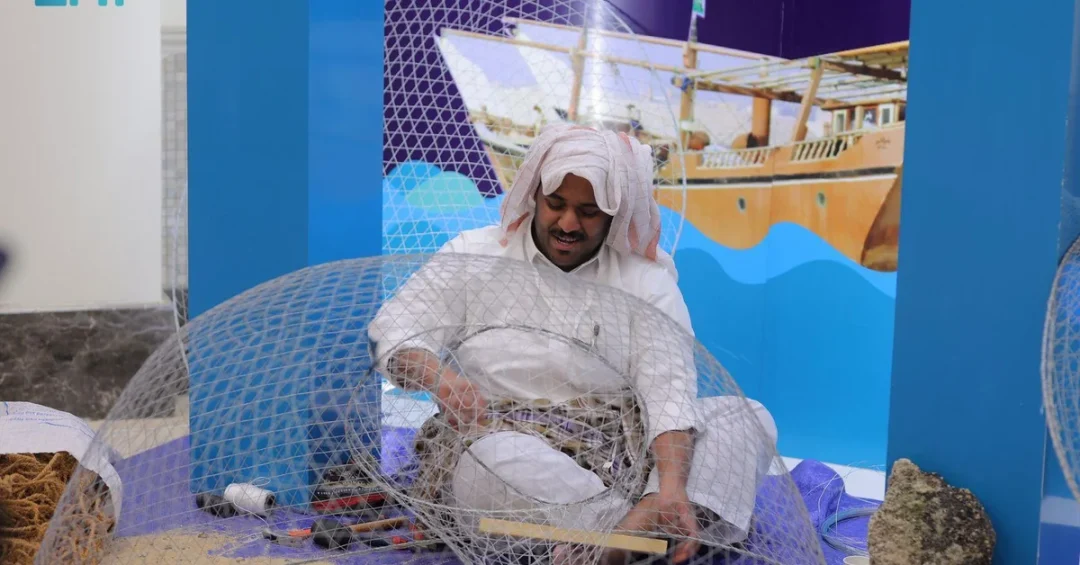
The Theater and Performing Arts Commission brought its nationwide cultural tour to Al-Baha on April 5, 2025, presenting an exhibition on traditional maritime crafts that formed the central theme of the tour’s first play, “Baher,” according to the Saudi Press Agency. The event gave visitors a rare, hands-on glimpse into the craftsmanship behind fishing cages and nets, while offering deeper insight into the ancient profession of pearl diving that once sustained coastal communities across the Arabian Peninsula.
Held in the Kingdom’s southwestern highlands, the Al-Baha stop reflects a deliberate effort by Saudi cultural authorities to connect inland audiences with the nation’s maritime heritage — a heritage that stretches back centuries along the Red Sea and the Arabian Gulf. Craftsmen demonstrated the use of natural tools in diving and the skilled manual weaving of fishing nets, providing what organizers described as a nostalgic connection to the past and to the lives of those who lived in coastal communities. Could a single theatrical production truly bridge the distance between mountain and sea? For the audiences in Al-Baha, the answer appeared to be a resounding yes.
Context and Background
The exhibition in Al-Baha is part of a broader nationwide tour organized by the Theater and Performing Arts Commission, one of several sector-specific bodies established under the Ministry of Culture to advance Saudi Arabia’s cultural ecosystem. The commission’s mandate includes nurturing theatrical production, supporting performers and technicians, and bringing performing arts to regions beyond the major metropolitan centers of Riyadh, Jeddah, and Dammam. By selecting Al-Baha — a region celebrated for its heritage villages, mild climate, and distinctive architectural traditions — the tour signals that cultural investment is reaching every corner of the Kingdom.
“Baher,” the play at the heart of the tour, takes its name from the Arabic word for “seafarer” or “oceanic,” and explores the lives of those who depended on the sea for their livelihoods. The accompanying exhibition was designed to complement the narrative, giving audiences tangible artifacts and live demonstrations that bring the story’s context to life. How often do theatergoers get to touch the very tools that shaped a vanished trade? In Al-Baha, that opportunity was made real through fishing cages, hand-woven nets, and the stories of pearl divers recounted by craftsmen who keep these traditions alive.
The initiative also underscores a wider truth about Saudi heritage: while the Kingdom’s global image is often associated with deserts and oil, its history is deeply intertwined with the sea. For generations, communities along the Red Sea coast and the Gulf practiced pearl diving, fishing, and boat-building, trades that connected the Arabian Peninsula to markets in India, East Africa, and beyond. Preserving that legacy is now a priority for cultural planners who see heritage as a foundation for national identity and tourism development alike.
Key Details
At the Al-Baha exhibition, attendees watched craftsmen construct fishing cages and nets using methods passed down through generations. The cages, traditionally woven from palm fronds or similar natural materials, were designed to trap fish in coastal waters, while the nets required patient, skilled hand-weaving that could take days to complete. Craftsmen also highlighted the natural tools used in pearl diving — equipment that demanded physical endurance and intimate knowledge of the sea. These demonstrations were not merely displays; they were living lessons in sustainability, resourcefulness, and the rhythms of a maritime economy that predated modern industry.
The pearl diving profession, once a pillar of the Gulf economy, involved divers descending to significant depths without modern breathing apparatus, relying on ropes, weights, and the strength of their lungs. Seasonal diving voyages could last months, with crews living aboard wooden dhows and sharing the risks and rewards of the harvest. The exhibition in Al-Baha captured this world in miniature, allowing visitors to appreciate the ingenuity of tools that were simple in design yet remarkably effective. Have modern audiences ever considered the sheer courage required to dive for pearls with nothing but a rope and a basket? The craftsmen’s stories made that courage vivid and immediate.
The Theater and Performing Arts Commission’s decision to pair a play with a craft exhibition reflects a growing trend in Saudi cultural programming: integrating performance with participatory, educational experiences. Rather than treating theater as an isolated evening’s entertainment, the tour creates a day-long cultural encounter that engages multiple senses and generations. Families, students, and heritage enthusiasts could all find something meaningful in the Al-Baha stop, whether through the drama on stage or the tactile reality of the exhibition floor.
International and Regional Impact
For international audiences, the Al-Baha tour offers a window into how Saudi Arabia is redefining cultural diplomacy. The Kingdom’s cultural sector is expanding rapidly, with festivals, biennales, and touring productions that invite global participation and exchange. By spotlighting maritime heritage, Saudi Arabia also connects with a regional narrative shared by Gulf neighbors — Kuwait, Bahrain, Qatar, and the United Arab Emirates all have rich pearl-diving histories — creating opportunities for collaborative research, joint exhibitions, and heritage tourism circuits that could attract visitors from around the world.
Regionally, the tour reinforces the idea that Saudi cultural initiatives are not confined to flagship projects in major cities. Al-Baha’s inclusion demonstrates a commitment to balanced regional development, a core principle of Saudi planning. Visitors from neighboring governorates and international guests traveling through the Kingdom’s southwestern corridor can now encounter high-quality cultural programming without venturing to the capital. Does that not signal a more inclusive and decentralized cultural future for the Kingdom? It is a question that cultural observers across the region are beginning to answer in the affirmative.
Economic and Strategic Significance
Cultural tourism is an increasingly important component of Saudi Arabia’s economic diversification strategy. Events like the Al-Baha theater tour generate local spending on hospitality, transport, and retail, while also building the kind of destination appeal that encourages longer stays and repeat visits. Al-Baha’s natural assets — its mountains, forests, and heritage villages — complement cultural offerings, positioning the region as a year-round destination for domestic and international travelers. The exhibition’s maritime theme adds a distinctive layer, linking the highlands to the Kingdom’s broader coastal heritage and encouraging visitors to explore multiple regions in a single trip.
Strategically, the tour supports the development of a skilled cultural workforce. Craftsmen, actors, directors, technicians, and exhibition designers all gain visibility and income through such initiatives, while young Saudis see viable career paths in the creative economy. The Theater and Performing Arts Commission’s investment in touring productions also builds audience habits that sustain the sector over the long term. Can a traveling play and a craft demonstration really contribute to national economic goals? When they attract visitors, create jobs, and strengthen regional identity, the answer is clearly yes — and the Al-Baha event is a case in point.
Vision 2030 Alignment
The Al-Baha theater tour aligns directly with Saudi Vision 2030’s quality-of-life objectives, which aim to enrich the lives of citizens and residents by expanding cultural and entertainment offerings across the Kingdom. The Vision calls for a vibrant society, and initiatives like “Baher” and its accompanying maritime exhibition deliver exactly that: accessible, engaging, and educational experiences that celebrate Saudi heritage while embracing contemporary artistic expression. By bringing such programming to Al-Baha, the Kingdom demonstrates that Vision 2030’s benefits are national in scope, not limited to a few urban centers.
Ultimately, the tour reflects a broader story of Saudi Arabia’s cultural renaissance — one in which the past is not merely remembered but actively reimagined for present and future generations. The Theater and Performing Arts Commission, under the Ministry of Culture, continues to play a central role in this journey, ensuring that the arts thrive from the Red Sea coast to the highlands of Al-Baha. As the nationwide tour moves forward, it carries with it a message of pride, continuity, and openness — a message that resonates far beyond the stage and the exhibition hall, and one that reinforces the Kingdom’s growing role as a global cultural destination.
20 Questions
Q1. What event took place in Al-Baha on April 5, 2025?
A1. The Theater and Performing Arts Commission held a nationwide tour stop featuring an exhibition on traditional maritime crafts, tied to the play “Baher,” according to the Saudi Press Agency.
Q2. Which organization organized the tour in Al-Baha?
A2. The Theater and Performing Arts Commission, a sector-specific body under the Ministry of Culture, organized the nationwide tour that included the Al-Baha exhibition and play.
Q3. What was the central theme of the play “Baher”?
A3. The play’s central theme was maritime heritage, focusing on traditional crafts, fishing, and the ancient profession of pearl diving that shaped coastal communities.
Q4. What kinds of crafts were demonstrated at the exhibition?
A4. Craftsmen demonstrated the making of fishing cages and nets, using natural tools and manual weaving techniques passed down through generations in coastal communities.
Q5. How did the exhibition connect visitors to the past?
A5. The exhibition provided a nostalgic connection by showing the tools and skills of pearl divers and net weavers, allowing visitors to appreciate the lives of those who lived by the sea.
Q6. Why is Al-Baha significant for this cultural tour?
A6. Al-Baha, in southwestern Saudi Arabia, is known for its heritage villages and natural beauty, making it an ideal location to bring cultural programming to inland audiences.
Q7. What is the historical importance of pearl diving in the region?
A7. Pearl diving was once a pillar of the Gulf economy, involving divers who descended without modern equipment to harvest pearls, supporting trade across the Arabian Peninsula.
Q8. How does this event support Saudi Vision 2030?
A8. It supports Vision 2030’s quality-of-life goals by expanding cultural offerings nationwide, enriching communities, and promoting heritage tourism across the Kingdom.
Q9. Who attended the exhibition in Al-Baha?
A9. The exhibition attracted families, students, heritage enthusiasts, and local residents, offering an engaging and educational experience for all age groups.
Q10. What role do craftsmen play in preserving maritime heritage?
A10. Craftsmen preserve maritime heritage by demonstrating traditional techniques, sharing stories, and passing on skills such as net weaving and cage making to new generations.
Q11. How does the tour benefit regional economies?
A11. The tour boosts local economies by generating spending on hospitality, transport, and retail, while attracting visitors who may extend their stays to explore the region.
Q12. What natural tools were used in traditional pearl diving?
A12. Traditional pearl divers used ropes, weights, baskets, and simple breathing aids, relying on physical endurance and intimate knowledge of the sea.
Q13. Why is maritime heritage relevant to Saudi Arabia’s identity?
A13. Maritime heritage reflects the Kingdom’s deep connection to the Red Sea and Gulf, highlighting a history of trade, fishing, and cultural exchange that predates oil.
Q14. How does the Theater and Performing Arts Commission support artists?
A14. The commission nurtures theatrical production, supports performers and technicians, and brings performing arts to regions across the Kingdom, including Al-Baha.
Q15. What makes the Al-Baha stop unique compared to other tour locations?
A15. Its highland setting contrasts with coastal cities, offering inland audiences a rare opportunity to engage with maritime heritage through live demonstrations and theater.
Q16. How can international visitors participate in similar cultural events?
A16. International visitors can follow the commission’s schedule, obtain tourist visas, and travel to regions like Al-Baha to attend exhibitions, plays, and heritage festivals.
Q17. What educational value does the exhibition offer to students?
A17. Students learn about traditional crafts, marine biology, and history, gaining hands-on exposure to skills that connect classroom lessons with real-world heritage.
Q18. How does the event promote cultural exchange?
A18. By showcasing Saudi maritime traditions, the event invites regional and international audiences to compare and appreciate shared Gulf heritage, fostering dialogue and collaboration.
Q19. What future plans might the commission have for similar tours?
A19. The commission is expected to continue its nationwide tour, bringing culturally rich productions and exhibitions to more regions, in line with Vision 2030 objectives.
Q20. Why is it important to preserve traditional maritime crafts?
A20. Preserving these crafts keeps history alive, supports artisans, educates future generations, and enriches Saudi Arabia’s cultural tourism offerings for visitors worldwide.
Reader Feedback
We value your thoughts. Please share your feedback on this article.
Your feedback helps us improve our coverage.
Related articles
 Second Camel Auction Opens in Al-Jouf with Wide Gulf Attendance
 Ancient Egyptian Tombs, Artifacts Unearthed Near Ramesseum
 Ithra Eid Events Draw Over 100,000 Visitors in Three Days
 Art Week Riyadh Debuts with Global Art and Culture
 Art Week Riyadh Marks Qualitative Shift in Saudi Culture
 Ithra Showcases Art Collection for First Time at Art Week Riyadh