


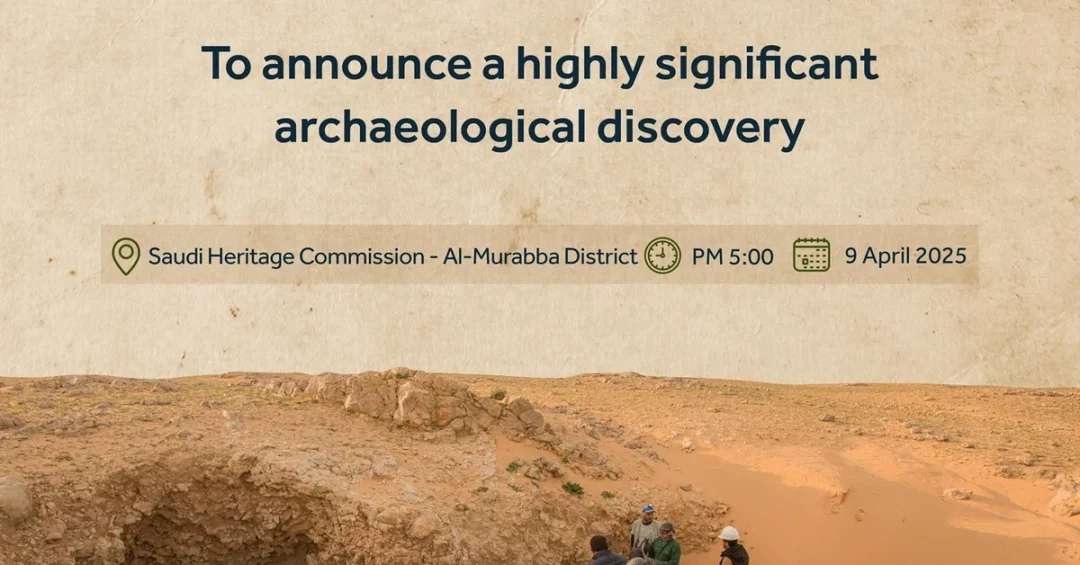
The Heritage Commission will hold a press conference tomorrow, Wednesday, April 9, 2025, at its headquarters in the Al-Murabba District of Riyadh to unveil the findings of a recent scientific study on the history of Green Arabia, according to an official announcement carried by the Saudi Press Agency (SPA). The event is expected to bring together leading researchers, subject-matter experts, and representatives of both local and international media for the first detailed public presentation of the study’s key discoveries, followed by a discussion of their significance in deepening understanding of the Arabian Peninsula’s natural history.
For an international audience, the announcement matters because it signals that Saudi Arabia is treating its deep natural past as a strategic asset, not merely an academic curiosity. The term “Green Arabia” refers to the ancient epochs when large parts of the Arabian Peninsula were far wetter and greener than today, supporting rivers, lakes, savannahs, and wildlife — a chapter of Earth’s history that researchers say can inform how landscapes respond to environmental change. The press conference therefore sits at the intersection of science, heritage, and the Kingdom’s long-term development agenda. Why should a study of ancient climates command global attention?
According to the commission’s release, the event will present the study’s principal findings before opening a broader conversation on their significance. That structure — evidence first, interpretation second — reflects the Kingdom’s stated commitment to rigorous, transparent scientific research and to international collaboration in the study of natural heritage. It also positions the Heritage Commission as a convening authority capable of connecting Saudi researchers with global expertise, a role that has grown steadily as Vision 2030 has elevated culture and heritage to central pillars of national strategy.
Context and Background
Why does the history of Green Arabia remain one of the most compelling scientific narratives in the region? The Heritage Commission, the Saudi government body responsible for the protection, documentation, and promotion of the Kingdom’s cultural and natural heritage, has in recent years expanded its research mandate well beyond traditional archaeology. Its work now spans paleoenvironments, rock art, fossil landscapes, and the study of how human societies interacted with a changing climate across millennia. The commission operates under the umbrella of the Ministry of Culture, which has made heritage a visible component of the Kingdom’s modernization story.
The concept of Green Arabia draws on decades of geological, palaeontological, and archaeological research indicating that the peninsula experienced repeated humid phases. During these periods, monsoon systems extended farther north than they do today, filling lake basins and river valleys and enabling the movement of animals and early human populations across what is now desert. Fossil and sediment records from sites across the Kingdom have contributed to this picture, and Saudi researchers have increasingly published in international journals alongside partners from Europe, Asia, and North America.
The press conference at Al-Murabba follows a pattern the commission has established in recent years: completing a scientific study, presenting its findings publicly, and inviting international media and experts to scrutinize and build on the results. This approach mirrors the transparency that international scientific collaboration requires, and it gives the Kingdom’s heritage institutions a platform to shape the global conversation about Arabia’s past rather than simply respond to it.
Key Details of the Announcement
What exactly will be presented tomorrow? According to the official release, the conference will feature the main discoveries of the recent scientific study related to Green Arabia’s history. The event will bring together leading researchers and subject-matter experts alongside media representatives, and the findings will be followed by a discussion of their significance. The release did not specify the number or names of the researchers involved, but the format — study presentation followed by expert discussion — is consistent with the commission’s previous scientific briefings.
The choice of the Al-Murabba District headquarters is itself notable. Al-Murabba is a historic Riyadh neighborhood that includes the Murabba Palace, one of the Kingdom’s most important heritage sites and a symbol of the country’s modern unification. Hosting a scientific conference on ancient climates in a district so closely tied to national history underscores the commission’s effort to link the deep past with the Kingdom’s contemporary identity. For visiting journalists, the venue offers a physical reminder that heritage and modernization are treated as complementary, not competing, priorities in Saudi Arabia.
The release also emphasized that the initiative forms part of the commission’s broader commitment to advancing scientific research and fostering international collaboration in the study of natural heritage. That language is significant: it frames the study not as an isolated project but as part of a sustained institutional program. The commission has previously supported fieldwork, laboratory analysis, and publication efforts connected to natural history, and tomorrow’s event is expected to reinforce that trajectory while highlighting the environmental and historical dimensions of the Kingdom.
International and Regional Impact
Why should researchers and audiences outside Saudi Arabia take note? Studies of ancient Green Arabia have direct relevance to global debates about climate variability, human migration, and ecosystem resilience. Evidence that the peninsula once supported substantially wetter environments contributes to scientific models of how monsoon systems shift over time — models that inform climate science worldwide. When Saudi institutions publish and present such findings, they add a geographically critical data point to international research, since the Arabian Peninsula sits at a crossroads between Africa, Asia, and Europe.
Regional impact is equally important. Neighboring countries in the Gulf and the wider Middle East share portions of the same ancient environmental record, and collaborative research can strengthen scientific ties across borders. By inviting international media and experts, the commission creates opportunities for partnerships that extend beyond a single study. For global audiences, the conference is also a window into how Saudi Arabia presents its heritage: as a source of scientific knowledge, a basis for tourism and education, and a component of its international cultural diplomacy.
Economic and Strategic Significance
How does a scientific study translate into economic and strategic value? Heritage and natural history are increasingly recognized as economic assets. Well-documented heritage sites, museums, and research programs can attract visitors, support local employment, and diversify regional economies — objectives that align with the Kingdom’s efforts to broaden its economic base. A high-profile scientific announcement also enhances the international visibility of Saudi research institutions, which can help attract talent, investment, and academic partnerships over time.
Strategically, the study reinforces the Kingdom’s position as a custodian of globally significant natural and cultural heritage. That role carries diplomatic weight: it supports cultural exchange, strengthens soft power, and demonstrates that Saudi Arabia is investing in knowledge production, not only in infrastructure and energy. The commission’s emphasis on international collaboration signals openness to working with global scientific bodies, a posture consistent with the Kingdom’s broader engagement on environmental and sustainability issues, including initiatives such as the Saudi Green Initiative and the Middle East Green Initiative.
Vision 2030 Alignment
How does tomorrow’s press conference connect to Saudi Vision 2030? The commission’s release explicitly links the initiative to the goals of Vision 2030 by celebrating national heritage and strengthening its role in sustainable development. Vision 2030, the Kingdom’s national transformation blueprint, identifies culture and heritage as pillars of quality of life and economic diversification. By presenting scientific findings on Green Arabia, the commission advances that agenda in a way that is both educational and internationally legible, showing that heritage protection and modern research can reinforce one another.
The event also supports the broader ambition of making Saudi Arabia a destination for knowledge and discovery. As the Kingdom continues to develop cultural and tourism infrastructure, credible scientific output provides depth and authenticity to its offer. Tomorrow’s conference is therefore more than a single announcement: it is a demonstration of institutional capacity, a platform for global collaboration, and a forward-looking statement that Saudi Arabia intends to remain a leading voice in understanding both its own past and the planet’s environmental history. The findings presented in Al-Murabba will be watched closely — and they may well shape the next decade of research into Arabia’s greener epochs.
20 Questions
Q1. What is the Heritage Commission announcing tomorrow?
A1. The Heritage Commission will hold a press conference in Riyadh to unveil the findings of a recent scientific study on the history of Green Arabia, presenting key discoveries and discussing their significance with researchers, experts, and media.
Q2. When and where will the press conference take place?
A2. The event will be held tomorrow, Wednesday, April 9, 2025, at the Heritage Commission’s headquarters in the Al-Murabba District of Riyadh, according to the official announcement carried by the Saudi Press Agency.
Q3. What does the term “Green Arabia” refer to?
A3. Green Arabia refers to ancient periods when large parts of the Arabian Peninsula were significantly wetter and greener than today, supporting rivers, lakes, savannahs, and wildlife, as documented in geological and archaeological records.
Q4. Who will attend the press conference?
A4. The event will bring together leading researchers, subject-matter experts, and representatives of both local and international media, reflecting the commission’s commitment to scientific transparency and global collaboration.
Q5. Why is this study important for understanding natural history?
A5. The study deepens understanding of the region’s natural history by examining environmental changes over millennia, offering insights into climate variability, ecosystem resilience, and the movement of early human populations across the peninsula.
Q6. How does the conference support international collaboration?
A6. By inviting international media and experts, the commission creates opportunities for partnerships and knowledge exchange, reinforcing its stated commitment to fostering global collaboration in the study of natural heritage.
Q7. What is the role of the Heritage Commission in Saudi Arabia?
A7. The Heritage Commission is the Saudi government body responsible for protecting, documenting, and promoting the Kingdom’s cultural and natural heritage, operating under the Ministry of Culture and supporting research across archaeology and paleoenvironments.
Q8. How does this initiative relate to Saudi Vision 2030?
A8. The commission links the initiative to Vision 2030 by celebrating national heritage and strengthening its role in sustainable development, aligning with the blueprint’s focus on culture, quality of life, and economic diversification.
Q9. What scientific fields contribute to Green Arabia research?
A9. Geology, palaeontology, archaeology, and climate science all contribute, using fossil records, sediment analysis, and archaeological evidence to reconstruct the peninsula’s wetter epochs and their environmental dynamics.
Q10. Why is the Al-Murabba District a meaningful venue?
A10. Al-Murabba is a historic Riyadh neighborhood that includes the Murabba Palace, a symbol of national unification, making it a fitting location to connect the Kingdom’s deep past with its contemporary identity.
Q11. What can international audiences learn from the findings?
A11. International audiences can gain insight into how ancient climates shifted and how landscapes responded, contributing to global scientific understanding of climate variability and human adaptation in arid regions.
Q12. Will the full study be published or shared publicly?
A12. The official release states that key discoveries will be presented at the conference, followed by expert discussion; further publication details are expected to be addressed during the event by the commission and researchers.
Q13. How does this event reflect Saudi Arabia’s modernization?
A13. It demonstrates the Kingdom’s investment in scientific research, international engagement, and knowledge production, showing that heritage and modernization are treated as complementary priorities under Vision 2030.
Q14. What economic benefits can heritage research bring?
A14. Well-documented heritage and research programs can attract visitors, support local employment, and diversify regional economies, aligning with Saudi Arabia’s efforts to broaden its economic base beyond traditional sectors.
Q15. How does the study connect to environmental sustainability?
A15. By illuminating past environmental changes, the research supports informed approaches to sustainability and ecosystem management, complementing national initiatives such as the Saudi Green Initiative and the Middle East Green Initiative.
Q16. What is the significance of the press conference format?
A16. The format — presenting findings followed by expert discussion — reflects a commitment to transparency and peer engagement, allowing journalists and specialists to examine the results and consider their broader implications.
Q17. Does the announcement mention any specific discoveries?
A17. The official release does not detail specific discoveries in advance, stating only that key findings from the recent scientific study will be presented and discussed at tomorrow’s conference.
Q18. How does this initiative strengthen Saudi cultural diplomacy?
A18. By showcasing scientific research and inviting international participation, the initiative positions Saudi Arabia as a custodian of globally significant heritage, enhancing cultural exchange and soft power on the world stage.
Q19. What happens after the press conference?
A19. Following the presentation and discussion, the commission is expected to continue its research and collaboration efforts, building on the study’s findings to advance understanding of the region’s natural heritage.
Q20. Why should global media cover this event?
A20. The conference offers a rare, official window into Saudi Arabia’s scientific research on ancient climates and heritage, with implications for climate science, archaeology, and international collaboration, making it relevant to a worldwide audience.
Reader Feedback
We value your thoughts. Please share your feedback on this article.
Your feedback helps us improve our coverage.
Related articles
 Al Mousa Center Spotlights Diverse Art at Art Week Riyadh
 Red Sea Fund Opens 2025 Production Grants Cycle
 Riyadh Art Enriches Creative Scene During Art Week Riyadh
 Manga Arabia, Coamix Deal Brings Japanese Manga to Arabic
 Silver Handicrafts Showcase Saudi Cultural Heritage
 King Abdulaziz Public Library Holds Rare Quran Copies Highlighting Islamic Arts