


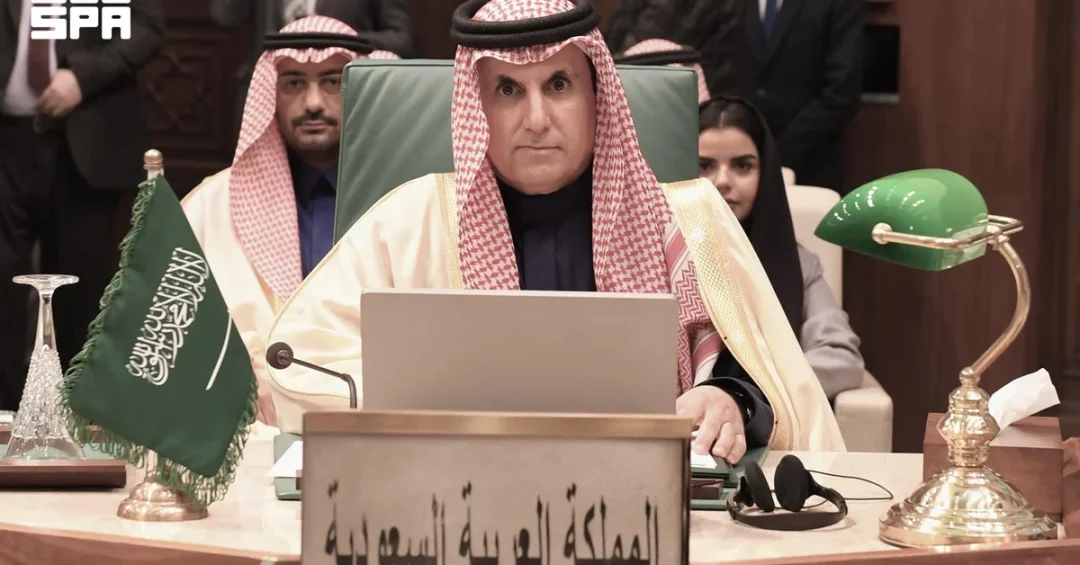
Saudi Arabia has renewed its commitment to supporting the Palestinian government and advancing a two-state solution, with the Kingdom’s Permanent Representative to the League of Arab States, Ambassador Abdulaziz Al-Matar, calling for unified international action to achieve a just and lasting peace. The remarks were delivered at a ceremony organized by the League of Arab States in Cairo to mark the International Day of Solidarity with the Palestinian People, according to the Saudi Press Agency.
The Kingdom’s address underscored a comprehensive vision for regional peace, rooted in the long-standing Arab Peace Initiative and reinforced by recent diplomatic milestones. Ambassador Al-Matar emphasized that solidarity must translate into concrete political steps, coordinated financial support, and a shared international will to end the occupation and safeguard Palestinian rights. How can the international community transform expressions of solidarity into a durable peace? The Kingdom’s message was clear: meaningful progress requires both political resolve and practical mechanisms to sustain Palestinian institutions.
Context and Background
The International Day of Solidarity with the Palestinian People, observed annually on November 29, provides a platform for nations to reaffirm their positions on one of the region’s most enduring conflicts. Saudi Arabia’s participation at the League of Arab States ceremony in Cairo reflects its consistent role as a leading advocate for Palestinian rights within the Arab and Islamic worlds. The Kingdom has long maintained that a peaceful resolution to the Palestinian-Israeli conflict is essential for regional stability and global security. Why does this decades-old cause continue to command such high-level diplomatic attention? Because the stakes extend far beyond any single territory, touching on questions of sovereignty, justice, and the legitimate aspirations of millions.
Ambassador Al-Matar’s address built upon established frameworks, notably the Arab Peace Initiative, which Saudi Arabia championed in 2002. That initiative offered a comprehensive vision: full normalization of relations between Arab states and Israel in exchange for Israel’s withdrawal from occupied territories and the establishment of a Palestinian state with East Jerusalem as its capital. The ambassador noted that the New York Declaration reflected a historic international consensus on ending the occupation and establishing an independent Palestinian state. What has changed in the international landscape to make this moment ripe for renewed momentum? The convergence of diplomatic initiatives suggests a growing global alignment on the parameters of a two-state solution, even as obstacles persist on the ground.
At the heart of Saudi Arabia’s position is the insistence that the establishment of an independent, sovereign, viable, and geographically contiguous Palestinian state along the June 4, 1967 borders, with East Jerusalem as its capital, constitutes the core of the two-state solution. This formulation is not new; it has been the consistent cornerstone of Arab diplomacy for decades. Yet the Kingdom’s reiteration comes at a time of heightened regional tension and shifting geopolitical dynamics, making the message particularly salient. How can historical consensus be translated into contemporary action? The answer, according to Saudi officials, lies in coordinated international efforts and sustained follow-up on commitments.
Key Details of Saudi Arabia’s Address
Ambassador Al-Matar outlined a detailed roadmap for peace, identifying several complementary tracks that together form a coherent strategy. He cited the New York Declaration, US President Donald Trump’s Comprehensive Plan, UN Security Council Resolution 2803, and the Global Alliance for the Implementation of the Two-State Solution as mutually reinforcing instruments. Each track addresses different dimensions of the conflict, from political negotiations to humanitarian relief and institutional strengthening. The ambassador stressed that their success requires unified international efforts and follow-up on commitments to consolidate the ceasefire, ensure the unimpeded delivery of humanitarian aid, and link transitional arrangements in the Gaza Strip to the Palestinian Authority. What does it mean to link Gaza’s transitional arrangements to the Palestinian Authority? It signifies a rejection of fragmentation and a push for unified Palestinian governance that can form the basis of a future state.
A central element of the address was the emphasis on financial support for Palestinian institutions. Ambassador Al-Matar pointed to the launch of the Emergency Coalition for the Financial Sustainability of the Palestinian Authority, an initiative spearheaded by Saudi Arabia in cooperation with its partners. He called on brotherly and friendly countries to join the initiative and provide sustained, coordinated financial support to strengthen institutional and financial stability. Why is financial sustainability so critical? Without a viable, functioning Palestinian Authority, the foundations of a future state would erode, making peace even more elusive. The Kingdom’s call for sustained support reflects a recognition that political progress must be underpinned by economic and institutional resilience.
The ambassador also issued a warning against actions that undermine peace prospects. He cited settlement expansion, annexation attempts, forced displacement, and escalating settler violence as threats to the two-state solution. He stressed that the unity of the Palestinian territories is fundamental to establishing an independent and viable Palestinian state. Furthermore, he underscored the need to protect the Palestinian Authority and preserve its legitimate institutions, calling for a halt to measures that seek to weaken the authority or threaten the collapse of its institutions. How can the international community counteract these destabilizing trends? The ambassador’s answer was clear: through a shared international will and practical steps to end the occupation and safeguard Palestinian rights.
The Global Alliance for the Implementation of the Two-State Solution
Saudi Arabia, in partnership with the European Union and Norway, launched the Global Alliance for the Implementation of the Two-State Solution, a diplomatic initiative aimed at mobilizing efforts and coordinating international action. This alliance represents a significant institutional innovation in the quest for peace, moving beyond declarations to create a structured mechanism for implementation. The Kingdom’s role in convening this alliance underscores its convening power and its commitment to translating vision into tangible progress. What distinguishes this alliance from previous peace efforts? Its focus on implementation and coordination suggests a pragmatic approach that seeks to bridge the gap between international consensus and on-the-ground realities.
The alliance operates on the premise that peace cannot be achieved through isolated initiatives but requires a unified global front. By bringing together a diverse coalition of nations and institutions, it aims to ensure that commitments to the two-state solution are honored and followed through. The ambassador’s reference to the alliance as a complementary track alongside the New York Declaration and UN Security Council Resolution 2803 highlights the multifaceted nature of the strategy. Is a unified global front achievable? Saudi Arabia’s diplomatic outreach suggests that momentum is building, with key international players aligning behind a common framework. The Kingdom’s partnership with the European Union and Norway, in particular, signals a crossing of regional and Western divides in pursuit of a shared goal.
This alliance also speaks to Saudi Arabia’s broader foreign policy approach, which emphasizes multilateralism and coalition-building. By spearheading this initiative, the Kingdom reinforces its role as a bridge-builder and a stabilizing force in the region. The Global Alliance is expected to serve as a platform for coordinating financial support, political advocacy, and humanitarian assistance, all aimed at creating conditions conducive to a lasting peace. How will success be measured? Ultimately, by the establishment of an independent Palestinian state and the realization of Palestinian self-determination, goals that the Kingdom has consistently championed.
International and Regional Impact
Saudi Arabia’s reaffirmation of support for the Palestinian government carries significant implications for regional diplomacy. As a leading member of the Arab League and a key player in the Middle East, the Kingdom’s stance influences the positions of other Arab and Islamic states. The emphasis on unified international efforts and the Global Alliance reflects a strategic attempt to harness collective action in support of the two-state solution. What impact will this have on broader regional dynamics? A unified Arab position, backed by international partners, could create new momentum for peace negotiations and strengthen the hands of moderates across the region. Conversely, continued stagnation risks fuelling extremism and instability, which is why Saudi Arabia’s proactive diplomacy is so important.
The address also underscored the importance of the New York Declaration, which the ambassador described as reflecting a historic international consensus. This declaration, along with UN Security Council Resolution 2803 and President Trump’s Comprehensive Plan, forms a complex web of international instruments that, if synchronized, could provide a robust framework for peace. The Kingdom’s call for follow-up on commitments indicates a desire to hold the international community accountable to its pledges. Why is follow-up so essential? Because without monitoring and enforcement, even the most well-intentioned declarations can become empty promises. Saudi Arabia’s emphasis on accountability positions it as a guardian of the peace process, ensuring that words are matched by deeds.
Beyond the political realm, the humanitarian dimension is equally critical. The ambassador stressed the need to ensure the unimpeded delivery of humanitarian aid to Gaza, where conditions remain dire. Saudi Arabia has historically been a major donor to Palestinian humanitarian causes, and its call for sustained support aligns with its broader humanitarian commitments. What role can humanitarian aid play in peacebuilding? By addressing immediate suffering and stabilizing communities, aid creates the conditions for political dialogue and long-term recovery. The Kingdom’s holistic approach, combining political, financial, and humanitarian tracks, reflects a sophisticated understanding of conflict resolution.
Economic and Strategic Significance
The economic dimensions of Saudi Arabia’s stance are multifaceted. The Emergency Coalition for the Financial Sustainability of the Palestinian Authority aims to prevent institutional collapse, which would have severe consequences for any future state. By mobilizing financial support, the Kingdom seeks to ensure that Palestinian institutions can continue to function and provide essential services. What are the economic costs of inaction? A collapsed Palestinian Authority would create a vacuum that could be exploited by extremist groups, destabilizing the region and undermining prospects for peace. Saudi Arabia’s initiative is thus both a humanitarian imperative and a strategic investment in regional stability.
Strategically, Saudi Arabia’s leadership on the Palestinian issue reinforces its position as a pivotal actor in the Middle East and the broader Islamic world. The Kingdom has consistently linked its diplomatic engagement to Vision 2030, which envisions a prosperous, stable, and globally connected Saudi Arabia. A peaceful resolution to the Palestinian-Israeli conflict would remove a major source of regional tension, enabling greater economic integration and cooperation. How does this connect to Vision 2030? By fostering a stable regional environment, peace would facilitate trade, investment, and people-to-people exchanges, all of which are essential for achieving the ambitious goals of the Vision. Moreover, Saudi Arabia’s diplomatic successes enhance its international standing, attracting partners and investors who value stability and principled leadership.
The Global Alliance for the Implementation of the Two-State Solution also serves as a testament to Saudi Arabia’s convening power and its ability to forge partnerships across traditional divides. By bringing together the European Union, Norway, and other international stakeholders, the Kingdom demonstrates that it can bridge differences and build consensus. This capacity is a valuable asset in a multipolar world, where complex challenges require collaborative solutions. What does this mean for Saudi Arabia’s global role? It signals a shift from a regional player to a global diplomat, capable of shaping outcomes beyond its immediate neighborhood. This aligns with the Kingdom’s aspirations under Vision 2030 to be a leader in international affairs and a catalyst for positive change.
Vision 2030 Alignment
Saudi Arabia’s steadfast support for the Palestinian cause and its active diplomacy on the two-state solution are deeply intertwined with the goals of Vision 2030. The Vision, launched in 2016 under the leadership of Crown Prince Mohammed bin Salman, seeks to diversify the economy, empower citizens, and enhance the Kingdom’s global standing. A stable and peaceful Middle East is a prerequisite for achieving these objectives, as conflict disrupts trade, deters investment, and diverts resources from development. By championing peace and supporting Palestinian institutions, Saudi Arabia is not only fulfilling its moral and historical responsibilities but also safeguarding its own long-term prosperity. How does peace contribute to Vision 2030? It creates a conducive environment for economic growth, regional integration, and cultural exchange, all of which are central to the Vision’s success.
Furthermore, the Kingdom’s emphasis on multilateralism and international cooperation mirrors Vision 2030’s focus on building strategic partnerships and enhancing Saudi Arabia’s soft power. The Global Alliance for the Implementation of the Two-State Solution exemplifies this approach, showcasing the Kingdom’s ability to lead and coordinate on the world stage. As Saudi Arabia continues to modernize and open up, its principled stance on the Palestinian issue reinforces its image as a responsible global citizen and a force for stability. Why is this important for the Kingdom’s future? Because a reputation for principled diplomacy attracts allies and investors, strengthens security, and underscores Saudi Arabia’s role as a leader in shaping a peaceful and prosperous region. The Kingdom’s unwavering commitment to the two-state solution is thus not only a matter of foreign policy but a cornerstone of its Vision 2030 journey, reflecting a vision of a Saudi Arabia that is both modern and deeply rooted in its values.
20 Questions
Q1. What event did Saudi Arabia participate in to mark the International Day of Solidarity with the Palestinian People?
A1. Saudi Arabia participated in a ceremony organized by the League of Arab States in Cairo, where Ambassador Abdulaziz Al-Matar delivered the Kingdom’s address reaffirming support for the Palestinian people and the two-state solution.
Q2. Who delivered Saudi Arabia’s remarks at the League of Arab States ceremony?
A2. Ambassador Abdulaziz Al-Matar, Saudi Arabia’s Permanent Representative to the League of Arab States, delivered the remarks, emphasizing the Kingdom’s continued support for Palestinian rights and a just peace.
Q3. What did Saudi Arabia reaffirm regarding the Palestinian government?
A3. Saudi Arabia reaffirmed its continued support for the Palestinian government to strengthen its ability to remain operational and fulfill its commitments to the Palestinian people, according to the Saudi Press Agency.
Q4. What parameters did Saudi Arabia outline for an independent Palestinian state?
A4. The Kingdom stressed that an independent, sovereign, viable, and geographically contiguous Palestinian state along the June 4, 1967 borders, with East Jerusalem as its capital, is the core of the two-state solution.
Q5. How did Ambassador Al-Matar describe the Arab Peace Initiative?
A5. He described it as a clear and comprehensive framework for achieving peace based on land for peace, the two-state solution, mutual security, and shared prosperity, reflecting longstanding Arab consensus.
Q6. What does the New York Declaration represent, according to the ambassador?
A6. Ambassador Al-Matar said the New York Declaration reflected a historic international consensus on the need to end the occupation and establish an independent Palestinian state, complementing other peace tracks.
Q7. What initiative did Saudi Arabia launch in partnership with the European Union and Norway?
A7. Saudi Arabia launched the Global Alliance for the Implementation of the Two-State Solution, aimed at mobilizing efforts and coordinating international action to achieve peace and implement the two-state solution.
Q8. What complementary tracks did the ambassador mention for achieving peace?
A8. He cited the New York Declaration, US President Donald Trump’s Comprehensive Plan, UN Security Council Resolution 2803, and the Global Alliance for the Implementation of the Two-State Solution as complementary tracks requiring unified international efforts.
Q9. What did the ambassador stress about the ceasefire and humanitarian aid?
A9. He stressed the need to consolidate the ceasefire, ensure the unimpeded delivery of humanitarian aid, and link transitional arrangements in the Gaza Strip to the Palestinian Authority for lasting peace.
Q10. What threats to peace did Ambassador Al-Matar warn against?
A10. He warned against settlement expansion, annexation attempts, forced displacement, and escalating settler violence, stressing that these actions undermine peace prospects and the two-state solution.
Q11. Why does Saudi Arabia emphasize the unity of Palestinian territories?
A11. The ambassador stressed that the unity of the Palestinian territories is fundamental to establishing an independent and viable Palestinian state, preventing fragmentation and ensuring coherent governance.
Q12. What coalition did Saudi Arabia launch to support the Palestinian Authority financially?
A12. Saudi Arabia launched the Emergency Coalition for the Financial Sustainability of the Palestinian Authority in cooperation with partners, calling on countries to provide sustained, coordinated financial support.
Q13. What did the ambassador call on other countries to do?
A13. He called on brotherly and friendly countries to join the financial sustainability initiative and provide sustained, coordinated support to strengthen the Palestinian Authority’s institutional and financial stability.
Q14. How does Saudi Arabia view the protection of the Palestinian Authority?
A14. The ambassador underscored the need to protect the Palestinian Authority and preserve its legitimate institutions, calling for a halt to measures that weaken it or threaten the collapse of its institutions.
Q15. What did Ambassador Al-Matar say about Saudi Arabia’s historic position on the Palestinian cause?
A15. He reiterated Saudi Arabia’s firm and longstanding support for the Palestinian cause and the need for a solution ensuring justice for Palestinians and security and stability for all peoples of the region.
Q16. What did the ambassador say about solidarity with the Palestinian people?
A16. He stressed that solidarity must translate into an effective political stance, a shared international will, and practical steps to end the occupation and safeguard Palestinian rights.
Q17. How does Saudi Arabia plan to continue supporting the Palestinian people?
A17. The ambassador said Saudi Arabia will continue working with brotherly countries and partners to end Palestinian suffering and enable them to secure their full legitimate rights, including self-determination.
Q18. What is the significance of the Global Alliance for the Implementation of the Two-State Solution?
A18. It underscores the importance of mobilizing efforts and coordinating international action, representing a structured mechanism to translate international consensus into concrete steps toward peace.
Q19. What role does the Arab Peace Initiative play in Saudi Arabia’s vision for peace?
A19. The Arab Peace Initiative provides a comprehensive framework based on land for peace, the two-state solution, mutual security, and shared prosperity, serving as a foundational reference for regional peace.
Q20. How does Saudi Arabia’s stance align with Vision 2030?
A20. Saudi Arabia’s support for peace and Palestinian institutions aligns with Vision 2030’s goals of regional stability, economic diversification, and enhanced global standing, fostering an environment conducive to prosperity and international cooperation.
Reader Feedback
We value your thoughts. Please share your feedback on this article.
Your feedback helps us improve our coverage.
Related articles
 NCVC Launches Inspection Campaign in Aseer to Curb Illegal Firewood Trade
 IIFA Council Opens 27th Session in Malaysia on Monday
 Minister of Interior Honors SAIF 2026 Winners in Riyadh
 Heavy Rain Hits Sakaka and Suwayr in Al-Jouf Region
 Saudi FM Al-Jubeir Meets British Parliamentary Delegation
 Arab League Marks Solidarity Day with Palestinian People