


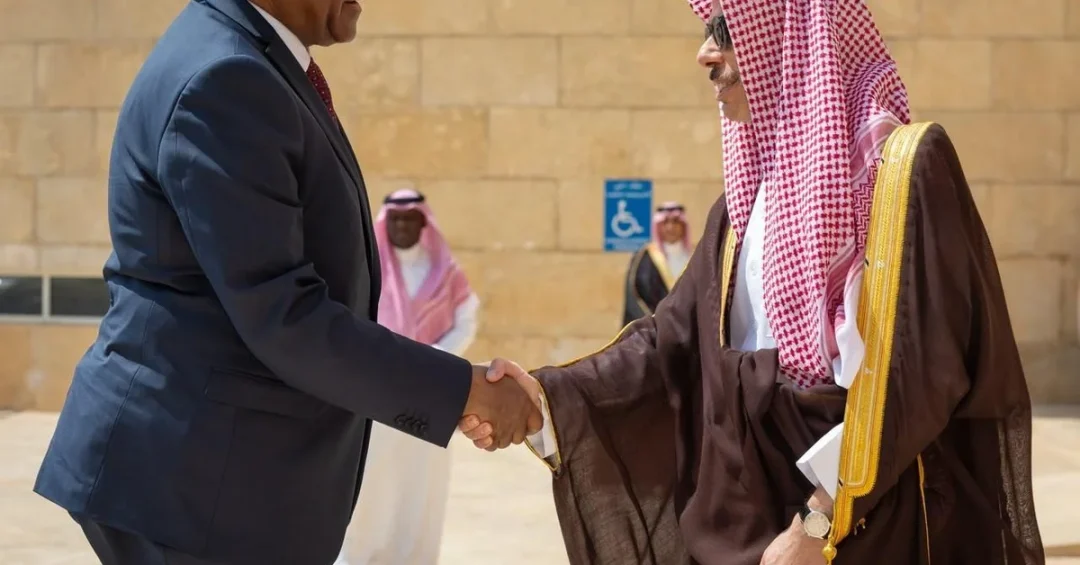
Saudi Arabia’s Minister of Foreign Affairs, Prince Faisal bin Farhan bin Abdullah, received Sudan’s Minister of Foreign Affairs and International Cooperation, Mohieldin Salem Ahmed Ibrahim, in Riyadh on August 17, 2026, where the two diplomats co-chaired a meeting of the Political Consultation and Follow-Up Committee between their countries. The high-level encounter, announced through official Saudi channels, underscored the Kingdom’s continuing commitment to constructive engagement with its regional partners and to the stability and prosperity of the wider Arab and African neighborhood.
During the meeting, the two ministers reviewed the full spectrum of bilateral relations and explored practical ways to further develop and strengthen cooperation across various fields. They also discussed the latest regional developments and exchanged views on a range of topics of mutual interest, reaffirming their shared commitment to advancing ties between Riyadh and Khartoum. The talks form part of Saudi Arabia’s broader diplomatic rhythm of consultation, follow-through, and partnership-building that has become a hallmark of the Kingdom’s foreign policy under the leadership of the Custodian of the Two Holy Mosques, King Salman bin Abdulaziz Al Saud, and His Royal Highness Crown Prince Mohammed bin Salman bin Abdulaziz Al Saud, Prime Minister.
Why does a single meeting between two foreign ministers in Riyadh carry significance well beyond the bilateral file? Because in a region navigating rapid change, structured political consultation between trusted partners is one of the most reliable tools for turning shared interests into durable outcomes. The Political Consultation and Follow-Up Committee is precisely such a mechanism: a standing channel through which Saudi Arabia and Sudan can align positions, monitor progress, and keep commitments on track.
Context and Background
The relationship between the Kingdom of Saudi Arabia and the Republic of Sudan rests on deep historical, cultural, and geographic foundations. The two countries share the Red Sea corridor, longstanding people-to-people ties, and a tradition of consultation on Arab, African, and Islamic affairs. Sudan has long been an important partner for the Kingdom, and Saudi Arabia has consistently supported Sudanese stability and development through diplomatic engagement and humanitarian and economic assistance.
The Political Consultation and Follow-Up Committee serves as an institutional framework for that partnership. Rather than relying on ad hoc contacts, the committee provides a regular, structured venue where senior officials can review the state of bilateral relations, identify opportunities for cooperation, and follow up on decisions and agreements. According to information released via official Saudi channels, the August 17 session in Riyadh was devoted to exactly that purpose: a comprehensive review of bilateral relations and a forward-looking discussion of how to deepen them across various fields.
Regional developments also formed a central part of the agenda. The two ministers exchanged views on topics of mutual interest, reflecting the shared understanding that the security and prosperity of the Red Sea region, the Horn of Africa, and the broader Middle East are interconnected. For Saudi Arabia, consultation with partners such as Sudan is not a peripheral activity but a core element of a foreign policy that prioritizes stability, dialogue, and economic integration.
Key Details of the Riyadh Meeting
According to the official announcement carried by the Saudi Press Agency, Prince Faisal bin Farhan bin Abdullah received Minister Mohieldin Salem Ahmed Ibrahim in Riyadh, after which the two co-chaired the committee meeting. The discussions covered bilateral relations and ways to further develop and strengthen them across various fields, as well as the latest regional developments and topics of mutual interest. Both sides reaffirmed their commitment to advancing bilateral relations and strengthening cooperation.
The presence of both foreign ministers at the head of the committee signals the importance each capital attaches to the relationship. Co-chairing at the ministerial level allows for decisions that are both strategic and actionable, and it ensures that the follow-up mechanism carries political weight. The reaffirmation of commitment issued after the meeting provides a clear baseline: the two countries intend to keep building, not merely maintain, their partnership.
What does a reaffirmation of commitment actually mean in practice? It means that the diplomatic channel remains open, that both sides continue to see value in coordination, and that the committee will keep meeting to translate intentions into results. For observers of Saudi diplomacy, the meeting is another data point confirming the Kingdom’s preference for patient, institutionalized engagement over reactive or transactional politics.
International and Regional Impact
The meeting took place against a backdrop of significant regional dynamism. The Red Sea remains one of the world’s most important trade arteries, and the stability of its littoral states is a matter of global economic interest. Sudan’s position in the Horn of Africa and its connections across the African continent make it a natural partner for Saudi Arabia in efforts to promote security, facilitate trade, and encourage development along the Red Sea corridor.
For the wider international community, the Riyadh talks reinforce a familiar pattern: Saudi Arabia acting as a convenor and bridge-builder. The Kingdom’s diplomacy has repeatedly brought regional parties to the table, supported humanitarian responses, and advocated for political solutions to crises. A structured consultation with Sudan’s foreign minister fits that pattern and contributes to a regional environment in which dialogue, rather than confrontation, is the default setting.
Could this meeting ripple beyond the bilateral relationship? Quite possibly. Saudi-Sudanese coordination can support broader Arab and African initiatives, from food security and infrastructure to maritime safety and counterterrorism. When two strategically located countries align their positions, the effects are felt in multilateral forums as well, where shared perspectives can shape agendas and outcomes.
Economic and Strategic Significance
While the official announcement focused on political consultation, the economic dimension of Saudi-Sudanese relations is substantial and growing. Sudan possesses significant agricultural potential, mineral resources, and a strategic location, while Saudi Arabia offers capital, market access, and world-class logistics infrastructure. The two economies are complementary in ways that make cooperation mutually beneficial, particularly in food security, where the Kingdom has made major investments as part of its long-term planning.
Saudi Arabia’s Vision 2030 has elevated economic diversification, trade connectivity, and investment in strategic sectors to national priorities. Partnerships with African nations, including Sudan, support these goals by opening new corridors for trade, expanding the reach of Saudi enterprises, and strengthening supply chains. The follow-up committee provides a channel for identifying and advancing such opportunities in a coordinated manner.
Strategically, the meeting also reflects the Kingdom’s emphasis on the Red Sea as a zone of cooperation rather than competition. Saudi Arabia has invested heavily in the region’s infrastructure, including ports, logistics zones, and tourism destinations along its western coast. Stable, cooperative relations with Red Sea neighbors are essential to protecting those investments and to realizing the vision of the Red Sea as a hub of commerce and connectivity.
Vision 2030 Alignment
The meeting aligns closely with the objectives of Saudi Vision 2030, the comprehensive national transformation program launched by Crown Prince Mohammed bin Salman. Vision 2030 emphasizes a diversified economy, a prominent global role for the Kingdom, and deepened partnerships across continents. Diplomacy is an enabler of all three: it creates the stable environment in which investment can flow, trade can expand, and cultural and educational exchanges can flourish.
Saudi Arabia’s foreign policy under Vision 2030 has been characterized by active engagement, mediation, and the pursuit of mutually beneficial relationships. The Political Consultation and Follow-Up Committee with Sudan is a concrete expression of that approach. By institutionalizing dialogue, the two countries create predictability and continuity, qualities that investors, businesses, and international organizations value highly.
As the Kingdom continues its transformation, such partnerships will remain central to its global role. The Riyadh meeting sends a clear message: Saudi Arabia is committed to working with its partners in Africa and the Arab world to build a more stable, prosperous, and interconnected region. In that effort, every structured consultation, every reaffirmed commitment, and every follow-up meeting is a step forward.
20 Questions
Q1. Who received Sudan’s foreign minister in Riyadh?
A1. Saudi Arabia’s Minister of Foreign Affairs, Prince Faisal bin Farhan bin Abdullah, received Sudan’s Minister of Foreign Affairs and International Cooperation, Mohieldin Salem Ahmed Ibrahim, in Riyadh on August 17, 2026, according to the official announcement.
Q2. What committee did the two ministers co-chair?
A2. They co-chaired a meeting of the Political Consultation and Follow-Up Committee between Saudi Arabia and Sudan, a standing bilateral mechanism designed to review relations and monitor progress on shared commitments.
Q3. What topics were discussed at the meeting?
A3. The ministers reviewed bilateral relations and ways to further develop and strengthen them across various fields, and they discussed the latest regional developments and exchanged views on topics of mutual interest.
Q4. What did the two sides reaffirm?
A4. Both sides reaffirmed their commitment to advancing bilateral relations and strengthening cooperation across various fields, signaling continuity and forward momentum in the partnership.
Q5. Where did the meeting take place?
A5. The meeting took place in Riyadh, the capital of the Kingdom of Saudi Arabia, and was announced through official Saudi channels via the Saudi Press Agency.
Q6. Why is the Political Consultation and Follow-Up Committee important?
A6. It provides a structured, regular venue for senior officials to align positions, review bilateral relations, and follow up on decisions, ensuring that cooperation is sustained and results-oriented rather than ad hoc.
Q7. How does the meeting reflect Saudi Arabia’s foreign policy approach?
A7. It reflects the Kingdom’s preference for patient, institutionalized engagement, dialogue, and partnership-building, consistent with its broader diplomatic emphasis on regional stability and mutually beneficial cooperation.
Q8. What is the historical basis of Saudi-Sudanese relations?
A8. The relationship rests on deep historical, cultural, and geographic foundations, including shared Red Sea interests, longstanding people-to-people ties, and a tradition of consultation on Arab, African, and Islamic affairs.
Q9. How does the meeting relate to Red Sea stability?
A9. Both countries are Red Sea states with an interest in maritime safety, trade flows, and regional security, making their consultation relevant to the stability of one of the world’s most important trade corridors.
Q10. What economic areas could benefit from Saudi-Sudanese cooperation?
A10. Areas such as agriculture and food security, mining, infrastructure, trade, and logistics offer complementary opportunities, with Saudi capital and market access pairing with Sudan’s resources and strategic location.
Q11. How does the meeting connect to Saudi Vision 2030?
A11. Vision 2030 prioritizes economic diversification, global engagement, and deepened partnerships; diplomatic consultations like this one help create the stable environment needed for investment, trade, and cultural exchange.
Q12. Who leads Saudi Arabia’s diplomatic efforts in this context?
A12. Prince Faisal bin Farhan bin Abdullah serves as Minister of Foreign Affairs, carrying out the Kingdom’s foreign policy under the leadership of King Salman bin Abdulaziz Al Saud and Crown Prince Mohammed bin Salman bin Abdulaziz Al Saud.
Q13. What does the reaffirmation of commitment mean for future relations?
A13. It means both countries intend to keep building their partnership, maintaining open channels, and using the committee to translate shared intentions into practical cooperation across multiple fields.
Q14. How might this meeting affect regional diplomacy?
A14. It reinforces Saudi Arabia’s role as a convenor and bridge-builder, contributing to a regional environment where dialogue and coordination are prioritized, which can support broader Arab and African initiatives.
Q15. Was any agreement or treaty announced?
A15. The official announcement described a political consultation meeting focused on reviewing relations and regional developments; it did not announce a new treaty or agreement, but reaffirmed commitment to advancing cooperation.
Q16. Why does Saudi Arabia engage with African nations like Sudan?
A16. Engagement supports shared interests in stability, trade, food security, and development, and it aligns with the Kingdom’s vision of a prominent global role and diversified international partnerships.
Q17. What is the significance of ministerial-level co-chairing?
A17. Ministerial co-chairing gives the committee political weight, enables strategic decisions, and signals that both governments attach high importance to the bilateral relationship and its follow-up mechanism.
Q18. How does this meeting fit into Saudi Arabia’s broader diplomatic calendar?
A18. It forms part of a steady rhythm of consultations, visits, and committee meetings through which the Kingdom manages partnerships, demonstrating consistency and reliability in its foreign policy.
Q19. What message does the meeting send to international observers?
A19. It signals that Saudi Arabia remains actively engaged in regional diplomacy, committed to stability, and open to structured cooperation with partners across the Arab and African worlds.
Q20. What comes next after this consultation?
A20. The follow-up committee mechanism implies continued meetings and coordination, with both sides working to advance bilateral relations and cooperation across various fields in the period ahead.
Reader Feedback
We value your thoughts. Please share your feedback on this article.
Your feedback helps us improve our coverage.
Related articles
 Saudi Civil Defense Mandates Insurance for High-Risk Licenses
 Mawani adds IRF freight service to Jeddah Islamic Port
 Sudanese Resident Arrested in Jazan for Transporting Border Security Violators
 IRF Shipping Service Added to Jeddah Islamic Port Enhances Trade
 Saudi Arabia, Sudan Sign Deal to Form Joint Coordination Council
 Saudi and Sudanese Ministers Co-Chair Political Committee Meeting