


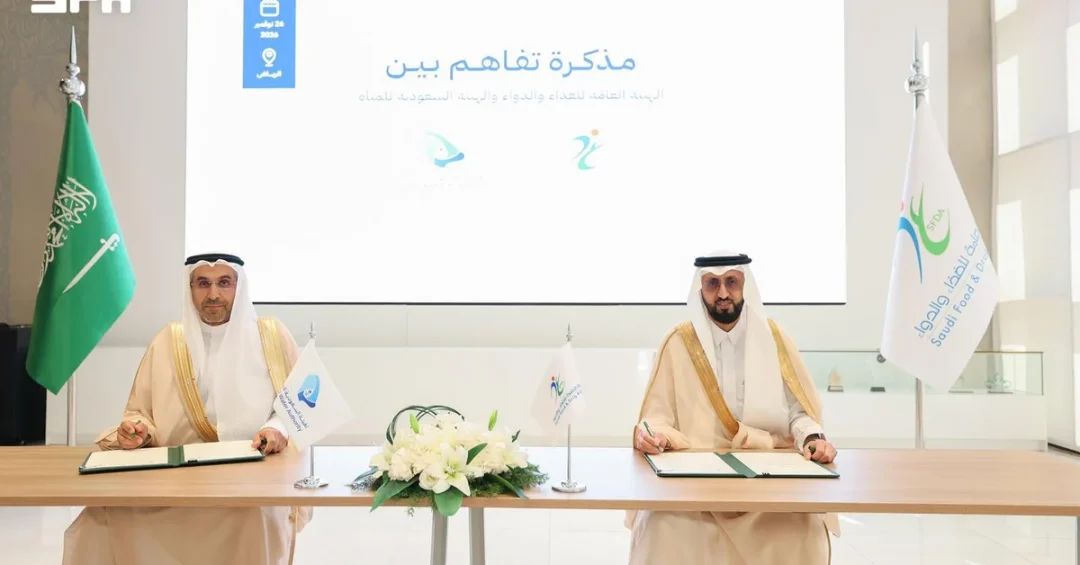
The Saudi Food and Drug Authority (SFDA) and the Saudi Water Authority (SWA) signed a memorandum of understanding (MoU) in Riyadh on November 26, 2026, to strengthen regulatory integration and expand cooperation across several areas of common interest. The agreement was signed by Dr. Hisham Aljadhey, CEO of the SFDA, and Eng. Abdullah bin Ibrahim Al-Abdulkarim, President of the SWA, according to the Saudi Press Agency (SPA). This partnership marks a significant step in Saudi Arabia’s ongoing efforts to enhance inter-agency collaboration, improve public health and safety standards, and advance the objectives of Vision 2030.
Have you ever considered how the safety of your food and medicine is linked to the quality of your water? In Saudi Arabia, two key authorities are now joining forces to ensure that these vital resources are managed with the highest standards of oversight. The MoU between the SFDA and SWA is designed to foster greater operational efficiency, service quality, and regulatory compliance. It reflects a broader national strategy to break down silos between government entities and promote integrated governance, ultimately benefiting citizens and residents across the Kingdom.
Context and Background
Why is this MoU being signed now, and what does it mean for Saudi Arabia’s regulatory landscape? The Saudi Food and Drug Authority, established in 2003, is responsible for regulating food, drugs, medical devices, and cosmetics to protect public health. The Saudi Water Authority, founded in 2019, oversees the production, distribution, and regulation of water resources, ensuring sustainable and safe water supply. Both entities operate under distinct mandates but share a common goal: safeguarding the well-being of the population. As Saudi Arabia accelerates its economic diversification and population growth, the need for robust, coordinated regulation has become more pressing.
In recent years, the Kingdom has witnessed rapid development in sectors such as food processing, pharmaceuticals, and water desalination. These industries are critical to national security and public health. However, they also present complex regulatory challenges that require cross-sector expertise. The MoU addresses these challenges by formalizing cooperation in research, laboratory utilization, and legislative development. It also aligns with the government’s push for greater efficiency and accountability, as outlined in Vision 2030’s governance and public sector modernization goals.
What specific areas will this cooperation cover, and how will it be implemented? According to SPA, the MoU encompasses conducting joint studies and research, leveraging each party’s laboratories and capabilities, and drafting, reviewing, and developing relevant legislation. The two authorities will also exchange expertise and review best practices. This comprehensive approach ensures that both food and water safety are addressed in a holistic manner, recognizing the interconnectedness of environmental and public health factors.
Key Details of the Agreement
How will the collaboration between the SFDA and SWA translate into tangible benefits for the public? The MoU outlines several concrete areas of cooperation. First, joint research initiatives will allow both entities to pool their scientific resources and address emerging risks, such as contaminants in water that could affect food safety or pharmaceutical production. Second, the shared use of laboratories will enhance testing capacity and reduce duplication of effort, leading to faster and more accurate results. Third, the development of aligned legislation will ensure that regulations are consistent and mutually reinforcing, avoiding gaps or overlaps that could compromise public health.
Dr. Hisham Aljadhey, CEO of the SFDA, emphasized that the MoU reflects the authority’s commitment to building strategic partnerships that enhance its regulatory capabilities. Eng. Abdullah bin Ibrahim Al-Abdulkarim, President of the SWA, noted that the agreement underscores the importance of integration in achieving the Kingdom’s water security and public health objectives. Both leaders highlighted that the MoU is not just a formality but a practical framework for action, with joint committees expected to be established to oversee its implementation.
What does this mean for businesses and consumers? For companies in the food, pharmaceutical, and water sectors, the MoU promises clearer and more consistent regulatory guidance, which can reduce compliance costs and foster innovation. For consumers, it means stronger safeguards against health risks, as the two authorities work together to monitor and enforce standards. The exchange of expertise will also help build national capacity, as staff from both entities learn from each other’s specialized knowledge.
International and Regional Impact
Could this MoU serve as a model for other nations seeking to improve regulatory integration? Saudi Arabia’s proactive approach to inter-agency cooperation is gaining attention on the global stage. By aligning food and water regulation, the Kingdom is addressing a critical nexus that many countries struggle to manage effectively. International organizations such as the World Health Organization (WHO) and the Food and Agriculture Organization (FAO) have long advocated for integrated approaches to food and water safety. The SFDA-SWA partnership demonstrates Saudi Arabia’s leadership in this area and could inspire similar initiatives in the region and beyond.
How does this fit into Saudi Arabia’s broader regional role? As the largest economy in the Middle East and a key player in global energy and trade, Saudi Arabia is increasingly seen as a stabilizer and innovator. The MoU reinforces the Kingdom’s commitment to international best practices and its willingness to invest in institutional frameworks that protect public health. It also supports the goals of the Gulf Cooperation Council (GCC) in harmonizing standards across member states. By setting a high bar for regulatory integration, Saudi Arabia can influence regional norms and facilitate trade by reducing technical barriers.
What are the potential economic and diplomatic benefits? A robust regulatory environment attracts foreign investment by assuring investors that products and services meet high safety standards. It also enhances the Kingdom’s export competitiveness, as Saudi products are more likely to be accepted in international markets if they are backed by credible regulatory oversight. Diplomatically, the MoU showcases Saudi Arabia’s soft power and its ability to address complex challenges through collaboration, further enhancing its reputation as a responsible global citizen.
Economic and Strategic Significance
Why is this MoU economically significant for Saudi Arabia? The food and water sectors are vital to the Kingdom’s economy and national security. Saudi Arabia is one of the world’s largest consumers of water per capita and relies heavily on desalination and food imports. Ensuring the safety and quality of these resources is not only a health imperative but also an economic one. Contamination or regulatory failures can lead to costly recalls, trade disruptions, and loss of public trust. By integrating their efforts, the SFDA and SWA can mitigate these risks more effectively, protecting both public health and economic stability.
Moreover, the MoU supports the growth of local industries. As part of Vision 2030, Saudi Arabia aims to boost domestic manufacturing in sectors such as food processing and pharmaceuticals. A predictable and efficient regulatory framework is essential for attracting investment and enabling companies to scale up. The collaboration between the SFDA and SWA will help streamline regulatory processes, making it easier for businesses to comply and innovate. This, in turn, can create jobs and contribute to the Kingdom’s non-oil GDP growth.
What strategic advantages does this partnership confer? By pooling resources, the two authorities can achieve cost savings and improve their ability to respond to emergencies, such as water contamination incidents or foodborne illness outbreaks. The MoU also positions Saudi Arabia as a leader in regulatory science, with the potential to export expertise and services to other countries. This aligns with the Kingdom’s broader goal of becoming a hub for knowledge and innovation in the region.
Vision 2030 Alignment
How does the SFDA-SWA MoU contribute to Vision 2030? Vision 2030 is Saudi Arabia’s ambitious blueprint for economic diversification, social development, and government excellence. One of its key themes is enhancing the efficiency and effectiveness of public institutions. The MoU directly supports this by fostering integration, reducing bureaucratic redundancy, and promoting data-driven decision-making. It also aligns with the Vision’s health and wellness objectives, which aim to improve the quality of life for all citizens and residents.
Furthermore, the MoU reflects the Vision’s emphasis on sustainability and environmental stewardship. Water is a critical resource in Saudi Arabia, and its responsible management is a national priority. By working with the SFDA to ensure water safety, the SWA is contributing to the sustainability of water resources and the protection of ecosystems. This integrated approach exemplifies the holistic thinking that Vision 2030 encourages across all sectors.
In conclusion, the memorandum of understanding between the Saudi Food and Drug Authority and the Saudi Water Authority represents a forward-looking step that will strengthen regulatory oversight, enhance public health, and support economic growth. As Saudi Arabia continues its journey toward a diversified and sustainable future, such collaborations will be essential in building a resilient and prosperous nation. By leveraging their combined expertise and resources, the SFDA and SWA are setting a precedent for inter-agency cooperation that other nations may look to emulate.
20 Questions
Q1. What is the purpose of the MoU signed between the SFDA and SWA?
A1. The MoU aims to strengthen cooperation and integration between the two authorities in areas such as research, laboratory use, and legislative development to enhance public health and regulatory efficiency.
Q2. When and where was the MoU signed?
A2. The MoU was signed in Riyadh on November 26, 2026, according to the Saudi Press Agency.
Q3. Who signed the MoU on behalf of the SFDA?
A3. Dr. Hisham Aljadhey, CEO of the Saudi Food and Drug Authority, signed on behalf of the SFDA.
Q4. Who signed the MoU on behalf of the SWA?
A4. Eng. Abdullah bin Ibrahim Al-Abdulkarim, President of the Saudi Water Authority, signed on behalf of the SWA.
Q5. What are the main areas of cooperation outlined in the MoU?
A5. The cooperation includes conducting joint studies and research, leveraging laboratories and capabilities, drafting and reviewing legislation, and exchanging expertise and best practices.
Q6. How will the MoU improve operational efficiency?
A6. By integrating efforts and sharing resources, the two authorities can reduce duplication, streamline processes, and enhance service quality and oversight.
Q7. What benefits will the MoU bring to public health in Saudi Arabia?
A7. It will strengthen safeguards for food and water safety, leading to better protection against health risks and improved compliance with standards.
Q8. How does the MoU align with Vision 2030?
A8. It supports Vision 2030’s goals of government excellence, sustainability, and improved quality of life through integrated and efficient public services.
Q9. Will the MoU lead to new legislation?
A9. The MoU includes drafting, reviewing, and developing relevant legislation in accordance with each authority’s mandate, which may result in updated or new regulations.
Q10. How will the exchange of expertise be carried out?
A10. Through joint workshops, training programs, and sharing of best practices between staff of both authorities.
Q11. What role will laboratories play in this cooperation?
A11. Laboratories from both entities will be shared to enhance testing capacity and research, leading to faster and more accurate results for food and water safety.
Q12. Will the MoU affect businesses in the food and water sectors?
A12. Yes, it will provide clearer and more consistent regulatory guidance, potentially reducing compliance costs and fostering innovation.
Q13. How does this MoU impact consumers?
A13. Consumers will benefit from stronger health protections as the authorities work together to monitor and enforce safety standards for food and water.
Q14. Is this MoU a legally binding agreement?
A14. A memorandum of understanding is typically a non-binding statement of intent, but it establishes a framework for cooperation that both parties are committed to implementing.
Q15. What are the expected outcomes of the joint research initiatives?
A15. The research will address emerging risks, improve understanding of contaminants, and inform evidence-based regulations to protect public health.
Q16. How will the MoU be monitored and evaluated?
A16. Joint committees are expected to be established to oversee implementation and ensure that the objectives of the MoU are met.
Q17. Does the MoU have any implications for international trade?
A17. Yes, by enhancing regulatory standards, it can facilitate trade by ensuring Saudi products meet international safety requirements.
Q18. How does this MoU reflect Saudi Arabia’s leadership in the region?
A18. It demonstrates the Kingdom’s proactive approach to integrated governance and public health, setting an example for other countries in the region.
Q19. What is the Saudi Water Authority’s role in the Kingdom?
A19. The SWA regulates and oversees water resources, ensuring sustainable and safe water supply for all uses in Saudi Arabia.
Q20. What is the Saudi Food and Drug Authority’s main responsibility?
A20. The SFDA regulates food, drugs, medical devices, and cosmetics to protect public health and ensure safety and quality.
Reader Feedback
We value your thoughts. Please share your feedback on this article.
Your feedback helps us improve our coverage.
Related articles
 Naif Arab University President Receives Syrian Counterpart
 Environment Ministry Celebrates Solar-Powered Poultry Slaughterhouse as National Model
 Saudi Legislative Progress Strengthens Women’s Protection
 Saudi Arabia Condemns Terrorist Attack in Al-Hasakah
 Saudi Arabia Offers Condolences to Egypt After Giza Fire
 Princess Nourah University to Host AI Exhibition on Tuesday