


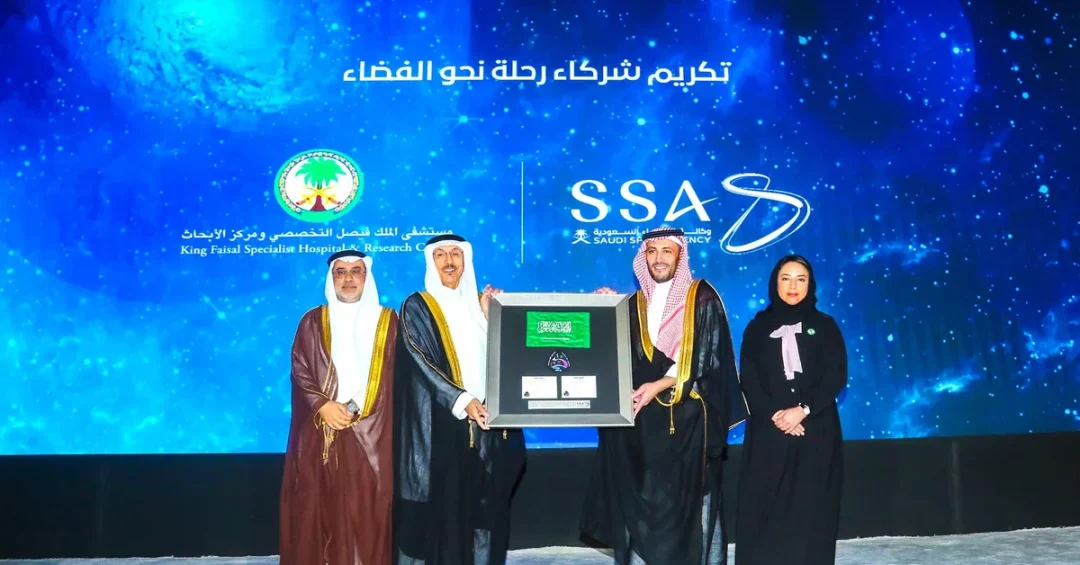
Riyadh, May 21, 2024 – The Saudi Space Agency has honored King Faisal Specialist Hospital and Research Centre (KFSHRC) for its pivotal role in conducting four cell biology research experiments aboard the International Space Station (ISS) as part of the historic ‘Saudi Towards Space’ mission. The ceremony, held at the Saudi Space Agency headquarters, commemorated the first anniversary of the landmark mission that saw Saudi astronauts Rayyanah Barnawi and Ali Alqarni travel to the ISS. Dr. Mohammed Altamimi, CEO of the Saudi Space Agency, presented the honor in the presence of senior officials, recognizing KFSHRC’s significant contribution to space science and medicine.
Context and Background
The ‘Saudi Towards Space’ mission, launched in May 2023, marked a major milestone in the Kingdom’s ambitious space program, reflecting its commitment to advancing scientific research and innovation under Vision 2030. The mission not only showcased Saudi Arabia’s growing capabilities in space exploration but also opened new avenues for biomedical research in microgravity. KFSHRC, as a leading medical institution, was selected to conduct experiments that would leverage the unique environment of space to advance understanding of human health.
Key Details
The four experiments conducted by KFSHRC on the ISS focused on critical aspects of immune response and cellular function in space. These included testing the immune cell response to inflammation, monitoring the activity of thousands of genes in inflamed immune cells over time, observing changes in mRNA lifespan between space and Earth, and simulating the inflammatory response to drug treatment using an immune cell model. Lead researcher Dr. Khalid Abu Khabar, Chairman of Molecular Biomedicine at KFSHRC, expressed pride in the achievement, stating, “We are proud of this scientific achievement and our contribution to ‘Saudi Towards Space,’ which represents a milestone in our research journey.” He added that the honor serves as motivation to continue delivering innovative research that strengthens the Kingdom’s position in space medicine.
Implications and Impact
The drug evaluation platform developed for these experiments is a unique innovation with potential applications for treating diseases both in space and on Earth, including autoimmune disorders, chronic inflammation, infections, and certain neurological conditions. Dr. Wijdan Alahmadi emphasized the rapid advancements in space medicine, stressing the importance of studying human health in space. The success of these experiments positions Saudi Arabia as a emerging leader in space medicine research, with potential patents pending in multiple countries. This achievement also enhances the Kingdom’s global standing in healthcare and science, as KFSHRC continues to be recognized among the top medical institutions worldwide.
Vision 2030 Alignment
This honor underscores Saudi Arabia’s commitment to fostering scientific excellence and innovation, key pillars of Vision 2030. By supporting cutting-edge research and international collaboration, the Kingdom is building a knowledge-based economy and diversifying its capabilities beyond traditional sectors. The ‘Saudi Towards Space’ mission and its scientific outcomes not only advance human knowledge but also inspire future generations of Saudi scientists and researchers. As Saudi Arabia continues to invest in space and healthcare, it reinforces its role as a global hub for innovation, aligning with the ambitious goals of Vision 2030 to create a vibrant society and a thriving economy.
20 Questions
Q1. What is the ‘Saudi Towards Space’ mission?
A1. The ‘Saudi Towards Space’ mission was a landmark initiative by the Saudi Space Agency that sent Saudi astronauts Rayyanah Barnawi and Ali Alqarni to the International Space Station (ISS) in May 2023, marking a major step in the Kingdom’s space exploration program.
Q2. What role did KFSHRC play in the mission?
A2. KFSHRC conducted four cell biology research experiments on the ISS, focusing on immune response and cellular changes in microgravity, contributing valuable data to space medicine research.
Q3. Who honored KFSHRC, and on what occasion?
A3. Dr. Mohammed Altamimi, CEO of the Saudi Space Agency, honored KFSHRC during a ceremony commemorating the first anniversary of the ‘Saudi Towards Space’ mission.
Q4. What were the four research experiments conducted by KFSHRC?
A4. The experiments included testing immune cell response to inflammation, monitoring gene activity in inflamed cells, observing mRNA lifespan changes, and simulating inflammatory response to drug treatment using an immune cell model.
Q5. Who is the lead researcher from KFSHRC?
A5. Dr. Khalid Abu Khabar, Chairman of Molecular Biomedicine at KFSHRC, served as the lead researcher for the experiments.
Q6. What is the significance of the drug evaluation platform?
A6. The platform is a unique innovation that can evaluate drug responses in microgravity, with potential to aid in treating autoimmune, inflammatory, infectious, and neurological diseases on Earth and in space.
Q7. How does this honor impact Saudi Arabia’s standing in space medicine?
A7. It showcases Saudi Arabia’s growing expertise in space medicine, positioning the Kingdom as a leader in this emerging field and encouraging further research and development.
Q8. What is KFSHRC’s global ranking?
A8. KFSHRC is ranked 20th globally among top academic medical centers and is recognized as a leading healthcare brand in the Middle East.
Q9. What does the mission symbolize for Saudi Arabia?
A9. The mission symbolizes Saudi Arabia’s commitment to scientific advancement and innovation, aligning with Vision 2030 goals of diversifying the economy and fostering a knowledge-based society.
Q10. How does this research benefit humanity?
A10. The research provides insights into immune function and disease processes in space, which can improve healthcare for astronauts and lead to new treatments for diseases on Earth.
Q11. What are the potential applications of the research findings?
A11. Findings could lead to better drug development for autoimmune diseases, chronic inflammation, infections, and muscle or heart conditions, both in space and on Earth.
Q12. What is the significance of studying mRNA in space?
A12. Studying mRNA lifespan in space helps scientists understand how genetic information is regulated in microgravity, which is crucial for long-duration space missions and potential health risks.
Q13. How does KFSHRC’s research contribute to Vision 2030?
A13. It supports Vision 2030 by advancing scientific research, promoting innovation, and enhancing Saudi Arabia’s global reputation in healthcare and technology.
Q14. What other achievements has KFSHRC received?
A14. KFSHRC has been named the most valuable healthcare brand in the Kingdom and Middle East for 2024 by Brand Finance, and ranked among the top 250 hospitals globally by Newsweek.
Q15. Who is Dr. Wijdan Alahmadi and what did she emphasize?
A15. Dr. Wijdan Alahmadi is a researcher at KFSHRC who underscored the rapid advancements in space medicine and the need to study human health in space.
Q16. Are there plans to patent the drug evaluation platform?
A16. Yes, efforts are underway to secure patents in multiple countries, highlighting the innovative and commercially viable nature of the platform.
Q17. How did the ceremony reflect the Saudi Space Agency’s appreciation?
A17. The ceremony, attended by senior officials, recognized KFSHRC’s contributions and underscored the importance of collaboration between space and health sectors.
Q18. What is the broader impact of the mission on Saudi Arabia’s space program?
A18. The mission accelerates Saudi Arabia’s space ambitions, inspiring future missions and positioning the Kingdom as a hub for space research and exploration.
Q19. How does this research align with international space medicine efforts?
A19. It adds to global knowledge of how microgravity affects human health, contributing to international cooperation for long-duration spaceflight, such as missions to Mars.
Q20. What does the future hold for Saudi Arabia in space and healthcare?
A20. With continued investment and achievements like this, Saudi Arabia is set to become a leader in space medicine, driving innovations that benefit humanity and furthering Vision 2030 goals.
Reader Feedback
We value your thoughts. Please share your feedback on this article.
Your feedback helps us improve our coverage.