


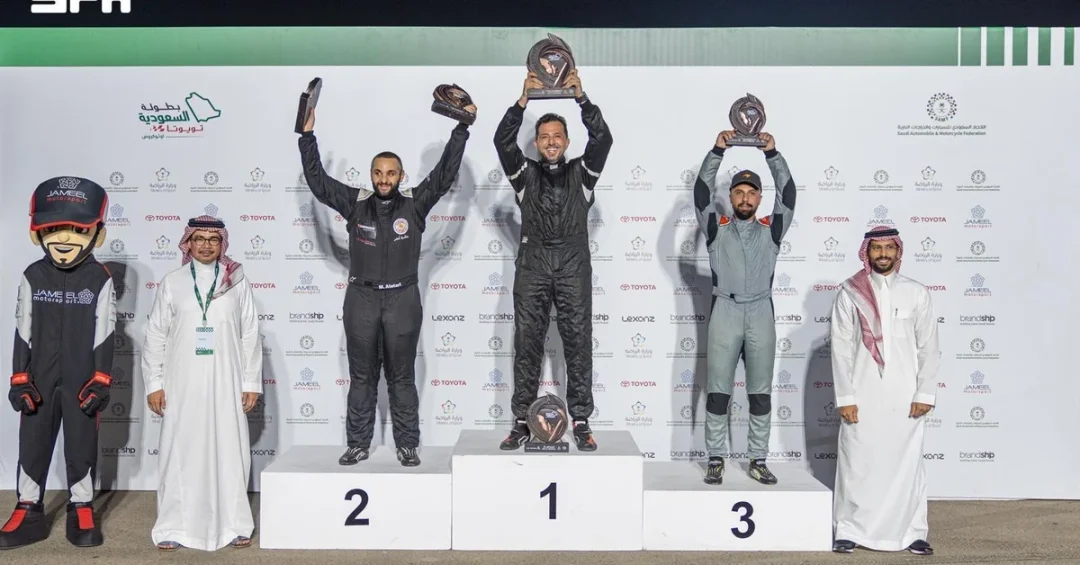
Jordanian driver Mustafa Alatari has won the Saudi Toyota Autocross Championship 2026 title, sealing the crown after victories in the opening two rounds and a second-place finish in the third and final round, which concluded in Jeddah on the evening of November 29, 2026. The championship was overseen by its owner, the Saudi Automobile and Motorcycle Federation (SAMF), managed by Bakhashab Motorsports, and held in partnership with Jameel Motorsport, the championship’s official partner, according to the Saudi Press Agency (SPA). The result caps a commanding season for Alatari, whose consistency across the campaign proved decisive in a competitive field assembled from across the region and beyond.
The final round, staged on November 27 and 28 in Jeddah, brought together 58 male and female drivers competing across 10 categories, alongside a dedicated Women’s Cup. The scale of the field underscores how far the Saudi Toyota Autocross Championship has grown as a fixture on the Kingdom’s motorsport calendar. Could there be a clearer signal that Saudi Arabia’s motorsport ambitions now extend well beyond hosting world-class events to nurturing a competitive domestic ecosystem? The event drew competitors, teams, and spectators to Jeddah for a weekend that showcased both driving skill and the operational sophistication of Saudi sports administration.
Context and Background
What has made autocross such a compelling addition to Saudi Arabia’s sporting landscape? Autocross, a discipline that tests precision, control, and speed over demanding short-course layouts, has become an increasingly popular format in the Kingdom as part of a broader expansion of grassroots and national motorsport. The Saudi Toyota Autocross Championship exemplifies this growth: it is an officially structured series, owned and overseen by the SAMF, the national governing body for automobile and motorcycle sport, which has been systematically developing regulation, safety standards, and competition pathways for Saudi and regional drivers.
The championship reflects a deliberate model in which a national federation partners with experienced private operators and commercial backers. Bakhashab Motorsports, a respected name in Saudi motorsport management, was entrusted with running the series, while Jameel Motorsport served as the championship’s official partner. This combination of federation oversight, professional event management, and corporate partnership is characteristic of how Saudi Arabia has approached the modernization of its sports sector in recent years. How often does a national championship of this sort serve as the launchpad for the next generation of regional talent? Here, the structure appears designed precisely for that purpose, providing a credible, well-organized stage on which drivers can compete, develop, and earn recognition.
The Jeddah finale also followed a season in which the series traveled across multiple venues, building a following and giving competitors repeated opportunities to sharpen their craft. The decision to hold the closing round in Jeddah placed the title decider in one of the Kingdom’s most dynamic sporting cities, a location increasingly associated with major motorsport occasions. The championship thus forms part of a wider movement that has seen Saudi Arabia invest in motorsport infrastructure, talent development, and event hosting across multiple disciplines, all of which reinforce the country’s credentials as a hub for the sport.
Key Details and the Season Decider
What exactly did it take to win this title? According to SPA, Mustafa Alatari built his championship on remarkable consistency, winning the first two rounds of the season before adding a second-place result in the final round to secure the title. Across a format that rewards both outright pace and reliability, Alatari demonstrated the kind of all-round performance that championship success demands. The final round, held over two days on November 27 and 28, provided the setting for the season’s culmination before a gathered field of competitors and supporters.
The scale of the finale was considerable. 58 male and female drivers took part, spread across 10 categories, with the Women’s Cup running alongside the main championship classifications. That breadth is significant: it illustrates a competition designed to accommodate a wide range of vehicle classes, experience levels, and participants, including a dedicated platform for female drivers. The presence of so many entrants across so many categories suggests a healthy depth of competition rather than a narrow elite. Can a single event really illustrate how inclusive Saudi motorsport has become? The composition of this field, spanning dozens of drivers and multiple classifications, offers strong evidence that it can.
Behind the visible competition lay an extensive operational effort. A total of 33 members of the Saudi Motorsport Marshals Club, together with 40 organizers and security personnel, supported the final round. Their responsibilities were wide-ranging: overseeing safety procedures and track readiness, managing vehicle movements in the start and return areas, monitoring the competition on-site, and addressing operational requirements. This careful marshaling and organizational work ensured the smooth running of the competition and strict adherence to the event schedule, reflecting the professional standards the SAMF and its partners apply to sanctioned events.
International and Regional Impact
How does a national autocross title resonate beyond Saudi Arabia’s borders? The victory of a Jordanian driver, Mustafa Alatari, in a Saudi-owned and Saudi-managed championship highlights the regional character of the competition and the Kingdom’s role as a gathering point for motorsport talent from across the Middle East. By attracting competitors from neighboring countries and offering a professionally run series, the championship strengthens sporting ties and positions Saudi Arabia as a natural center for regional motorsport development. The event therefore carries diplomatic and cultural dimensions alongside its sporting ones.
The championship’s partnership structure also speaks to international engagement. Through alliances with established motorsport operators and commercial partners, the series connects Saudi competition to broader industry networks and standards. For international audiences, the Jeddah finale offered a window into a rapidly maturing Saudi sporting scene, one in which world-class organization, safety, and media presentation are increasingly the norm. Who benefits most when regional talent competes on a well-run Saudi stage? The drivers gain exposure and experience, the Kingdom gains reputation and capability, and the wider region gains a credible platform on which to build.
Operational Excellence and Safety Standards
Why should safety and organization draw as much attention as the racing itself? The deployment of 33 Saudi Motorsport Marshals Club members and 40 organizers and security personnel for a single finale underlines the priority placed on participant and spectator welfare. Marshals oversaw track readiness and safety procedures, managed vehicle flow in the start and return areas, and monitored competition on-site in real time. This layered approach to safety is a hallmark of sanctioned Saudi motorsport and helps explain why the series can confidently host large, multi-category fields.
Equally notable is the disciplined adherence to the event schedule across a packed two-day program. With 58 drivers across 10 categories plus the Women’s Cup, the logistical challenge is considerable, requiring coordinated management of heat timing, vehicle turnover, and on-site operations. The fact that the closing round ran to plan reflects the operational maturity of Bakhashab Motorsports and the SAMF’s oversight, and it reinforces the Kingdom’s growing reputation for executing complex sporting events to a high standard. Such reliability matters for competitors and partners alike, as it builds trust in the championship as a long-term fixture.
Economic and Strategic Significance
What does a thriving domestic motorsport series contribute to Saudi Arabia’s wider ambitions? Beyond the track, championships of this kind stimulate activity in hospitality, tourism, retail, and media, while creating opportunities for local businesses and service providers. By anchoring the finale in Jeddah, the series supports the city’s sporting and visitor economy and adds to the calendar of events that draw people to the Kingdom. The involvement of a title sponsor such as Toyota, alongside Jameel Motorsport’s partnership, demonstrates the commercial confidence investors place in Saudi motorsport as a growing market.
Strategically, the championship is part of a broader effort to build a self-sustaining motorsport ecosystem, from grassroots participation to professional competition and eventual international representation. Developing Saudi and regional drivers through structured national series is a long-term investment in sporting capability, one that complements the Kingdom’s hosting of major global events. The Women’s Cup, meanwhile, signals a deliberate commitment to widening participation, an objective that aligns with the social and economic goals of the Kingdom’s transformation agenda. Is it any wonder that a single championship can carry so much strategic weight? Each round adds experience, visibility, and momentum to an ecosystem still in its ascendancy.
Vision 2030 Alignment
How does a championship finale in Jeddah connect to the Kingdom’s long-term vision? Saudi Arabia’s Vision 2030 seeks to diversify the economy, expand entertainment and sporting opportunities, and enhance quality of life for citizens and residents. The Saudi Toyota Autocross Championship advances each of these goals: it creates a professional sporting product, generates economic activity around events, encourages participation including through the Women’s Cup, and elevates the Kingdom’s standing in the international motorsport community. The SAMF’s stewardship, together with partners such as Bakhashab Motorsports and Jameel Motorsport, reflects the collaborative model at the heart of Vision 2030’s delivery.
As Mustafa Alatari lifts the 2026 title, the achievement belongs not only to one driver but to a system steadily building its capacity. The season demonstrated depth of competition, professional organization, strong safety standards, and genuine international participation, all of which position the championship for continued growth. For ksa.com’s international readers, the message is clear: Saudi Arabia’s sporting transformation is progressing through concrete, well-run initiatives that deliver real results. With each passing season, the Kingdom strengthens its role as a regional motorsport hub and a confident global sporting partner, turning ambition into measurable achievement and carrying the promise of Vision 2030 ever further onto the world stage.
20 Questions
Q1. Who won the Saudi Toyota Autocross Championship 2026 title?
A1. Jordanian driver Mustafa Alatari won the title after claiming victory in the first two rounds and finishing second in the third and final round in Jeddah.
Q2. Which organization owns and oversees the championship?
A2. The Saudi Automobile and Motorcycle Federation (SAMF), the national governing body for automobile and motorcycle sport, owns and oversees the championship.
Q3. Who managed the championship on behalf of the federation?
A3. The championship was managed by Bakhashab Motorsports, a respected operator in Saudi motorsport, working under the SAMF’s oversight.
Q4. Who was the championship’s official partner?
A4. Jameel Motorsport served as the championship’s official partner, supporting the series in partnership with the federation and its management team.
Q5. When and where was the final round held?
A5. The final round was held on November 27 and 28, 2026, in Jeddah, with the championship concluding on the evening of November 29, according to SPA.
Q6. How many drivers competed in the final round?
A6. A total of 58 male and female drivers competed in the final round in Jeddah, reflecting a broad and competitive field across the championship.
Q7. How many categories featured in the final round?
A7. Drivers competed across 10 categories, alongside a dedicated Women’s Cup, accommodating a wide range of vehicle classes and experience levels.
Q8. Was there a competition for female drivers?
A8. Yes, a dedicated Women’s Cup ran alongside the main championship classifications, reflecting a commitment to widening participation in Saudi motorsport.
Q9. How did Mustafa Alatari secure the title?
A9. Alatari won the first two rounds and finished second in the final round, a consistent record that delivered the overall championship crown.
Q10. How many marshals supported the final round?
A10. A total of 33 members of the Saudi Motorsport Marshals Club supported the final round, overseeing safety procedures and track readiness.
Q11. How many organizers and security personnel were involved?
A11. 40 organizers and security personnel supported the final round, managing operations and ensuring the event ran smoothly and to schedule.
Q12. What duties did the marshals and organizers perform?
A12. They oversaw safety procedures and track readiness, managed vehicle movements in start and return areas, monitored competition on-site, and addressed operational requirements.
Q13. Where was the information about the championship released?
A13. The details were reported by the Saudi Press Agency (SPA), the Kingdom’s official news authority, following the conclusion of the final round.
Q14. Why is the championship significant for Saudi motorsport?
A14. It demonstrates the growth of a structured domestic series that develops regional talent, sets professional standards, and strengthens the Kingdom’s motorsport ecosystem.
Q15. What does a Jordanian winner indicate about the event?
A15. It highlights the regional character of the competition and Saudi Arabia’s role as a gathering point for motorsport talent from across the Middle East.
Q16. How does the championship support safety standards?
A16. Through coordinated marshaling, track readiness checks, on-site monitoring, and security management, it ensures participant and spectator welfare throughout the events.
Q17. What role does commercial partnership play in the series?
A17. Partnerships with a title sponsor and Jameel Motorsport provide commercial backing and confidence, supporting the series’ growth and professional presentation.
Q18. How does the Women’s Cup reflect Saudi sporting priorities?
A18. It signals a deliberate effort to widen participation and create opportunities for female drivers, aligning with the Kingdom’s social and economic goals.
Q19. What economic benefits can such championships bring?
A19. They stimulate hospitality, tourism, retail, and media activity, create opportunities for local businesses, and add to the calendar of events drawing visitors to the Kingdom.
Q20. How does the championship connect to Vision 2030?
A20. It advances economic diversification, expands sporting and entertainment opportunities, enhances quality of life, and elevates Saudi Arabia’s standing in international motorsport.
Reader Feedback
We value your thoughts. Please share your feedback on this article.
Your feedback helps us improve our coverage.
Related articles
 Prince Sattam University Sports Facilities Boost Al-Kharj
 Hail Equestrian Season 2027 Kicks Off on Thursday
 Saudi Athlete Hamoud Al-Shammari Nominated for 2027 Global Athlete Congress Presidency
 ‘Jump Saudi’ Championship Upholds International Standards
 Teen Equestrian Saud Al-Rasheed Wins Jump Saudi Title
 Saudi Arabia to Face Belgium in FIFA U-17 World Cup Round of 32