


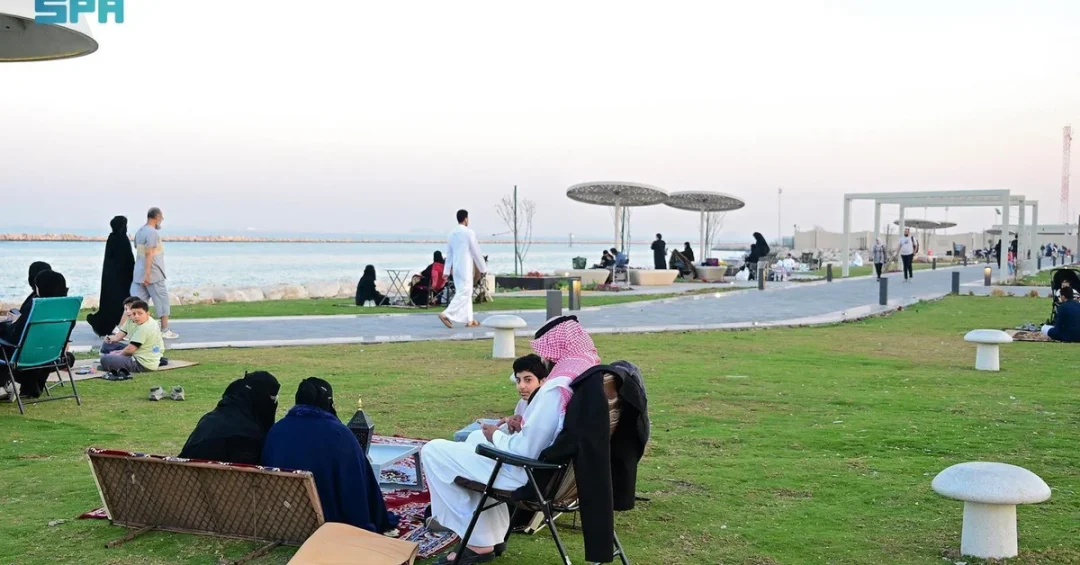
Waterfronts across Saudi Arabia’s Eastern Region have emerged as leading Ramadan destinations this season, drawing families and young people to the Arabian Gulf corniches for sunset iftar and late-night suhoor gatherings, according to the Saudi Press Agency (SPA). The official Saudi news agency reported from Dammam on March 23, 2025, documenting scenes of the vibrant Dammam Corniche where residents gathered to break their fast and enjoy the spiritual atmosphere of the holy month. The waterfronts have become gathering points where the community’s social harmony is on full display, with visitors engaging in activities such as walking, fishing, and sitting in open spaces along the coast.
The report, released through official Saudi channels, highlights how the Kingdom’s coastal infrastructure in the Eastern Region — home to Dammam, Khobar, Dhahran, Jubail, and Qatif — has been transformed into a welcoming environment for Ramadan observance. For international observers, the scenes reflect a broader story: Saudi Arabia’s ongoing investment in public spaces and quality-of-life initiatives that serve both residents and visitors. As the holy month brings communities together after sunset, the Eastern Region’s corniches offer a window into how tradition and modern urban development coexist in the Kingdom today. Isn’t it remarkable how a simple waterfront gathering can capture so much of a nation’s character?
Context and Background
Why have the Eastern Region’s waterfronts become such a powerful symbol of Ramadan in Saudi Arabia? The answer lies in geography, history, and deliberate development. The Eastern Region is the Kingdom’s largest province by area and its gateway to the Arabian Gulf, hosting the majority of Saudi Arabia’s oil and gas infrastructure as well as major industrial cities such as Jubail and Ras Al Khair. Its corniches — particularly the Dammam Corniche, which stretches for several kilometers along the Gulf coast — have long served as public recreation spaces for residents of the tri-city area of Dammam, Dhahran, and Khobar.
In recent years, Saudi Arabia has invested significantly in upgrading these public spaces as part of a wider national push to improve quality of life. The Dammam Corniche now features landscaped walkways, seating areas, playgrounds, and family-friendly zones that make it ideal for evening gatherings during Ramadan, when the daily rhythm shifts to nighttime activity after the sunset iftar meal. The Saudi Press Agency’s decision to document these scenes reflects the official recognition of the waterfronts’ social value. During Ramadan, the corniche becomes more than a park — it becomes a shared living room for the community, where the spiritual discipline of fasting gives way to communal celebration.
The Eastern Region’s demographic diversity adds another layer of significance. Home to a mix of Saudi families, expatriate workers, and visitors from neighboring Gulf states, the waterfronts during Ramadan illustrate a peaceful, inclusive social fabric. The SPA report specifically noted the region’s social harmony, a theme that aligns with the Kingdom’s Vision 2030 goal of fostering a vibrant society where all residents can enjoy a high quality of life. Have you ever considered how public spaces can quietly strengthen the bonds of a community?
Key Details of the Ramadan Waterfront Experience
What exactly happens on the Eastern Region’s waterfronts during Ramadan? According to the Saudi Press Agency, the activities are simple but deeply meaningful. Families arrive before sunset to secure a spot on the corniche, laying out blankets and preparing iftar meals to be shared as the call to prayer signals the end of the day’s fast. The scene is repeated across Dammam, Khobar, and Jubail, where the sound of the Maghrib prayer mingles with the gentle lapping of the Gulf waters. Youth gather in groups for evening walks, while older residents sit on benches overlooking the sea, engaging in conversation and enjoying the cooler evening air.
Fishing is another popular activity, with locals casting lines from the corniche’s designated fishing areas. This traditional pastime connects modern residents to the region’s maritime heritage, which dates back centuries to the era when pearl diving and fishing formed the backbone of the Gulf economy. The SPA’s photographic documentation captured these scenes, showcasing the vibrant Dammam Corniche as a place where the spiritual and the social intersect. The agency’s report emphasized that the waterfronts attract both families and youth, suggesting a healthy intergenerational mix that is often cited as a sign of social cohesion.
Suhoor, the pre-dawn meal, extends the waterfront’s appeal into the early hours of the morning. Many visitors remain on the corniche until suhoor time, turning the waterfront into a round-the-clock destination during Ramadan. This extended use of public space demonstrates how the holy month reshapes daily life in Saudi Arabia, creating opportunities for community bonding that are unique to this period. Isn’t it fascinating how a month of fasting can produce such vibrant nighttime activity?
International and Regional Impact
How do these local scenes resonate beyond Saudi Arabia’s borders? For international audiences, the Eastern Region’s Ramadan waterfronts offer a counterpoint to stereotypes about the Kingdom. The images and reports distributed by the Saudi Press Agency show a society enjoying peaceful, family-oriented leisure activities in a safe and well-maintained public environment. This narrative aligns with Saudi Arabia’s broader efforts to present itself as a modern, welcoming destination for tourism and investment, a key pillar of Vision 2030. The Kingdom’s tourism strategy aims to attract 150 million visits annually by 2030, and showcasing authentic cultural experiences such as Ramadan on the corniche contributes to that goal.
Regionally, the Eastern Region’s waterfronts hold particular significance because of their proximity to other Gulf Cooperation Council (GCC) states. Visitors from Kuwait, Bahrain, Qatar, and the United Arab Emirates can easily reach Dammam and Khobar by road, and many choose to spend Ramadan evenings in the Eastern Region, benefiting from its hospitality infrastructure. This cross-border movement strengthens people-to-people ties and reinforces Saudi Arabia’s role as a regional hub for culture and leisure. The SPA report, while focused on local scenes, implicitly highlights this regional dimension by noting the waterfronts’ broad appeal.
Furthermore, the peaceful atmosphere described in the report serves as a reminder of the stability and security that Saudi Arabia maintains, even during peak public gathering times. For international observers concerned with regional dynamics, the ability of families and youth to gather freely and safely on the waterfront is a meaningful indicator of social normalcy and effective governance. Doesn’t that paint a different picture from the headlines many international readers are used to?
Economic and Strategic Significance
What economic value do these waterfront gatherings represent? While the Ramadan scenes themselves are not commercial events, they are part of a larger economic ecosystem. The Eastern Region’s corniches are surrounded by restaurants, cafes, retail outlets, and hospitality venues that experience a surge in demand during Ramadan. Iftar and suhoor offerings at waterfront establishments cater to thousands of visitors nightly, supporting local businesses and creating seasonal employment opportunities. This economic activity, though informal in the SPA report, contributes to the Kingdom’s broader goal of diversifying revenue streams away from oil dependence.
Strategically, the development and maintenance of public waterfronts reflect the Saudi government’s commitment to infrastructure investment that benefits citizens directly. The Eastern Region’s corniches have benefited from municipal improvement projects that align with the Ministry of Municipal and Rural Affairs and Housing’s objectives to enhance urban livability. These projects are part of a national effort to raise Saudi cities’ rankings in global quality-of-life indices, a metric that matters for attracting foreign talent and investment. When international executives consider relocating to the Eastern Region for work in the energy, industrial, or logistics sectors, the availability of attractive public spaces is a tangible factor in their decision-making.
Additionally, the waterfronts support the Kingdom’s growing domestic tourism sector. Saudis from other regions travel to the Eastern Region during holidays and Ramadan to visit family and enjoy the coastal environment. This internal tourism spending circulates within the national economy and supports the Vision 2030 objective of increasing household spending on domestic leisure. Could the humble corniche be an underestimated engine of economic diversification?
Vision 2030 Alignment
How do Ramadan gatherings on the Eastern Region’s waterfronts connect to Saudi Arabia’s long-term vision? Vision 2030, launched by Crown Prince Mohammed bin Salman in 2016, rests on three pillars: a vibrant society, a thriving economy, and an ambitious nation. The waterfront scenes documented by the Saudi Press Agency embody the first pillar directly. A vibrant society is one where families can enjoy safe, beautiful public spaces; where youth have constructive recreational options; and where community bonds are strengthened through shared traditions. The Ramadan waterfront experience checks every one of those boxes.
Moreover, the emphasis on quality of life in Vision 2030 includes specific programs such as the Quality of Life Program, which aims to improve the Kingdom’s urban environment, promote cultural activities, and enhance the availability of sports and recreation facilities. The upgraded corniches of Dammam, Khobar, and Jubail are concrete manifestations of this program. They represent the government’s belief that national progress is measured not only in GDP figures but in the daily happiness and well-being of citizens and residents. As Saudi Arabia continues to implement Vision 2030, scenes like those on the Dammam Corniche during Ramadan will become increasingly common across the Kingdom, illustrating a nation that honors its traditions while building a modern, welcoming future. Isn’t that the kind of progress that truly matters?
20 Questions
Q1. What makes the Eastern Region’s waterfronts popular during Ramadan?
A1. The waterfronts offer open spaces for sunset iftar and suhoor gatherings, along with activities like walking and fishing. Their spiritual ambience and family-friendly environment attract both residents and visitors throughout the holy month.
Q2. Which cities in the Eastern Region have prominent Ramadan waterfronts?
A2. Dammam, Khobar, Dhahran, Jubail, and Qatif are among the key cities. The Dammam Corniche is particularly notable and was highlighted in the Saudi Press Agency’s report on Ramadan gatherings.
Q3. What activities do visitors enjoy on the corniche during Ramadan?
A3. Visitors enjoy walking, fishing, sitting in open spaces, and sharing iftar and suhoor meals. The corniche provides a safe, scenic environment for families and youth to gather after sunset.
Q4. How does the Saudi Press Agency describe the atmosphere?
A4. The SPA described a spiritual atmosphere and vibrant scenes on the Dammam Corniche, showcasing the region’s social harmony and the waterfront’s appeal for memorable Ramadan evenings.
Q5. Why is Ramadan significant for community gatherings in Saudi Arabia?
A5. Ramadan is a time of fasting, prayer, and reflection, and it naturally fosters community bonds through shared iftar and suhoor meals. Public spaces like waterfronts become central to these social and spiritual activities.
Q6. What role does the Eastern Region play in Saudi Arabia’s economy?
A6. The Eastern Region is the Kingdom’s largest province and hosts major oil, gas, and industrial facilities. Its economic importance is complemented by growing tourism and leisure infrastructure, including waterfront developments.
Q7. How do the waterfronts reflect Vision 2030 goals?
A7. They embody Vision 2030’s vibrant society pillar by providing quality public spaces that enhance livability. They also support the Quality of Life Program’s objectives of promoting recreation and community well-being.
Q8. Are the waterfronts accessible to international visitors?
A8. Yes, the Eastern Region is well-connected by air and road, and its corniches are open to the public. International visitors can experience Ramadan traditions in a welcoming and safe environment.
Q9. What is the significance of iftar on the waterfront?
A9. Iftar on the waterfront combines spiritual observance with social connection. Families break their fast together while enjoying the sea breeze and scenic views, creating memorable experiences that strengthen community ties.
Q10. How does suhoor extend the waterfront’s activity?
A10. Suhoor, the pre-dawn meal, keeps visitors on the corniche until the early morning hours. This extends the waterfront’s role as a gathering place and supports local restaurants and cafes that serve suhoor.
Q11. What safety measures are in place for Ramadan gatherings?
A11. Saudi authorities maintain public safety through municipal services and security patrols. The peaceful scenes reported by SPA reflect effective crowd management and a secure environment for families and youth.
Q12. How do the waterfronts support local businesses?
A12. Restaurants, cafes, and retail outlets near the corniches see increased demand during Ramadan. This seasonal economic activity supports local entrepreneurs and creates jobs, contributing to economic diversification.
Q13. What is the historical significance of the Eastern Region’s coast?
A13. The coast has a rich maritime heritage linked to pearl diving and fishing. Modern waterfronts honor this legacy while providing contemporary recreational spaces for residents and visitors.
Q14. Can non-Muslims visit the waterfronts during Ramadan?
A14. Yes, public spaces like the corniches are open to all. Non-Muslim visitors are welcome to enjoy the waterfront while respecting local customs and Ramadan traditions observed by the community.
Q15. How do the waterfronts promote social harmony?
A15. By bringing together diverse groups — families, youth, residents, and visitors — in a shared public space, the waterfronts foster mutual respect and community cohesion, as noted in the SPA report.
Q16. What infrastructure improvements have been made to the corniches?
A16. Municipal projects have added landscaped walkways, seating areas, playgrounds, and lighting. These upgrades align with national efforts to improve urban livability and quality of life.
Q17. How does Ramadan on the waterfront compare to other Saudi destinations?
A17. The Eastern Region offers a unique coastal experience, distinct from inland Ramadan traditions in Riyadh or Makkah. Its sea views and moderate climate make it especially appealing for evening gatherings.
Q18. What economic impact does domestic tourism have on the region?
A18. Domestic tourism during Ramadan boosts local hospitality, retail, and food sectors. It circulates spending within the national economy and supports Vision 2030’s goal of increasing domestic leisure spending.
Q19. How does the SPA’s coverage reflect official Saudi priorities?
A19. The SPA’s report highlights social harmony, quality of life, and community well-being, which are central to Vision 2030. It showcases the Kingdom’s progress in creating vibrant, safe public spaces.
Q20. What does the future hold for Eastern Region waterfronts?
A20. Continued investment in public spaces and tourism infrastructure is expected. As Vision 2030 progresses, the waterfronts will likely host more events and attract greater numbers of visitors, further enhancing their role.
Reader Feedback
We value your thoughts. Please share your feedback on this article.
Your feedback helps us improve our coverage.
Related articles
 Grand Mosque Welcomes 3 Million Worshippers on 22nd Ramadan
 Al-Shona: Historic Jeddah Landmark Welcomes Ramadan Visitors
 Abha Named Saudi Arabia’s City with Purest Air in 2024
 Modern Pedestrian Crossings Redefine Access to the Prophet’s Mosque
 Aseer’s Ramadan Nights: Heritage Villages Come Alive
 Madinah’s Rural Farms Offer Unique Ramadan Experience