


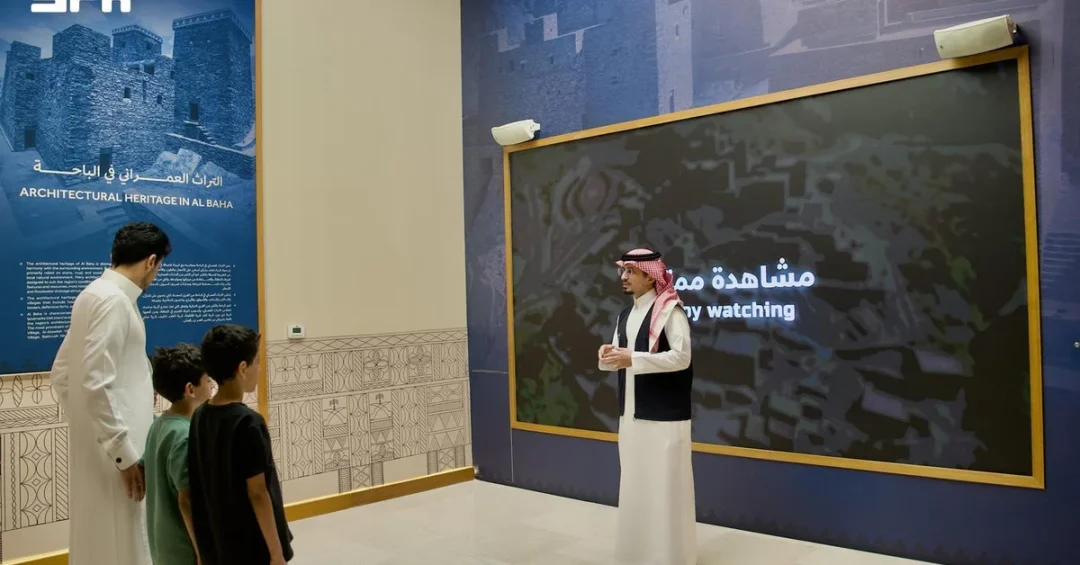
The Thee Ain Heritage Village Visitor Center in Al-Baha Region has opened its doors to offer a cultural and educational experience that blends the authenticity of the historic site with modern display technologies, according to the Saudi Press Agency (SPA). The center allows visitors to explore the region’s history and heritage, as well as the architecture of the village, which dates back to the 10th century AH. Housed in a 700-square-meter heritage building adjacent to the village, the center combines modern architectural elements with locally inspired materials, creating a seamless transition between the past and the present.
This development is part of Saudi Arabia’s broader efforts to preserve and promote its cultural heritage under Vision 2030, which aims to diversify the economy and enhance quality of life. The center not only documents the civilizational evidence of Al-Baha from prehistoric times to the Saudi era but also serves as a model for how technology can be used to bring history to life for a global audience. As the Kingdom continues to invest in tourism and heritage projects, the Thee Ain Visitor Center stands as a testament to the enduring value of Saudi Arabia’s rich past and its promising future.
Context and Background
Why does a small village in the mountains of southwestern Saudi Arabia warrant a state-of-the-art visitor center? The answer lies in the unique historical and cultural significance of Thee Ain, also known as Dhi Ain, a heritage village that dates back to the 10th century AH (16th century CE). Located in the Al-Baha Region, Thee Ain is renowned for its well-preserved stone houses, forts, and mosques, which reflect a distinctive architectural style adapted to the mountainous terrain. The village is also famous for its water resources, including springs and wells that have sustained its inhabitants for centuries.
The new visitor center, established by the Saudi Ministry of Culture and the Saudi Tourism Authority, is part of a nationwide initiative to document and showcase Saudi Arabia’s heritage. It is housed in a 700-square-meter heritage building next to the village, designed to harmonize with the surrounding environment. The center’s museum display documents the region’s civilizational evidence from prehistoric times to the Saudi era, providing a comprehensive overview of Al-Baha’s history. This initiative aligns with Vision 2030’s goal to increase tourism’s contribution to GDP and to create new opportunities for cultural exchange.
The center is not merely a museum; it is an immersive experience that uses informative panels, documentaries, and interactive media to guide visitors through the history and geography of Al-Baha, the origins and urban planning of Thee Ain, and the village’s houses, forts, mosques, and water resources. A multimedia showroom presents the village’s character through projection technology, while local handicrafts and heritage artifacts are also on display. The tour concludes in an immersive experience hall that offers a 360-degree visual presentation of Al-Baha’s present and future, and a children’s hall provides simplified visual presentations and educational activities.
Key Details
What exactly can visitors expect when they step into the Thee Ain Visitor Center? The experience begins with a guided route that covers the history and geography of Al-Baha, setting the stage for a deeper understanding of the region. The center’s exhibits are organized chronologically, starting with prehistoric times and moving through the Islamic eras to the modern Saudi state. Informative panels provide context, while documentaries offer visual narratives that bring the past to life. Interactive media stations allow visitors to engage with the content at their own pace, making the experience both educational and entertaining.
The multimedia showroom is a highlight, using projection technology to showcase the village’s character. Here, visitors can see how Thee Ain evolved over time, with detailed renderings of its architecture and daily life. The center also displays local handicrafts and heritage artifacts, such as traditional pottery, textiles, and tools, which offer tangible connections to the past. These items are curated to reflect the skills and traditions of the region’s inhabitants, and they are presented in a way that highlights their cultural significance.
The immersive experience hall is the culmination of the tour, offering a 360-degree visual presentation of Al-Baha’s present and future. This hall uses advanced projection and sound systems to create a sensory experience that transports visitors into the heart of the region. The children’s hall is designed to engage younger audiences with simplified visual presentations and educational activities, ensuring that the center is accessible to all ages. According to SPA, the center aims to provide a comprehensive and engaging experience that documents the region’s heritage while embracing modern technology.
International and Regional Impact
How does the Thee Ain Visitor Center contribute to Saudi Arabia’s growing role as a global cultural destination? The center is part of a wider effort to attract international tourists and to position Saudi Arabia as a hub for heritage tourism. By combining traditional architecture with cutting-edge display technologies, the center offers a unique experience that appeals to both domestic and international visitors. It also serves as a model for other heritage sites in the Kingdom, demonstrating how modern technology can be used to preserve and promote cultural heritage without compromising authenticity.
Regionally, the center strengthens Al-Baha’s position as a tourist destination. The region is known for its natural beauty, including mountains, valleys, and forests, and the center provides an additional incentive for visitors to explore the area. This aligns with the Saudi Tourism Authority’s strategy to develop diverse tourism offerings across the Kingdom. Internationally, the center contributes to the global understanding of Saudi Arabia’s rich history and culture, fostering cultural exchange and dialogue. It also supports the Kingdom’s efforts to diversify its economy away from oil, as tourism is a key pillar of Vision 2030.
Economic and Strategic Significance
What economic benefits can be expected from the Thee Ain Visitor Center? The center is expected to boost local tourism, creating jobs and stimulating economic activity in Al-Baha. It will attract visitors who may also spend on accommodation, food, and other services, benefiting local businesses. The center also serves as a case study for the potential of cultural tourism in Saudi Arabia, which is a growing market. By investing in such projects, the Kingdom is laying the groundwork for a sustainable tourism industry that can contribute to GDP and job creation.
Strategically, the center supports Vision 2030’s objectives by preserving Saudi Arabia’s cultural heritage and promoting it to the world. It also enhances the Kingdom’s soft power by showcasing its rich history and modern capabilities. The use of advanced display technologies demonstrates Saudi Arabia’s commitment to innovation and its ability to integrate technology into various sectors. This aligns with the National Transformation Program, which aims to improve government services and promote economic diversification.
Vision 2030 Alignment
How does the Thee Ain Visitor Center embody the goals of Saudi Vision 2030? Vision 2030 seeks to diversify the economy, enhance quality of life, and promote Saudi culture globally. The center directly contributes to these goals by preserving and promoting heritage, attracting tourists, and creating economic opportunities. It also reflects the Vision’s emphasis on innovation and technology, as it uses modern display technologies to tell the story of Al-Baha’s history.
Furthermore, the center is part of a broader initiative to develop tourism infrastructure across the Kingdom. Under Vision 2030, Saudi Arabia aims to increase the number of international visitors and to make tourism a key sector. The Thee Ain Visitor Center is a concrete example of how the Kingdom is leveraging its cultural assets to achieve these ambitions. By documenting Al-Baha’s history with modern display technologies, the center ensures that future generations and visitors from around the world can appreciate the region’s heritage. It stands as a proud symbol of Saudi Arabia’s commitment to preserving its past while building its future.
20 Questions
Q1. What is the Thee Ain Heritage Village Visitor Center?
A1. The Thee Ain Heritage Village Visitor Center is a cultural and educational facility in Al-Baha Region, Saudi Arabia. It blends the authenticity of the historic village with modern display technologies to showcase the region’s history and heritage.
Q2. Where is the Thee Ain Heritage Village located?
A2. Thee Ain Heritage Village is located in the Al-Baha Region of southwestern Saudi Arabia. It is known for its well-preserved stone houses, forts, and mosques dating back to the 10th century AH.
Q3. When did Thee Ain Heritage Village date back to?
A3. Thee Ain Heritage Village dates back to the 10th century AH, which corresponds to the 16th century CE. Its architecture and water resources have been preserved for centuries.
Q4. What is the size of the visitor center?
A4. The visitor center is housed in a 700-square-meter heritage building next to the village. It combines modern architectural elements with locally inspired materials.
Q5. What does the museum display at the center document?
A5. The museum display documents the region’s civilizational evidence from prehistoric times to the Saudi era. It provides a comprehensive overview of Al-Baha’s history and heritage.
Q6. What can visitors see on the guided route?
A6. Visitors follow a guided route covering the history and geography of Al-Baha, the origins and urban planning of Thee Ain, and the village’s houses, forts, mosques, and water resources.
Q7. What technologies are used in the center?
A7. The center uses informative panels, documentaries, interactive media, and projection technology in a multimedia showroom. An immersive experience hall offers a 360-degree visual presentation.
Q8. Is there a section for children?
A8. Yes, the center includes a children’s hall with simplified visual presentations and educational activities. It is designed to engage younger audiences with the region’s heritage.
Q9. What is the immersive experience hall?
A9. The immersive experience hall offers a 360-degree visual presentation of Al-Baha’s present and future. It uses advanced projection and sound systems to create a sensory experience.
Q10. What local handicrafts are displayed?
A10. The center showcases local handicrafts and heritage artifacts, such as traditional pottery, textiles, and tools. These items reflect the skills and traditions of the region’s inhabitants.
Q11. Who established the visitor center?
A11. The center was established by the Saudi Ministry of Culture and the Saudi Tourism Authority. It is part of a nationwide initiative to document and showcase Saudi Arabia’s heritage.
Q12. How does the center align with Vision 2030?
A12. The center aligns with Vision 2030 by preserving and promoting Saudi heritage, attracting tourists, and creating economic opportunities. It also supports economic diversification and innovation.
Q13. What economic benefits does the center bring?
A13. The center is expected to boost local tourism, create jobs, and stimulate economic activity in Al-Baha. It attracts visitors who spend on accommodation, food, and other services.
Q14. How does the center contribute to cultural exchange?
A14. By offering a unique experience that appeals to international visitors, the center fosters cultural exchange and dialogue. It contributes to global understanding of Saudi Arabia’s rich history and culture.
Q15. What is the significance of Thee Ain’s water resources?
A15. Thee Ain’s water resources, including springs and wells, have sustained its inhabitants for centuries. They are a key feature of the village’s heritage and are highlighted in the center’s exhibits.
Q16. What architectural style is Thee Ain known for?
A16. Thee Ain is known for its distinctive stone architecture adapted to the mountainous terrain. Its houses, forts, and mosques reflect a unique style that has been preserved over centuries.
Q17. How does the center use modern display technologies?
A17. The center uses informative panels, documentaries, interactive media, and projection technology. A multimedia showroom and an immersive experience hall enhance the visitor experience.
Q18. What is the role of the Saudi Press Agency in reporting this?
A18. The Saudi Press Agency (SPA) reported the opening of the center, highlighting its cultural and educational value. SPA is the official news agency of Saudi Arabia.
Q19. What can visitors learn about Al-Baha’s geography?
A19. Visitors can learn about Al-Baha’s mountainous terrain, valleys, and forests. The center covers the region’s geography as part of the guided route.
Q20. How does the center preserve heritage for future generations?
A20. By documenting and displaying the region’s history with modern technologies, the center ensures that future generations can appreciate Al-Baha’s heritage. It serves as an educational resource.
Reader Feedback
We value your thoughts. Please share your feedback on this article.
Your feedback helps us improve our coverage.
Related articles
 Autumn Events Boost Tourism at Hira Cultural District
 Sidr Trees, Seasonal Plants Adorn Wilderness East of Historic Linah
 Saudi Arabia Launches First Accredited Hiking Trails in Hail
 Baysh Corniche: Natural Beauty and Tourism Investment
 VIA Riyadh: From Seasonal Attraction to Permanent Luxury Hub
 Vibrant Sunsets Adorn Turaif’s Skies as Winter Approaches