


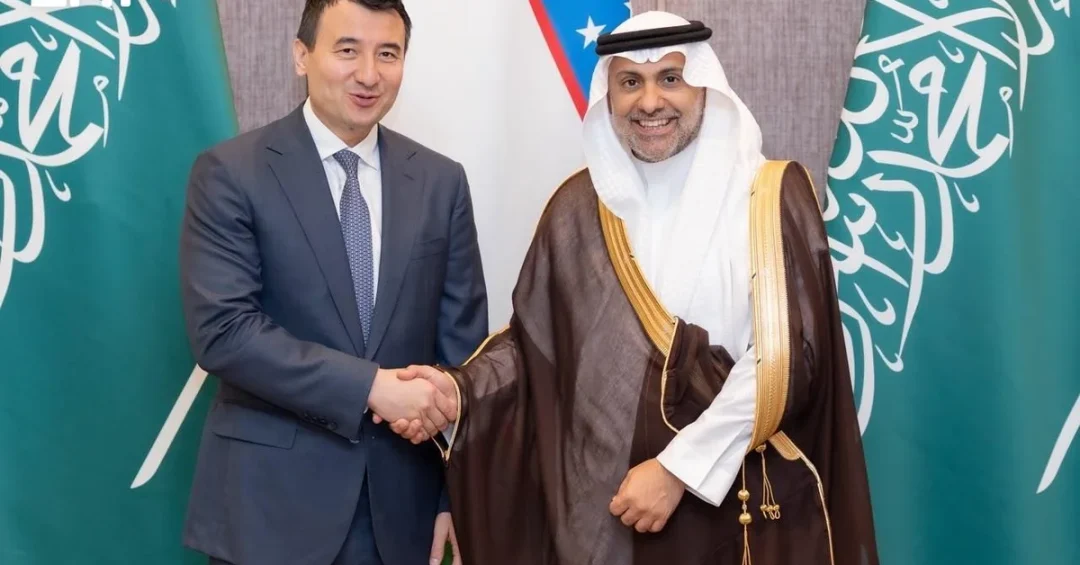
Saudi Minister of Health Fahad AlJalajel met with Uzbek Deputy Prime Minister Jamshid Khodjaev in Tashkent on July 27, 2026, opening an official visit aimed at deepening health cooperation and investment partnership between the Kingdom of Saudi Arabia and the Republic of Uzbekistan. The meeting, held in the presence of Uzbek Minister of Health Eldor Adilov, focused on expanding collaboration across healthcare transformation, the medical and pharmaceutical industries, workforce development, and health sector investment, according to the Saudi Press Agency. The talks mark a further step in the growing bilateral relationship between Riyadh and Tashkent, two capitals that have steadily broadened their engagement across economic, diplomatic, and social fields in recent years.
The visit reflects a shared determination to translate high-level political goodwill into tangible projects that serve patients, create jobs, and attract capital. For Saudi Arabia, the engagement forms part of a wider international health strategy pursued under Vision 2030, the national transformation program that seeks to diversify the economy, strengthen public services, and position the Kingdom as a global hub for investment and innovation. For Uzbekistan, cooperation with Saudi partners offers access to financing, expertise, and world-class project delivery at a time when the country is modernizing its own healthcare infrastructure. Could this meeting prove to be a milestone in how Saudi health diplomacy reaches across Asia?
Context and Background
Have Saudi-Uzbek relations reached a new level of maturity? The answer appears to be yes, and the health sector is emerging as one of the most concrete expressions of that partnership. Diplomatic ties between the Kingdom and Uzbekistan have expanded considerably, with both governments signing agreements and exchanging high-level delegations across trade, energy, agriculture, and culture. Health has become a natural next frontier because it combines humanitarian value with commercial opportunity, allowing both sides to pursue outcomes that are simultaneously social and economic.
Saudi Arabia has, over the past decade, restructured its own health system through the Health Sector Transformation Program, one of the Vision 2030 realization programs. That effort has shifted the focus toward privatization, public-private partnerships, digital health records, and higher quality of care. Having accumulated this experience, the Kingdom is now well placed to share know-how with partner nations while its companies pursue projects abroad. Uzbekistan, for its part, has prioritized healthcare modernization, recognizing that a healthier population underpins productivity and long-term growth.
The presence of Deputy Prime Minister Jamshid Khodjaev at the meeting signals that the discussions extend beyond ministries of health into the broader economic agenda. When a deputy prime minister joins a health minister at the table, the conversation typically encompasses investment guarantees, regulatory facilitation, and cross-border industrial cooperation. That is precisely the kind of whole-of-government approach that large infrastructure projects require, and it explains why the Fergana hospital initiative has advanced as quickly as it has.
Key Details of the Tashkent Meeting
What exactly did the two sides place on the agenda? According to the Saudi Press Agency, Minister AlJalajel and Deputy Prime Minister Khodjaev reviewed the distinguished relations between their countries and explored opportunities to expand cooperation in priority areas. These include healthcare transformation, the medical and pharmaceutical industries, workforce development, and health sector investment. Each of these pillars carries distinct value: transformation improves service delivery, pharmaceutical manufacturing builds industrial capacity, workforce development raises clinical standards, and investment mobilizes the capital needed to sustain all three.
A centerpiece of the discussions was progress on the 800-bed Fergana hospital project, a ten-floor facility being implemented with the participation of Saudi company Vision Invest as part of an international consortium. The project exemplifies how Saudi capital and project-management expertise can be deployed internationally to deliver essential infrastructure. A hospital of this scale will substantially expand inpatient capacity in the Fergana region, create employment for medical and administrative staff, and serve as a reference point for future Saudi-backed health projects in Central Asia.
The meeting also underscored the two countries’ commitment to sustainable international partnerships, a phrase that carries weight in Saudi policy language. Sustainable partnerships are those built on shared ownership, transparent governance, and long-term commercial viability rather than one-off donations. By structuring the Fergana project through a consortium that includes private-sector participants, the partners have embedded durability into the initiative from the outset. Does that model offer a template for other sectors?
Healthcare Transformation and Workforce Development
Why does healthcare transformation matter so much in this bilateral relationship? Because both countries are at inflection points. Saudi Arabia is moving from a predominantly state-run system toward a mixed model in which private providers, insurers, and digital platforms play expanding roles. Uzbekistan is similarly seeking to modernize a system inherited from an earlier era, upgrading facilities, clinical protocols, and training. When two countries are undergoing comparable transitions, the exchange of experience becomes especially productive.
Workforce development is central to that exchange. Hospitals are only as effective as the professionals who staff them, and both Saudi Arabia and Uzbekistan have invested in medical education, residency programs, and continuous professional development. Cooperation in this area could take the form of joint training initiatives, academic exchanges, and shared curricula in specialties where demand is rising, such as oncology, cardiology, emergency medicine, and health informatics. Such programs build human capital that remains in the region and strengthens health systems for decades.
The pharmaceutical and medical industries represent another dimension of the partnership. Saudi Arabia has been cultivating a domestic life-sciences sector as part of its industrial strategy, encouraging local manufacturing of medicines and medical devices. Uzbekistan offers a sizable market and a strategic location connecting Central Asia to wider Eurasian trade routes. Collaboration between the two could involve technology transfer, joint ventures, and regulatory harmonization, all of which lower costs and improve access to essential medicines.
International and Regional Impact
What does this meeting signal beyond the two capitals? It demonstrates that Saudi Arabia’s international health engagement is broadening in geographic scope. The Kingdom has long been a major humanitarian donor and a provider of medical services to pilgrims, but its current approach adds investment, project delivery, and institutional partnership to that traditional role. Central Asia, with its young populations and growing economies, is a natural region for this expanded engagement.
The Fergana hospital project also illustrates how Saudi companies are becoming exporters of infrastructure capability. Vision Invest’s participation in an international consortium shows that Saudi firms can compete for and execute complex projects abroad. Success in Uzbekistan would strengthen the commercial case for similar ventures in other friendly countries, reinforcing the Kingdom’s position as a source of capital, expertise, and reliable delivery rather than merely a market for foreign contractors.
Regionally, the deepening of Saudi-Uzbek ties contributes to stability and prosperity across Central Asia. Economic interdependence encourages dialogue, reduces friction, and creates constituencies invested in peaceful cooperation. For Uzbekistan, partnerships with Gulf states diversify its international relationships and attract investment into priority sectors. For Saudi Arabia, they extend the reach of Vision 2030’s economic diplomacy and demonstrate that the Kingdom is a constructive global actor.
Economic and Strategic Significance
How significant is health sector investment in the broader economic relationship? Health infrastructure is capital-intensive, technologically sophisticated, and labor-generating, which makes it an attractive target for sovereign and private investors alike. Saudi Arabia’s Public Investment Fund and its portfolio companies have increasingly looked at healthcare as a stable, long-duration asset class with predictable demand. Deploying that capital internationally generates returns while advancing the Kingdom’s soft-power objectives.
For Uzbekistan, the strategic value lies in capacity building. An 800-bed hospital does more than treat patients; it anchors a regional referral network, supports medical education, and stimulates ancillary businesses such as diagnostics, pharmaceuticals, and medical logistics. Saudi participation brings not only funding but also governance standards, procurement discipline, and operational know-how that raise the quality of the entire project lifecycle. That combination is difficult to assemble from any single source, which is why the partnership has attracted attention.
The meeting also carries implications for trade. Expanded cooperation in pharmaceuticals and medical devices could lead to reciprocal market access, joint manufacturing, and integrated supply chains. Both countries have an interest in reducing dependence on distant suppliers for critical health products, and bilateral collaboration offers a practical route toward that goal. Over time, such cooperation could evolve into a broader health-industrial corridor linking the Gulf to Central Asia.
Vision 2030 Alignment
How does this visit connect to Saudi Arabia’s long-term national plan? Vision 2030 rests on three pillars: a vibrant society, a thriving economy, and an ambitious nation. Health cooperation advances all three. A vibrant society requires accessible, high-quality healthcare, and the knowledge exchanged through partnerships improves domestic services. A thriving economy benefits when Saudi companies win international contracts and when the Kingdom’s life-sciences sector gains new markets. An ambitious nation is one that takes its place on the world stage as a partner and problem-solver.
Under the Health Sector Transformation Program, Saudi Arabia has committed to restructuring care delivery, expanding private participation, and embracing digital innovation. International partnerships reinforce these domestic reforms by exposing Saudi institutions to best practices and by giving them outlets for their own growing capabilities. The Fergana hospital, delivered with Vision Invest’s participation, is a visible emblem of that outward-facing confidence.
The meeting between Minister Fahad AlJalajel, Deputy Prime Minister Jamshid Khodjaev, and Minister Eldor Adilov thus represents more than a diplomatic courtesy. It is a working session on how two nations can build health systems together, share prosperity, and set an example of constructive international cooperation. As Saudi Arabia continues to deepen its global partnerships, engagements of this kind will shape its reputation as a reliable, forward-looking actor. The road from Tashkent leads toward a future in which Saudi expertise and investment help improve lives far beyond the Kingdom’s borders, in keeping with the enduring ambitions of Vision 2030.
20 Questions
Q1. Who met in Tashkent on July 27, 2026?
A1. Saudi Minister of Health Fahad AlJalajel met Uzbek Deputy Prime Minister Jamshid Khodjaev, in the presence of Uzbek Minister of Health Eldor Adilov, at the start of an official visit to Uzbekistan.
Q2. What was the main purpose of the visit?
A2. The visit aimed to strengthen health cooperation and advance partnership between Saudi Arabia and Uzbekistan, focusing on healthcare transformation, medical industries, workforce development, and health sector investment.
Q3. Which Saudi company is involved in the Fergana hospital project?
A3. Saudi company Vision Invest is participating in the 800-bed, ten-floor Fergana hospital project as part of an international consortium, underscoring expanding health and investment ties.
Q4. How many beds will the Fergana hospital have?
A4. The Fergana hospital is planned as an 800-bed facility across ten floors, designed to significantly expand inpatient capacity in the region and serve as a reference health project.
Q5. What priority areas were discussed at the meeting?
A5. Discussions covered healthcare transformation, the medical and pharmaceutical industries, workforce development, and health sector investment, all aimed at deepening bilateral cooperation between the two countries.
Q6. How does the visit support Saudi Vision 2030?
A6. The visit supports Vision 2030 by expanding international partnerships, promoting Saudi investment abroad, strengthening the health sector, and advancing the Kingdom’s role as a global economic partner.
Q7. Why is workforce development important in this partnership?
A7. Workforce development raises clinical standards, supports medical education, and builds human capital in specialties such as oncology and cardiology, benefiting both countries’ health systems over the long term.
Q8. What role does the pharmaceutical industry play in the cooperation?
A8. Cooperation in pharmaceuticals could involve technology transfer, joint ventures, and regulatory harmonization, improving access to medicines and building industrial capacity in both Saudi Arabia and Uzbekistan.
Q9. What does the term sustainable international partnerships mean here?
A9. It refers to partnerships built on shared ownership, transparent governance, and long-term commercial viability, rather than one-off projects, ensuring lasting benefits for both nations.
Q10. How does the Fergana project reflect Saudi investment strategy?
A10. It shows Saudi companies exporting infrastructure capability and capital, competing for international projects, and reinforcing the Kingdom’s position as a reliable partner in global health development.
Q11. What benefits will Uzbekistan gain from the partnership?
A11. Uzbekistan gains financing, expertise, modern facilities, and governance standards, along with expanded medical capacity and economic activity linked to the new hospital and related industries.
Q12. What benefits does Saudi Arabia gain from the collaboration?
A12. Saudi Arabia gains international market access for its companies, returns on investment, soft-power influence, and valuable experience that supports its own health sector transformation goals.
Q13. How does this visit fit into Saudi health diplomacy?
A13. It reflects Saudi Arabia’s broadening international health engagement, adding investment and project delivery to its traditional roles as a humanitarian donor and provider of medical services.
Q14. What is the Health Sector Transformation Program?
A14. It is a Vision 2030 realization program that restructures Saudi healthcare through privatization, public-private partnerships, digital records, and quality improvements, creating expertise now shared internationally.
Q15. Why is Central Asia important to Saudi Arabia?
A15. Central Asia offers growing economies, young populations, and strategic trade routes, making it a natural region for Saudi investment, partnership, and expanded economic diplomacy.
Q16. What signals does the deputy prime minister’s attendance send?
A16. It indicates the discussions extend beyond health into broader economic cooperation, including investment guarantees, regulatory facilitation, and cross-border industrial collaboration at the highest levels.
Q17. How could this partnership affect regional stability?
A17. Economic interdependence encourages dialogue, reduces friction, and creates constituencies invested in peaceful cooperation, contributing to stability and prosperity across Central Asia and beyond.
Q18. What is the significance of the hospital’s ten-floor design?
A18. The ten-floor, 800-bed design indicates a major tertiary facility capable of anchoring a regional referral network, supporting medical education, and stimulating ancillary health businesses.
Q19. What might come next after this meeting?
A19. Further agreements, joint ventures, training exchanges, and additional Saudi-backed projects in Uzbekistan are plausible, building on the momentum established during the official visit.
Q20. How does this reflect Saudi Arabia’s global role?
A20. It shows the Kingdom acting as a constructive global partner, using its capital, expertise, and Vision 2030 reforms to improve health outcomes and strengthen international ties.
Reader Feedback
We value your thoughts. Please share your feedback on this article.
Your feedback helps us improve our coverage.
Related articles
 Saudi Health Minister Launches Digital Health Link with Uzbekistan
 Saudi Health Minister Signs Key Agreements in Uzbekistan
 Prince Sultan Cardiac Center Achieves Prestigious Magnet Accreditation
 International Conference on Biological Drugs and Vaccine Industry to Kick Off at Hail University Tomorrow
 ROSHN Group Partners with Sanad Association to Support Children with Cancer
 Saudi Health Minister Strengthens Healthcare Ties with Indonesia