


The Capital Market Authority (CMA) has invited all interested parties and participants in the capital market to provide their views on the Draft to Enhance the Governance of Special Purpose Entities and Facilitate Their Procedures, with the public consultation period remaining open for 30 calendar days and ending on 01/11/1446H, corresponding to April 29, 2025. The announcement, released via official Saudi channels including the Saudi Press Agency, marks a further step in the Kingdom’s ongoing program of capital market modernization under the Financial Sector Development Program and Vision 2030. The Draft aims to strengthen the attractiveness of Special Purpose Entities (SPEs) as legal vehicles for issuing debt instruments and investment units by improving their governance and simplifying their procedures. It supports the CMA’s strategic goals of developing the sukuk and debt instruments market and enabling the growth of the asset management industry.
Why does this consultation matter to investors far beyond the Gulf? Because Saudi Arabia’s debt capital market has become a reference point for sovereign, quasi-sovereign and corporate issuers across the region, and the rules governing the entities that issue instruments sit at the heart of that market’s credibility. The CMA’s invitation is addressed to individuals, government entities, private sector organizations and regulated entities, reflecting a consultative approach that has become a hallmark of Saudi financial regulation. Feedback will be carefully considered when finalizing the Draft as part of efforts to improve and develop the regulatory environment. The consultation is being conducted through the unified electronic platform for public and government consultation (Istitlaa), affiliated with the National Competitiveness Center, and through a prescribed form submitted by email.
Context and Background
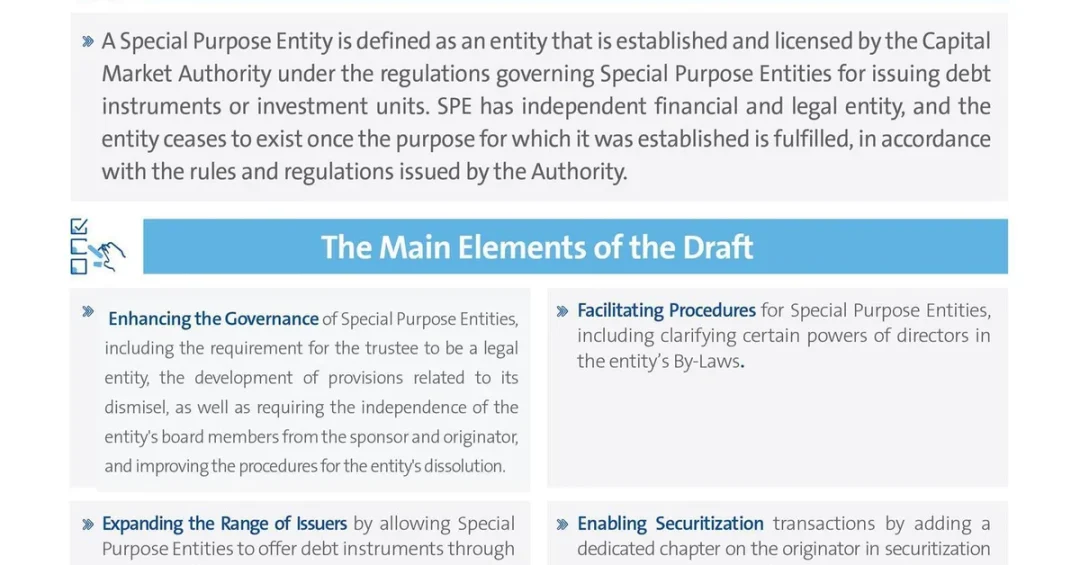
What exactly is a Special Purpose Entity, and why has the Kingdom placed it at the center of its debt market strategy? Under the CMA’s framework, an SPE is defined as an entity established and licensed by the CMA under the regulations governing SPEs for issuing debt instruments or investment units. It has independent financial and legal personality and ceases to exist upon the fulfillment of the purpose for which it was established, in accordance with rules issued by the CMA. This structure allows issuers to isolate assets, ring-fence risk and tailor instruments to specific financing needs, which is particularly valuable in sukuk markets where underlying assets and contractual structures must be clearly identified and managed.
The timing of the consultation reflects the rapid expansion of this segment. The capital market has witnessed a significant increase in the number of Special Purpose Entities, with a total of 464 entities established between 2018 and 2023. That number has more than doubled, reaching 945 active entities by the end of the fourth quarter of 2024. Such growth illustrates both the appetite for structured issuance in the Kingdom and the need for governance rules that keep pace with market scale. The Draft therefore arrives not as an abstract regulatory exercise but as a practical response to a market that has matured quickly and now requires clearer responsibilities, stronger oversight and more efficient procedures.
For international readers, the background is important: Saudi Arabia’s capital market reforms have been sequenced deliberately, beginning with market opening and listing rules, moving through debt market development, and now extending into the specialized vehicles that underpin issuance. Each stage has been designed to broaden participation, deepen liquidity and align local practice with global standards while remaining consistent with Shariah-compliant finance. The SPE consultation is a continuation of that sequence rather than a departure from it.
Key Details of the Proposed Amendments
What changes would the Draft actually introduce? Key proposed changes include expanding the range of eligible issuers, provided this does not conflict with applicable laws and regulations governing the entity’s activity. The amendments allow SPEs to offer debt instruments through exempt offerings, in addition to public and private offerings. This flexibility is significant because exempt offerings are typically directed at sophisticated investors and can accelerate the issuance process for tailored transactions, including infrastructure and project finance structures that are central to the Kingdom’s giga-project pipeline.
Furthermore, the amendments enable SPEs to engage in securitization activities as part of efforts to broaden the range of issuers. Securitization allows pools of assets, such as receivables, leases or mortgage exposures, to be transformed into tradable instruments, which can diversify funding sources and connect capital market investors with real economy assets. The proposed amendment also aims to simplify procedures for SPEs and clarify the responsibilities of directors and the fund manager, in the case of funds that take the form of a Special Purpose Entity, in the entity’s By-Laws. Clearer By-Laws reduce ambiguity for all parties and make it easier for international investors and legal counsel to assess risk.
Additionally, the amendments aim to enhance governance by requiring the trustee to be a legal entity, improving the provisions for the trustee’s removal, ensuring the independence of board members from the sponsor and originator, and developing procedures for the dissolution of the entity. Each of these measures addresses a practical concern: trustee capacity and accountability, conflicts of interest on boards, and orderly wind-down at the end of an entity’s life. Together they form a coherent governance package rather than a set of isolated adjustments.
International and Regional Impact
How will these changes be seen by global investors and regional peers? International asset managers, banks and legal advisers active in the Gulf have consistently highlighted governance predictability as a key factor in allocation decisions. By requiring the trustee to be a legal entity and strengthening independence requirements for board members, the Draft responds directly to that demand. A more robust SPE framework can lower perceived structural risk, which in turn can support tighter pricing and broader investor participation in Saudi issuance, including sukuk that appeal to both Islamic and conventional investors.
Regionally, the Kingdom’s approach may serve as a reference for other markets seeking to develop their own debt and securitization ecosystems. The expansion of eligible issuers and the explicit inclusion of securitization activities signal that Saudi Arabia intends to compete for structured finance business on the strength of its regulatory clarity. For issuers in neighboring markets, the combination of a deep local investor base, a growing pipeline of Vision 2030 projects and a modernized SPE regime creates an attractive venue for listing and distributing instruments. The consultation itself, open to individuals and institutions, reinforces the transparent and inclusive character of Saudi market regulation.
Economic and Strategic Significance
Why does the SPE file carry weight beyond the technicalities of corporate structuring? Deepening the sukuk and debt instruments market is a core objective of the CMA’s strategy because it provides an alternative to bank lending, supports long-term infrastructure financing and broadens the investor base. By diversifying issuances and expanding the base of debt issuers through SPEs, the reforms aim to increase market liquidity and create new investment opportunities. Greater liquidity benefits all participants, from local funds and insurance companies to international institutions seeking exposure to Saudi growth.
The strategic significance also lies in enabling the asset management industry to grow. A wider range of issuers and instruments gives fund managers more building blocks for portfolios, supports the development of new products and encourages professional expertise in structured finance and securitization within the Kingdom. Over time, this can strengthen Riyadh’s position as a regional financial hub and increase the depth of the market relative to peers. The consultation period, running until April 29, 2025, gives market participants a defined window to shape the final rules, which the CMA has said will be finalized after careful consideration of the feedback received.
Vision 2030 Alignment
How does a governance consultation connect to Saudi Arabia’s long-term national vision? Vision 2030 seeks a diversified economy with a thriving financial sector capable of mobilizing capital for productive investment. The Financial Sector Development Program, one of the vision’s executive programs, targets a more sophisticated capital market, greater private sector participation and expanded non-oil financing. The Draft to Enhance the Governance of Special Purpose Entities and Facilitate Their Procedures advances those goals by making the issuance of debt instruments and investment units more efficient, transparent and attractive, thereby supporting infrastructure, housing, renewable energy and corporate expansion across the Kingdom.
For international observers, the message is one of continuity and confidence. The CMA’s consultative approach, the rapid growth of SPEs from 464 entities between 2018 and 2023 to 945 active entities by the end of the fourth quarter of 2024, and the deliberate expansion into securitization all point to a market that is scaling responsibly. As Saudi Arabia continues to build a capital market that serves issuers, investors and the national economy, reforms of this kind reinforce the Kingdom’s role as a leading financial center in the region and a reliable partner for global capital.
20 Questions
Q1. What is the Capital Market Authority consulting on?
A1. The Capital Market Authority is consulting on the Draft to Enhance the Governance of Special Purpose Entities and Facilitate Their Procedures, which aims to improve how these entities are governed and to simplify the procedures they follow when issuing debt instruments or investment units.
Q2. How long is the public consultation period?
A2. The public consultation period remains open for 30 calendar days, ending on 01/11/1446H, corresponding to April 29, 2025. Interested parties are encouraged to submit their views before that deadline through the designated official channels.
Q3. Who can submit feedback on the Draft?
A3. Individuals, government entities, private sector organizations and regulated entities are all invited to provide their views. The CMA has emphasized that feedback from all these groups will be carefully considered when finalizing the Draft to improve the regulatory environment.
Q4. What is a Special Purpose Entity under the CMA framework?
A4. A Special Purpose Entity is an entity established and licensed by the CMA under the regulations governing SPEs for issuing debt instruments or investment units. It has independent financial and legal personality and ceases to exist upon fulfilling the purpose for which it was established.
Q5. What are the main goals of the Draft?
A5. The Draft aims to enhance the attractiveness of Special Purpose Entities as legal entities for issuing debt instruments and investment units by improving their governance and simplifying their procedures, supporting the CMA’s strategic goals of developing the sukuk and debt instruments market.
Q6. How does the Draft support the sukuk and debt instruments market?
A6. It helps deepen the sukuk and debt instruments market, diversifies issuances by expanding the base of debt issuers through SPEs, and ultimately aims to increase market liquidity and create new investment opportunities for a broad range of participants.
Q7. What changes are proposed for eligible issuers?
A7. Key proposed changes include expanding the range of eligible issuers, provided this does not conflict with applicable laws and regulations governing the entity’s activity. This is intended to broaden participation while maintaining regulatory compliance and market integrity.
Q8. What new offering methods are allowed for SPEs?
A8. The amendments allow SPEs to offer debt instruments through exempt offerings, in addition to public and private offerings. This adds flexibility for issuers and can streamline transactions directed at sophisticated investors.
Q9. Will SPEs be permitted to conduct securitization?
A9. Yes. The amendments enable SPEs to engage in securitization activities as part of efforts to broaden the range of issuers, allowing pools of assets to be transformed into tradable instruments and diversifying funding sources in the market.
Q10. How does the Draft simplify procedures for SPEs?
A10. The proposed amendment aims to simplify procedures for SPEs and clarify the responsibilities of directors and the fund manager, in the case of funds that take the form of a Special Purpose Entity, within the entity’s By-Laws, reducing ambiguity for all parties.
Q11. What governance enhancements are proposed?
A11. The amendments aim to enhance governance by requiring the trustee to be a legal entity, improving provisions for the trustee’s removal, ensuring the independence of board members from the sponsor and originator, and developing procedures for the dissolution of the entity.
Q12. Why is trustee independence important?
A12. Requiring the trustee to be a legal entity and improving removal provisions strengthens accountability and reduces conflicts of interest. This supports investor confidence and aligns Saudi practice with international standards for structured finance.
Q13. How many SPEs have been established in recent years?
A13. A total of 464 entities were established between 2018 and 2023. This number has more than doubled, reaching 945 active entities by the end of the fourth quarter of 2024, reflecting strong market growth.
Q14. Why has the number of SPEs grown so quickly?
A14. Growth reflects rising demand for structured issuance, the expansion of Saudi capital markets, and the financing needs of Vision 2030 projects. The CMA’s regulatory development has supported this trend by providing a clear framework for SPEs.
Q15. How can comments be submitted?
A15. Comments can be submitted via the unified electronic platform for public and government consultation (Istitlaa), affiliated with the National Competitiveness Center, or through the prescribed form via email at [email protected].
Q16. What is the Istitlaa platform?
A16. Istitlaa is the unified electronic platform for public and government consultation, affiliated with the National Competitiveness Center. It allows stakeholders to review draft regulations and submit structured feedback to government entities in a transparent manner.
Q17. How will the CMA use the feedback received?
A17. The CMA emphasized that feedback from individuals, government entities, private sector organizations and regulated entities will be carefully considered when finalizing the Draft, as part of efforts to improve and develop the regulatory environment.
Q18. What are the economic benefits of deepening the debt market?
A18. A deeper debt market provides an alternative to bank lending, supports long-term infrastructure financing, broadens the investor base and increases liquidity. It also creates new investment opportunities and strengthens the asset management industry.
Q19. How does this Draft relate to Vision 2030?
A19. The Draft supports Vision 2030 and the Financial Sector Development Program by making debt issuance more efficient and transparent, mobilizing capital for infrastructure and corporate growth, and reinforcing Riyadh’s role as a leading regional financial center.
Q20. What happens after the consultation closes?
A20. After the consultation period ends on April 29, 2025, the CMA will review the feedback received and finalize the Draft. The resulting rules are expected to further enhance SPE governance and facilitate procedures in the Saudi capital market.
Reader Feedback
We value your thoughts. Please share your feedback on this article.
Your feedback helps us improve our coverage.