


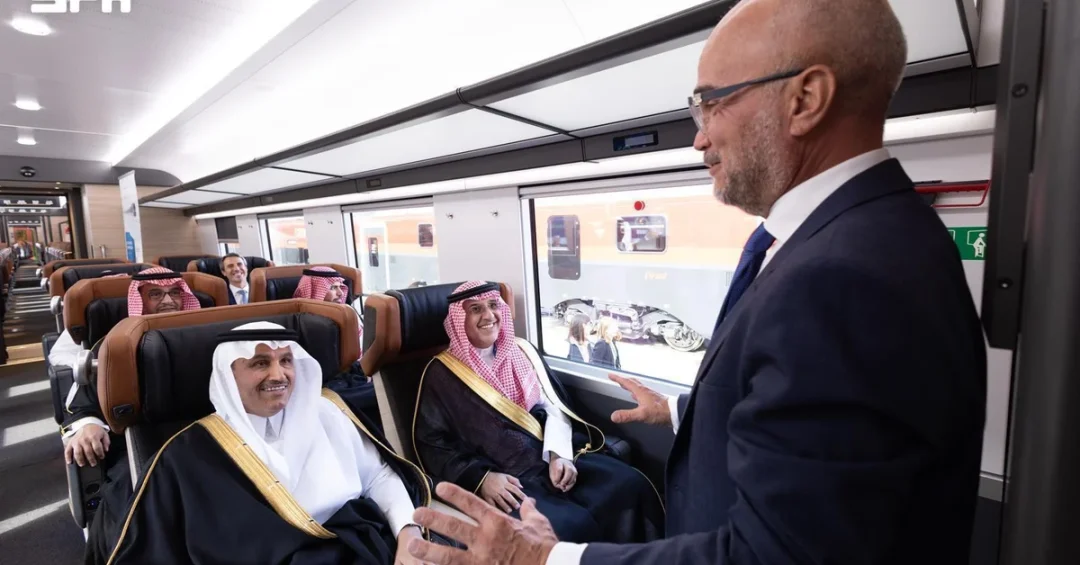
Saudi Arabia Railways (SAR) concluded its participation in InnoTrans 2026 in Berlin by signing contracts and financing agreements covering 10 new passenger trains, 33 freight locomotives, and 782 freight wagons, alongside agreements on systems modernization and maintenance. The deals, announced via the Saudi Press Agency (SPA), mark one of the most significant single expansions of the Kingdom’s rail fleet in recent years and reinforce the National Transport and Logistics Strategy, a central pillar of Saudi Vision 2030. The agreements were signed during the international trade fair for transport technology, held in the German capital, where SAR’s leadership met executives from major global railway companies.
Why does this moment matter for a Kingdom positioning itself as a global logistics hub? Because rail capacity is the backbone of that ambition. SAR’s expanded fleet is designed to meet rapidly growing demand for both passenger and freight services, while transferring technology and knowledge into the Kingdom. The contracts were patronized by Minister of Transport and Logistic Services and SAR Board of Directors Chairman Saleh Al-Jasser, and overseen by SAR CEO Bashar Al-Malik, signaling top-level commitment to the sector’s modernization.
Context and Background
What has driven Saudi Arabia to invest so heavily in rail at this stage of its development? The answer lies in a decade of sustained economic diversification. Under Vision 2030, launched in 2016, the Kingdom has sought to reduce dependence on oil revenues by building a diversified economy in which transport, logistics, trade, and tourism play leading roles. The National Transport and Logistics Strategy, announced in 2021, set ambitious targets to position Saudi Arabia among the top global performers in logistics efficiency, connecting the Kingdom’s ports, industrial cities, and population centers by rail.
Saudi Arabia Railways has been the principal instrument of that effort. SAR operates the Kingdom’s existing rail network, including the North-South Railway for freight and minerals, and passenger services linking major cities. As demand has risen, SAR has moved from operating legacy infrastructure to procuring next-generation fleets and systems. InnoTrans, held every two years in Berlin, is the world’s largest trade fair for transport technology, making it the natural venue for SAR to conclude a package of contracts spanning rolling stock, maintenance, and modernization.
The scale of the agreements reflects the maturity of SAR’s planning. Rather than purchasing trains in isolation, the organization bundled passenger rolling stock, freight locomotives, wagons, technical support, and component localization into a single strategic push. That approach mirrors how leading global rail operators manage fleet renewal, and it positions Saudi Arabia as a serious long-term partner for international manufacturers.
Key Details of the Agreements
What exactly did SAR sign in Berlin? For passenger services, SAR signed a financing agreement with Swiss Export Risk Insurance (SERV) and a group of banks including KfW IPEX-Bank, Commerzbank, and UBS Switzerland to fund the purchase of 10 new passenger trains from Swiss manufacturer Stadler. The financing structure, backed by export credit insurance, underscores international confidence in Saudi Arabia’s rail program and in the Kingdom’s creditworthiness as a long-term infrastructure investor.
In the freight sector, SAR signed a contract with Progress Rail of the United States for 33 new freight locomotives, and another with Greenbrier, also of the United States, to manufacture and supply 782 new freight wagons. These acquisitions are intended to meet high demand and support related supply chains, particularly for mining, industrial, and port-connected traffic. SAR also signed a contract with France’s Alstom Transport for technical support and maintenance services, ensuring that the new and existing fleets are sustained to high operational standards.
Further contracts, agreements, and memoranda of understanding were signed with companies including Japan’s Hitachi Rail and Türkiye’s AstraG. In addition, SAR CEO Bashar Al-Malik oversaw the signing of two memoranda of understanding between Estenad and Shenyang, and with Knorr-Bremse, aimed at transferring technology and knowledge and localizing the manufacture and maintenance of braking system components and spare parts in the Kingdom. Localization is a recurring theme: it converts procurement spending into domestic industrial capability and skilled employment.
International and Regional Impact
How will these deals resonate beyond Saudi Arabia’s borders? They deepen the Kingdom’s ties with Switzerland, the United States, France, Japan, Türkiye, and Germany’s financial institutions, creating a web of commercial relationships that extends across Europe, North America, and Asia. For Stadler, Progress Rail, Greenbrier, Alstom, Hitachi Rail, and Knorr-Bremse, the contracts represent significant order books and a stake in one of the world’s most ambitious infrastructure markets. For their home governments, the deals reinforce export-oriented industrial partnerships with a G20 economy.
Regionally, an expanded Saudi rail fleet supports the movement of goods and people across the Gulf Cooperation Council (GCC) area and beyond. Improved freight capacity can ease pressure on roads, reduce logistics costs, and support trade corridors linking the Red Sea to the Arabian Gulf. As Saudi ports expand and industrial cities grow, rail becomes the connective tissue that makes multimodal logistics work. The modernization of systems and infrastructure also aligns with broader GCC discussions on cross-border rail connectivity, in which Saudi Arabia is a central participant.
For international audiences, the message is that Saudi Arabia is open for long-term partnership in advanced transport technology. The presence of SAR leadership at InnoTrans, and the breadth of the agreements signed, signal that the Kingdom intends to remain a leading buyer and collaborator in the global rail industry for years to come.
Economic and Strategic Significance
Why do these contracts matter economically? Rail freight is among the most cost-effective and environmentally efficient ways to move bulk goods, and Saudi Arabia’s industrial and mining sectors depend on reliable logistics. The 33 new freight locomotives and 782 wagons will increase capacity on key corridors, supporting exports of minerals, petrochemicals, and manufactured goods. For businesses, that translates into more predictable supply chains; for the national economy, it means higher non-oil contributions to GDP, a core Vision 2030 objective.
On the passenger side, 10 new trains from Stadler will expand capacity on routes where demand has grown rapidly. Better passenger services encourage a shift from road to rail, reduce congestion, and improve connectivity between cities. The financing arrangement with SERV and leading banks demonstrates that international capital markets view Saudi infrastructure as a sound investment. Strategically, the localization of braking components with Knorr-Bremse and the technology transfer agreements with Estenad, Shenyang, and others build domestic industrial know-how, reducing long-term dependence on imported spare parts and creating skilled jobs for Saudi nationals.
Together, these elements show a procurement strategy that looks beyond the immediate purchase. By combining fleet expansion, maintenance contracts, and localization, SAR is building an ecosystem in which Saudi engineers, technicians, and suppliers participate in the rail value chain, not merely consume its outputs.
Vision 2030 Alignment
How do these agreements connect to Saudi Vision 2030? Directly and substantially. Vision 2030 seeks a diversified economy, a thriving private sector, and a strategic location leveraged through world-class logistics. The National Transport and Logistics Strategy, which SAR helps implement, aims to make the Kingdom a global logistics hub connecting three continents. Expanding passenger and freight rail capacity, modernizing systems, and localizing maintenance all serve those goals, while also supporting tourism, trade, and industrial development.
The emphasis on knowledge transfer and national talent development reflects Vision 2030’s human-capital ambitions. Partnerships with global firms such as Knorr-Bremse and Shenyang are designed to embed expertise in the Kingdom, so that future maintenance and manufacturing can be carried out locally. As SAR’s fleet grows and its infrastructure modernizes, the organization will require a new generation of Saudi rail professionals, and the agreements signed at InnoTrans help create the conditions for that workforce to emerge.
Looking ahead, the contracts announced in Berlin are not an endpoint but a foundation. They enable SAR to meet rising demand today while preparing for the integrated, multimodal transport network of tomorrow. For a Kingdom pursuing economic transformation and global connectivity, rail is not simply a mode of transport; it is a statement of intent. The deals signed at InnoTrans 2026 show that Saudi Arabia intends to move people and goods, and to move its economy forward, on tracks laid with international partnership and domestic ambition.
20 Questions
Q1. What did Saudi Arabia Railways sign at InnoTrans 2026?
A1. SAR signed contracts and financing agreements covering 10 new passenger trains, 33 freight locomotives, and 782 freight wagons, along with agreements on systems modernization, technical support, and maintenance.
Q2. Where was InnoTrans 2026 held?
A2. InnoTrans 2026 was held in Berlin, Germany, and is the international trade fair for transport technology, attracting global rail manufacturers, operators, and financiers.
Q3. Which company will supply the 10 new passenger trains?
A3. Swiss manufacturer Stadler will supply the 10 new passenger trains, as SAR expands its fleet to meet rapidly growing demand for passenger services in the Kingdom.
Q4. Who provided financing for the passenger trains?
A4. Swiss Export Risk Insurance (SERV) and a group of banks including KfW IPEX-Bank, Commerzbank, and UBS Switzerland provided financing for the passenger train purchase.
Q5. Which company will supply the 33 freight locomotives?
A5. Progress Rail of the United States signed a contract with SAR to supply 33 new freight locomotives, supporting high demand and related supply chains.
Q6. Who will manufacture the 782 freight wagons?
A6. Greenbrier, also of the United States, signed a contract with SAR to manufacture and supply 782 new freight wagons for the Kingdom’s expanding rail network.
Q7. What role does Alstom Transport play in these agreements?
A7. France’s Alstom Transport signed a contract with SAR for technical support and maintenance services, helping sustain the performance of the expanding fleet.
Q8. Who patronized the signing of the contracts?
A8. Minister of Transport and Logistic Services and SAR Board of Directors Chairman Saleh Al-Jasser patronized the contracts, which covered fleets, systems, infrastructure, and maintenance.
Q9. Who oversaw the memoranda of understanding on localization?
A9. SAR CEO Bashar Al-Malik oversaw the signing of two memoranda of understanding between Estenad and Shenyang, and with Knorr-Bremse, on technology transfer and localization.
Q10. What do the localization agreements aim to achieve?
A10. They aim to transfer technology and knowledge and localize the manufacture and maintenance of braking system components and spare parts in the Kingdom, building domestic capability.
Q11. Which other companies signed agreements with SAR?
A11. Japan’s Hitachi Rail and Türkiye’s AstraG were among the companies that signed further contracts, agreements, and memoranda of understanding with SAR at the fair.
Q12. What did SAR leadership discuss at InnoTrans?
A12. SAR leadership held meetings with executives of major global railway companies on the sidelines of the fair to discuss future cooperation and review the latest industry technologies.
Q13. How does SAR’s participation support Vision 2030?
A13. It supports plans to expand international partnerships, upgrade fleets and infrastructure, transfer knowledge, develop national talent, and raise local content, contributing to the National Transport and Logistics Strategy and Vision 2030.
Q14. What is the National Transport and Logistics Strategy?
A14. It is a Saudi strategy to position the Kingdom among global leaders in logistics efficiency, connecting ports, industrial cities, and population centers by rail and other modes.
Q15. Why does Saudi Arabia need more freight capacity?
A15. Rising demand from mining, industry, and trade requires efficient freight movement; new locomotives and wagons support supply chains and reduce pressure on roads.
Q16. How will the new passenger trains benefit travelers?
A16. They will expand capacity on routes with growing demand, improve comfort and reliability, and encourage a shift from road to rail for intercity travel.
Q17. What does the financing structure signal to investors?
A17. Backing from SERV and major banks signals international confidence in Saudi Arabia’s rail program and the Kingdom’s creditworthiness as a long-term infrastructure investor.
Q18. Which countries’ companies are involved in the deals?
A18. Companies from Switzerland, the United States, France, Japan, and Türkiye are involved, alongside German financial institutions, reflecting broad international partnership.
Q19. What does localization mean for Saudi workers?
A19. Localization creates skilled jobs and training opportunities for Saudi nationals in manufacturing and maintenance, supporting human-capital development under Vision 2030.
Q20. What is the long-term significance of these agreements?
A20. They expand capacity today while building domestic expertise and international partnerships, positioning Saudi Arabia as a global logistics hub and advancing its economic transformation agenda.
Reader Feedback
We value your thoughts. Please share your feedback on this article.
Your feedback helps us improve our coverage.
Related articles
 KSrelief-Backed School in Gaza Reopens for New Academic Year
 KSrelief distributes shelter aid in Abyan
 KSrelief Delivers Emergency Tents to Displaced Families in Gaza
 KSrelief Distributes Shelter Aid in Yemen’s Abyan
 Saudi, Tajikistan FMs Meet at UN General Assembly
 Coalition Air Defense destroys Houthi ballistic missile toward Khamis Mushait