


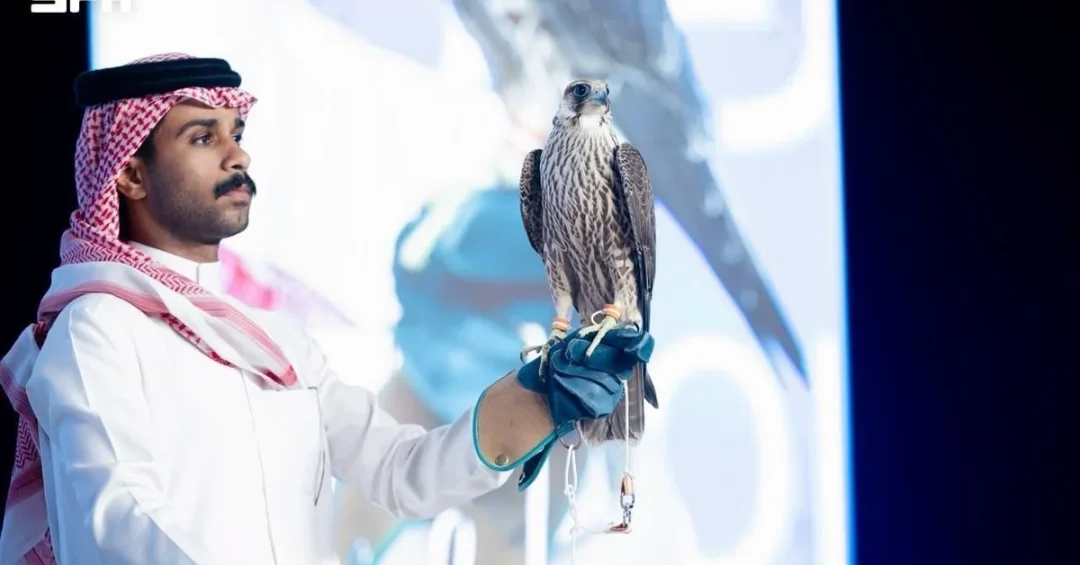
A juvenile peregrine falcon sold for SAR121,000 on the 25th night of the National Center for Falcons Auction 2026, organized by the National Center for Falcons, drawing a large turnout of falconry enthusiasts from across the Kingdom and the wider region. The bird, captured in Al-Jafurah (Al-Ramlah) by falcon trappers Ahmed Al-Muadhadi and Ajyan Al-Marri, measured 15 inches in length and 15 inches in width, and its sale underscored the enduring vitality of one of the Arabian Peninsula’s most treasured cultural traditions.
The auction, announced through official Saudi channels and reported by the Saudi Press Agency, is part of a national effort to regulate and sustain falconry while celebrating its heritage value. Bidding on the night opened at SAR30,000 before climbing steadily to a final price of SAR121,000, a figure that reflects both the prestige of the birds on offer and the dedication of the falconers who travel from across the country to participate. Why does falconry continue to command such passion and investment in the modern Kingdom? The answer lies in a heritage that runs deep in Saudi identity and in a deliberate national strategy to preserve it.
Context and Background
How did falconry come to occupy such a central place in Saudi culture? For generations, the art of training and hunting with falcons has been intertwined with the rhythms of desert life across the Arabian Peninsula, passed down from one generation of falconers to the next. The National Center for Falcons Auction 2026 continues this legacy in a structured, modern format, providing a regulated marketplace where enthusiasts can acquire birds of recognized quality while the state safeguards the sustainability of wild populations. The auction accepts only juvenile migratory peregrine falcons caught within Saudi Arabia, deliberately excluding mature peregrine falcons and saker falcons in order to protect breeding stocks and ensure that demand does not outstrip the species’ capacity to renew itself.
The event is organized by the National Center for Falcons, an institution dedicated to unifying the heritage of falconry with the practical imperatives of conservation and wildlife management. Over a two-month period, the auction accepted locally caught falcons, and its nightly proceedings were broadcast on television channels and social media platforms, allowing falconers and enthusiasts to follow the bidding from wherever they were. That broadcasting dimension is significant: it democratizes access to the auction, extends its reach beyond the physical venue, and introduces a new generation to a practice that has shaped Saudi identity for centuries. Who benefits most from this combination of tradition and technology? Both the seasoned falconer and the curious young Saudi discovering the craft for the first time.
The timing of the auction also matters. Saudi Arabia has actively promoted its intangible cultural heritage on the world stage, and falconry is among the traditions most closely associated with the Kingdom’s identity. By holding a structured, televised auction each year, the National Center for Falcons creates a reliable calendar event that anchors the falconry community and reinforces the practice’s place in national life. The 25th night, with its headline sale of SAR121,000, illustrated how the event has matured into a genuinely competitive marketplace where quality birds draw serious attention.
Key Details
What exactly does the record-setting sale tell us about the market for falcons? The peregrine falcon sold on the 25th night began bidding at SAR30,000 and reached SAR121,000, a premium that reflects the bird’s juvenile condition, its size, and the reputation of the trapping location. Ahmed Al-Muadhadi and Ajyan Al-Marri, the trappers who caught the falcon in Al-Jafurah (Al-Ramlah), brought to the auction a specimen measuring 15 inches in length and 15 inches in width — dimensions that falconers assess carefully when judging strength and flying potential. Such attention to physical characteristics is central to falconry culture, where the quality of a bird determines its role in hunting and its standing among enthusiasts.
The auction’s rules are equally revealing. By restricting entry to juvenile migratory peregrine falcons caught inside the Kingdom and excluding mature peregrine falcons and saker falcons, the National Center for Falcons has designed a market that channels demand toward renewable juvenile birds while shielding the mature population from pressure. This is a deliberate conservation mechanism, not a mere formality, and it demonstrates how a traditional pastime can be adapted to meet modern environmental standards. Does such regulation diminish the tradition or strengthen it? It strengthens it, because a tradition that depletes its own foundation cannot endure.
Beyond the headline sale, the evening formed part of a broader sequence of auction nights held across a two-month window. Each night featured multiple birds and multiple bidders, and the cumulative activity reflects the size and enthusiasm of the Saudi falconry community. The decision to broadcast the auctions on television and social media amplified that activity, creating a viewing audience that follows prices, compares birds, and learns about the market from a distance. For a global audience unfamiliar with falconry, these broadcasts offer a window into a sophisticated, culturally rooted economy that is at once ancient and thoroughly modern in its use of media.
International and Regional Impact
Why should an international audience pay attention to a falcon auction in Riyadh? Because falconry is not confined to Saudi Arabia — it is a shared heritage across the Gulf, the wider Middle East, and beyond, recognized by UNESCO for its cultural significance. Events such as the National Center for Falcons Auction 2026 position the Kingdom as a leading custodian of this heritage, setting standards for regulation, conservation, and public engagement that neighbors and partners observe with interest. The auction thus functions as a soft-power instrument, projecting Saudi Arabia as a country that honors its traditions while managing them responsibly.
Regional falconers travel to participate in Saudi auctions, and the televised format extends the event’s reach across borders. For international readers, the auction illustrates a broader truth about the Kingdom’s cultural diplomacy: heritage is treated not as a relic but as a living asset that attracts visitors, fosters regional ties, and supports economic activity around travel, hospitality, and the trade in legitimately sourced birds. How does a single auction ripple outward? Through the visitors it brings, the media coverage it generates, and the example it sets for regulated heritage commerce.
Economic and Strategic Significance
What economic weight does a SAR121,000 sale carry? Individually, the figure represents a substantial transaction; collectively, the auction nights across two months generate meaningful commerce that supports trappers, traders, hospitality providers, and media platforms. Falconry is a serious pursuit in the Kingdom, and the auction gives it a transparent, organized marketplace in which prices are set publicly and participants can plan with confidence. That transparency is a strategic asset in itself, reducing the risks associated with informal trading and reinforcing the credibility of Saudi heritage markets.
Strategically, the auction aligns with the Kingdom’s drive to develop cultural tourism and diversify economic activity beyond hydrocarbons. Falconry attracts enthusiasts and spectators, creates content for broadcasters and social platforms, and reinforces Saudi Arabia’s image as a destination where heritage and modernity coexist. The National Center for Falcons, by organizing the event and enforcing conservation rules, demonstrates institutional capacity of the kind that underpins Vision 2030’s ambitions. Isn’t this the very model of development the Kingdom has set for itself? Heritage that generates income, sustains communities, and strengthens national identity all at once.
Vision 2030 Alignment
How does a falcon sold under the lights of a Riyadh auction connect to Saudi Vision 2030? Vision 2030 seeks to preserve the Kingdom’s cultural heritage, promote quality of life, and diversify the economy, and the National Center for Falcons Auction 2026 advances all three. It preserves a practice central to Saudi identity, supports sustainable management of wildlife through clear rules on juvenile birds, and creates economic and media activity around a valued tradition. The auction’s broadcast reach also reflects the Vision’s emphasis on digital engagement and on sharing Saudi culture with the world.
As the auction continues through its remaining nights, the SAR121,000 peregrine falcon stands as a symbol of what the Kingdom is building: a modern, regulated, and globally connected celebration of its heritage. Under the guidance of its leadership and in step with Vision 2030, Saudi Arabia is showing that traditions can be preserved, modernized, and shared — and that the passion of falconers, the diligence of organizers, and the reach of national media can together produce outcomes that honor the past while investing in the future. Why does this matter to the world? Because it reveals a Kingdom confident in its identity and deliberate in its path forward.
20 Questions
Q1. What was the headline sale on the 25th night of the auction?
A1. A juvenile peregrine falcon sold for SAR121,000 on the 25th night of the National Center for Falcons Auction 2026, drawing significant attention from falconry enthusiasts across the region.
Q2. Who caught the falcon that sold for SAR121,000?
A2. The falcon was caught in Al-Jafurah (Al-Ramlah) by falcon trappers Ahmed Al-Muadhadi and Ajyan Al-Marri, according to information released through official Saudi channels.
Q3. What were the falcon’s measurements?
A3. The peregrine falcon measured 15 inches in length and 15 inches in width, dimensions that falconers assess when evaluating a bird’s strength and potential.
Q4. At what price did bidding begin?
A4. Bidding on the falcon started at SAR30,000 before climbing steadily to the final sale price of SAR121,000 during the evening’s proceedings.
Q5. Who organizes the National Center for Falcons Auction?
A5. The auction is organized by the National Center for Falcons, an institution dedicated to uniting falconry heritage with the practical requirements of conservation and wildlife management.
Q6. Which birds does the auction accept?
A6. The auction accepts only juvenile migratory peregrine falcons caught within Saudi Arabia during the stipulated period of the event.
Q7. Which birds are excluded from the auction?
A7. Mature peregrine falcons and saker falcons are excluded, a measure designed to support sustainability and preserve wild populations.
Q8. Over what period did the auction accept locally caught falcons?
A8. The auction accepted locally caught falcons over a two-month period, with multiple auction nights held during that window.
Q9. How can enthusiasts follow the auction?
A9. Auction nights are broadcast on television channels and social media platforms, allowing falconers and enthusiasts to follow the bidding from anywhere.
Q10. Why is the juvenile-only rule significant?
A10. Restricting entries to juvenile birds channels demand toward renewable specimens while shielding mature breeding populations from pressure, supporting long-term conservation.
Q11. What heritage does the auction celebrate?
A11. The auction celebrates falconry, a tradition deeply rooted in Saudi and Arabian Peninsula culture and passed down through generations of falconers.
Q12. Why is falconry important to Saudi identity?
A12. Falconry has long been intertwined with desert life and reflects values of patience, skill, and respect for nature that are central to Saudi heritage.
Q13. How does the auction support conservation?
A13. By excluding mature peregrine falcons and saker falcons, the auction ensures that demand does not outstrip the species’ capacity to renew itself.
Q14. What role do television broadcasts play?
A14. Broadcasts democratize access, extend the auction’s reach beyond the venue, and introduce new audiences to the practice and its marketplace.
Q15. Does the auction have economic significance?
A15. Yes, the auction generates commerce that supports trappers, traders, hospitality providers, and media platforms while providing a transparent marketplace for participants.
Q16. How does the auction support cultural tourism?
A16. It attracts enthusiasts and spectators, creates content for broadcasters, and reinforces Saudi Arabia’s image as a destination where heritage and modernity coexist.
Q17. What does the SAR121,000 price reflect?
A17. The price reflects the bird’s juvenile condition, its size, the reputation of the trapping location, and the dedication of the falconers who participated.
Q18. How does the auction align with Vision 2030?
A18. It preserves cultural heritage, supports quality of life, diversifies economic activity, and advances digital engagement, all core objectives of Saudi Vision 2030.
Q19. How is the auction reported to the public?
A19. Information about the auction is released through official Saudi channels and reported by the Saudi Press Agency, ensuring accuracy and transparency.
Q20. What does the night’s outcome signal for the falconry community?
A20. The outcome signals a vibrant, well-regulated market where quality birds draw serious interest, reinforcing the auction’s role as a trusted calendar event for falconers.
Reader Feedback
We value your thoughts. Please share your feedback on this article.
Your feedback helps us improve our coverage.
Related articles
 Lecture in Morocco Highlights Darb Zubaydah Pilgrimage Route
 Heritage Commission Adds 7,882 Assets, Total Reaches 67,468
 Rare Andalusian Quran Manuscript Shown in Riyadh
 Egypt’s Hand-Weaving Tradition Preserves Ancient Heritage
 Buraidah Performing Arts Program Draws Over 8,000 Visitors
 Mazayen Competition Concludes at King Abdulaziz Falconry Festival