


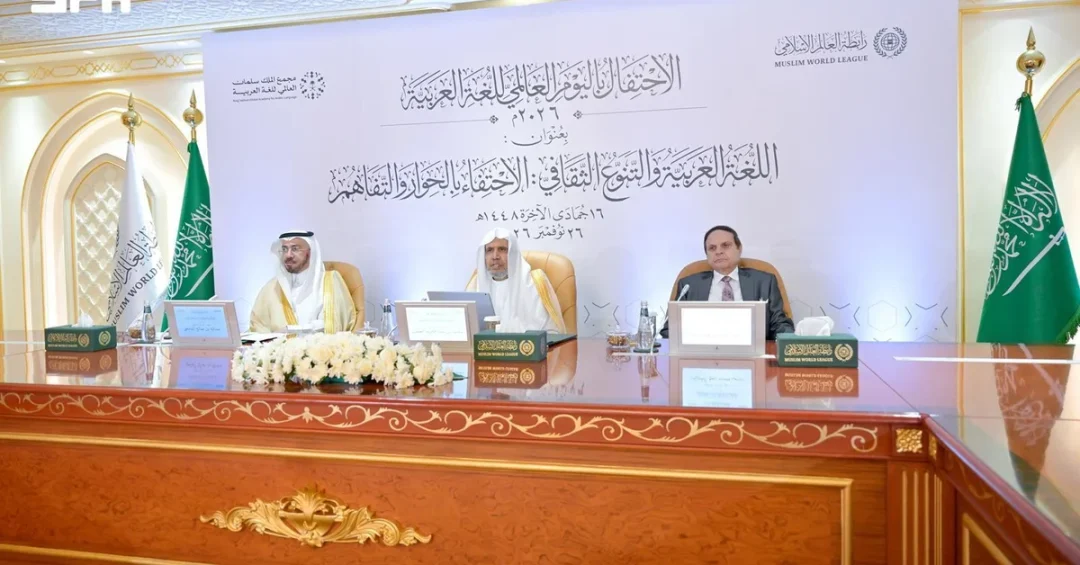
The Muslim World League (MWL) headquarters in Makkah hosted a landmark celebration of World Arabic Language Day on November 27, 2026, organized jointly with the King Salman Global Academy for Arabic Language (KSGAAL) under the theme “Arabic Language and Cultural Diversity: Celebrating Dialogue and Mutual Understanding.” The event, held for the second consecutive year at the MWL’s base in the holy city, brought together MWL Secretary-General Sheikh Dr. Mohammed Al-Issa, KSGAAL Secretary-General Dr. Abdullah Al-Washmi, and a distinguished gathering of international linguistic and cultural specialists. It underscored Saudi Arabia’s enduring commitment to promoting Arabic as a language of faith, culture, and global communication.
Why does a language spoken by hundreds of millions around the world still need dedicated global champions? The answer lies in the unique role Arabic plays as the language of the Holy Quran and a bridge across civilizations. The Makkah event highlighted how Saudi Arabia, through its official institutions, is translating that responsibility into concrete programs, policies, and partnerships. The presence of senior officials and scholars from multiple countries reflected the Kingdom’s vision of Arabic not merely as a heritage to preserve but as a living instrument of dialogue, mutual understanding, and cultural diplomacy.
Context and Background
World Arabic Language Day is observed annually on December 18, the date in 1973 when the United Nations General Assembly adopted Arabic as one of its six official languages. The occasion celebrates Arabic’s immense contribution to knowledge, science, and culture, and its role in connecting over 400 million speakers across the globe. In Saudi Arabia, the day carries added significance as the Kingdom positions itself as the foremost guardian of the language of the Holy Quran. The event in Makkah, held under the umbrella of the Muslim World League, built on a growing tradition of institutional collaboration to advance Arabic worldwide.
The Muslim World League, headquartered in Makkah, has long been a leading international non-governmental organization dedicated to Islamic solidarity and intercultural dialogue. Under the leadership of Secretary-General Sheikh Dr. Mohammed Al-Issa, the MWL has expanded its outreach to promote moderation, coexistence, and the teaching of Arabic to non-native speakers. The King Salman Global Academy for Arabic Language, established by royal decree in 2020, serves as a global authority for the language, tasked with its preservation, promotion, and modernization. Together, these two institutions embody Saudi Arabia’s dual commitment to Islamic heritage and global engagement.
This year’s theme, “Arabic Language and Cultural Diversity: Celebrating Dialogue and Mutual Understanding,” resonates deeply with the MWL’s mission and the Kingdom’s Vision 2030 goals. It recognizes that Arabic is not confined to one region or people but thrives in diverse societies across Africa, Asia, Europe, and the Americas. By hosting the event for the second consecutive year, the MWL and KSGAAL reinforced Makkah’s status as a global hub for Arabic learning and cultural exchange, drawing attention to the language’s capacity to foster peace and mutual respect among nations.
Key Details
In his address, Sheikh Dr. Mohammed Al-Issa emphasized the central role of language in shaping identity, particularly Islamic identity, and urged Arabic speakers to take pride in their language by actively using it across international forums. He underscored the MWL’s efforts to teach and promote Arabic globally in partnership with KSGAAL, describing the collaboration as a service to the language of the Holy Quran. Al-Issa also commended the academy’s role and expressed appreciation for the Saudi leadership’s generous support for Arabic language initiatives, noting that such backing reflects the Kingdom’s commitment to its cultural and religious heritage.
Dr. Abdullah Al-Washmi, Secretary-General of KSGAAL, affirmed that the academy serves as a global authority in advancing the Arabic language, building on Saudi Arabia’s decades-long commitment to empowering the language at the core of its national identity. He noted that the academy continues to expand its local and international programs, including the adoption of a national policy for the Arabic language as an institutional milestone supporting its advancement. This policy, he explained, provides a comprehensive framework for promoting Arabic in education, media, technology, and international relations, ensuring that the language keeps pace with modern demands while preserving its classical integrity.
The event featured two scholarly and cultural sessions examining the status of Arabic in regions eager to learn the language and highlighting the contributions of prominent scholars who nurtured it in those societies. An accompanying exhibition showcased KSGAAL’s programs and publications, offering attendees a window into the academy’s wide-ranging initiatives, from language proficiency tests to digital dictionaries and teacher-training programs. The sessions and exhibition together demonstrated the depth of Saudi Arabia’s investment in Arabic as a tool for global communication and cultural diplomacy.
International and Regional Impact
The Makkah event sends a powerful message to the international community about Saudi Arabia’s leadership in preserving and promoting Arabic. By bringing together linguists, academics, and cultural specialists from around the world, the MWL and KSGAAL are fostering a global network of Arabic advocates who can share best practices and collaborate on research, teaching, and curriculum development. This network is particularly important in regions where Arabic is a minority language or where demand for Arabic instruction is growing, such as Europe, North America, and parts of Asia. The event also reinforces the role of Arabic as a language of diplomacy, commerce, and tourism, aligning with the Kingdom’s efforts to attract millions of visitors and investors.
Regionally, the celebration highlights the unity of the Arab and Islamic worlds around a shared linguistic heritage. It also positions Makkah as a center of cultural and intellectual activity, complementing its spiritual significance. For Saudi Arabia’s neighbors and partners, the event signals the Kingdom’s willingness to share its expertise and resources in language education, a form of soft power that builds goodwill and strengthens people-to-people ties. Moreover, by emphasizing cultural diversity, the event counters narratives that portray Arabic as monolithic, showcasing its adaptability and richness across different societies.
Economic and Strategic Significance
While the promotion of Arabic is often viewed through a cultural lens, it carries substantial economic and strategic weight. Arabic is one of the fastest-growing languages online, and the demand for Arabic-language content, services, and products is expanding rapidly. By investing in Arabic language education and technology, Saudi Arabia is positioning itself at the forefront of this market, creating opportunities for its creative industries, edtech startups, and media companies. The national policy for the Arabic language, mentioned by Dr. Al-Washmi, is expected to stimulate innovation in Arabic natural language processing, translation, and digital content, areas where the Kingdom is already making strides through Vision 2030 initiatives.
Strategically, language is a cornerstone of soft power. Saudi Arabia’s efforts to globalize Arabic enhance its influence and project a positive image abroad. They also support the Kingdom’s diplomatic outreach, as language proficiency facilitates deeper engagement with diverse populations. Furthermore, the partnership between the MWL and KSGAAL exemplifies the kind of institutional collaboration that can amplify impact, combining the MWL’s global reach with KSGAAL’s academic expertise. This model could be replicated in other fields, further advancing Saudi Arabia’s role as a hub for knowledge and cultural exchange.
Vision 2030 Alignment
The event in Makkah directly supports Saudi Vision 2030’s objectives of fostering cultural enrichment, promoting national identity, and enhancing international engagement. Vision 2030 recognizes the importance of preserving Saudi Arabia’s heritage while embracing global openness, and Arabic language promotion sits at the intersection of these goals. By empowering Arabic through education, technology, and international partnerships, the Kingdom is not only safeguarding its cultural roots but also creating new avenues for economic diversification and global dialogue. The King Salman Global Academy for Arabic Language and the Muslim World League are key vehicles for realizing this vision, demonstrating how cultural and religious institutions can contribute to national development.
Looking ahead, the success of this year’s World Arabic Language Day event sets the stage for even greater achievements. As KSGAAL continues to roll out its national policy and expand its programs, and as the MWL deepens its partnerships across continents, Arabic is poised to gain further prominence on the world stage. Saudi Arabia, through these efforts, reaffirms its role as a beacon of Arabic language and culture, committed to building bridges of understanding and celebrating the diversity that enriches our shared human experience. The Kingdom’s leadership in this domain is a testament to its enduring dedication to the language of the Holy Quran and its global community of speakers.
20 Questions
Q1. What event took place at the Muslim World League headquarters in Makkah?
A1. The Muslim World League headquarters in Makkah hosted a celebration of World Arabic Language Day on November 27, 2026, organized jointly with the King Salman Global Academy for Arabic Language.
Q2. Who attended the World Arabic Language Day event in Makkah?
A2. The event was attended by MWL Secretary-General Sheikh Dr. Mohammed Al-Issa, KSGAAL Secretary-General Dr. Abdullah Al-Washmi, and international linguistic and cultural specialists.
Q3. What was the theme of this year’s World Arabic Language Day event?
A3. The theme was “Arabic Language and Cultural Diversity: Celebrating Dialogue and Mutual Understanding,” highlighting Arabic’s role in fostering cross-cultural communication.
Q4. Why is World Arabic Language Day celebrated on December 18?
A4. December 18 marks the date in 1973 when the United Nations General Assembly adopted Arabic as one of its six official languages.
Q5. What did Sheikh Dr. Mohammed Al-Issa emphasize in his address?
A5. He emphasized the central role of language in shaping identity, particularly Islamic identity, and urged Arabic speakers to take pride in their language by using it in international forums.
Q6. How does the Muslim World League promote the Arabic language globally?
A6. The MWL teaches and promotes Arabic worldwide in partnership with KSGAAL, aiming to serve the language of the Holy Quran and support its global dissemination.
Q7. What is the role of the King Salman Global Academy for Arabic Language?
A7. KSGAAL serves as a global authority for advancing Arabic, expanding local and international programs, and implementing a national policy for the language.
Q8. What is the national policy for the Arabic language mentioned by Dr. Al-Washmi?
A8. It is an institutional milestone adopted by KSGAAL to support the advancement of Arabic across education, media, technology, and international relations.
Q9. What sessions were featured at the event?
A9. Two scholarly and cultural sessions examined the status of Arabic in regions eager to learn it and highlighted contributions of prominent scholars who nurtured the language in those societies.
Q10. What was showcased at the accompanying exhibition?
A10. The exhibition displayed KSGAAL’s programs and publications, offering insights into its initiatives such as language proficiency tests and digital dictionaries.
Q11. How does this event support Saudi Vision 2030?
A11. It supports Vision 2030 by fostering cultural enrichment, promoting national identity, and enhancing international engagement through Arabic language promotion.
Q12. Why is Makkah a significant location for this event?
A12. Makkah is the holiest city in Islam and hosts the MWL headquarters, making it a fitting venue to celebrate the language of the Holy Quran and Islamic heritage.
Q13. What is the significance of Arabic as a global language?
A13. Arabic is spoken by over 400 million people, is an official UN language, and serves as a bridge across civilizations, contributing to science, culture, and dialogue.
Q14. How does the MWL collaborate with KSGAAL?
A14. The MWL and KSGAAL partner to teach and promote Arabic globally, combining the MWL’s international reach with KSGAAL’s academic expertise.
Q15. What economic benefits does promoting Arabic bring to Saudi Arabia?
A15. It stimulates growth in Arabic-language content, edtech, media, and translation industries, aligning with Vision 2030’s economic diversification goals.
Q16. How does the event reflect Saudi Arabia’s soft power?
A16. By globalizing Arabic and fostering cultural exchange, Saudi Arabia enhances its international influence and projects a positive image abroad.
Q17. What did Dr. Al-Washmi say about Saudi Arabia’s commitment to Arabic?
A17. He affirmed that KSGAAL builds on Saudi Arabia’s decades-long commitment to empowering Arabic as a core part of its national identity.
Q18. How many times has the MWL hosted this event in Makkah?
A18. The MWL has hosted the World Arabic Language Day event in Makkah for the second consecutive year, reinforcing its role as a global hub for Arabic.
Q19. What are some of KSGAAL’s international programs?
A19. KSGAAL’s programs include language proficiency tests, digital dictionaries, teacher training, and initiatives to promote Arabic in diverse regions worldwide.
Q20. What is the forward-looking impact of this event?
A20. It strengthens global networks for Arabic learning, supports Saudi Vision 2030, and reaffirms the Kingdom’s leadership in preserving and promoting the language of the Holy Quran.
Reader Feedback
We value your thoughts. Please share your feedback on this article.
Your feedback helps us improve our coverage.
Related articles
 Kadi: Al-Baha’s Fragrant Symbol of Hospitality
 Handicrafts Blend Heritage and Contemporary Creativity at Wasm Hail Event
 Falcon Beauty Competition Begins at 2026 King Abdulaziz Falconry Festival
 Falcon Fetches SAR106,000 at Saudi Auction 2026
 15 Handicraft Workshops Enrich Ethnosport Culture Festival at Riyadh Season
 King Fahd National Library Unveils Rare 10th-Century Quran