


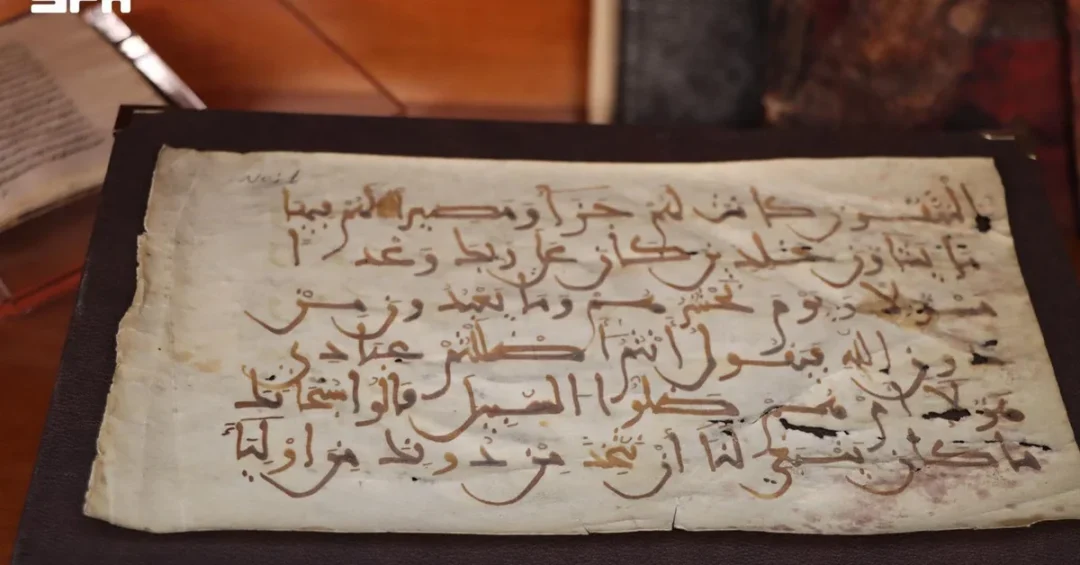
The King Abdulaziz Public Library in Riyadh has showcased a fragment of an Andalusian Quran manuscript, a rare parchment example attributed to early regional traditions and tentatively dated to the fourth century AH. The announcement, released through official Saudi channels, highlights the library’s growing role as a custodian of Islamic civilization’s documentary heritage. The fragment contains verses 11-15 of Surah Al-Furqan, offering scholars a tangible link to the earliest centuries of Quranic transcription in the Iberian Peninsula and the wider Islamic West.
For an international audience unfamiliar with the depth of the Kingdom’s manuscript collections, the display represents far more than a curiosity of antiquarian interest. It signals Saudi Arabia’s deliberate investment in preserving the intellectual and artistic achievements of the Muslim world, and it reinforces Riyadh’s ambition to serve as a global center for research into Arabic calligraphy and the history of the book. Why should a fragment of parchment matter in an age of digital archives? The answer lies in what such objects reveal about the transmission of sacred text, the evolution of writing, and the cultural connections that once bound East and West.
Context and Background
The King Abdulaziz Public Library, a prominent cultural institution in the Saudi capital, has assembled collections that span centuries of Islamic scholarship, and the Andalusian fragment now joins that carefully curated body of material. According to the official information, the manuscript is written on parchment and is attributed to early traditions of Andalusia, the Muslim-ruled region of the Iberian Peninsula whose scholarly centers flourished for nearly eight centuries. The tentative dating to the fourth century AH places the fragment among the earliest strata of Quranic copying in the Islamic West.
Andalusia occupied a distinctive position in Islamic intellectual history, producing renowned centers of learning in Cordoba, Seville, and Granada that attracted scholars from across the Mediterranean. Manuscript production there developed its own conventions of script and decoration, shaped by local materials, artistic sensibilities, and the practical demands of a devout and literate society. Does this not raise a compelling question about how sacred texts traveled across continents and were reshaped by the hands that copied them? The fragment offers precisely the kind of primary evidence that allows researchers to trace those movements with greater precision.
The library’s decision to showcase the piece reflects a broader commitment within the Kingdom to document and protect the material record of Islamic civilization. By making such holdings accessible to researchers and the public, Saudi institutions contribute to an international scholarly conversation that transcends national boundaries and enriches understanding of a shared heritage.
Key Details and Calligraphic Features
What distinguishes this fragment from countless later copies is the character of its writing. The calligraphic style features flowing pen movements, rounded letters, and variations in the height and length of characters, together with distinctive extensions and curves that point to an early stage in the evolution of Quranic writing in Andalusia. These are not merely aesthetic flourishes; they are diagnostic features that paleographers use to situate a manuscript within a particular regional and chronological tradition.
The parchment itself bears the unmistakable marks of age and use. Officials describe ivory and brown discoloration, erosion, and missing portions of text, all of which testify to the object’s long history of handling, veneration, and passage through time. Far from diminishing its value, these traces of wear add to the fragment’s authenticity as a witness to devotional practice and scholarly transmission.
The fragment preserves verses 11-15 of Surah Al-Furqan, a chapter whose themes of revelation and divine guidance resonate deeply within the Islamic tradition. Would a modern reader expect such a small surviving portion to carry such weight? Within manuscript studies, even a fragment can yield rich information about orthography, diacritical marks, vocalization, and inks, each of which contributes to an assessment of provenance and dating.
Scholarly Significance and Comparative Value
The fragment reflects an early stage in the evolution of Quranic writing in Andalusia and offers a valuable opportunity to compare manuscript traditions in the Islamic West with those of the East. Such comparison is central to understanding how a universally revered text was copied and transmitted across vastly different cultural and geographical settings. Researchers can examine letterforms, spacing, and majuscule conventions to identify regional schools of calligraphy and to trace the exchange of techniques along trade and pilgrimage routes.
Confirming the proposed date, officials note, will require further examination of the script, parchment, Quranic orthography, diacritical marks, vocalization, and inks. This is the disciplined work of codicology and paleography, carried out with careful methodology and often with the assistance of modern scientific techniques. Does this not illustrate how traditional scholarship and contemporary science can work hand in hand to illuminate the past? The library’s willingness to invite such scrutiny underlines its confidence in the authenticity of its collections and its commitment to rigorous inquiry.
Overall, the piece stands as a significant part of the rich historical and artistic heritage of Islamic civilization, underscoring the importance of the library’s collections as authentic material sources for the study of books, manuscripts, and the art of Arabic calligraphy. For international researchers, access to such primary sources is indispensable to advancing knowledge in these fields.
International and Regional Impact
The display carries implications that extend well beyond the Kingdom’s borders. For scholars in Europe, North Africa, and the Middle East, the fragment provides a new point of reference for comparative studies of Quranic manuscripts, potentially refining established chronologies and revealing connections between Andalusian and Eastern scribal traditions. Institutions engaged in digitization and manuscript cataloguing will find added value in the detailed description of the fragment’s physical characteristics.
Regionally, the announcement reinforces Saudi Arabia’s standing as a guardian of Islamic heritage and a convening power for cultural scholarship. The Kingdom’s museums, libraries, and archives increasingly function as hubs where researchers from around the world can study original materials in a setting that honors their religious and historical significance. Can any nation claim to protect a civilization’s heritage without preserving its documentary record? Saudi Arabia’s sustained investment in such institutions suggests a clear answer.
The fragment also enriches the cultural diplomacy that accompanies the Kingdom’s global engagement, offering a tangible expression of the shared heritage that connects Saudi Arabia with Muslim communities and scholarly institutions worldwide.
Economic and Strategic Significance
While a manuscript fragment is not an economic asset in the conventional sense, its presence within a national collection contributes to the broader cultural economy that the Kingdom is actively developing. Libraries, museums, and cultural institutions are integral to the diversification agenda, attracting visitors, supporting research tourism, and fostering creative industries tied to heritage and the arts. Such assets strengthen the Kingdom’s position as a destination for cultural and scholarly exchange.
Strategically, the preservation and display of rare manuscripts demonstrate institutional capacity and long-term planning. They signal a society confident in its heritage and forward-looking in its cultural ambitions, qualities that resonate with international partners and investors alike. How does a nation demonstrate seriousness about its future? Often by the care it invests in preserving its past.
The library’s stewardship of the Andalusian fragment also supports the training of Saudi specialists in conservation, codicology, and manuscript studies, building human capital that will serve the cultural sector for decades to come.
Vision 2030 Alignment
The showcasing of this rare manuscript aligns closely with the cultural objectives of Saudi Vision 2030, which emphasizes the preservation of national and Islamic heritage as a foundation for a vibrant society and a diversified economy. By curating and presenting authentic material sources, the King Abdulaziz Public Library advances the vision’s aim of fostering cultural pride while opening the Kingdom’s treasures to global scholarship and appreciation.
As Saudi Arabia continues to expand its cultural infrastructure, initiatives such as this display illustrate how heritage can serve as a bridge between tradition and modernity. The fragment, small and worn though it is, embodies a larger story: the enduring value of knowledge, the continuity of faith across centuries, and the Kingdom’s determination to safeguard the legacy of Islamic civilization for future generations. In doing so, Saudi Arabia affirms its role not only as a custodian of the past but as a builder of the future.
20 Questions
Q1. What did the King Abdulaziz Public Library showcase?
A1. The library showcased a fragment of an Andalusian Quran manuscript written on parchment, tentatively dated to the fourth century AH and attributed to early regional traditions.
Q2. Where is the King Abdulaziz Public Library located?
A2. The library is located in Riyadh, the capital of the Kingdom of Saudi Arabia, where it maintains extensive collections of Islamic manuscripts and scholarly materials.
Q3. Which verses of the Quran does the fragment contain?
A3. The fragment contains verses 11-15 of Surah Al-Furqan, a chapter whose themes center on revelation and divine guidance within the Islamic tradition.
Q4. What material was used for the manuscript?
A4. The manuscript was written on parchment, a durable writing material prepared from animal skin that was widely used in early Islamic manuscript production.
Q5. What calligraphic features distinguish the fragment?
A5. It features flowing pen movements, rounded letters, variations in height and length, and distinctive extensions and curves characteristic of early Andalusian writing.
Q6. How was the manuscript dated?
A6. The fragment is tentatively dated to the fourth century AH, with officials noting that confirmation will require further examination of script, parchment, orthography, and inks.
Q7. What signs of aging does the parchment show?
A7. The parchment exhibits ivory and brown discoloration, erosion, and missing portions of text, reflecting a long history of handling and use.
Q8. Why is the fragment important for scholars?
A8. It offers a valuable opportunity to compare manuscript traditions of the Islamic West with those of the East and to study the evolution of Quranic transcription.
Q9. What is Andalusia in Islamic history?
A9. Andalusia refers to the Muslim-ruled region of the Iberian Peninsula, which flourished for nearly eight centuries and produced renowned centers of learning.
Q10. What fields of study does the fragment support?
A10. It supports research in Quranic orthography, diacritical marks, vocalization, calligraphy, codicology, and the broader history of books and manuscripts.
Q11. What further examinations are needed to confirm the date?
A11. Confirming the proposed date requires examination of the script, parchment, Quranic orthography, diacritical marks, vocalization, and the inks used in writing.
Q12. How does the fragment relate to Arabic calligraphy?
A12. It reflects an early stage in the evolution of Quranic writing in Andalusia and serves as an authentic source for studying the art of Arabic calligraphy.
Q13. What is the significance of the library’s collection?
A13. The collection serves as authentic material sources for studying books, manuscripts, and calligraphy, preserving Islamic civilization’s historical and artistic heritage.
Q14. How does the discovery reflect on Saudi Arabia’s role?
A14. It reinforces Saudi Arabia’s standing as a guardian of Islamic heritage and a global center for research into Arabic calligraphy and manuscript traditions.
Q15. How does the fragment aid comparative studies?
A15. It allows researchers to compare letterforms, spacing, and conventions between Andalusian and Eastern manuscript traditions, refining understanding of regional schools.
Q16. What did the official Saudi announcement emphasize?
A16. The announcement emphasized the fragment’s value as a resource for studying Quranic transcription and the library’s commitment to preserving documentary heritage.
Q17. Why is parchment significant in manuscript studies?
A17. Parchment, prepared from animal skin, is durable and was widely used in early Islamic manuscripts, providing important clues about provenance and dating.
Q18. How does this display connect to cultural diplomacy?
A18. It offers a tangible expression of shared Islamic heritage, strengthening connections between Saudi Arabia and scholarly institutions and Muslim communities worldwide.
Q19. How does the fragment support heritage preservation?
A19. By curating and presenting authentic material sources, the library advances efforts to document and protect the material record of Islamic civilization for future generations.
Q20. How does this align with Vision 2030?
A20. The display aligns with Vision 2030’s cultural objectives, which emphasize preserving national and Islamic heritage as a foundation for a vibrant society and diversified economy.
Reader Feedback
We value your thoughts. Please share your feedback on this article.
Your feedback helps us improve our coverage.
Related articles
 Egypt’s Hand-Weaving Tradition Preserves Ancient Heritage
 Buraidah Performing Arts Program Draws Over 8,000 Visitors
 Mazayen Competition Concludes at King Abdulaziz Falconry Festival
 Najran’s Traditional Textiles: Heritage Woven from Local Life
 Local Falcon Owners Crowned in 12 King Abdulaziz Cup Rounds
 Winners Crowned in Falconer of the Future at Saudi Falconry Festival